ICD-10 code S61.201A: Open wound of left index finger without nail damage
ICD-10 code S61.201A covers a left index finger wound of unstated type ICD-10 co...

Last Updated: Oct 16, 2026
Billable Code Specific Code
S98.149A is the billable ICD-10-CM code for partial traumatic amputation of one unspecified lesser toe, initial encounter.
The FY 2026 edition took effect on October 1, 2025, under the annual CMS update cycle. The code covers a single lesser toe, and the record does not have to name which one.
The parent code S98.149 is not billable on its own. Coders must append the appropriate 7th character before submitting a claim. S98.149A, the initial encounter form, is the one most often used. Always confirm the code against the CDC/NCHS ICD-10-CM web tool for the current fiscal year before billing.
Let Pabau's smart automation suggest the right codes, reduce claim denials, and keep your practice compliant—effortlessly.
Automate repetitive tasks and focus on what matters most—your patients.
Reduce coding errors and ensure compliance with the latest regulations.
Clean claims, fewer denials, and faster reimbursements.
Powerful insights and reporting to help your practice thrive.
HIPAA compliant SOC 2 certified GDPR-compliant Trusted by 4,000+ clinics worldwide

S98.149A is the billable ICD-10-CM code for partial traumatic amputation of one unspecified lesser toe, initial encounter.
The 7th character ‘A’ specifies the initial encounter; use ‘D’ for subsequent encounters and ‘S’ for sequela.
Document whether the amputation is partial or complete, because that choice decides between S98.149A and S98.139A.
S98.129A is not the complete-amputation counterpart. It codes a partial great toe amputation, so it is easy to pick by mistake.
Two or more amputated lesser toes leave this range entirely and belong in the S98.22x subcategory.
Pabau’s claims management software integrates with Claim.MD to support accurate ICD-10 code submission and real-time claim validation.
A partial traumatic amputation means the toe tissue, bone, or soft structure is severed but not completely detached. Some soft tissue or bone still connects the distal fragment to the foot. A complete amputation separates the toe from the foot entirely.
The “unspecified lesser toe” wording applies when the record does not identify which lesser toe is involved. It still describes a single toe, so two or more partially amputated lesser toes belong in S98.22x instead.
Lesser toes are toes 2 through 5. The great toe (toe 1) has its own code series, S98.11x and S98.12x. Clinicians should name the toe when they can, because the S98.14x subcategory carries laterality-specific codes. S98.149A is the right choice when the record leaves the side or the toe unstated.
These approximate synonyms all map to S98.149A.
ICD-10-CM requires a 7th character on every code in the S98 category. The parent code S98.149 carries three valid extensions, and picking the wrong one is a common cause of denial on traumatic injury claims.
The encounter type therefore has to be documented in the clinical notes before the code is assigned. That is what makes clean claim submission possible on the first pass.
A common misconception is that “initial encounter” means the first time the provider sees the patient. Under ICD-10-CM guidelines, it means the patient is still in the active treatment phase for that condition.
A patient can therefore have several “A” encounters while treatment continues across the ER, surgery, and wound care. Once care shifts to monitoring and routine follow-up, code D applies.
Document the treatment phase explicitly in every clinical note. If a patient moves from active wound management to routine follow-up between visits, say so in the note. That single line decides whether you bill S98.149A or S98.149D. Ambiguous notes create audit risk and coding inconsistencies.
Category S98 splits by anatomical level first, then by whether the amputation is complete or partial. Reading it in that order prevents the most common mis-code on a toe claim. S98.149A sits in the last of the six subcategories that cover the ankle and a single toe.
The final digit of each code carries laterality. A 1 means right, a 2 means left, and a 9 means unspecified. So S98.149 is the partial, one-lesser-toe, unspecified-side option, and the 7th character then sets the encounter type.
Three further anatomical levels sit outside that group. S98.21x and S98.22x cover two or more lesser toes, complete and partial. S98.31x and S98.32x cover the midfoot, and S98.91x and S98.92x cover a foot amputation at an unspecified level.
Taking the level, the degree, the side, and the encounter type in that fixed order keeps a toe claim out of the wrong subcategory.
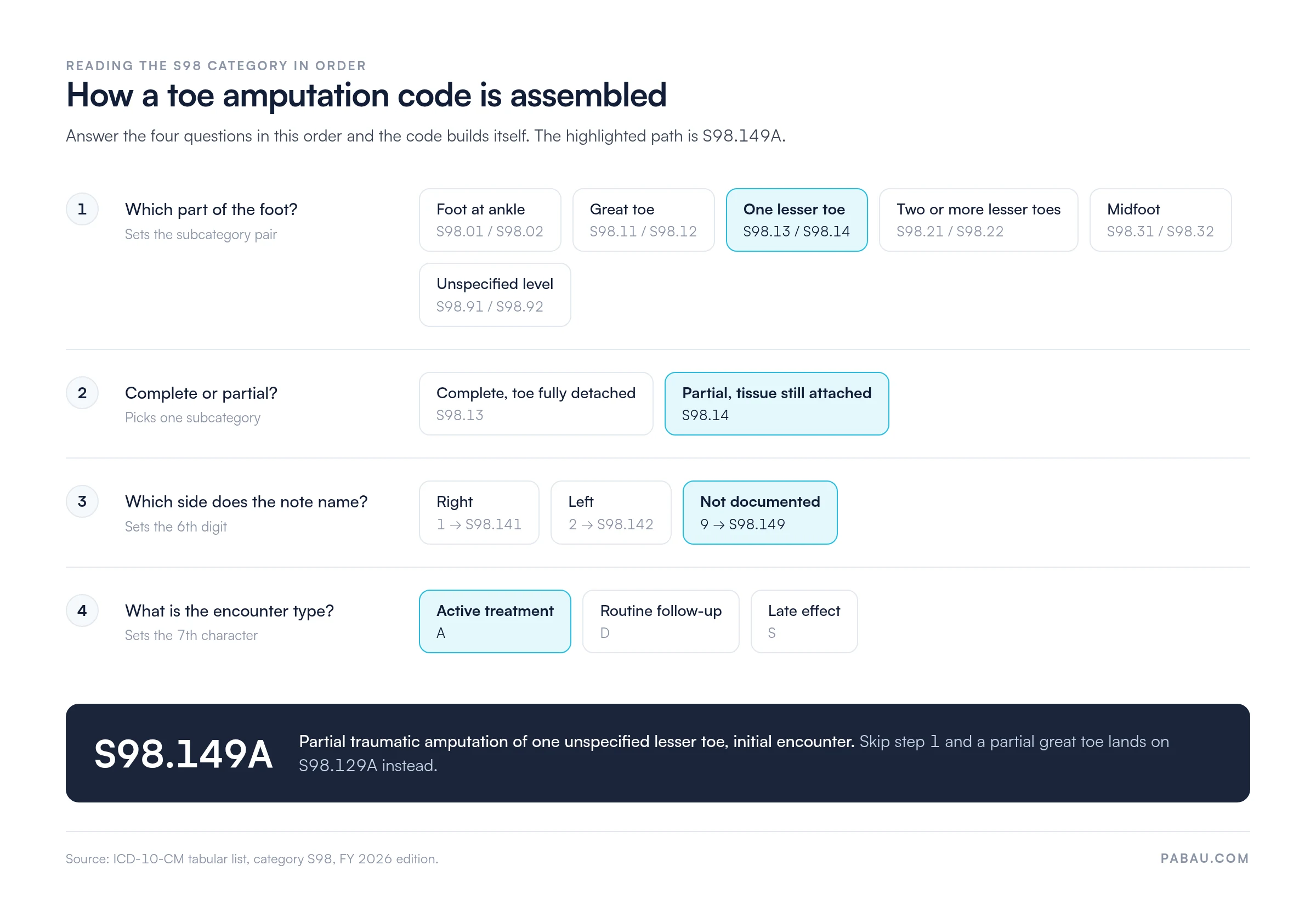
The S98.14x subcategory covers partial traumatic amputation of one lesser toe. Its complete-amputation counterpart is S98.13x, not S98.12x, which belongs to the great toe. Reading the adjacent codes side by side helps a coder pick the most specific option the record supports. The table below lists the siblings worth reviewing before submission.
The clinical difference between partial and complete amputation drives the code selection. If any soft tissue bridge connects the toe to the foot, the amputation is partial and S98.149A applies. If the toe is entirely separated, the code is S98.139A.
Physician notes should state “partial” or “complete” and describe the status of the soft tissue. See the AAPC ICD-10-CM code lookup for full code descriptions and guidelines.
S98.129A looks like the complete-amputation pair because the digits sit so close together. It is a great toe code for a partial amputation. Choosing it turns one coding error into two, since both the toe and the degree then read wrong on the claim.
Legacy billing systems, payer portals, and historical claims data may still reference ICD-9-CM codes. Knowing the crosswalk from S98.149A to its ICD-9 equivalents supports claims reconciliation across older payer systems.
According to CMS ICD-10-CM resources, crosswalk mappings are derived from the General Equivalence Mappings (GEMs) files.
GEMs crosswalk mappings are approximate rather than exact. ICD-9-CM did not separate partial from complete amputations the way ICD-10-CM does. Code 895.0 covered both degrees in one entry, with no laterality and no toe-level detail. The choice between 895.0 and 895.1 turns on whether the wound was complicated.
Use these mappings for reference and historical reconciliation only. Never substitute an ICD-9 code on a current HIPAA submission. One ICD-9 toe code can map to several ICD-10-CM codes, so reconciling an old claim means reading the GEMs file in both directions.
Incomplete documentation is the main driver of coding errors on traumatic amputation claims. The ICD-10-CM Official Guidelines require the code to reflect what the medical record says. Coders cannot infer a partial amputation from a vague description of “toe injury.”
These elements support confident assignment of ICD-10 code S98.149A and cut the rework that lands on the billing team later.
Structured note templates tied to the S98 block help clinicians capture each required element at the point of care. The denial codes seen most often on traumatic amputation claims point at a missing encounter phase or a missing external cause code.
Run a monthly audit of denied S98.14x claims. Sort them into two buckets, a wrong 7th character and an injury description too vague to code. One or two recurring documentation habits usually account for the bulk of the rejections. That makes the fix a template change rather than a coder retraining exercise.
On a professional claim, S98.149A is entered in box 21 of the CMS-1500 and pointed at the service line it justifies through box 24E. On an institutional claim it reports in form locator 67 of the UB-04. The code carries no laterality, so a payer cannot tell which foot was treated from the diagnosis alone.
Sequencing matters as much as the code itself. ICD-10-CM guidelines put the injury code first and the external cause code after it. An external cause code from Chapter 20 is never reported as the principal or first-listed diagnosis, which is a frequent front-end edit on amputation claims.
Where the record supports them, add a place of occurrence code from Y92 and an activity code from Y93. An external cause status code from Y99 belongs there too. Each of those is reported once per encounter, not once per injury. Work-related injuries usually route to a workers’ compensation payer, so confirm the responsible payer before the claim goes out.
Most denials on this code trace back to five recurring errors. Each one is visible in the note before the claim is built, which makes them cheap to catch at the point of documentation.
A quarterly review of rejected S98 claims will usually show the same one or two errors repeating. Fixing the note template that produces them removes the whole class of denial rather than one claim at a time.
A coder can assign S98.149A correctly and still watch the claim reject at the clearinghouse. Practice management software like Pabau integrates with Claim.MD to validate, submit, and track ICD-10-coded claims across thousands of US payers.
For a traumatic injury code like S98.149A, that covers eligibility checks before the encounter and CMS-1500 or 837P claim generation. Remittances post back into the same record, so a denial can be worked the day it arrives.

Running claims management software and the clinical record in one workflow keeps the 7th character consistent from note to claim. Nobody has to retype the treatment phase at billing.
Pabau’s built-in ICD-10 catalog includes the full S98 block. Code descriptions surface while the clinician writes, which prompts them to state the injury type before the note is saved. The partial-versus-complete question gets answered at the bedside rather than by a coder query a week later.

Pabau integrates with Claim.MD to submit, validate, and track ICD-10-coded claims in real time. See how practices reduce denials with structured clinical documentation built into every encounter.

Getting S98.149A right starts with documentation that states the degree of amputation, the number of toes, and the encounter type. Without those three elements a coder has to fall back on a less specific code or raise a physician query. Both outcomes slow the revenue cycle.
It also helps to know the neighbors. S98.139A is the complete-amputation counterpart, S98.229A covers two or more lesser toes, and S98.129A belongs to the great toe despite how close the digits look.
Pabau’s denial workflows and Claim.MD integration give practices a structured path from clinical note to paid claim. To see how traumatic injury documentation and ICD-10 code submission work end to end, book a demo.

Need to understand how clearinghouse submissions work? Claim.MD clearinghouse overview explains how electronic claims reach payers and how to track their status.
Want to reduce claim denials across your practice? Revenue cycle management fundamentals covers the full billing workflow from coding to payment posting.
Looking for a clean claim checklist? Superbill documentation guide outlines what every claim needs before submission to avoid front-end edits.
ICD-10 code S98.149A is the billable ICD-10-CM code for partial traumatic amputation of one unspecified lesser toe, initial encounter. It is valid for fiscal year 2026 under the CMS update effective October 1, 2025. It applies when one lesser toe is partially severed but some anatomical connection remains, and the record does not name the toe.
Yes, S98.149A is a billable, specific ICD-10-CM code valid for HIPAA-covered transactions in FY 2026. The parent code S98.149 without the 7th character is not billable on its own.
S98.139A describes complete traumatic amputation of one unspecified lesser toe, meaning the toe is fully detached. S98.149A describes a partial amputation, where some soft tissue or bone attachment remains. The treating clinician has to document that difference, because a coder cannot infer the degree of amputation from a vague injury description.
No. S98.129A is partial traumatic amputation of the unspecified great toe, initial encounter. It is neither a lesser toe code nor a complete-amputation code, and the correct complete counterpart of S98.149A is S98.139A.
The 7th character “A” designates an initial encounter, meaning the patient is receiving active treatment for the injury. It does not mean the patient’s first visit. A patient can have several initial encounters while still in the active treatment phase across different care settings.
Two or more lesser toes move out of the S98.13x and S98.14x range. Use S98.219A for a complete amputation of two or more unspecified lesser toes, or S98.229A for a partial amputation. Both take the same 7th characters as S98.149A.
The approximate ICD-9-CM equivalents are 895.0 for an uncomplicated toe amputation and 895.1 when the wound is complicated. Both cover complete and partial amputations in a single entry. The mapping comes from the CMS General Equivalence Mappings, and it is approximate because ICD-9-CM drew no partial-versus-complete distinction.
Document the degree of amputation as partial or complete, say whether any soft tissue or bone remains attached, and record how many toes are involved. Name the specific toe where you can, state the encounter type, and include the mechanism of injury. Those elements together support accurate 7th character assignment and reduce denial risk.