ICD-10 Code Y76.0: Diagnostic obstetric and gynecological devices
ICD-10 Code Y76.0: Definition and billable status ICD-10 Code Y76.0 is a valid, ...

Last Updated: Oct 23, 2026
Billable Code Specific Code
S98.141A is the billable ICD-10-CM code for partial traumatic amputation of one right lesser toe, initial encounter.
It records no detail about the joint the digit was severed at, even though widely copied descriptions of this code claim it does. Joint level belongs to the CPT code and the operative note instead.
Let Pabau's smart automation suggest the right codes, reduce claim denials, and keep your practice compliant—effortlessly.
Automate repetitive tasks and focus on what matters most—your patients.
Reduce coding errors and ensure compliance with the latest regulations.
Clean claims, fewer denials, and faster reimbursements.
Powerful insights and reporting to help your practice thrive.
HIPAA compliant SOC 2 certified GDPR-compliant Trusted by 4,000+ clinics worldwide

S98.141A is a billable ICD-10-CM code for partial traumatic amputation of one right lesser toe, initial encounter
The code encodes three axes only: Great toe versus one lesser toe, partial versus complete, and right versus left
No S98 code names a joint level, so the code cannot separate a proximal interphalangeal amputation from a metatarsophalangeal one
Joint level is a CPT-side distinction: 28825 for the interphalangeal joint, 28820 for the metatarsophalangeal joint, 28810 with the metatarsal
Picking the wrong 7th character is a common audit trigger: A is initial encounter, D is subsequent, and S is sequela
The code groups to MS-DRG 913 or 914 under MDC 21, the injuries and poisonings MDC, not a musculoskeletal one
Practice management software like Pabau validates ICD-10 and CPT pairings before a claim leaves the practice
S98.141A is a valid, billable ICD-10-CM injury code within Chapter 19 (Injury, Poisoning, and Certain Other Consequences of External Causes). The table below summarizes its attributes at a glance, as published in the CDC/NCHS ICD-10-CM web tool.
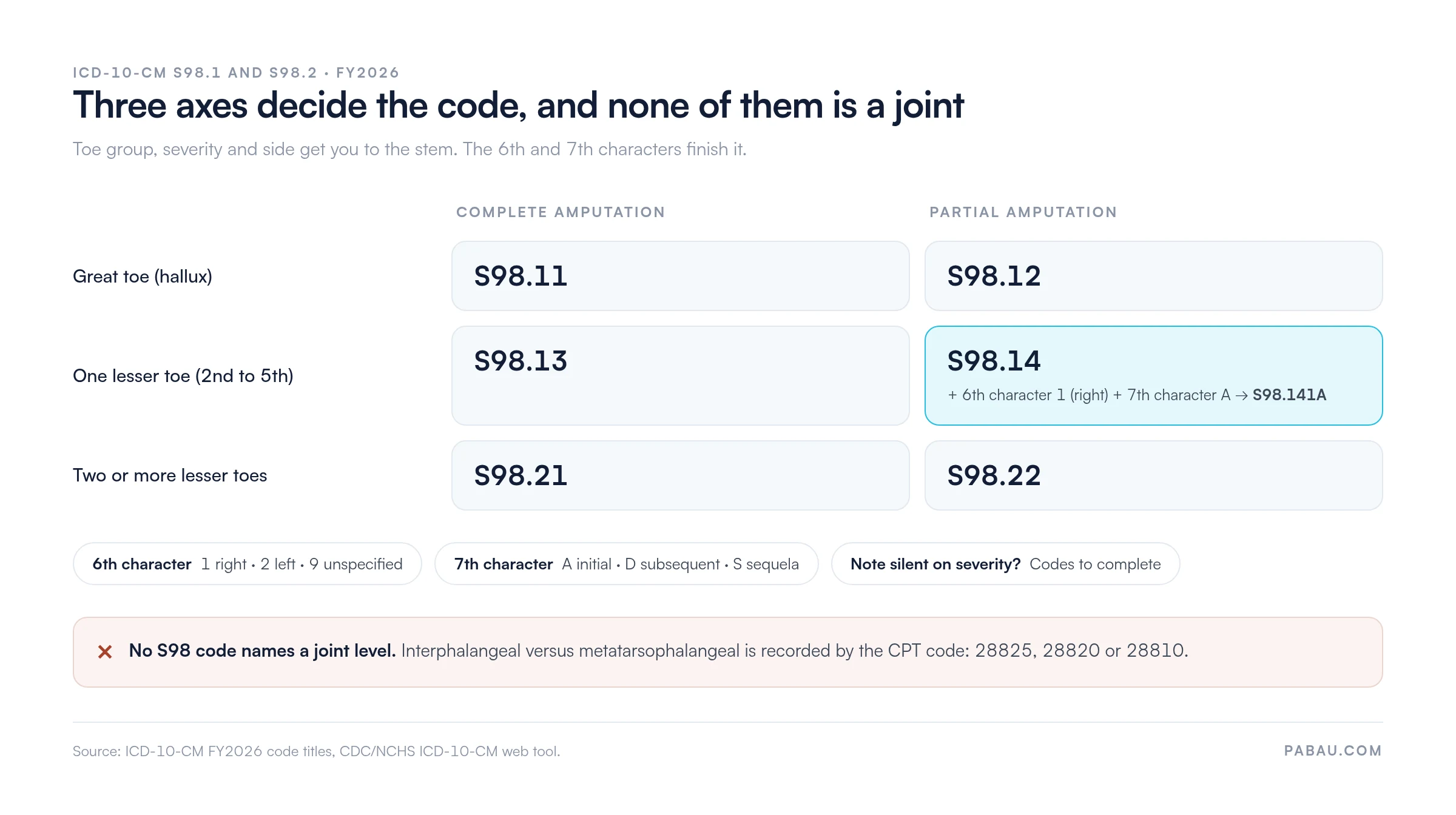
The S98.141A description carries exactly four pieces of information: The toe group, the laterality, the severity, and the encounter type. Get any one of them wrong and the code is non-specific or invalid. Detail beyond those four elements has to come from elsewhere on the claim. The grid below shows how the three coding axes land on a stem, and where joint level goes instead.
Lesser toes are the 2nd through 5th toes, every toe except the hallux (great toe). The hallux has its own S98 subcategories. When a provider documents injury to the second, third, fourth, or fifth toe on the right foot, that falls under the lesser toe grouping.
A partial amputation means the digit was not severed through its full cross-section, so some tissue bridge remains. S98.14 covers that presentation. S98.13 covers a complete amputation of one lesser toe. The distinction is not a coder judgment call.
S98 carries an Applicable To note that settles ambiguous documentation: An amputation not identified as partial or complete is coded to complete. An operative note that says only “traumatic amputation of the right third toe” therefore lands on S98.131A, not S98.141A.
No code in the S98.1 block names a joint. Read the full titles in order and only three axes appear. They are great toe or one lesser toe, complete or partial, and right or left. The 7th character then adds the encounter type.
That is a deliberate design choice rather than an oversight. ICD-10-CM spells out joint level freely in other blocks, so it clearly can when it wants to. S63.238, for instance, is titled “Subluxation of proximal interphalangeal joint of other finger”.
The practical consequence matters at the point of coding. A provider note that documents amputation at the proximal interphalangeal joint does not unlock a more specific ICD-10-CM code, because none exists. That detail drives the CPT selection instead, and it belongs in the operative report.
Does a coding reference give S98.141A a description ending in “at proximal interphalangeal joint”? Check it against the CDC ICD-10-CM web tool before you trust the rest of that page. The official FY2026 title stops at “one right lesser toe, initial encounter”.
S98.141A is a billable and specific ICD-10-CM code, confirmed valid for use on HIPAA-covered electronic health claims. The CMS ICD-10-CM code files confirm its FY2026 effective date as October 1, 2025, with validity through September 30, 2026. Submitting this code on a claim does not require additional specificity. It is already the most granular code available for this diagnosis.
Verify the code’s effective date against your clearinghouse before submitting claims for dates of service near the October 1 fiscal year transition. A FY2025 date of service requires the FY2025 code file, even if you submit the claim in FY2026.
Under ICD-10-CM Official Guidelines Section I.C.19.a, all traumatic injury codes in Chapter 19 require a 7th character to indicate the encounter type. Selecting the wrong character is one of the most common audit triggers for S98 codes. The parent stem S98.141 has three valid options.
A key clarification: “initial encounter” does not mean the first calendar visit. It refers to the phase of treatment. A patient can visit the same provider three times during active surgical management. All three visits use 7th character A. Switching to D happens when active treatment concludes and ongoing monitoring begins. The same A, D and S logic applies across every Chapter 19 injury code.
Knowing where S98.141A sits in the ICD-10-CM hierarchy helps coders navigate to the correct code. It also prevents picking a non-billable parent code by mistake.
Only S98.141A, S98.141D, and S98.141S are billable. Submitting S98.141 without a 7th character will be rejected as an invalid code by most payers and clearinghouses.
Several codes within the S98 family are commonly confused with S98.141A. The table below maps the most clinically relevant siblings. It covers laterality variants, complete versus partial amputation, toe count, and the great toe distinction. That same pattern of severity plus side repeats across the other ICD-10 diagnostic codes in Chapter 19.
Check with the AAPC ICD-10-CM code lookup when confirming the full S98 sibling code set for any payer-specific claim edits.
S98 carries no Excludes1 or Excludes2 note of its own. The annotations that reach S98.141A are inherited from the chapter and the block above it, plus one Applicable To note on S98. Misreading an Excludes1 note as an Excludes2 is a common denial trigger in traumatic injury billing.
Excludes1 means the two codes cannot describe the same episode. The relevant note is printed under S91, open wound of ankle, foot and toes. It excludes traumatic amputation of ankle and foot (S98.-) as a Type 1 exclude.
The effect runs in both directions on a claim. Do not report an S91 open wound code alongside S98.141A for the same injury to the same toe. S91 also carries a Type 1 exclude for open fracture of the ankle, foot, and toes.
Excludes2 means the excluded condition is not part of this code’s description but may occur at the same time. Both codes are valid when both conditions are documented. The S90-S99 block carries these:
Chapter 19 adds two more Excludes2 entries at the top level: Birth trauma (P10-P15) and obstetric trauma (O70-O71). Neither comes up often on an adult toe amputation claim.
When in doubt about Excludes note interpretation, the AHA Coding Clinic is the official source for guidance on ICD-10-CM coding questions.
ICD-10 code S98.141A is a diagnosis code. It describes what the patient has. The CPT code describes what the provider did, and it is the side of the claim that carries the joint level.
All three CPT codes can legitimately sit alongside S98.141A, because the diagnosis code does not constrain the surgical level. Read the operative report to confirm what the surgeon resected, then pick the CPT code that matches it. The claims management software used by your billing team should flag any CPT-ICD pairing that falls outside standard medical necessity edits.
These three scenarios follow one injury through the encounter types and show where the diagnosis code stays fixed and where it changes.
A patient drops a steel plate on the right foot in a workshop. The third toe is partially severed but still attached by a soft tissue bridge, which the ED documents explicitly. Code S98.141A, plus external cause codes for the mechanism and place of injury.
The tissue is not viable, so the surgeon completes the amputation at the metatarsophalangeal joint. The diagnosis stays S98.141A, because active treatment is still under way and the traumatic injury was partial. The procedure is CPT 28820, which is where the MTP level gets recorded.
This is the pairing that trips coders who expect the ICD-10-CM code to match the surgical level. It does not have to, and no S98 code offers that match.
Three weeks on, the patient attends a routine wound check with active treatment complete. That visit uses S98.141D. If altered gait or scar pain persists after healing, code the residual condition first and S98.141S second.
S98.141A groups under MDC 21 (Injuries, Poisonings and Toxic Effects of Drugs), not under the musculoskeletal MDC that some code references list. The CMS grouper assigns it to MS-DRG 913 (traumatic injury with MCC) or MS-DRG 914 (traumatic injury without MCC).
The code also appears in MS-DRGs 963, 964, and 965, titled other multiple significant trauma. Those three sit in MDC 24 and apply when the stay involves several qualifying injuries rather than one toe.
The final DRG depends on the principal diagnosis, any complications or comorbidities (CCs), and the procedure codes billed. A major complication or comorbidity (MCC) moves the case from 914 to 913. For hospital inpatient claims, verify the DRG number through the current CMS grouper rather than a single-code lookup.
For outpatient and physician claims, DRG does not directly apply. Medical necessity edits, LCD (Local Coverage Determination) requirements, and prior authorization rules still govern coverage for surgical amputation procedures.
Review the relevant payer’s LCD for foot and ankle surgery before submitting. Clearinghouse edit checks catch payer-specific problems before the claim reaches the insurer.
Accurate documentation from the treating provider is the foundation of correct S98.141A coding. These are the details most often missing from notes that lead to downcoding or denial on traumatic lesser toe amputation claims.
A superbill that captures laterality, severity, and encounter type at the point of service cuts coding queries. Get those three details onto the note at intake and the claim usually goes out clean.
A patient returns for a wound check after an initial debridement of a partial toe amputation. Switch from 7th character A to D only once the note confirms active treatment is complete. Premature switching to D, while surgery is still planned, is a common audit finding.
Plenty of podiatry and surgical billing teams still check code specificity by hand. Someone opens a code lookup in one tab, the patient record in another, and retypes the diagnosis into a claim form. Every hop is a chance to carry over a stale description, such as the joint level that S98.141A never had.
Practice management software like Pabau keeps the diagnosis, the procedure, and the claim in one record. Codes are entered against the visit that generated them, so the claim inherits what the clinician documented rather than what a coder remembered later.
Pabau’s Claim.MD clearinghouse integration validates ICD-10 and CPT code pairings against payer edits before submission. That reduces the risk of denial on traumatic amputation claims. The platform supports CMS-1500 and 837P claim formats and reaches thousands of US payers.
Claim statuses and electronic remittance advice come back into the same record. Your team can see which S98 claims paid and which need rework without leaving the patient file.

Pabau’s claims management tools help billing teams submit accurate ICD-10 codes, validate CPT pairings, and track claim status in one platform. See how it works for podiatry and surgical billing teams.

S98.141A records a partial traumatic amputation of one right lesser toe during active treatment. The code stops there. A coder who goes looking for a PIP reference in the code title is chasing a description ICD-10-CM never published.
So the audit risk sits on the 7th character rather than on specificity. Re-read the note before you switch a claim from A to D, because the switch has to follow the end of active treatment.
Document partial versus complete, name the toe and the side, and let the operative note drive the CPT choice. Pabau’s claims management software connects to the Claim.MD clearinghouse to validate those pairings and catch edit failures before submission. To see how Pabau handles ICD-10 coding workflows for podiatry and surgical practices, book a demo.

Need to understand medical billing compliance requirements? Medical billing compliance covers the documentation and regulatory requirements that apply to traumatic injury claims.
Researching how clearinghouses validate ICD-10 claims? How medical claims clearinghouses work explains the claim validation process from submission to payer adjudication.
Looking for guidance on revenue cycle management? What is revenue cycle management covers how ICD-10 coding fits into the broader billing and reimbursement workflow.
ICD-10 code S98.141A is a billable ICD-10-CM diagnosis code for partial traumatic amputation of one right lesser toe, initial encounter. That official title is the whole description. The code is valid for FY2026, from October 1, 2025 through September 30, 2026. It applies during the active treatment phase of the injury.
No. S98.141A names the toe group, the side, the severity, and the encounter type, and nothing else. No code in the S98.1 block distinguishes a proximal interphalangeal amputation from a metatarsophalangeal one. Descriptions that add “at proximal interphalangeal joint” to this code are inaccurate. Joint level is recorded by the CPT code and the operative note.
Yes, S98.141A is a billable and specific ICD-10-CM code valid for use on HIPAA-covered electronic health claims. It does not require further specification. It is already the most granular code available for this diagnosis in the FY2026 code set.
The three codes share the same clinical description but differ in encounter type. S98.141A is used during active treatment, the initial encounter. S98.141D covers the healing and follow-up phase, the subsequent encounter. S98.141S applies when a late effect of the original injury persists after healing. Selecting the correct 7th character is one of the most common audit triggers for Chapter 19 injury codes.
CPT 28825 covers amputation at an interphalangeal joint of the toe. CPT 28820 covers the metatarsophalangeal joint. CPT 28810 covers a ray amputation, taking the metatarsal with the toe. All three can pair with S98.141A, because the diagnosis code does not fix the surgical level. CPT selection always follows the operative documentation.
The 7th character A designates the initial encounter under ICD-10-CM Official Guidelines Section I.C.19.a. It applies whenever the patient is receiving active, definitive treatment for the injury, including emergency care, surgery, and initial wound management. It does not mean only the first calendar visit. It refers to the active treatment phase, which may span several visits.
S98 carries no Excludes1 or Excludes2 note of its own. The Excludes1 that matters is printed under S91, which excludes traumatic amputation of ankle and foot (S98.-). Do not report an open wound code with S98.141A for the same injury. Inherited Excludes2 notes cover burns and corrosions, ankle and malleolus fracture, frostbite, and venomous bites or stings.
The CMS grouper assigns S98.141A to MS-DRG 913 (traumatic injury with MCC) or MS-DRG 914 (traumatic injury without MCC). Both sit under MDC 21, Injuries, Poisonings and Toxic Effects of Drugs. The code also appears in MS-DRGs 963 to 965 for other multiple significant trauma, which sit in MDC 24. It is not grouped under the musculoskeletal MDC.