ICD-10 Code S42.444P: Medial epicondyle fracture, right humerus
ICD-10 Code S42.444P: full descriptor and code validity ICD-10 Code S42.444P car...

Last Updated: Oct 13, 2026
Billable Code Specific Code
S92.322D is the billable ICD-10-CM code for displaced fracture of second metatarsal bone, left foot, subsequent encounter for fracture with routine healing.
Two details decide whether the claim clears. The record has to name the left foot, and the note has to show the encounter is a follow-up.
Let Pabau's smart automation suggest the right codes, reduce claim denials, and keep your practice compliant—effortlessly.
Automate repetitive tasks and focus on what matters most—your patients.
Reduce coding errors and ensure compliance with the latest regulations.
Clean claims, fewer denials, and faster reimbursements.
Powerful insights and reporting to help your practice thrive.
HIPAA compliant SOC 2 certified GDPR-compliant Trusted by 4,000+ clinics worldwide

S92.322D covers a displaced fracture of the second metatarsal bone in the left foot, at a subsequent encounter with routine healing.
The 6th character carries displacement and side together, so 1, 2 and 3 are displaced right, left and unspecified foot.
The 7th character D marks a follow-up visit with normal healing, so submitting S92.322A at that visit is a frequent rejection cause.
S92.323D is the unspecified-foot version of the same fracture, so reach for it only when the record never names a side.
Practice management software like Pabau captures laterality, encounter type and the 7th character in the note, so claims carry the detail payers check.
ICD-10 Code S92.322D describes a displaced fracture of the second metatarsal bone of the left foot. It applies at a subsequent encounter where the fracture is healing routinely. Every part carries a specific clinical and billing meaning, and all of them are needed for a correct submission.
The 6th character is the one to read twice. Within the second metatarsal group, 1 is a displaced fracture of the right foot, 2 is the left foot, and 3 is an unspecified foot. Nondisplaced fractures of the same bone run 4, 5 and 6 in the same order.
The code sits within the ICD-10-CM system, run jointly by CMS and NCHS. It falls under the S90-S99 chapter for injuries to the ankle and foot. ICD-10-CM is the US version of the WHO’s ICD-10 system.
The 7th character is where most coding errors for S92.322D occur. “D” does not mean the second visit or the fourth visit. It means any visit after the first active treatment visit, as long as the fracture is healing as expected. The grid below maps both variable digits at once.
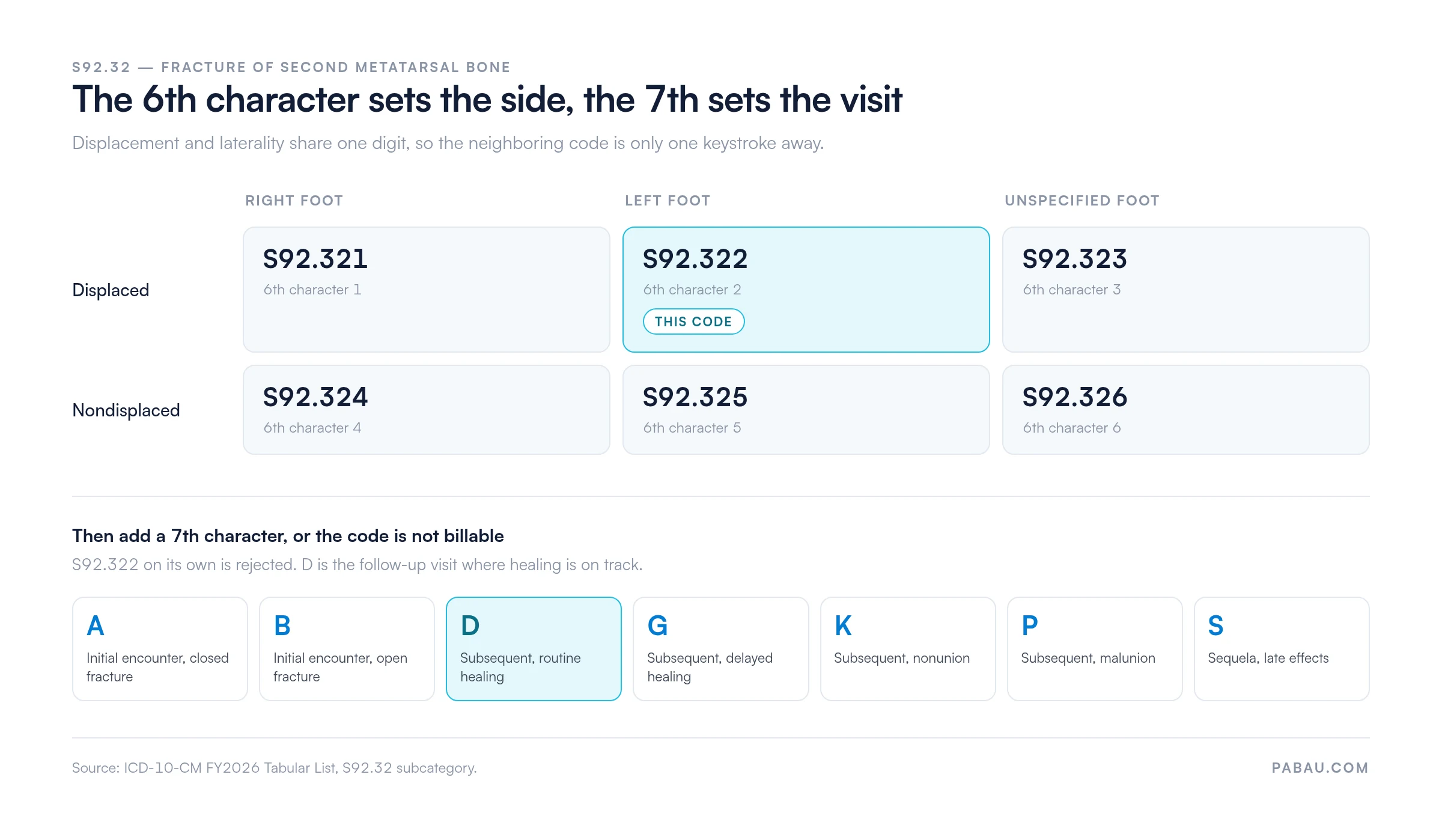
Character D applies no matter how many follow-up visits have happened. What matters is whether the clinician is still treating the injury or watching a healing fracture. That has to be clear in the note for each visit.
The 7th character has to be right in the note before it reaches the claim. Practices that record the encounter type at documentation time avoid rebilling later. Practice management software like Pabau keeps that detail on the record. Its claims management software then carries it into the submission, so the biller is not rebuilding it from the chart.

S92.322D sits within a defined parent structure. Reading the hierarchy from the top down helps coders pick the right level of detail. It also makes the nearby codes easy to find when laterality or displacement status differs.
Two points in that table catch coders out. S92.32 is the general parent for a second metatarsal fracture, so displaced, nondisplaced and unspecified codes all sit beneath it. S92.322 on its own is also not billable, because every complete code in the S92 category needs a 7th character.
The second metatarsal is the longest metatarsal bone and the one most often broken under stress. It acts as the central weight-bearing pillar of the midfoot. That leaves it exposed during sudden changes of direction, falls from height, or a direct impact to the dorsum of the foot.
A displaced fracture means the bone fragments have moved out of place. Displacement drives the treatment decision. A non-displaced second metatarsal fracture is often managed with a walking boot. A displaced one may need closed reduction, or surgical fixation, before the subsequent-encounter phase begins.
Laterality is a required element of the note, and it is what separates S92.322D from its two neighbors. A note that records only “foot fracture” supports S92.323D (unspecified foot) at best. Many payers treat that as an unspecified-diagnosis denial.
The imaging report is not a substitute. If the radiologist writes “left” and the clinician writes nothing, the encounter note still fails an audit of the coded side.
Document the laterality, the displacement status, and the healing assessment clearly in every follow-up note for a metatarsal fracture. Phrases like ‘healing as expected’ or ‘fracture callus forming on X-ray’ directly support the ‘routine healing’ qualifier in S92.322D. Vague progress notes are the main audit trigger for subsequent encounter fracture claims.
The wordings below are documentation phrasings that map to S92.322D. None is the official descriptor. That reads “Displaced fracture of second metatarsal bone, left foot, subsequent encounter for fracture with routine healing”, and it carries no “closed” qualifier. Check the Alphabetic Index and Tabular List before you choose the final code.
These wordings help most when an auditor is matching the note against the coded diagnosis. The AAPC Codify ICD-10-CM lookup carries a synonyms section for the code, which is a quick way to cross-check the language a clinician actually used.
The S92.3 block covers every metatarsal fracture. The table below lists the siblings coders reach for most often around S92.322D. Watch how the 6th character moves. 1 is the right foot, 2 is the left, and 3 is unspecified, in the displaced and nondisplaced groups alike.
Working down the S92.3 block in order lowers the risk of picking a nearby code with a different displacement or laterality qualifier. When claims for any of these codes are denied, tag each denial by ICD-10 code family. Our reference on denial codes explains what each rejection reason means.
Tagging that way shows patterns across the whole S92 block, instead of one rejected claim at a time.
Getting S92.322D accepted on first submission takes documentation that supports every qualifier in the code. Five qualifiers carry it. They are the bone, the side, the displacement status, the encounter type, and the healing status. A miss on any one creates audit exposure.
Switch from A to D once the active treatment phase ends. For a conservatively managed displaced second metatarsal fracture, this often means the first follow-up after the fracture is reduced or immobilized. For a surgically managed fracture, it means follow-up after surgery, once early recovery care is complete.
Use G (delayed healing) when the clinical note documents that expected healing milestones have not been met. Continuing to use D while imaging or clinical findings show delayed healing is a coding accuracy issue. The CDC/NCHS ICD-10-CM web tool carries the official tabular guidance on 7th character selection for S92 category codes.
Subsequent encounter codes, including S92.322D, are exempt from Present on Admission (POA) reporting requirements. The POA indicator is required only for inpatient diagnoses present at the time of hospital admission. For outpatient fracture follow-up visits, POA does not apply.
Practices submitting through Pabau’s Claim.MD integration send claims in the CMS-1500 and 837P formats. Those are the standard submission paths for outpatient foot fracture follow-up encounters. The integration moves the claim to the payer and tracks its status. Choosing the 7th character stays with the coder and the note.
Run a monthly audit of the S92.3-block claims that carry ‘A’ as their 7th character. Flag any encounter dated more than 14 days after the first fracture visit. A high rate of ‘A’ codes at 3-6 week follow-ups means clinical staff are not moving to subsequent encounter codes when they should. That is an audit risk and a compliance risk at once.
S92.322D has been in the ICD-10-CM Tabular List since the US rollout on October 1, 2015. The FY2026 edition took effect on October 1, 2025 under the standard CMS annual update cycle. It carried no change to the code’s description, its billable status, or its 7th character assignments.
Annual ICD-10-CM updates sometimes retire, revise, or add codes within the S92 block. Check any code’s edition status against the CMS ICD-10 codes page at the start of each fiscal year. Practices that refresh their code library every October 1 avoid coding on retired or revised descriptions.
For coders using the global system, the WHO ICD-10 browser holds the parent version. ICD-10-CM differs from the WHO edition in its level of detail. The clearest example is the 7th character on injury codes, which the WHO version does not carry in the same form.
Claims for subsequent encounter fracture visits often pair S92.322D with an evaluation and management (E/M) code or a physical therapy procedure code. Which one depends on the treating provider and on what the follow-up visit involved. The diagnosis code alone does not determine reimbursement. It has to be paired with a procedure code that reflects the services given.
For practices billing US insurance, the electronic remittance advice from each payer shows whether S92.322D was accepted, adjusted, or denied. Monitoring that data by ICD-10 code family lets billing teams spot repeat coding issues before they compound across patients.
Retention rules apply to the supporting documentation too. Keep the note that explains the 7th character for each visit, because that is what an auditor asks for. Our guide to a clean claim covers what has to be in place before submission.
Most practices keep the coding detail for a fracture episode in three separate places:
Matching the three by hand is where the encounter type gets lost. A visit coded A in the note becomes a visit billed A six weeks later, long after the fracture moved on to routine healing.
Pabau keeps them on one record. The diagnosis code the clinician enters at the follow-up visit stays attached to that appointment. The invoice and the claim are then raised from the same record, so nobody retypes the code into a second system.
Pabau’s Claim.MD integration submits and tracks those claims for thousands of US payers, and checks eligibility in real time. That matters for fracture follow-up patients, whose coverage may have changed since the first visit. Choosing the code and writing the note that supports it stay with your clinical team.

Pabau records ICD-10 codes, encounter types and laterality in the clinical note, and raises the claim from that same record. See how the claims management tools and the Claim.MD integration keep foot fracture follow-up billing on one system.

A displaced second metatarsal fracture generates a sequence of coding decisions across the episode of care. S92.322D carries the bulk of the follow-up billing for left-foot cases that are healing well.
Two habits keep it clean. Write the side and the healing status into every follow-up note, and move to G the first time the imaging stops agreeing with “routine”. Both are documentation decisions, made at the visit rather than at the claim.
Book a demo to see how Pabau keeps the side, the encounter type and the healing note attached to the claim it bills.

Managing complex fracture billing workflows? Denial management in healthcare covers how to build a systematic response to claim rejections across ICD-10 code families.
Need to understand the full claims submission process? Pabau’s Claim.MD clearinghouse guide explains how electronic claim submission works from code selection through remittance.
Looking for compliance documentation standards? Medical billing compliance outlines the record retention and documentation accuracy requirements for subsequent encounter fracture codes.
ICD-10 Code S92.322D is the billable ICD-10-CM code for a displaced fracture of the second metatarsal bone, left foot. The 7th character D makes it a subsequent encounter with routine healing. It is used at follow-up visits once active treatment is complete and healing is on track. The code is valid for HIPAA-covered electronic transactions and is current in the FY2026 edition.
Yes, S92.322D is a billable and specific ICD-10-CM code, valid for claim submission and for HIPAA-covered electronic transactions. It carries every required detail: the bone (second metatarsal), the side (left foot), the displacement status, and the encounter type. The parent code S92.322 is not billable without a 7th character.
S92.322D is typically paired with evaluation and management codes such as CPT 99213 or 99214 for office follow-up visits. In rehabilitation encounters it is paired with physical therapy procedure codes, such as therapeutic exercise (CPT 97110) or therapeutic activities (CPT 97530). The specific codes depend on the treating provider type and the services rendered at the visit.
Subsequent encounter codes apply from the first follow-up visit after the active treatment phase ends. For a conservatively managed fracture, that is often the first return visit after the fracture is splinted or braced. For a surgically managed fracture, it begins after surgery, once early recovery care is complete. The fracture does not need to be fully healed, as long as routine healing is documented.