ICD-10 code S61.201A: Open wound of left index finger without nail damage
ICD-10 code S61.201A covers a left index finger wound of unstated type ICD-10 co...

Last Updated: Oct 16, 2026
Billable Code Specific Code
S91.246A is the billable ICD-10-CM code for puncture wound with foreign body of unspecified lesser toe(s) with damage to nail, initial encounter.
The 7th character carries the whole claim. Send the parent code S91.246 on its own, and no payer can adjudicate it. The CPT pairings come at the end.
Let Pabau's smart automation suggest the right codes, reduce claim denials, and keep your practice compliant—effortlessly.
Automate repetitive tasks and focus on what matters most—your patients.
Reduce coding errors and ensure compliance with the latest regulations.
Clean claims, fewer denials, and faster reimbursements.
Powerful insights and reporting to help your practice thrive.
HIPAA compliant SOC 2 certified GDPR-compliant Trusted by 4,000+ clinics worldwide

S91.246A is a billable ICD-10-CM code for a puncture wound with foreign body of unspecified lesser toe(s) with damage to nail, initial encounter.
The parent code S91.246 is not billable, so always append the 7th character A, D, or S.
Laterality is unspecified here, so use S91.244A for the right lesser toe(s) and S91.245A for the left.
The chart has to confirm the puncture mechanism, the foreign body, the nail damage, the encounter type, and the toe involved.
Practice management software like Pabau carries searchable ICD-10-CM and CPT libraries, so coders can check the S91.24x family inside the record.
S91.246A describes a puncture injury to one or more lesser toes, meaning toes two through five. A foreign object entered the wound, the nail sustained damage, and the record does not say which foot. The 7th character A then confirms the patient is receiving active treatment for that injury.
The code is valid for HIPAA-covered claims to Medicare, Medicaid, and commercial payers. It appears in the CDC/NCHS ICD-10-CM web tool and in the CMS tabular list for the current fiscal year.
Each character in S91.246A answers one question the chart has to answer first. Work through them in order and the correct code falls out on its own.
The grid below maps the two questions that set the subcategory, then the digit that names the toe.
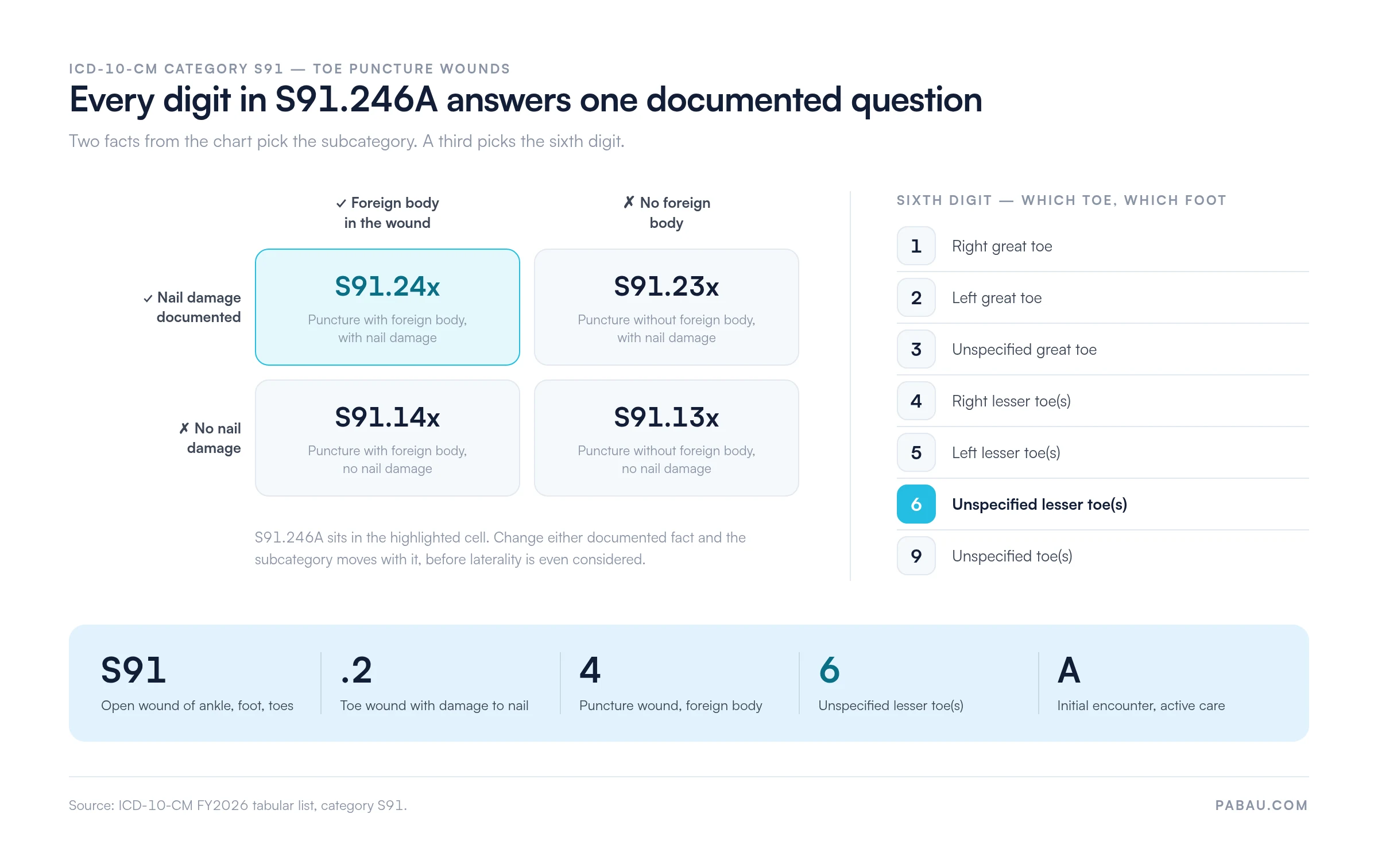
Two documented facts settle the subcategory. A foreign body plus nail damage lands on S91.24x. Nail damage on its own moves the claim to S91.23x. Take the nail damage away and the same two options become S91.14x and S91.13x.
The sixth digit then names the toe and the foot. Great toe codes use 1, 2, or 3. Lesser toe codes use 4, 5, or 6, while 9 covers an unspecified toe. So S91.246A reads as nail damage, foreign body, unspecified lesser toe, initial encounter.
Chapter S builds most injury codes this way, so the pattern transfers once you have seen it. Our ICD-10-CM code reference indexes the families a wound-care coder meets most often.
Every injury code in chapters S and T needs a 7th character, per the CMS ICD-10-CM Official Guidelines for Coding and Reporting. Submit the parent code S91.246 without it and the result is an invalid code that no payer can process.
One rule from the official guidelines catches people out. The 7th character reflects the status of the treatment, not the status of the wound. A patient can still be in the initial encounter phase on a second visit, as long as active treatment continues.
Once the provider moves to routine aftercare, the encounter becomes subsequent and the character changes to D.
S91.246A applies when all of the criteria below are present at once. Miss any one of them and the claim belongs to a different code in the S91.1x or S91.2x families.
In podiatry and occupational health, this code turns up most often in workers’ compensation claims. Stepping on metal debris, construction nails, or equipment on a job site produces exactly this injury. Workers’ comp rules vary by state jurisdiction, so confirm coverage with the carrier before submission.
A billing team cannot infer these details from the chief complaint. Each one needs explicit language in the provider’s note. The table below pairs what the record has to say with what happens to the claim when it stays silent.
Look for the phrase ‘foreign body’ before you assign any S91.24x code. If the chart says ‘puncture wound, nail involved’ but never mentions an object, the family changes. Use S91.234A, S91.235A, or S91.236A for the right, left, or unspecified lesser toe. One missing phrase moves the claim to another code family.
Take a walk-in case. The note reads: patient stepped on a roofing nail, with a 2 cm puncture of the right second toe. A partially avulsed nail plate is documented, and the fragment came out under local anesthetic. That gives you a foreign body, nail damage, a lesser toe, a named foot, and active treatment.
That case codes to S91.244A, not S91.246A. The wound itself did not change. Only the record did, and specificity outranks an unspecified option every time. Reaching for the unspecified code when a specific one exists is a common audit finding.
The decision runs in a fixed order. Is there a foreign body? Is there nail damage? Which foot? Answer those three in sequence and only one code survives.
Auditing older records or migrating a legacy system brings ICD-9-CM into the picture as well. These are the relationships worth keeping beside you while you work an S91.246A claim.
Infection is handled separately. The tabular instruction is to code also any associated wound infection, so the infection gets its own secondary code and S91.246A stays as it is. That 7th character only says which encounter this is. It never signals a complication.
Check the site of the injury before you commit to S91. The category covers open wounds of the ankle, the foot, and the toes. S91.3 picks up open wounds of other parts of the foot, including the midfoot. Fractures of the tarsals and metatarsals sit in S92.x, and nerve injuries in S94.x.
Five mistakes account for most of the rework on these claims. Each one below comes with the correction, because knowing the error rarely helps on its own.
Audit S91.246x denials in two passes. Filter the clearinghouse rejection report for codes missing a 7th character first, then for encounter-type mismatches. Those two account for most S91 family rejections in wound care. Correcting the default code template in your EHR takes about five minutes and stops the same denial repeating on every claim.
Denial management in wound-care practices traces most S91.x rejections back to the first two errors on that list. Clear those two in a coder audit and the rest of the queue usually shrinks on its own.
S91.246A is accepted across Medicare, Medicaid, commercial insurers, and workers’ compensation carriers, subject to jurisdiction. On the claim, the diagnosis supports one or more CPT codes for the services performed.
The line between simple and complicated decides which removal code you report, and it is the pairing payers question most. Our guide to CPT 10121 sets out the operative detail that supports the higher-value code.
Reimbursement rates for wound care sit in the CMS Physician Fee Schedule and vary by locality. Rates update every January 1, so quote a figure only against the current year’s schedule.
Workers’ compensation adds a second layer. Some states want supporting forms alongside the CMS-1500, while others accept a standard electronic 837P. Ask the carrier what it expects before the first submission, because a corrected claim restarts the payment clock.
Most wound-care teams handle this code twice. A coder reads the note, looks the code up in a separate reference, then types it into the claim. Someone else checks it against the chart before the batch goes out. Every hop is a chance for the 7th character to fall off.
Pabau closes that loop inside one record. The CPT code attached to the service lands on the charge line by itself. ICD-10 slots are seeded from the patient’s recorded problem list.
Searchable ICD-10-CM and CPT libraries sit behind a search icon on the claim. A coder can compare S91.244A, S91.245A and S91.246A without opening a second tab.
Before the send button unlocks, Pabau checks that the claim’s required fields are complete, then submits through Claim.MD to thousands of US payers.
Eligibility checks, ERA posting and claim-status tracking all run in the same place. That gives a wound-care practice cleaner claims management without a separate billing system.

Pabau pre-fills the claim from the patient record and checks that required fields are complete before submission. Claims then go out through Claim.MD to thousands of US payers, with eligibility checks and ERA posting in the same place.

The chart decides this code, and a provider writes it long before the coder opens it. The claim turns on the puncture mechanism, the foreign body, the nail damage, the encounter type, and the toe. Miss one and the claim moves to a different subcategory, not just a different digit.
So the fix belongs upstream, in the note. Give providers a template that prompts for laterality and nail involvement, and unspecified codes stop showing up by default. The trade-off is a slightly longer note, which costs far less than a resubmission.
Keeping the code libraries, the claim form and the clearinghouse in one record removes the handoffs where detail goes missing. Book a demo to see how a toe puncture claim travels from the chart note to a submitted 837P in Pabau.

Need help reading a claim rejection? Denial codes in medical billing explains the most common CARC codes and how to clear them before resubmission.
Want a faster route to clean claim submission? Claim.MD clearinghouse overview covers how electronic claims reach payers and where validation happens in the 837P workflow.
Building a wound care billing process from scratch? How to create a superbill walks through pairing ICD-10 diagnosis codes with CPT procedure codes on one document.
Not sure what a payer counts as a clean claim? What makes a clean claim lists the fields that have to be complete before an 837P is accepted first time.
Worried about an audit of your injury coding? Medical billing compliance sets out the documentation standards auditors apply to diagnosis and procedure pairings.
Only when a state mandate or a payer asks for one. ICD-10-CM sets no national requirement for chapter 20 external cause codes. Most workers’ compensation carriers do want them, so add the matching W code, such as W45.0XXA when a nail entered through the skin.
Add Z23, encounter for immunization, as a secondary diagnosis. The vaccine product and its administration are billed with their own CPT codes, not under S91.246A. Sequence the injury code first, since the puncture is the reason the patient came in.
Report the retained material with a code from Z18, sequenced after S91.246A. Z18.81 covers retained glass fragments and Z18.9 covers unspecified material. S91.246A still describes the injury itself, so the Z18 code supplements it rather than replacing it.
Code both digits. The great toe takes S91.241A, S91.242A, or S91.243A, and the lesser toe takes S91.244A, S91.245A, or S91.246A. ICD-10-CM offers no combination code for the two, and payers expect a separate line for each injured digit.
Yes, provided the record documents that an object was in the wound. The code turns on what was in the toe, not on who removed it. Note who removed the object and when, so the chart supports the choice under audit.