ICD-10 Code Y76.0: Diagnostic obstetric and gynecological devices
ICD-10 Code Y76.0: Definition and billable status ICD-10 Code Y76.0 is a valid, ...

Last Updated: Oct 23, 2026
Billable Code Specific Code
S90.579A is the billable ICD-10-CM code for other superficial bite of ankle, unspecified ankle, initial encounter.
The code took effect on October 1, 2025 and is valid for claims in fiscal year 2026. It comes from the 2026 edition of ICD-10-CM. That edition is published by the Centers for Medicare and Medicaid Services (CMS) and the CDC's National Center for Health Statistics (NCHS).
Wound depth is what separates this code from its closest neighbor. Superficial bites stay in S90, and a bite that reaches deeper tissue moves to S91.
Let Pabau's smart automation suggest the right codes, reduce claim denials, and keep your practice compliant—effortlessly.
Automate repetitive tasks and focus on what matters most—your patients.
Reduce coding errors and ensure compliance with the latest regulations.
Clean claims, fewer denials, and faster reimbursements.
Powerful insights and reporting to help your practice thrive.
HIPAA compliant SOC 2 certified GDPR-compliant Trusted by 4,000+ clinics worldwide

S90.579A is a billable ICD-10-CM code for other superficial bite of unspecified ankle, initial encounter, valid for FY2026 (effective October 1, 2025).
The 7th character A designates an initial encounter, meaning active treatment. Use D for subsequent encounters and S for sequelae.
Never use S90.579A for open bites of the ankle. Those code to S91.05- under ICD-10-CM Excludes1 rules.
Practice management software like Pabau embeds ICD-10-CM codes directly into clinical notes and insurance claims, which cuts transcription errors at the point of care.
The full clinical description of ICD-10 code S90.579A is “Other superficial bite of unspecified ankle, initial encounter.” Each word in that description carries a specific coding meaning that determines when the code applies and when it does not.
Clinical scenarios that support S90.579A include:
Insect bites fall under separate tabular entries. The CDC/NCHS ICD-10-CM coding tool also lists approximate synonyms accepted in documentation. They include “bite of ankle,” “superficial bite of ankle,” and “wound of ankle due to bite.”
S90.579 requires a 7th character to be complete and billable. Without it, the code is a header-level category, not a valid claim submission code. The 7th character identifies the type of encounter, which affects reimbursement logic and medical necessity documentation.
The ICD-10-CM Official Guidelines for Coding and Reporting (Section II) define “initial encounter” as any encounter during active treatment. The calendar order of the visit does not decide it. A patient seen for debridement on visit three is still an “A” encounter if active treatment continues. Switching to “D” is appropriate once the provider’s role shifts to monitoring routine recovery.
Flag S90.579D encounters in your billing workflow with a documentation prompt asking whether active treatment is still ongoing. Submitting a subsequent-encounter code while a wound is still being actively managed is a common audit finding and can trigger post-payment review.
Understanding the full code hierarchy helps coders confirm they are working in the right section of the tabular list and quickly find related laterality-specific codes.
S90.579A has two direct laterality siblings and several closely related codes within the S90 category. When documentation specifies the affected ankle, use a laterality-specific code rather than the unspecified variant.
The AAPC ICD-10-CM code reference restates the tabular list’s guidance on specificity. Coders select the highest degree of specificity the documentation supports. Unspecified codes like S90.579A are valid when the provider genuinely does not document laterality. They should not stand in for a laterality-specific code that the chart supports.
The S90 category carries Excludes1 and Excludes2 notes that define the boundaries of this code. Misapplying S90.579A when an exclusion applies is one of the most common reasons ankle-bite claims return with an edit.
An Excludes1 note means the excluded condition is mutually exclusive. You cannot code both S90.579A and an Excludes1 code for the same encounter, because the two conditions are contradictory by definition.
Excludes2 notes indicate that the excluded condition is not part of S90.579A but may co-exist. Both codes can appear on the same claim when clinically appropriate.
Accurate documentation is what keeps S90.579A claims out of the denial queue. Providers need to record specific details, and coders need to verify those details map to the code before submission.
Those details resolve in a fixed order. The chart below runs the decision from bite type down to encounter phase, and shows where S90.579A is the answer.
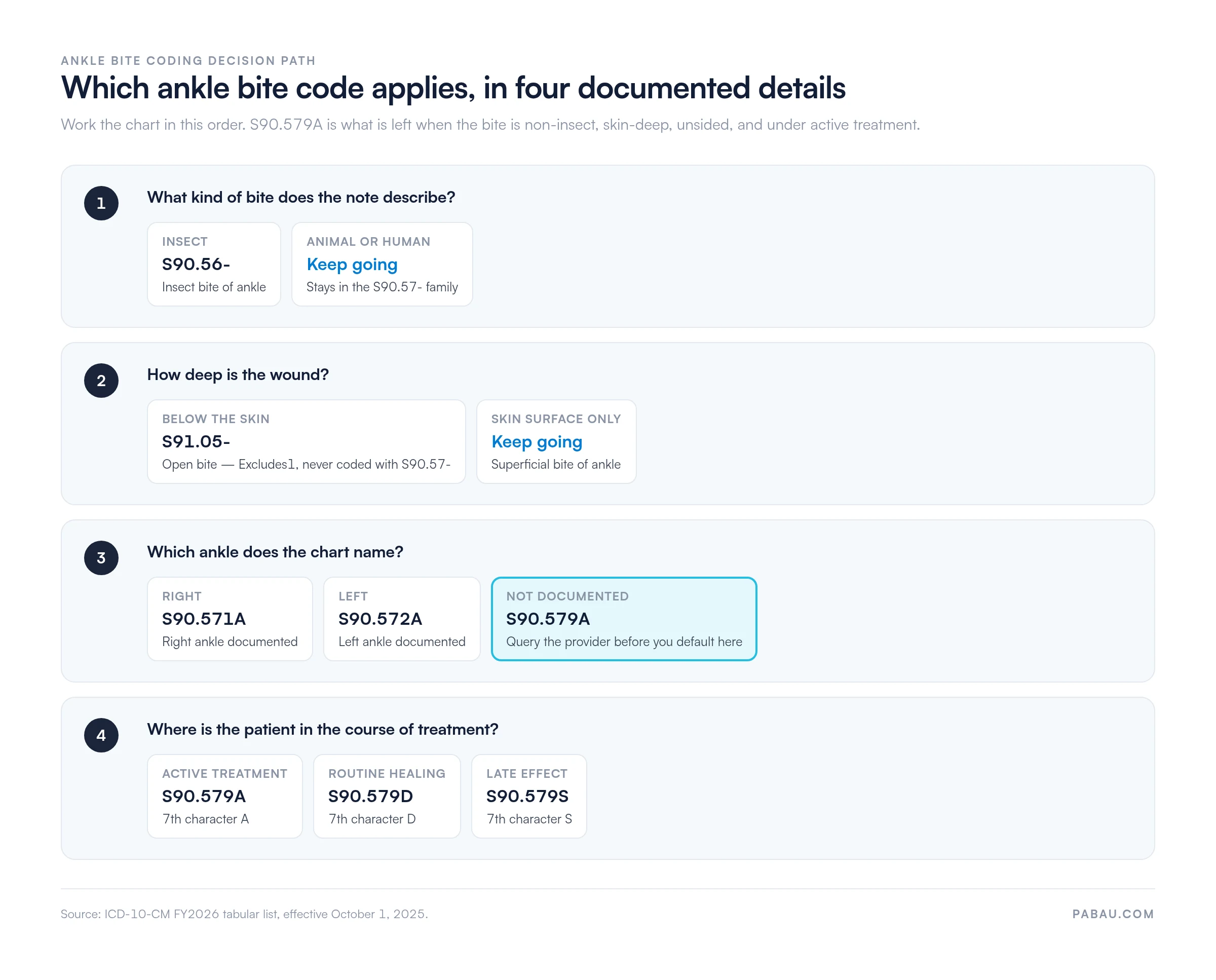
A persistent misconception is that “unspecified” codes are acceptable whenever a provider does not explicitly write “right” or “left.” The standard under ICD-10-CM guidelines is narrower. Use the unspecified code only when the information is genuinely unavailable.
If the provider documented a physical exam of one ankle, the laterality is inferable and should be queried. Submitting S90.579A when the chart supports S90.571A or S90.572A is undercoding, which carries its own compliance risk.
The fix is to query the provider at the point of documentation, before the claim drops, rather than defaulting to “unspecified” as a shortcut. A query takes minutes. A corrected claim costs a whole resubmission cycle.
Excludes1 violations and an incorrect 7th character are the two errors that show up most on ankle-injury claims. Both surface later as denial codes worth preventing, so a documentation review before submission is cheaper than an appeal.
Submitting a clean claim means confirming the Excludes rules and the encounter type first. Both checks take seconds once the note is in front of you.
ICD-10 lookup usually happens somewhere other than where the note and the claim live. A coder confirms the code on an external site, then retypes it into the EHR or the billing system. That retyping step is where transcription errors enter.
Practice management software like Pabau removes the retyping step. Pabau builds ICD-10-CM code selection into the clinical note and the billing screen, which is what makes claims management without re-entry possible. Providers document the encounter, pick the diagnosis code in the same place, and that code flows into the outbound claim.
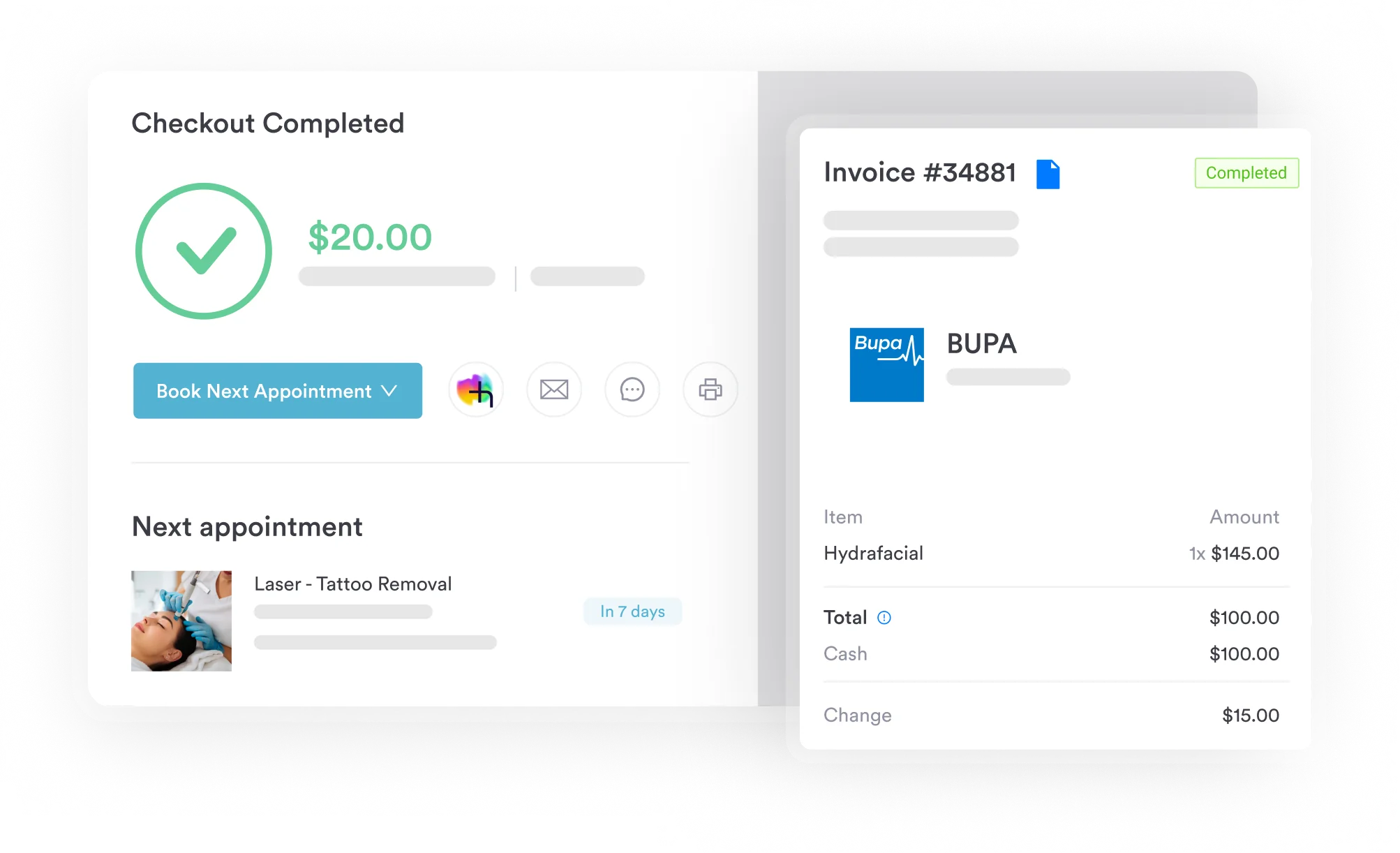
For US practices, Pabau’s Claim.MD clearinghouse integration handles electronic claim submission across thousands of US payers. It also covers real-time eligibility checks and ERA (electronic remittance advice) processing.
A code like S90.579A can move from the clinical note to a submitted 837P claim with built-in ICD-10 and CPT validation. That validation catches a code-level problem before the claim reaches the payer. Injury documentation sits in the patient record alongside the billing record, so the audit trail stays in one place.
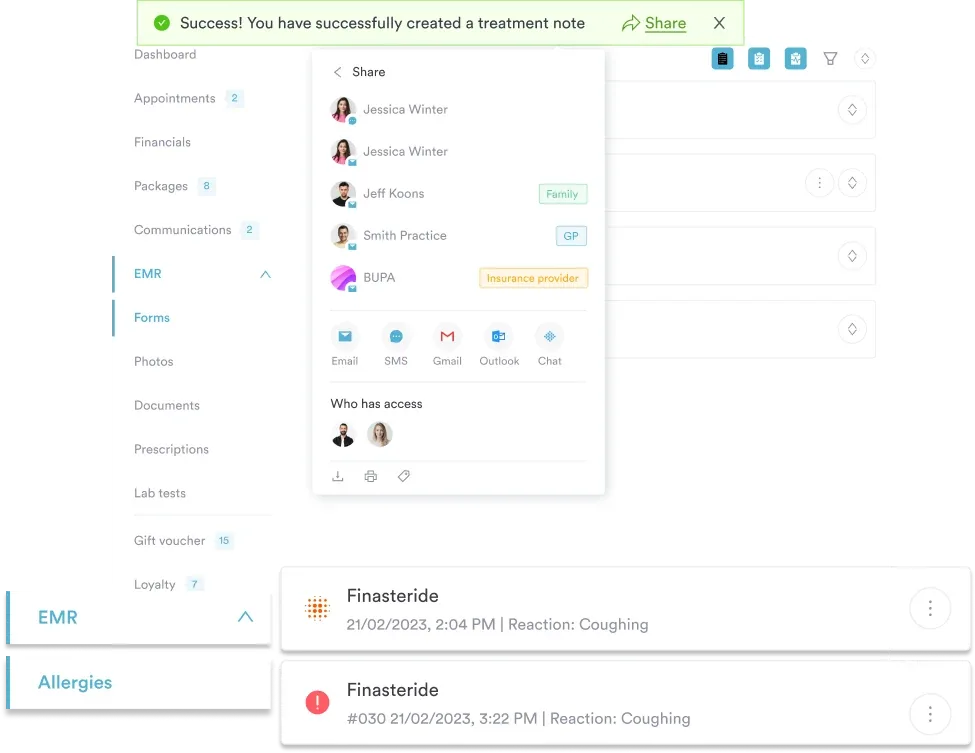

Pabau links diagnosis codes like S90.579A directly to clinical notes, invoices, and insurance claims in one platform. Less manual transfer means fewer transcription errors and faster reimbursement.

S90.579A is a straightforward billable code when the documentation supports it. Two decision points drive most of the errors. Wound depth separates S90 from S91, and laterality separates the unspecified code from the specific ones.
Get both right before submission and the claim clears without an edit. Get either wrong and the correction costs more than the query would have.
Pabau’s coding and claims workflow removes the retyping step that creates most of those errors. Book a demo to see how an injury code moves from the clinical note into a submitted claim.

Need to understand how clearinghouse submissions work for injury codes? How the Claim.MD clearinghouse processes claims walks through EDI submission, 835 remittances, and denial handling for US payers.
Want to reduce coding-related claim denials across your practice? Electronic remittance advice (ERA) explained covers how 835 files help you identify and correct systematic code errors before they become write-offs.
Need documentation standards that hold up in an audit? Medical billing compliance covers the documentation and query practices that keep coded claims defensible.
ICD-10 code S90.579A is a billable ICD-10-CM diagnosis code for “Other superficial bite of unspecified ankle, initial encounter.” It is valid for FY2026, effective October 1, 2025. It applies to skin-only bite wounds at the ankle when laterality is not documented and the patient is under active treatment.
Yes. S90.579A is a specific, billable ICD-10-CM code that can be used to support a diagnosis for reimbursement purposes. The parent code S90.579 (without the 7th character) is a header-level category and is not billable on its own.
S90.579A designates an initial encounter, meaning the patient is receiving active treatment for the bite. S90.579D designates a subsequent encounter, used for routine wound checks and follow-up visits after active treatment has concluded. Using S90.579A after the treatment phase ends is a 7th character error and a common audit finding.
A superficial bite (S90.57-) involves only the skin surface without penetration into deeper structures. An open bite (S91.05-) penetrates beyond the skin into subcutaneous tissue or deeper layers. The Excludes1 note on S90 means you cannot code both together for the same wound. Wound depth documented by the provider decides which one applies.
Yes. S90.579A is valid for fiscal year 2026 under the 2026 edition of ICD-10-CM, which became effective on October 1, 2025. Per the CMS ICD-10 codes page, it carries no deletion or revision flag in the current annual update cycle.
S90 is the ICD-10-CM category for superficial injuries of the ankle, foot, and toes. It sits within the S90-S99 block, injuries to the ankle and foot, under Chapter 19 (S00-T88). The WHO ICD-10 browser provides the international classification hierarchy for cross-reference.