ICD-10 Code Y76.0: Diagnostic obstetric and gynecological devices
ICD-10 Code Y76.0: Definition and billable status ICD-10 Code Y76.0 is a valid, ...

Last Updated: Oct 23, 2026
Billable Code Specific Code
S90.541A is the billable ICD-10-CM code for external constriction, right ankle, initial encounter.
The 7th character A means the patient is still in active treatment, not that this is visit number one. Miss that, or leave the side out of the note, and the claim comes back.
Let Pabau's smart automation suggest the right codes, reduce claim denials, and keep your practice compliant—effortlessly.
Automate repetitive tasks and focus on what matters most—your patients.
Reduce coding errors and ensure compliance with the latest regulations.
Clean claims, fewer denials, and faster reimbursements.
Powerful insights and reporting to help your practice thrive.
HIPAA compliant SOC 2 certified GDPR-compliant Trusted by 4,000+ clinics worldwide

S90.541A covers external constriction of the right ankle during active treatment, not a sprain, a fracture, or an internal injury.
The 7th character A stays in place while treatment is active, even when the patient sees a new provider.
Switch to D once care becomes routine wound checks, and to S only for a later complication.
S90.541 without a 7th character is not billable, so a claim carrying the bare stem gets rejected.
Use S90.549A only when the chart genuinely does not name a side, because payers read it as a documentation failure.
S90.541A can go on a claim form as it stands. No further digits, no extra subdivision. It sits at the most granular level of the ICD-10-CM hierarchy for this injury, which is what payers mean by a billable, specific code.
The CDC/NCHS ICD-10-CM web tool confirms the code became effective on October 1, 2025, for fiscal year 2026. It remains current in the American clinical modification. The table below gathers the reference data a biller needs, drawn from the CMS ICD-10-CM annual update files.
The stem S90.541 is not a billable code. Send it without A, D, or S and the claim comes back for lacking specificity. The parent chain shows why. Each level narrows the injury, and the 7th character is the last narrowing step.
Coders working from a parent category rather than the full code hit this across every injury chapter. The fix is mechanical. Search on the complete seven-character string, never the stem.
The 7th character records the phase of care. ICD-10-CM Official Guidelines require it on every injury code in the S chapter, so it is neither a modifier nor an optional extra. Picking the wrong one is a common reason an injury claim comes back.
“Initial encounter” does not mean the first calendar visit. It means the patient is still in active treatment. Someone who sees a different provider for the same ongoing wound still gets the A suffix, as long as that treatment continues.
Move to D once the wound is healing and care has become routine. Reserve S for a complication that grew out of the original constriction. Coding D on an active-treatment visit, or holding A through routine follow-ups, both draw attention in retrospective audits.
Treatment intent written plainly in the clinical note is the best defense. The wording of the note decides the suffix, not the position of the visit in the calendar.
External constriction is an injury where an outside material compresses or restricts the ankle. That separates it from a sprain, which damages ligament, and from a fracture, which damages bone. It also separates it from internal vascular problems that can look similar on presentation.
Causes recorded under S90.541A include a bandage applied before the swelling peaked, or a constrictive ankle brace. Tight stockings, restrictive footwear, and a tourniquet left on too long all count. Name the object in the note. That one phrase supports the diagnosis code and any external cause code a payer asks for.
Category S90 covers superficial injuries only. Where the constriction caused deeper soft tissue damage, a fracture, or neurovascular compromise, S90.541A either belongs in second position or needs company on the claim.
The S90.54 family covers the ankle only. Constriction of the foot has its own subcategory, S90.84, so the right foot at initial encounter is S90.841A.
Anatomy decides which one applies, and the note has to say which structure the object compressed. Pressure across the malleoli is an ankle injury. Pressure across the midfoot is not.
Site drives the code outside the lower limb too. A hair tourniquet or tight band compressing part of the scalp sits in category S00, and the healing-phase recheck codes to S00.04XD.
The scenarios below show what this code looks like on the floor, rather than in the tabular list.
When that same patient comes back for a wound check and the constriction has resolved, the code moves to S90.541D. Holding A through routine follow-up is an overcoding error, and it surfaces in retrospective audits.
ICD-10-CM expects laterality wherever the chart names a side. Reaching for S90.549A when the note already says “right ankle” is a shortcut. Payers read it as a documentation failure rather than a clinical one.
Most commercial payers and Medicare Advantage plans treat unspecified laterality as an incomplete claim. Some down-code it, some deny it outright. Query the treating provider before you default to S90.549A.
A provider attestation or a short addendum usually supports a corrected claim, which costs far less than a formal appeal. Good denial management starts at the note, well before the remittance arrives.
Three sides multiplied by three encounter types gives nine codes in the S90.54 family. Landing on the right one is two decisions rather than one, and the grid below puts both of them in view at the same time.
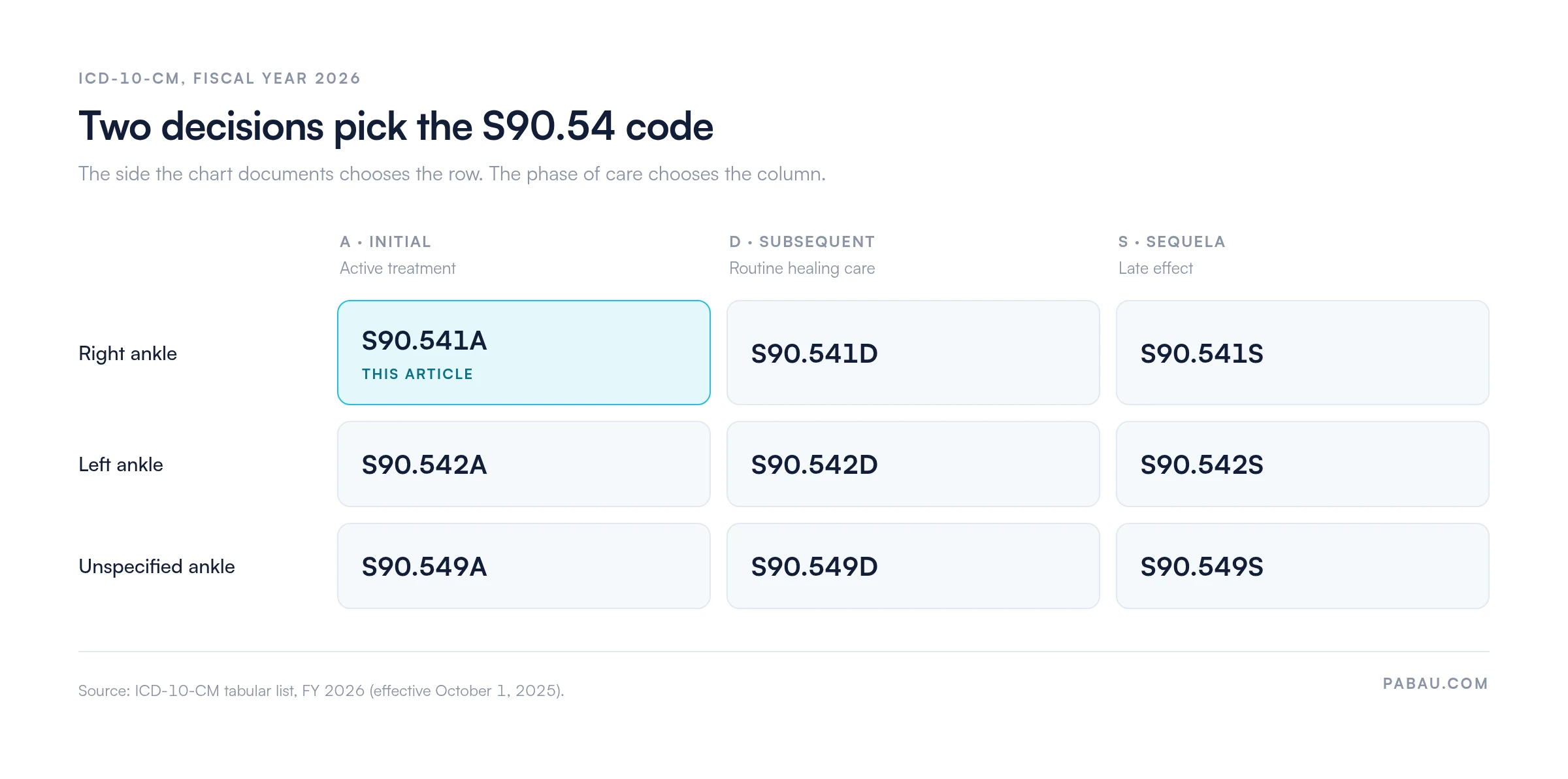
Loading all nine into a favorites group in your system saves a few seconds per claim. It also stops coders reaching for unspecified simply because the correct laterality code is harder to find at speed.
When a case spans more than one injury chapter, the ICD-10-CM code index is quicker than working from memory.
Four elements have to be legible in the record before S90.541A is defensible. Miss one and the claim is exposed on review.
Run a monthly audit on every S90.54x code your practice submits. Filter for the S90.549A claims and trace each one back to the note behind it. Often the documentation names the side and the coder defaulted to unspecified anyway. Correcting those at source lifts your specificity rate and heads off payer queries before they turn into denials.
A claim for S90.541A travels a short path. The clinician documents, the coder selects, the software builds the CMS-1500, and the clearinghouse forwards it to the payer.
Errors introduced at the coding step are cheap to catch here and expensive to fix later.
Your claims management software should accept the whole seven-character string and allow more than one diagnosis per claim line. A system that quietly truncates to six characters will submit an incomplete code and tell you nothing.
Plenty of practices run this workflow across two systems. The note lives in the clinical record, and the claim gets rebuilt by hand in a separate billing tool. Every re-keying step is another chance to drop the 7th character or pick the wrong side.
Practice management software like Pabau keeps both in one place. The CMS-1500 pre-fills from the record, so the diagnosis codes already attached to the visit land on the claim without re-entry. Built-in ICD-10-CM and CPT lookup libraries let coders search the full S90.541A string instead of the stem.
For US practices, our Claim.MD integration reaches thousands of US payers and supports the CMS-1500 and 837P formats. Real-time eligibility checks, ERA posting, and claim-status tracking run in the same workflow. Your billing team can see where an S90.541A claim stopped, instead of guessing.

Pabau pre-fills the CMS-1500 straight from the clinical record and submits it electronically, so the codes on the note are the codes the payer receives. Your billing team tracks every claim from submission through to remittance in one place.

S90.541A has two decision points, and both of them live in the clinical note. The suffix tracks the phase of care. The laterality digit tracks the side. The rest of the claim follows from those two.
Practices that stop seeing these denials are the ones that fixed the problem upstream. They query the provider before the coder has to guess. They also audit their own S90.549A volume, rather than waiting for a payer to raise it.
Pabau’s claims management tools give billing teams one place to enter the code, send the claim, and watch what the payer does with it. Book a demo to see how ICD-10 workflows run from the note through to remittance.

Need to understand how ICD-10 codes flow through to payment? What is revenue cycle management explains how diagnosis coding connects to reimbursement at every stage of the billing cycle.
Looking for guidance on clean claim submission? Clean claim requirements covers the documentation and coding standards payers check before processing an injury code claim.
Want to reduce ICD-10 coding errors across your team? Medical billing compliance requirements outlines audit-ready documentation practices for injury codes and beyond.
ICD-10-CM sets no time limit. The A suffix applies for as long as the patient receives active treatment for the constriction injury. That may run to a single visit or to several weeks. Surgical care, an emergency department evaluation, and active wound treatment all count as active treatment. Once care becomes routine monitoring of a healing injury, move to S90.541D.
The ICD-10-CM Official Guidelines set no national requirement for external cause reporting. Individual payers, state agencies, and trauma registries often do require it, so check your own contracts first. Where you report one, the chapter 20 code names the object and the circumstances. Examples include a cast applied in clinic, or a tourniquet placed during transport.
Yes, when the record documents both injuries. Sequence the condition chiefly responsible for the encounter first and report the other as a secondary diagnosis. A patient treated mainly for a tight post-operative cast leads with S90.541A. A patient treated mainly for the underlying fracture leads with the fracture code instead.
Sequela coding takes two codes. Report the residual condition first, such as a scar or a nerve deficit, then add S90.541S in second position. The S code never travels alone, and it never carries a D as well. ICD-10-CM also places no time limit on when a sequela may be reported.