

ICD-10 Code S42.444P: Medial epicondyle fracture, right humerus
ICD-10 Code S42.444P: full descriptor and code validity ICD-10 Code S42.444P car...

Last Updated: Oct 13, 2026
Billable Code Specific Code
S85.312A is the billable ICD-10-CM code for laceration of greater saphenous vein at lower leg level, left leg, initial encounter.
The 2026 edition of ICD-10 Code S85.312A became effective October 1, 2025. According to the CDC/NCHS ICD-10-CM tool, this code is valid for submission across all applicable claim types.
Let Pabau's smart automation suggest the right codes, reduce claim denials, and keep your practice compliant—effortlessly.
Automate repetitive tasks and focus on what matters most—your patients.
Reduce coding errors and ensure compliance with the latest regulations.
Clean claims, fewer denials, and faster reimbursements.
Powerful insights and reporting to help your practice thrive.
HIPAA compliant SOC 2 certified GDPR-compliant Trusted by 4,000+ clinics worldwide

S85.312A is a billable ICD-10-CM code describing laceration of the greater saphenous vein at lower leg level, left leg, initial encounter.
The parent code S85.312 is non-billable. Coders must use a child code: S85.312A (initial), S85.312D (subsequent), or S85.312S (sequela).
Laterality is mandatory. S85.311A covers the right leg; S85.319A covers unspecified side. Using the wrong code risks claim denial.
Pabau’s claims management software supports clean claim submission for vascular injury codes, with Claim.MD clearinghouse integration for US payers.
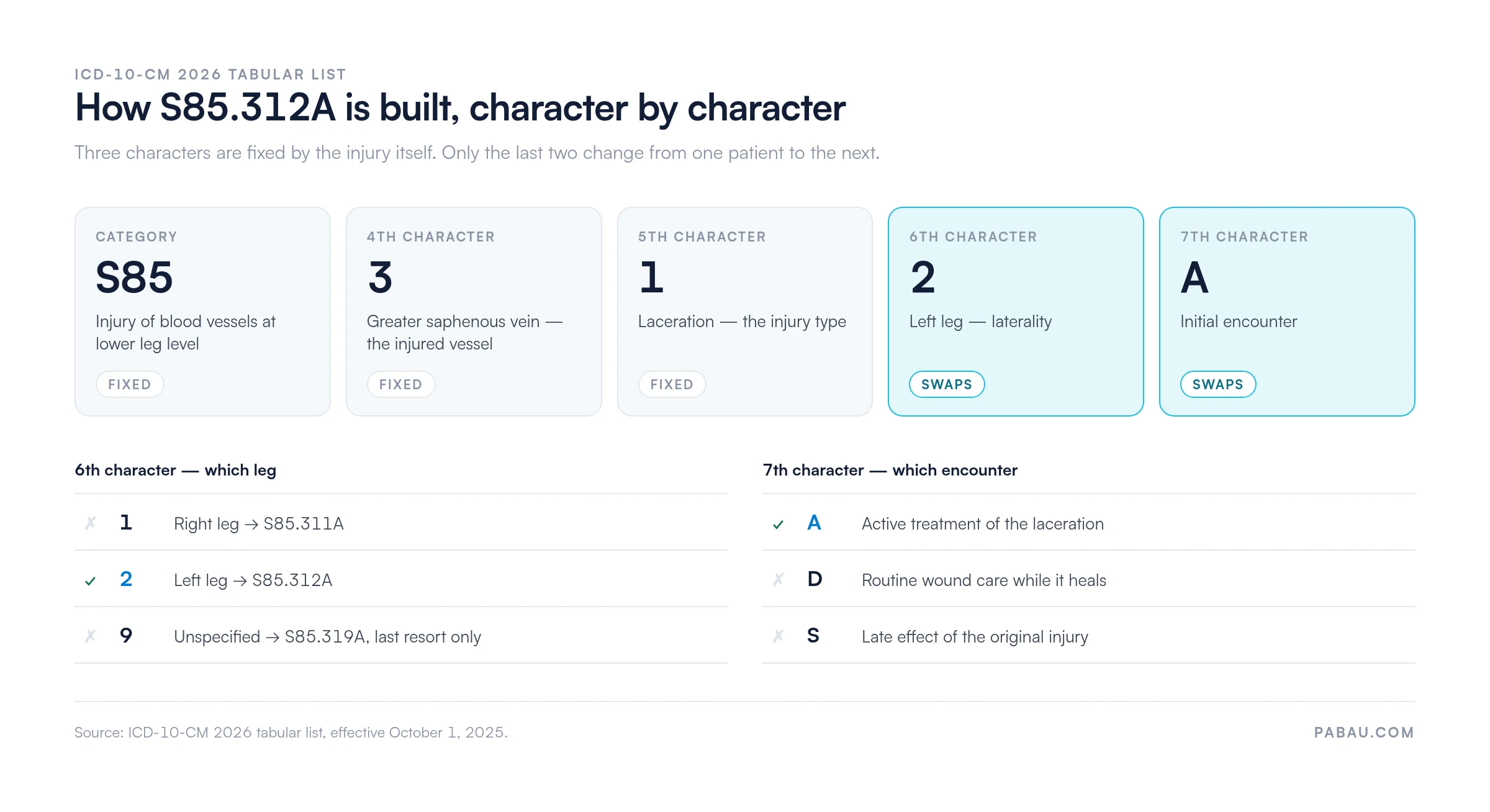
S85.312A carries the vessel, the level, the side, and the encounter type in one code string. The table below summarizes the core code profile.
Each position in the code string carries a specific meaning. The vessel and the injury type sit in separate characters, which is where most miscoding starts.
The greater saphenous vein (GSV) is the longest vein in the body. It runs from the dorsum of the foot, along the medial aspect of the leg, to the femoral vein in the groin. At lower leg level, it lies superficially along the medial tibia, making it vulnerable to lacerations from trauma, falls, or sharp-object injuries.
Common scenarios behind an S85.312A claim include:
Documentation should specify the left leg explicitly. It should also name the nature of the wound, laceration rather than another injury type. The level must read lower leg, not thigh and not ankle.
S85.312A is a billable/specific ICD-10-CM code, valid for claim submission across Medicare, Medicaid, and most commercial payers. The CMS ICD-10 codes page confirms its inclusion in the 2026 ICD-10-CM tabular list, with an effective date of October 1, 2025.
“Valid for submission” means the code is specific enough for payers to process without a more detailed child code. S85.312A is already the most specific code in its subcategory chain.
Practices running billing through practice management software like Pabau send it out on a CMS-1500 or 837P claim. The Claim.MD clearinghouse behind that submission reaches thousands of US payers and runs a real-time eligibility check first.
The most common submission error is using the parent code S85.312 directly. It carries no 7th character, so it rejects at the clearinghouse before a payer ever sees it.
S85.312 requires a 7th character to be billable. Three valid child codes exist under this parent.
The “A” encounter applies every time active treatment is being provided for the injury itself. Once active treatment ends and the patient returns for routine monitoring or management of residual effects, switch to “D.” When the visit is specifically treating a late complication caused by the original laceration, “S” applies.
Document the encounter type in the clinical notes before selecting the 7th character. If a patient returns for a dressing change after the initial repair, that is a subsequent encounter (D), not initial (A). Mismatch between the documented encounter and the coded 7th character is a top audit trigger for vascular injury claims.
Correct laterality documentation prevents one of the most avoidable coding errors in the S85.31x subcategory. The three sibling codes for laceration of the greater saphenous vein at lower leg level are:
S85.319A (unspecified side) should be a last resort. Most payers prefer or require laterality-specific codes. If the clinical note documents the left leg, S85.312A is the correct choice. Once the vessel and the level are settled, only two characters in the string still change.
S85.312 is a non-billable header code. It serves as the parent in the ICD-10-CM hierarchy but cannot be submitted on a claim without a 7th character suffix.
The full code path for S85.312A is:
The neighboring subcategories matter on trauma cases, because a single wound can involve more than one vessel. S85.0- and S85.5- cover the popliteal artery and vein, and S85.4- covers the lesser saphenous vein. Each carries its own laterality and encounter characters. The rest of the family is indexed in our diagnostic codes library.
The S85 category’s excludes notes define its boundaries. They matter for dual-coding scenarios and for avoiding claim edits.
Excludes2 note for S85: the category carries an Excludes2 note for injury of blood vessels at ankle and foot level, coded to S95.-. A saphenous vein injury at ankle level therefore maps to a different code range. Because the note is Excludes2 rather than Excludes1, both codes may be reported together when the patient has both injuries.
Additionally, popliteal artery and vein injuries (S85.0-, S85.5-) are in the same S85 category but represent different vessels and require their own codes. Do not use S85.312A when the injury involves the popliteal vessels or when the injury level is at the thigh rather than the lower leg.
Read the excludes notes at both the code level and the category level before you finalize the claim. Per AAPC’s ICD-10-CM lookup resources, a note attached to the S85 category governs every code beneath it, including S85.312A.
The ICD-10-CM index includes several clinical synonyms that map to S85.312A. Recognition of these terms helps documentation staff and coders align clinical language with the correct code.
Coders should watch for operative reports or ED notes using shorthand such as “GSV cut” or “saphenous laceration left LE.” These map to S85.312A when the note documents lower leg level and an initial encounter. Shorthand that omits the side or the level still needs a query before the claim goes out.
For inpatient facility billing, two additional coding dimensions apply: MS-DRG assignment and the Present on Admission (POA) indicator.
Inpatient claims with a discharge date on or after October 1, 2025 are grouped by the FY2026 MS-DRG grouper, version 43.0. A medical stay for a traumatic injury like this one typically groups to DRG 913 or DRG 914, traumatic injury with or without MCC.
If the stay includes an operating room procedure such as vascular repair, the case moves to a surgical DRG instead. Either way the final assignment turns on the procedures performed and the secondary diagnoses reported. Coders validating grouper output can reference the ResDAC guidance on ICD codes in Medicare files.
S85.312A is not POA-exempt. For inpatient admissions, the POA indicator must be reported. The options are:
POA reporting matters for Hospital-Acquired Condition (HAC) review. An intraoperative saphenous vein laceration coded as “N” may trigger HAC scrutiny and affect reimbursement. Make sure the operative report states when the injury occurred relative to admission. The POA indicator itself is a coder-assigned field, so the note has to settle the timeline before the claim is built.
For intraoperative GSV lacerations coded as S85.312A with POA = N, document the timeline explicitly in the operative note. Record when the complication was identified, how it was managed, and whether it extended the procedure or admission. Vague notes that leave POA status ambiguous are the primary reason these claims enter manual review queues.
For historical record comparison and payer crosswalk documentation, S85.312A maps back to ICD-9-CM via the CMS General Equivalence Mapping (GEM) files. The approximate ICD-9-CM equivalent is:
ICD-9-CM code 904.3 covered the saphenous veins as a group. It drew no line between greater and lesser, between sides, between encounter types, or between anatomical levels. That is why the mapping runs one-to-many in the other direction and is flagged approximate.
Payers may decline a GEM mapping on some claim types, particularly on prior-period billing comparisons. Verify with the payer before you rely on one. The mapping files and their user guides are published in the CMS GEM archive.
Selecting the right 7th character is the most actionable coding decision for this code. The clinical scenario, not the calendar date, determines encounter type.
The clinical note should state whether the encounter is initial treatment, follow-up care, or management of a late effect. That single line is what supports clean claim submission when the coding is reviewed. It maps straight onto the ICD-10-CM 7th character guidance.
A clean claim for S85.312A requires the clinical note to support four specifics: the injured vessel, the anatomical level, laterality, and the encounter type. Missing any one of these invites a documentation query or a denial.
Coding the laceration correctly is the first half of the job. The claim still has to leave the practice, reach the payer, and come back reconciled against the encounter it belongs to.
Practices splitting that across a chart system and a separate billing tool retype the same diagnosis twice. That second entry is where a right-leg code lands on a left-leg note.
Practice management software like Pabau keeps the note, the diagnosis, and the claim on one patient record. Its claims management software connects to the Claim.MD clearinghouse. The CMS-1500 or 837P claim carrying S85.312A then goes out from the same chart the surgeon documented in. Nothing is re-entered, so nothing drifts between the note and the claim.
Before the claim goes out, that integration runs a real-time eligibility check against the payer. Afterward it returns Electronic Remittance Advices, so payments reconcile against the original encounter instead of a spreadsheet. Claim.MD reaches thousands of US payers, which means a commercial plan and a Medicaid plan follow the same path out of the same screen.
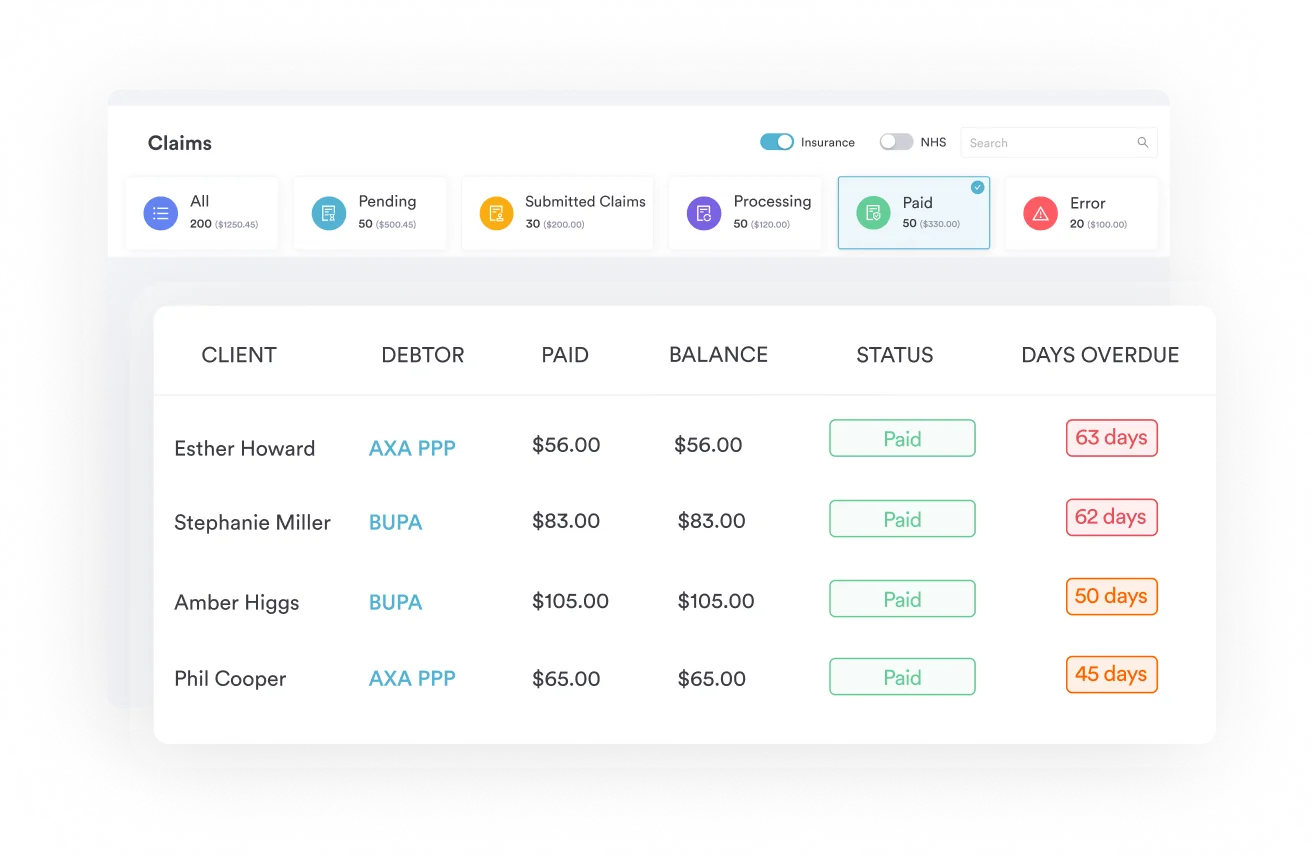
The result is one place to see which vascular injury claims are paid and which are still pending. It also shows which came back needing a corrected 7th character.

Pabau’s claims management software connects directly to Claim.MD for real-time eligibility checks, clean 837P submission, and ERA remittance for codes including S85.312A. See how it fits your billing workflow.

S85.312A is ready to submit the moment the note names the greater saphenous vein, the lower leg, the left side, and an initial encounter.
Three habits account for most rejections on this code. The first is submitting the non-billable parent S85.312. The second is holding the “A” character past the end of active treatment. The third is defaulting to S85.319A when the record does state a side.
The fix sits upstream of the coder. When the operative note and each follow-up note say which stage of care they represent, the 7th character stops being a judgment call. The claim stops bouncing with it. That is a documentation habit, not a coding one, so it is worth agreeing on before the next trauma case arrives.
Book a demo to see how Pabau keeps the note, the diagnosis, and the remittance on one record.

Need a clean-claim checklist for vascular injury codes? Clean claim guide covers the documentation elements payers check before processing traumatic injury diagnoses.
Wondering how your clearinghouse processes ICD-10 claims? Medical claims clearinghouse overview explains 837P file structure, eligibility, and ERA workflows relevant to surgical and vascular claims.
Managing denial patterns on injury codes? Denial codes in medical billing breaks down the most common CARC codes and how to respond to each.
ICD-10 Code S85.312A is a billable diagnosis code describing laceration of the greater saphenous vein at lower leg level, left leg, initial encounter. Each character specifies the injury type (laceration), vessel (greater saphenous vein), laterality (left), and encounter type (initial). It is valid for claim submission in the 2026 ICD-10-CM edition, effective October 1, 2025.
Yes. S85.312A is a billable/specific ICD-10-CM code valid for reimbursement and claim submission. The parent code S85.312 is non-billable; coders must always use one of the three child codes (S85.312A, S85.312D, or S85.312S) to submit a claim.
The approximate ICD-9-CM equivalent is 904.3 (injury to saphenous veins), via CMS General Equivalence Mapping (GEM) files. This is an approximate crosswalk only: ICD-9-CM 904.3 did not distinguish between greater and lesser saphenous veins, laterality, or encounter type. Payers may not accept GEM crosswalks for all claim types.
The clinical note must name the vessel as the greater saphenous vein and the level as lower leg or below-knee. It must also document left-leg laterality and that this is an initial encounter for active treatment. Injury mechanism documentation further supports medical necessity. Missing any of these elements risks a documentation query or claim denial.




