ICD-10 Code S42.444P: Medial epicondyle fracture, right humerus
ICD-10 Code S42.444P: full descriptor and code validity ICD-10 Code S42.444P car...

Last Updated: Oct 13, 2026
Billable Code Specific Code
S83.116A is the billable ICD-10-CM code for anterior dislocation of proximal end of tibia, unspecified knee, initial encounter.
The 6 in S83.116A marks unspecified laterality, not the left knee. A widely repeated shortcut reads it as left, and that misreading is the most expensive error a coder makes with this code. The left-knee anterior dislocation code is S83.115A.
The 6th and 7th character rules below reflect the FY2026 ICD-10-CM edition, effective October 1, 2025, per CMS ICD-10 coding guidance.
Let Pabau's smart automation suggest the right codes, reduce claim denials, and keep your practice compliant—effortlessly.
Automate repetitive tasks and focus on what matters most—your patients.
Reduce coding errors and ensure compliance with the latest regulations.
Clean claims, fewer denials, and faster reimbursements.
Powerful insights and reporting to help your practice thrive.
HIPAA compliant SOC 2 certified GDPR-compliant Trusted by 4,000+ clinics worldwide

ICD-10 Code S83.116A means anterior dislocation of the proximal end of the tibia, unspecified knee, initial encounter. Use it when the record never states a side.
The 6th character carries severity and side together. In the S83.11 dislocation group 4 is right, 5 is left and 6 is unspecified, so the left-knee code is S83.115A.
The 7th character ‘A’ indicates active treatment. Use ‘D’ (S83.116D) for routine follow-up and ‘S’ (S83.116S) for sequela or late effects.
Query the provider for laterality before you submit. Payers scrutinize unspecified-laterality injury codes, and S83.114A or S83.115A supports a cleaner claim.
Practice management software like Pabau integrates with Claim.MD, so orthopedic injury claims carrying ICD-10-CM codes go out electronically.
S83.116A is a billable, specific code, so it can go on a claim without a more granular child code beneath it. Payers recognize it for HIPAA-covered transactions. The FY2026 edition took effect October 1, 2025, and the code has been in the ICD-10-CM tabular list since implementation.
Billable is not the same as preferred. ICD-10-CM guidelines ask for the highest level of specificity the record supports, so an unspecified-laterality code is a fallback rather than a default. Verify the current code status annually using the CDC/NCHS official ICD-10-CM web tool, which reflects each fiscal year’s released tabular list.
This code describes a specific traumatic injury. The proximal tibia, the upper end of the shinbone that forms the lower half of the knee joint, displaces anteriorly relative to the femur. Clinicians most often see this in high-energy trauma such as sports collisions, motor vehicle accidents, and falls from height.
What S83.116A does not describe is a side. The injury itself always happened to one knee, but the documentation in front of the coder never says which. Unspecified is a statement about the record, not about the patient.
Common clinical synonyms that map to S83.116A include:
Before assigning S83.116A, confirm two things in the operative or emergency department note. The direction must read anterior, and no part of the chart may name a right or left knee.
The base code S83.116 requires a 7th character to be billable. Selecting the wrong encounter type is one of the most common sources of denial on orthopedic injury claims. The three options are defined by the ICD-10-CM Official Guidelines for Coding and Reporting, Chapter 19.
All three of these codes carry unspecified laterality. If the side becomes documented at any point in the course of treatment, move to the S83.114 or S83.115 series for that encounter.
Use S83.116A whenever the patient is in the active treatment phase. This includes the first emergency department visit, closed reduction under anesthesia, and surgical stabilization. It also covers any follow-up where the provider still directs the primary course of treatment.
The 7th character ‘A’ does not mean this is literally the patient’s first visit. It means the injury is still being actively treated. A surgeon performing arthroscopic reconstruction two weeks after the dislocation still codes that encounter as ‘A’.
S83.116D applies once the patient is in the healing or recovery phase and active treatment has concluded. Physical therapy visits, scheduled follow-ups to monitor healing, and cast or brace checks fall here. Once the provider’s role shifts from active management to monitoring progress, switch from ‘A’ to ‘D’.
S83.116S captures late effects that emerge after the initial injury has resolved. Chronic knee instability, post-traumatic arthritis, or peroneal nerve palsy developing months after the dislocation would be coded here. When using ‘S’, code the sequela condition itself first, for example M17.30 for unilateral post-traumatic osteoarthritis of an unspecified knee. S83.116S then follows as the causal injury.
Knowing where S83.116A sits in the ICD-10-CM structure makes parent codes, sibling codes and category-level logic easier to navigate. The full path from chapter to specific code is below. That same chapter-to-code path applies to every entry in the ICD-10-CM code index.
Coders frequently need to move between S83.116A and related codes in the S83.1x group. The table below carries the full severity and laterality structure inside the anterior tibial dislocation sub-subcategory.
The 6th character in the S83.11 group carries two facts at once. It says whether the displacement is partial or complete, and it says which knee. Reading it as laterality alone is where coders go wrong.
So a 6 marks unspecified laterality, never the left knee. The left-knee anterior dislocation code is S83.115A. There is no S83.119, and the same pattern repeats in the posterior (S83.12), medial (S83.13), and lateral (S83.14) groups. The grid below reads the whole S83.1x group at once.
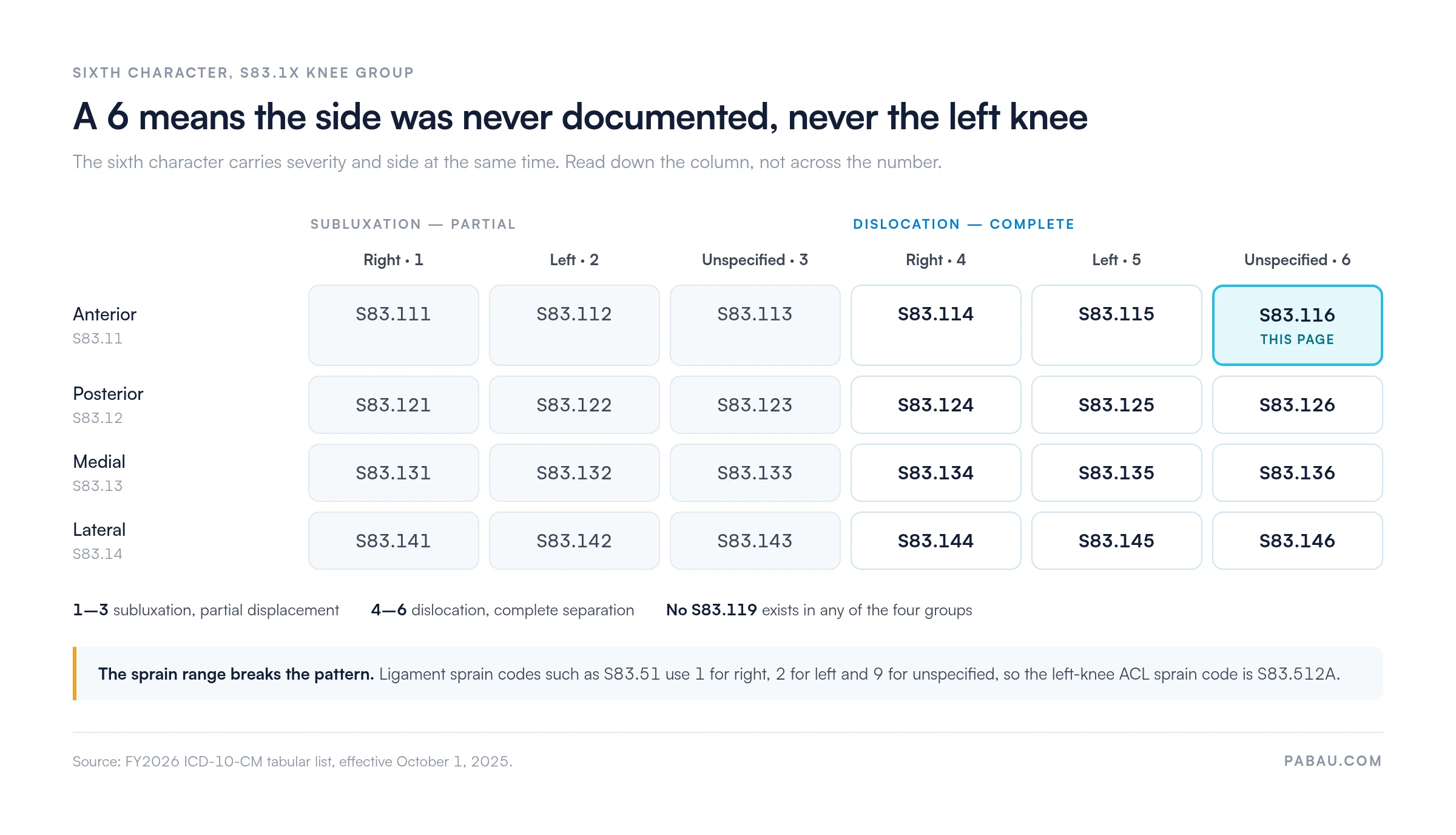
The second common error is severity. Coders sometimes select S83.113A, anterior subluxation of an unspecified knee, when the documentation states a full dislocation. Subluxation implies partial displacement and dislocation implies complete separation of the joint surfaces. Confirm which term the treating provider used before assigning either code.
S83.116A has an unusual documentation profile. Three elements must be present in the medical record, and one specific element must be absent. Verify all four before you assign the code.
Treat that last element as a prompt to query, not as a resting place. ICD-10-CM guidelines ask for the most specific code the record supports.
Payers also read a run of unspecified-laterality injury claims as a documentation problem. A single query to the provider usually converts S83.116A into S83.114A or S83.115A.
Digital intake and clinical forms can prompt for laterality and injury direction at the point of care. For orthopedic and sports medicine volumes, that prompt cuts down on downstream documentation queries. Standardized intake records the side while the patient is still in the room.
Knee trauma often presents with overlapping injury patterns. The table below lists alternative ICD-10-CM codes to consider when the documentation does not support S83.116A, or when additional injuries are present. Confirm each one against the current tabular list before submission.
Note the laterality convention shift between the dislocation and sprain groups. Ligament sprain codes such as S83.51 use 1 for right, 2 for left, and 9 for unspecified. So the left-knee ACL sprain code is S83.512A.
Once that sprain moves into routine follow-up the 7th character changes, and the code becomes S83.512D. Carrying the dislocation pattern into the sprain range produces codes that do not exist.
The checklist above also rules out the patella, so a dislocated kneecap moves the claim into the S83.0 range. A left patella displaced laterally codes to S83.015A at the initial visit, and to S83.015D once follow-up care begins.
Knee dislocations typically require imaging, reduction, and often surgical intervention. The CPT codes below are most frequently billed alongside S83.116A in orthopedic and emergency settings.
These pairings are illustrative. Confirm medical necessity and payer coverage for each procedure against the AMA CPT code set guidelines, or with a certified coder.
Most of these CPT codes take a laterality modifier, LT or RT, even when the diagnosis code carries unspecified laterality. A modifier that names a side alongside S83.116A is an internal contradiction, and it is a common trigger for a claim edit. Resolve the diagnosis code first.
Electronic submission sends the ICD-10-CM diagnosis code and the paired CPT procedure codes together in one claim. Reconciling the remittance afterward is what surfaces a denial pattern. Review which code pairing triggered the denial rather than assuming the diagnosis code caused it.
Before submitting S83.116A, run a quick three-point check: (1) Does the note say ‘anterior’? (2) Is the provider still actively treating the injury? (3) Does any part of the chart name a side? If a side appears anywhere – triage note, imaging order, operative report – switch to S83.114A or S83.115A. S83.116A is only correct when the side is genuinely undocumented.
Orthopedic injury claims involving knee dislocation carry above-average scrutiny from payers, particularly Medicare and Medicaid. Several billing considerations apply specifically to S83.116A claims.
Code the external cause at every encounter, not just the first. Many practices add the external cause code at initial presentation and then omit it on follow-up claims. ICD-10-CM guidelines require external cause coding at each encounter for the duration of treatment for injury cases.
In most orthopedic practices the side of the injury goes missing somewhere between the triage note and the claim. A coder spots the blank field, raises a query, and the claim waits days for a one-word answer. High-volume practices absorb that delay again and again.
Practice management software like Pabau holds the intake form, the clinical note and the claim in one record. Laterality can be a required field on the injury form, so the side gets captured while the patient is still in the room. Coders then read it without chasing anyone.
Pabau’s claims management software then sends the diagnosis and procedure codes electronically through Claim.MD, which reaches over 4,000 US payers. Remittances land back in the same record, so you can see which code pairing a payer rejected instead of guessing.

Pabau integrates with Claim.MD to submit ICD-10-CM diagnosis codes and CPT procedure codes directly to 4,000+ US payers. Reduce denials with built-in code validation and real-time eligibility checks before the patient leaves the room.

S83.116A is a correct code and a weak one at the same time. It will pass a claim edit, and it will also tell the payer that your documentation never recorded which knee. Across a run of claims that reads as a documentation problem, not a coding choice.
So treat every S83.116A you assign as a query waiting to be answered. One question to the provider usually turns it into S83.114A or S83.115A, and the claim goes out stronger. The 6 never stands in for the left knee, which is S83.115A.
The cheapest fix sits upstream of the coder. Make the injured side a required field on the injury form and most of these queries never start. Book a demo to see how Pabau connects the injury note to the claim for orthopedic and sports medicine practices.

Need guidance on how medical billing workflows connect to ICD-10 codes? What Is Medical Billing explains how diagnosis codes feed into the broader revenue cycle, from charge entry to payer adjudication.
Looking to understand how the Claim.MD clearinghouse integration works? Claim.MD clearinghouse guide covers how Pabau connects to 4,000+ US payers for real-time eligibility and electronic claims submission.
Want to reduce orthopedic claim denials before they happen? Denial codes in medical billing breaks down the most common CARC denial reasons and how to address each one at the documentation stage.
ICD-10 Code S83.116A is a billable ICD-10-CM diagnosis code describing anterior dislocation of the proximal end of the tibia, unspecified knee, initial encounter. Unspecified means the medical record does not document which knee was injured. The code belongs to ICD-10-CM Chapter 19, the injury codes S00-T88. It falls under category S83, dislocation and sprain of joints and ligaments of the knee. It is valid for HIPAA-covered transaction submission in FY2026.
No. S83.116A carries unspecified laterality, and the left-knee code is S83.115A. In the S83.11 group the 6th character encodes both severity and side. Characters 1, 2 and 3 mark subluxation of the right, left and unspecified knee. Characters 4, 5 and 6 mark dislocation of the right, left and unspecified knee. Reading the 6 as left laterality is a common and costly error.
Yes, S83.116A is a billable, specific ICD-10-CM code valid for direct claim submission without a more granular child code. It is accepted by all HIPAA-covered payers, including Medicare and Medicaid. Billable is not the same as preferred, though. Because the code carries unspecified laterality, some payers request records or downcode the claim, so query the provider for the side wherever possible.
The difference lies in the encounter type indicated by the 7th character. S83.116A (character ‘A’) is used during active treatment – the ED visit, reduction procedure, or any encounter where the injury is being managed. S83.116D (character ‘D’) applies once the patient is in the routine recovery or healing phase. S83.116S (character ‘S’) captures sequela, meaning late effects such as chronic instability or post-traumatic arthritis that develop after the original injury has healed. All three carry unspecified laterality.
The most frequently paired CPT codes are 27550 and 27552, closed reduction without and with anesthesia. Imaging codes 73560 (knee X-ray) and 73721 (knee MRI without contrast) also appear often. For surgical cases, 27556 (open treatment of knee dislocation) and 27427 (ligamentous reconstruction) are also commonly billed. Note that an LT or RT laterality modifier on the procedure contradicts an unspecified-laterality diagnosis code. Confirm medical necessity with a certified coder before submission, as payer policies vary.
Yes, S83.116A is valid for both FY2025 and FY2026 submissions. The FY2026 edition became effective October 1, 2025, and the code was also present in the FY2025 tabular list. Always verify against the CMS annual ICD-10-CM release to confirm code status for the fiscal year covering the date of service.
Knee dislocation ICD-10 codes fall within category S83, which covers dislocation and sprain of joints and ligaments of the knee. The S83.1x subcategory covers subluxation and dislocation of the proximal tibia by direction: anterior (S83.11), posterior (S83.12), medial (S83.13), and lateral (S83.14). Within each of those groups, the 6th character sets severity and side. S83.116A is the code for anterior dislocation of an unspecified knee during an initial encounter, while S83.114A and S83.115A cover the right and left knee.