

ICD-10 Code S42.444P: Medial epicondyle fracture, right humerus
ICD-10 Code S42.444P: full descriptor and code validity ICD-10 Code S42.444P car...

Last Updated: Oct 13, 2026
Billable Code Specific Code
S82.302K is the billable ICD-10-CM code for unspecified fracture of lower end of left tibia, subsequent encounter for closed fracture with nonunion.
The code is valid for HIPAA-covered transactions under the FY2026 ICD-10-CM edition, effective October 1, 2025. It applies at follow-up visits, once active fracture treatment has ended. Assignment turns on documented nonunion, confirmed by imaging or by the physician's clinical assessment.
Let Pabau's smart automation suggest the right codes, reduce claim denials, and keep your practice compliant—effortlessly.
Automate repetitive tasks and focus on what matters most—your patients.
Reduce coding errors and ensure compliance with the latest regulations.
Clean claims, fewer denials, and faster reimbursements.
Powerful insights and reporting to help your practice thrive.
HIPAA compliant SOC 2 certified GDPR-compliant Trusted by 4,000+ clinics worldwide

S82.302K covers a left distal tibia fracture that has not healed by the follow-up visit.
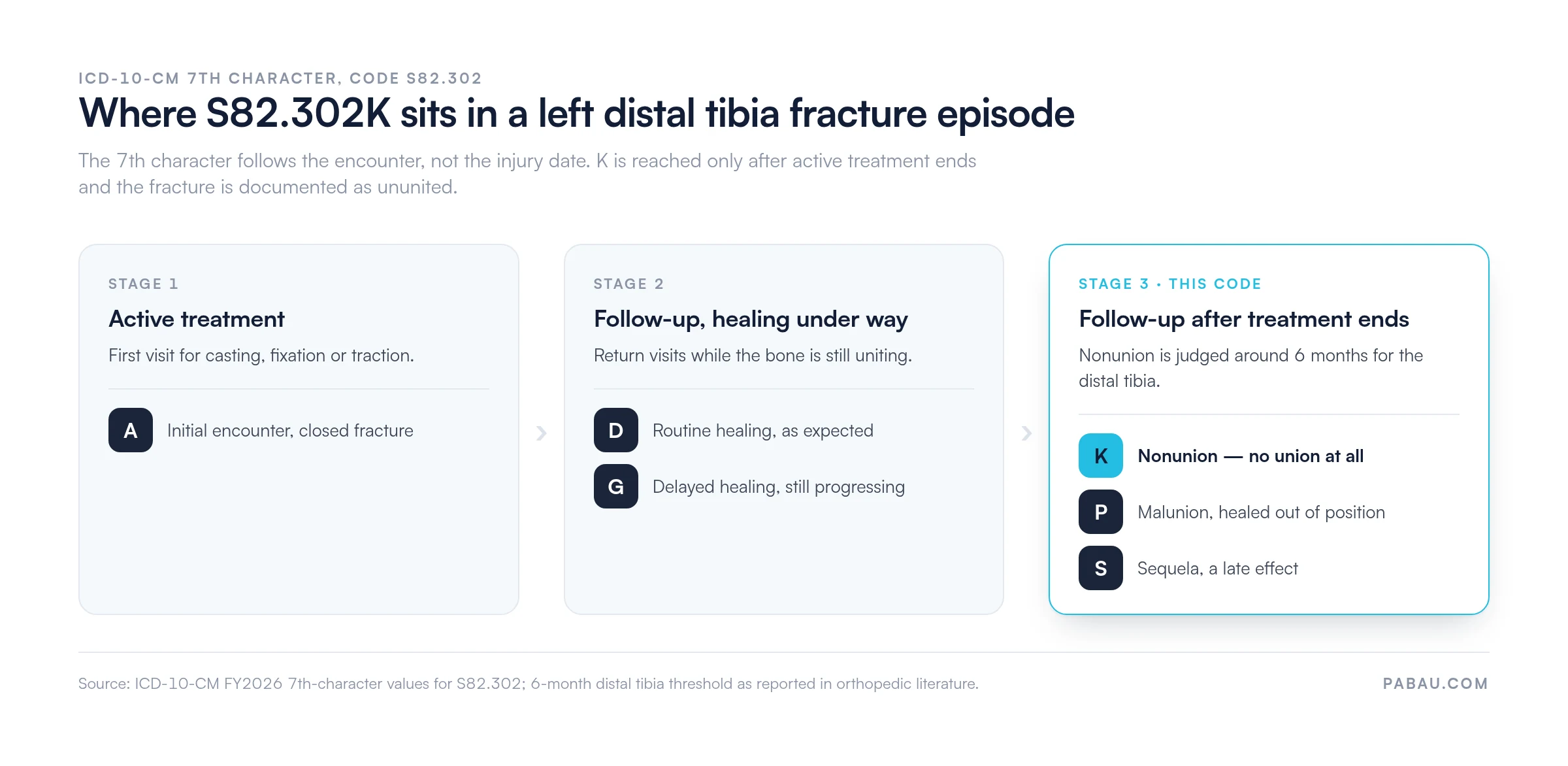
The K character separates nonunion from routine healing (D), delayed healing (G) and malunion (P).
K is correct only once active treatment has ended and the patient returns with confirmed nonunion.
Excludes1 notes block coding S82.302K with a bimalleolar fracture (S82.84-) or a medial malleolus fracture (S82.5-).
Pabau validates ICD-10-CM codes before submission, which cuts 7th-character errors on fracture claims.
The table below summarizes the key billing facts for S82.302K. These are the details coders and billing staff confirm before submitting a claim for an orthopedic or sports medicine follow-up visit.
Every character in S82.302K carries a specific clinical meaning. Misreading even one position leads to the wrong code and a likely denial. The breakdown below follows the CMS ICD-10-CM coding structure.
The word “unspecified” in the descriptor refers to the fracture pattern. It records that the treating physician named no subtype, such as Salter-Harris or Pilon. That is clinically appropriate when imaging shows a distal tibia fracture with no further pattern detail.
The 7th character K means the patient is returning after active fracture treatment, and the fracture site has not healed. Choosing the wrong 7th character is a frequent audit target in fracture coding. The full option set for S82.302 is worth reading before applying K.
K applies when the patient is seen for a follow-up visit and documentation confirms the fracture has not healed. That confirmation typically comes from imaging (X-ray or CT) showing no bridging callus, or from clinical findings consistent with nonunion. ICD-10-CM Official Guidelines Section I.C.19 frames the visit as care for a complication of the fracture, once the active treatment phase has ended.
That places K at the close of the episode rather than the start. The flow below shows where it falls between the initial encounter and the codes for malunion and sequela.
Document nonunion explicitly in the clinical note before applying the K character. A claim submitted with S82.302K that has no imaging report or clinical documentation of failed healing is a red flag for payers. The note should state something like: ‘No evidence of fracture union on today’s X-ray, consistent with nonunion.’ That sentence alone will support the 7th character K if the claim is reviewed.
Nonunion means a fracture has failed to heal within the timeframe expected for that injury and bone location. For the distal tibia, most orthopedic literature places that threshold at approximately 6 months, though payer policies and clinical judgment vary. The ICD-10-CM guidelines do not specify a fixed number of weeks; the diagnosis must be based on the treating physician’s clinical or radiographic assessment.
The lower end of the tibia (distal tibia) is the portion of the shinbone just above the ankle joint. Its metaphysis carries a less robust blood supply than the shaft. Nonunion is therefore more common here than in mid-shaft tibial fractures.
Nonunion and delayed healing carry different 7th characters, so the clinical distinction matters for coding. They also point to different treatment decisions, including surgery for a nonunion. Both G and K report a problem. What separates them is whether any healing is occurring at all.
Laterality and healing status are the two axes that separate sibling codes from S82.302K. The table below shows the most commonly confused codes in the S82.30 family. For a broader reference, the AAPC ICD-10-CM code range lookup lists the full S82 subcategory.
A common workflow error is using S82.302A (initial encounter) for a visit that is clearly a follow-up. The patient may already carry a prior claim with S82.302A for the same fracture episode. Submitting another A-character code at the follow-up raises an edit flag with most payers.
Applying ICD-10 Code S82.302K correctly requires the encounter to meet three conditions simultaneously. Missing any one of them means a different 7th character applies.
The CDC/NCHS ICD-10-CM web tool references ICD-10-CM Official Guidelines Section I.C.19 for fracture coding. That section ties the 7th character to the encounter type rather than the injury date. A patient returning six months after a tibial fracture still gets a subsequent-encounter character. The number of weeks since the injury does not change that.
Tracking the 7th character accurately from the first claim through every follow-up keeps a fracture episode internally consistent. Switching from D to K mid-episode requires documentation that supports the change in healing status. Where that documentation is thin, the claim ends up in denial management.
Run a monthly audit on claims submitted with 7th characters D, G, K, and P for the same patient and fracture site. A history that shows D repeatedly, then a single K, is consistent with a documented nonunion progression. If K appears at the first follow-up with no prior D or G claim, check the note. Either it supports nonunion at that point, or the wrong character was selected.
Two Excludes1 notes govern how S82.302K interacts with other ankle and lower-leg fracture codes. Both sit at the S82.3 subcategory level, and getting either one wrong is a straightforward way to generate an unbundling edit.
An Excludes1 note means the two conditions cannot occur together and cannot be coded simultaneously. If a patient has a bimalleolar fracture of the lower leg (S82.84-), you cannot also code S82.302K for the same injury episode. The bimalleolar code takes precedence because it is more specific to that fracture pattern.
The tabular list applies the same Excludes1 rule here. A fracture of the medial malleolus alone (S82.5-) has its own code, so it is never reported with S82.302K for the same injury. Code the malleolar fracture on its own when that is what the record describes.
Checking both notes before assigning the code is what keeps the claim clean. An Excludes1 pairing that reaches the payer comes back as an unbundling edit, and the encounter has to be recoded from the note.
Clinical documentation rarely uses ICD-10 descriptor language verbatim. Coders need to recognize the terms physicians and therapists use and map them correctly to S82.302K. The following synonyms and variants all map to this code when combined with the subsequent encounter and nonunion context.
The phrase “lower end” in the official descriptor corresponds to what many clinicians document as “distal tibia” or “tibial metaphysis.” Both are acceptable in source documentation for this code. The note still has to specify the left side, the distal location, and the nonunion status. A note reading only “tibial fracture follow-up” does not support S82.302K. That documentation test runs through the rest of the ICD-10-CM codes as well.
Practices dealing with legacy records, payer crosswalk queries, or audit reviews of older claims may need the ICD-9-CM predecessor codes. The General Equivalence Mappings (GEMs) provide approximate conversions, but these are not exact equivalences. As the AAPC notes in its crosswalk reference, a single ICD-9 code may map to several ICD-10 codes. Laterality and encounter type drive the split, and ICD-9 never captured either at that level of specificity.
The most notable structural difference is that ICD-9 required a separate nonunion code (733.82) assigned alongside the fracture code. In ICD-10-CM, nonunion is encoded within the 7th character K, eliminating the need for a secondary code. Coders working on crosswalk reviews should confirm the GEM mapping against current documentation rather than relying on direct code equivalence.
Orthopedic and sports medicine practices bill a high volume of fracture follow-up claims, so 7th-character errors accumulate quickly. A single visit miscoded with D instead of K may pass once. Across hundreds of monthly claims, the pattern becomes an audit signal. A clean nonunion claim depends on the clinical note, the diagnosis code, and the procedure code all telling the same story.
Practice management software like Pabau builds ICD-10 code validation into the billing workflow, before claims reach the clearinghouse. Our claims management software connects to Claim.MD, our US clearinghouse partner, which reaches thousands of US payers. That connection supports real-time eligibility verification alongside CMS-1500 and 837P claim submission. For a practice juggling initial and subsequent fracture encounters, the system flags an inconsistent 7th character before the claim goes out.
A practice-level review of the billing workflow shows where 7th-character errors enter the system. They usually start in the clinical documentation, at the coding step, or during charge entry. Fixing the source is what reduces the downstream denials that nonunion coding errors generate.

Pabau’s claims management tools help orthopedic and sports medicine practices validate ICD-10 codes before submission, so 7th-character errors get caught before they reach the payer.

S82.302K describes one narrow scenario. A patient returns for follow-up of a left distal tibia closed fracture, and the bone has not united. The code holds up only when active treatment has already ended and the note documents the failed healing. Payer audits concentrate on precisely that point in an episode of fracture care.
Three controls carry most of the weight on a high-volume fracture list. Documentation templates prompt the physician for healing status. Code validation catches the character at charge entry, and the clearinghouse flags a mismatch before the payer sees it. Put them in that order and the K claims stop coming back. Book a demo to see how Pabau validates fracture codes in an orthopedic workflow.

Need guidance on denial prevention for fracture claims? Denial management in healthcare covers the most common claim rejection patterns and how to address them systematically.
Want to understand how clearinghouse claim processing works? Medical claims clearinghouse explains how electronic claims move from the practice to the payer and where errors get caught.
Looking for a billing compliance framework? Superbill documentation requirements outlines what a compliant billing record needs to contain before a claim is submitted.
ICD-10 Code S82.302K is the billable ICD-10-CM diagnosis code for an unspecified fracture of the lower end of the left tibia. It covers a subsequent encounter for a closed fracture with nonunion. The code is valid for HIPAA-covered transactions under the FY2026 edition, effective October 1, 2025. Use it at follow-up visits, once a left distal tibia fracture has failed to heal.
The 7th character K denotes a subsequent encounter for a closed fracture with nonunion. The patient is returning after active treatment, and the fracture site has not healed. Other 7th characters for subsequent encounters include D (routine healing), G (delayed healing), and P (malunion). K applies only when clinical or radiographic evidence confirms the fracture is failing to unite.
Use S82.302A (7th character A) at the initial encounter when the patient first receives active treatment for the fracture. Use S82.302K at a subsequent encounter once active treatment is complete and nonunion is confirmed. Using A at a follow-up visit, or using K at a first visit, is a 7th-character error that commonly triggers claim review.
Nonunion (7th character K) means the fracture has not healed at all; bone ends remain separated or unstable beyond the expected healing timeframe. Malunion (7th character P) means the fracture healed, but in a misaligned, angulated, or shortened position that may impair function. Both are subsequent-encounter codes, but they describe opposite healing outcomes and are not interchangeable.
Confirm three points first. Active treatment is complete, the visit is a return for the same fracture episode, and the note documents nonunion. Then apply S82.302K for the left tibia, S82.301K for the right tibia, or S82.309K if laterality is genuinely unspecified. Assign the appropriate E/M code for the visit level alongside the diagnosis code.
Yes. S82.301K covers the right tibia; S82.309K covers unspecified laterality. Within the same left tibia episode, S82.302D covers routine healing follow-ups and S82.302G covers delayed healing. S82.302P covers malunion, and S82.302S covers sequela. Excludes1 notes also block coding S82.302K alongside a bimalleolar fracture (S82.84-) or a medial malleolus fracture (S82.5-).




