

ICD-10 Code S42.444P: Medial epicondyle fracture, right humerus
ICD-10 Code S42.444P: full descriptor and code validity ICD-10 Code S42.444P car...

Last Updated: Oct 13, 2026
Billable Code Specific Code
S82.233J is the billable ICD-10-CM code for displaced oblique fracture of shaft of unspecified tibia, subsequent encounter for open fracture type IIIA, IIIB, or IIIC with delayed healing.
The sixth character 3 says the chart never named a side. The seventh character J says three more things at once. The visit is a follow-up, the original injury was open Gustilo type IIIA, IIIB or IIIC, and the provider has documented delayed healing.
Two mistakes follow this code around. Coders reach for J when the note says nonunion, which takes N. They also read the third 3 as left, which is S82.232. Both are settled below.
Let Pabau's smart automation suggest the right codes, reduce claim denials, and keep your practice compliant—effortlessly.
Automate repetitive tasks and focus on what matters most—your patients.
Reduce coding errors and ensure compliance with the latest regulations.
Clean claims, fewer denials, and faster reimbursements.
Powerful insights and reporting to help your practice thrive.
HIPAA compliant SOC 2 certified GDPR-compliant Trusted by 4,000+ clinics worldwide

ICD-10 code S82.233J covers a displaced oblique fracture of the tibial shaft at a follow-up visit, open Gustilo type III, with delayed healing.
The sixth character 3 means unspecified tibia. The record did not name a side, so this is not the left-tibia code.
Seventh character J carries three facts: A subsequent encounter, an open type IIIA, IIIB or IIIC fracture, and delayed healing.
J is not nonunion. Open type III nonunion takes N, so the left-tibia nonunion code is S82.232N.
Practice management software like Pabau builds the CMS-1500 claim from the encounter record, so the diagnosis you coded is the one that ships.
S82.233J is a billable, specific ICD-10-CM code. You report it at a follow-up visit for a displaced oblique fracture of the tibial shaft. The original injury has to be documented as an open fracture of Gustilo type IIIA, IIIB or IIIC. The provider must also state that healing is behind schedule.
Per the Centers for Medicare and Medicaid Services, ICD-10-CM is updated every October. This code is valid in every HIPAA-covered transaction from October 1, 2025. Its wording has not changed since FY2016.
One detail decides whether the claim clears the first edit. S82.233 on its own is not billable, so a truncated six-character string fails at the clearinghouse. Only the full seven-character code reaches a payer.
Five levels separate the category from the billable code. Each one narrows the description, and each one has to be supported somewhere in the chart.
Segment, pattern, displacement and laterality are fixed by the original injury and by what the chart says about it. Only the seventh character changes as the patient moves through treatment.
This is the character that gets misread most often on S82.233J. The third 3 does not mean left. It means the tibia was not identified as left or right anywhere in the documentation.
Subcategory S82.23 packs two variables into that one position. Displacement runs first, then laterality, in the order right, left, unspecified.
The sixth character repeats one order twice. Nondisplaced runs right, left, unspecified as 4, 5 and 6. The displaced rows above them run the same way as 1, 2 and 3.
That makes S82.233J a code you should rarely need. The tibia is a paired bone, and the side is recorded in the operative note, the imaging report and the consent form. An unspecified code on a follow-up claim usually means the side was never carried forward into today’s note.
Payers read it the same way. Unspecified laterality on a limb injury invites a medical necessity review, because the plan cannot match the claim to the surgery it already paid for. Query the provider and move to S82.231J or S82.232J when the record supports a side.
Run a monthly report on unspecified-laterality codes billed by your orthopedic providers. Every S82.233J line is a candidate for a same-day query, because the side usually sits in the operative note from the index admission. Clear that queue weekly and the side reaches the claim before a payer asks for it.
J tells the payer that this is a subsequent encounter, that the fracture was open at Gustilo type III, and that healing has slowed. Change any one of those three facts and the character changes with it.
The grid below shows why. Fracture type runs across the top, healing status runs down the side, and J sits in a single cell where the two meet.
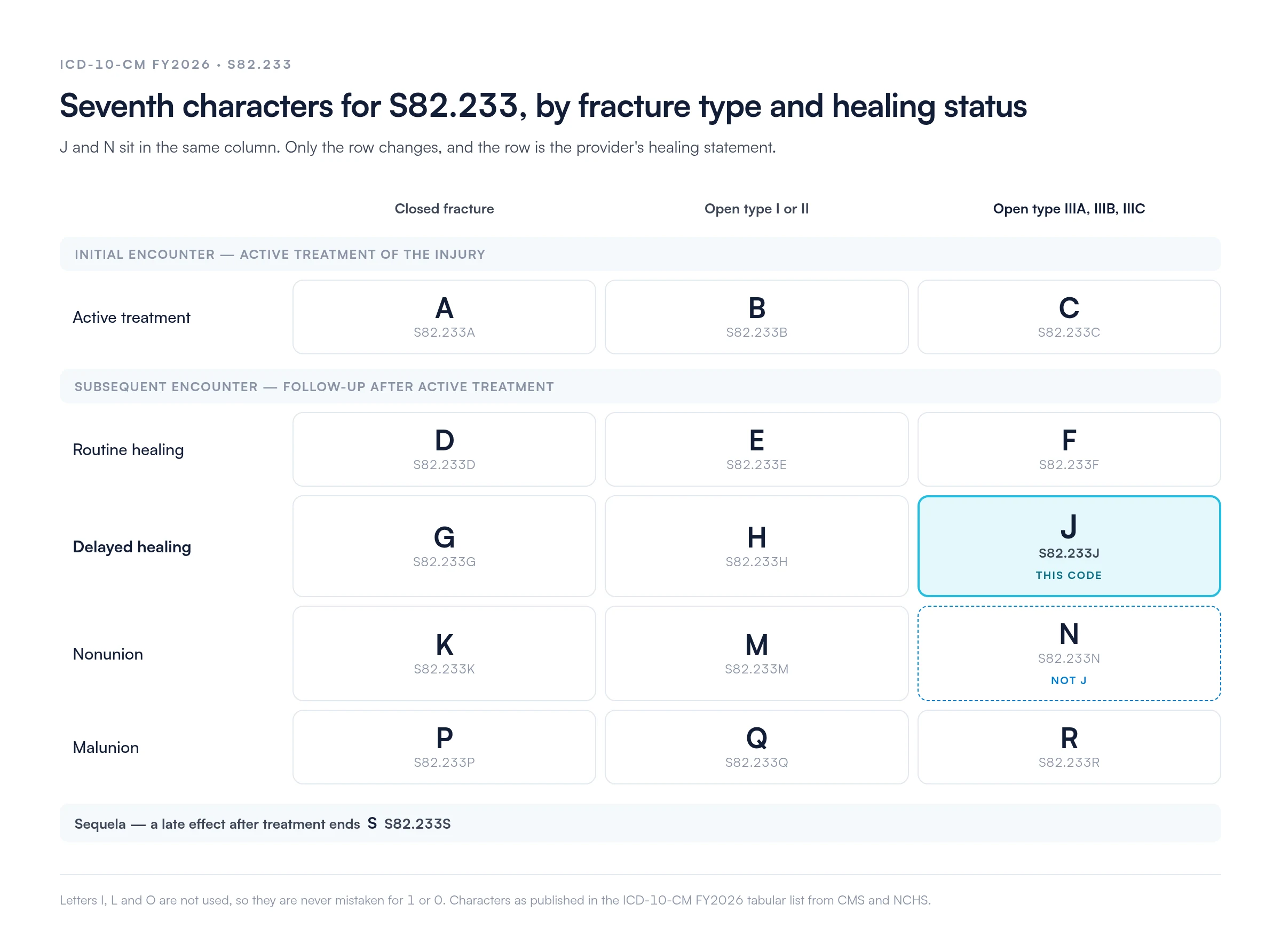
N is the row directly below J. It describes the same open type III fracture that has stopped healing altogether. K is a step further away, because it changes the fracture type to closed as well as the healing status.
Every valid extension for S82.233 is listed below. Each one produces a distinct billable code, and the letters I, L and O are skipped so nobody reads them as 1 or 0.
Descriptions above follow the FY2026 tabular list. You can confirm any of them in the CDC and NCHS ICD-10-CM lookup tool before you submit.
The open fracture designations in the seventh character come from the Gustilo-Anderson classification. The surgeon assigns it at the index procedure, and it then follows the patient through every later visit.
All three type III grades share one set of characters, so S82.233J covers IIIA, IIIB and IIIC alike. The distinction between them drives the surgical work, not the diagnosis code.
There is a default worth knowing. The ICD-10-CM Official Guidelines say that when the Gustilo type is not documented, you assign the characters for type I or II. At a delayed-healing follow-up, that means H rather than J.
Make the Gustilo type a required field in the operative note template, with IIIA, IIIB and IIIC as options. One dropdown at the index surgery settles the seventh character for every follow-up that year. Leave it blank and the guidelines push the claim down to the type I or II characters. That understates the injury for the rest of the episode.
ICD-10-CM never defines delayed healing in weeks or months. It is a clinical judgment the treating provider writes into the note. A coder cannot read an X-ray report and decide that union is behind schedule.
The four healing states below map to different characters, and the fracture type decides which column you read.
Reading the table left to right separates the two findings coders swap. Delayed healing and nonunion describe different clinical states. Each one then splits again by fracture type.
The distinction has money attached. Payers treat continued delayed healing as active management, and nonunion as a trigger for surgical intervention. Tracking which one your denials cluster around starts with the denial reason codes on the remittance.
Encounter type follows the nature of the care, not the visit number. A patient can be coded as an initial encounter several times while active treatment continues. The switch happens when treatment ends and the patient moves into follow-up.
For an open type III oblique tibial shaft fracture, the sequence usually runs like this.
Encounter type drives a steady share of rework on injury claims. Confirm that active treatment has ended before you reach for a subsequent character.
Most coding on this family is a small edit to one variable. The table below holds the neighbors worth bookmarking, with the single difference that separates each from S82.233J.
Two rows deserve a second look. S82.232N is the code many notes describe, because it names a left tibia that has stopped healing. S82.233N is its unspecified twin, and neither one uses the letter J.
Surgeons rarely write in code descriptions. These are the phrasings that should send you to this code when you search the alphabetic index by clinical language.
The index path is Fracture, traumatic → tibia → shaft → oblique (displaced). Laterality comes next, and the seventh character comes last.
This code does not change how a claim travels. It changes where the claim gets stuck, and there are only two places that happens.
That gives you a short routine to run before the claim leaves. Six checks, and five of them live in the chart:
Only the last check is a keystroke. The other five live in the chart, which is where review time on this code pays off.
The record has to carry five facts at once. When it does, the claim holds up under review without an appeal.
Most of the work above happens in two systems that rarely talk to each other. The healing statement lives in the clinical note. The claim gets rebuilt somewhere else, often from a superbill written after the visit.
Practice management software like Pabau keeps both on one record. Its claims management software pre-fills the CMS-1500 from the encounter, so the diagnosis you coded is the diagnosis that ships. An ICD-10-CM library lets a coder check the seventh character set without leaving the chart.
Required-field checks run before the claim unlocks, which stops incomplete submissions at the desk. On the US pipeline, Claim.MD handles submission, real-time eligibility checks and remittance posting. A denial lands back on the same record as the note behind it, so your coder reads both together.

Pabau pre-fills the CMS-1500 from the encounter record, checks eligibility before the visit, and posts remittance advice back to the same chart. Your coders read the note and the denial reason side by side.

S82.233J is settled by two lines someone else wrote. One is the Gustilo type from the index surgery. The other is the healing status at today’s visit. Find both, or ask for them.
Then check the side. The third 3 in this code means the tibia was never identified as left or right. That is a documentation result rather than a clinical one. When the chart does name a side, S82.231J or S82.232J is the honest code.
Trouble on this code starts in the note far more often than in the lookup. A claim that says delayed healing while the chart says nonunion tells the payer a different story. The note decides which one you are paid for.
Book a demo to see how Pabau ties the coded encounter to the claim that leaves your practice.

Coding the same seventh character on a different bone? ICD-10 code S72.352J works through delayed healing on an open femoral shaft fracture.
Need the nonunion side of this logic? ICD-10 code S82.091N shows what the record must prove when union has stopped.
Reading a denial on a fracture line? Denial codes in medical billing maps the reason codes you will meet most often.
Not sure what makes a claim clean before it leaves? Clean claim sets out the checks that stop a rejection at the clearinghouse.
New to electronic claim submission? Claim.MD clearinghouse explains how 837P submission, remittance advice and eligibility checks fit together.
S82.233J is the ICD-10-CM code for a displaced oblique fracture of the shaft of the unspecified tibia. The rest of the title reads subsequent encounter for open fracture type IIIA, IIIB, or IIIC with delayed healing. It is billable and specific. The code is valid for FY2026 and took effect on October 1, 2025.
No. The sixth character 3 means the tibia was not identified as left or right in the documentation. Left is S82.232 and right is S82.231. Use S82.232J or S82.231J once the record names a side, because unspecified laterality invites a payer review.
No. J means delayed healing, where union is behind schedule but still progressing. Nonunion on an open type IIIA, IIIB or IIIC fracture takes N, so the code is S82.233N. For a documented left tibia with nonunion, the code is S82.232N.
Yes. S82.233J carries all seven characters, so it is valid on a claim. Its parent code S82.233 is not billable on its own. A truncated six-character string rejects at the clearinghouse before a payer sees it.
That depends on how the injury presented. S82.233A is the initial encounter for a closed fracture. S82.233C is the initial encounter for an open type IIIA, IIIB or IIIC fracture. That is the code which normally precedes S82.233J in the same episode.
Type IIIA has extensive soft tissue damage with adequate bone coverage. Type IIIB adds soft tissue loss and periosteal stripping, so coverage usually needs a flap. Type IIIC involves an arterial injury needing repair. All three share one seventh character set, and an undocumented type defaults to the type I or II characters.




