

ICD-10 Code S42.444P: Medial epicondyle fracture, right humerus
ICD-10 Code S42.444P: full descriptor and code validity ICD-10 Code S42.444P car...

Last Updated: Oct 13, 2026
Billable Code Specific Code
S82.192A is the billable ICD-10-CM code for other fracture of upper end of left tibia, initial encounter for closed fracture.
Coders reach for S82.192A most often after an emergency visit or a first orthopedic evaluation. Two decisions follow from there. The first is which 7th character applies at each later visit. The second is which sibling code covers the other side or an open wound.
Let Pabau's smart automation suggest the right codes, reduce claim denials, and keep your practice compliant—effortlessly.
Automate repetitive tasks and focus on what matters most—your patients.
Reduce coding errors and ensure compliance with the latest regulations.
Clean claims, fewer denials, and faster reimbursements.
Powerful insights and reporting to help your practice thrive.
HIPAA compliant SOC 2 certified GDPR-compliant Trusted by 4,000+ clinics worldwide

S82.192A is a billable ICD-10-CM code for other fracture of upper end of left tibia, initial encounter for closed fracture.
It became effective on October 1, 2025 and is valid for the FY2026 edition of ICD-10-CM.
The 7th character A means an initial encounter for a closed fracture, while later stages take D, G, K, P, or S.
‘Other fracture’ separates this code from the displaced and nondisplaced subtypes, so the note must confirm laterality, fracture type, and encounter stage.
Pabau’s claims management supports accurate ICD-10 entry and clean claim submission for orthopedic and physical therapy practices.
ICD-10 Code S82.192A is a billable, specific ICD-10-CM diagnosis code. Its full official description is: Other fracture of upper end of left tibia, initial encounter for closed fracture.
According to the CDC/NCHS ICD-10-CM web tool, the code became effective on October 1, 2025 and is valid for the fiscal year 2026 edition. It is accepted for HIPAA-covered electronic transactions and stands on its own as a diagnosis code for reimbursement.
“Billable/specific” means S82.192A carries enough clinical detail to go on a claim without a more granular child code. It sits at the terminal level of the ICD-10-CM hierarchy for this fracture presentation.
The 7th character is a required part of an ICD-10-CM fracture code. It changes the code’s clinical meaning rather than qualifying it. For the S82.192 family, that character tells payers which phase of care the visit belongs to. The patient is presenting for the first time, returning for ongoing care, or being seen for a complication of healing.
Character A designates an initial encounter for a closed fracture. According to CMS ICD-10 coding guidance, “initial encounter” applies while the patient is receiving active treatment for the fracture.
That covers the emergency department visit, the first orthopedic evaluation, and the application of a cast or splint. The label reaches every visit where active treatment continues, including the second and the third.
Switching from A to D too early is one of the most common 7th character errors in orthopedic billing. If a provider continues active casting or manipulation, the encounter stays initial even on the third or fourth visit.
Only when treatment turns into routine monitoring does the encounter become subsequent. Payers report the resulting rejection with a specific remittance code, and the denial codes reference lists the ones fracture claims hit most.
ICD-10 Code S82.192A sits inside a structured hierarchy. Each character position carries one piece of the specificity. Reading the code from left to right names the site, the subtype, the side, and the stage of care.
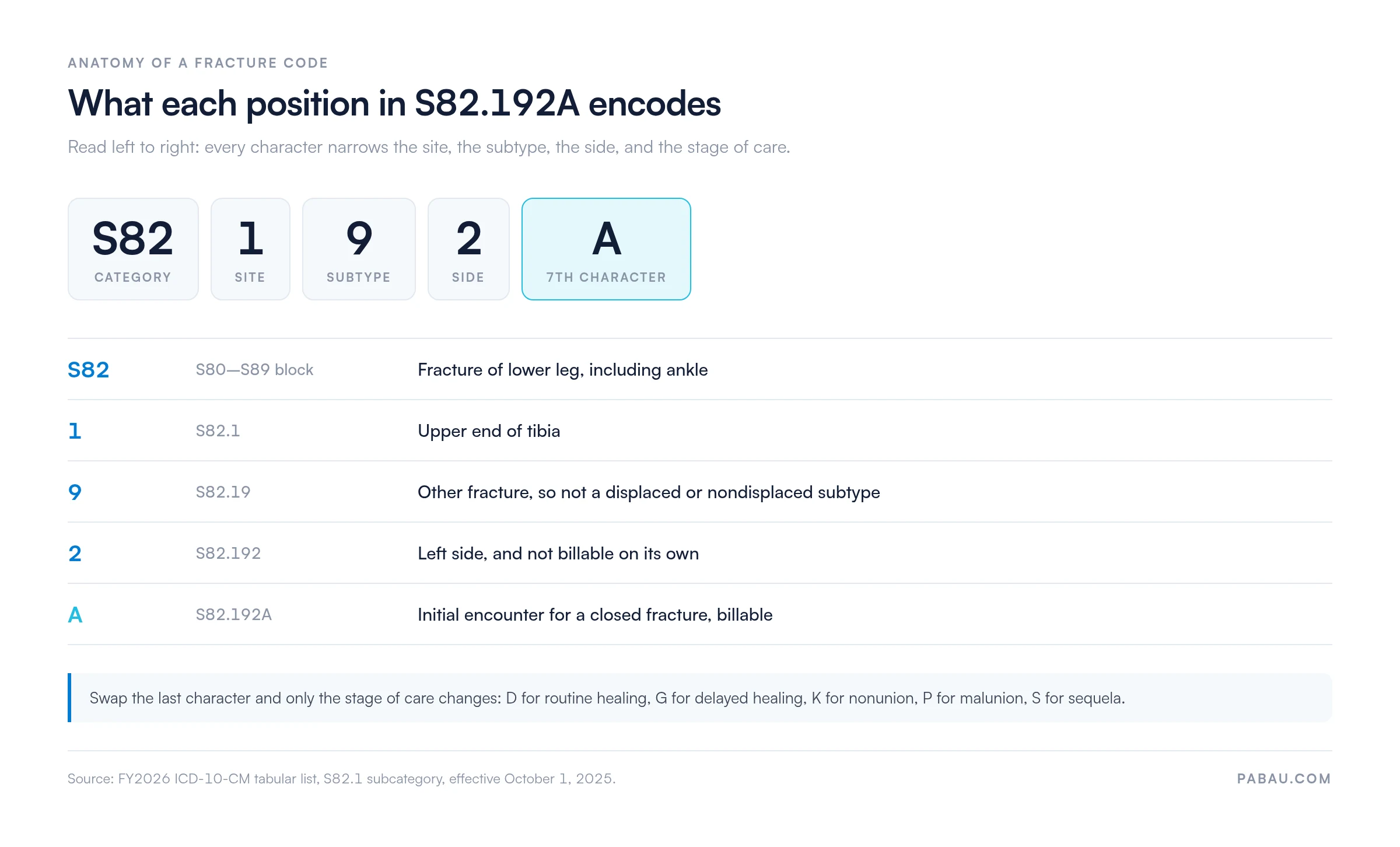
The path from category to terminal code runs like this:
S82.192 is not itself billable. The 7th character completes the code, and a claim carrying S82.192 without it will be rejected. Parent codes define the anatomical site and the injury type, while the final characters add the laterality and the encounter stage.
S82.192A belongs to a code family covering every presentation of an upper-end tibia fracture. Laterality and fracture subtype decide which sibling code applies, and laterality is among the most audited elements in orthopedic billing.
S82.199A belongs on a claim only where the operative report or the clinical note genuinely does not state left or right.
Payers audit laterality routinely and may downcode or deny a claim that reports “unspecified” when the side is documented. Always default to the laterally specific code. For an open wound at the initial visit on the right side, the sibling code is S82.191B.
Using ICD-10 Code S82.192A correctly requires documentation that supports all three elements built into it: the fracture location, the laterality, and the encounter type. Leaving any one of them out of the clinical record creates an audit vulnerability even when the code itself is correct.
The ICD-10-CM Official Guidelines for Coding and Reporting, maintained by the National Center for Health Statistics, are the authoritative source for fracture coding conventions. Key requirements for S82.192A include:
A documentation checklist built into the intake or encounter workflow keeps incomplete records out of the coding queue. The FY2026 ICD-10-CM official guidelines from NCHS are the baseline an internal coding policy should match.
Document the fracture type, laterality, and encounter stage in every clinical note rather than relying on coders to infer these details from imaging reports alone. When all three elements appear explicitly in the provider’s assessment, coding S82.192A takes seconds rather than requiring a query back to the provider.
Use S82.192A for as long as active treatment continues, then move to a subsequent-encounter character once care becomes monitoring. That transition point is where the coding usually breaks down, because a practice without a written policy keeps billing A after the cast comes off.
Physical therapy visits are a common billing pitfall. If the PT encounter treats a closed left proximal tibia fracture that is healing on schedule, the diagnosis code is S82.192D rather than S82.192A. An encounter-type prompt in the scheduling or documentation workflow catches that at the point of care.
ICD-10 Code S82.192A goes on the claim as a diagnosis code, paired with the CPT procedure code for the service rendered. The CPT code drives the payment, and S82.192A establishes medical necessity. Payers cross-reference the two to confirm the procedure suits the diagnosis.
Practices submitting fracture claims through practice management software like Pabau can route them to Claim.MD, our integrated US clearinghouse partner.
Claim.MD validates code combinations before submission and flags a mismatched CPT and ICD-10 pairing before it reaches the payer. Catching an encounter-character error at that stage removes a round of rework on a musculoskeletal claim.
S82.192A is a diagnosis code. It describes the patient’s condition, and the CPT code describes the treatment rendered. The table below lists the CPT codes most often billed with S82.192A for upper-end tibia fractures.
Verify each pairing against payer policy and AAPC’s ICD-10-CM code lookup, since coverage rules vary by payer and region.
When ORIF is performed under CPT 27536, the diagnosis at surgery is still S82.192A if this is the initial surgical encounter. The 7th character does not shift with the invasiveness of the procedure. It reflects whether the patient remains in the active treatment phase of the injury episode.
Check payer-specific LCD (Local Coverage Determination) policies before pairing CPT 27536 with S82.192A. Some Medicare Administrative Contractors have specific documentation requirements for ORIF on upper-end tibia fractures. Verify medical necessity criteria in the operative note match what the payer’s policy requires.
Coding accuracy for an orthopedic diagnosis like S82.192A depends on how complete the clinical record is when the coder opens it. When the note leaves out the laterality or the encounter stage, the coder has two poor options. Querying the provider adds days to the billing cycle, and falling back on a less specific code invites payer scrutiny.
Pabau keeps the coded diagnosis attached to the clinical record, so the claim inherits it without manual re-entry. Its cleaner claims management ties the note, the code, and the submission together in one pass.
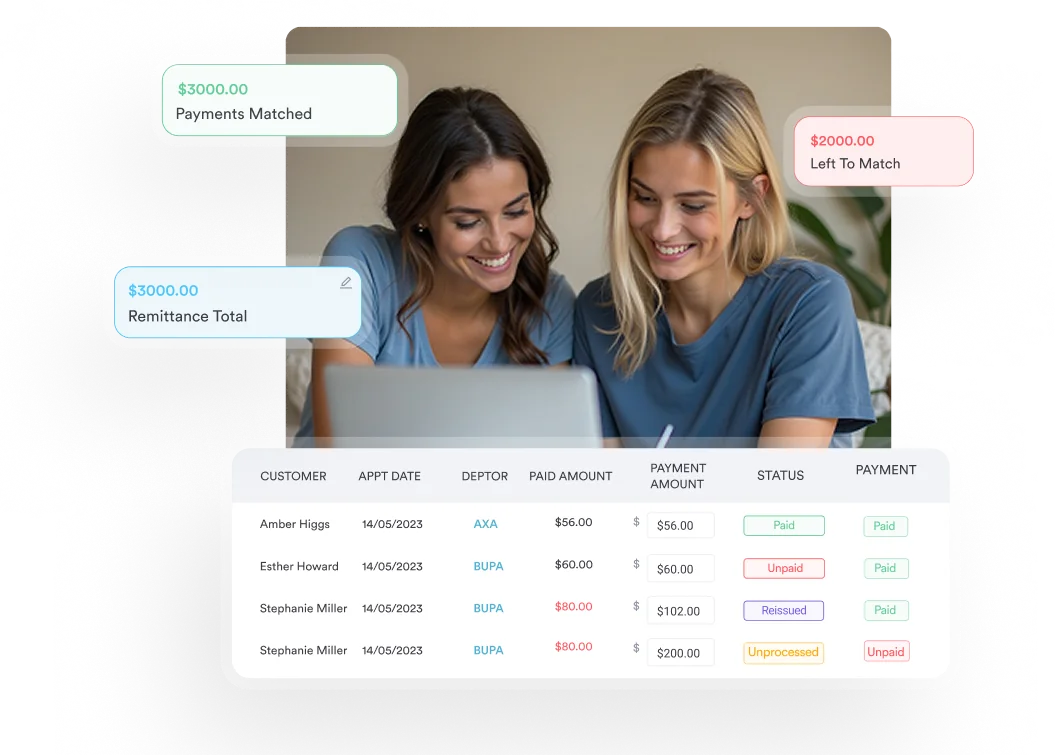
For orthopedic and physical therapy practices, Pabau connects to Claim.MD for electronic submission, real-time eligibility verification, and ERA posting. Built-in CPT and ICD-10 catalogs validate code combinations before they reach the payer, so a fracture billing error surfaces before it becomes a denial.

Pabau’s integrated claims management connects directly to Claim.MD for pre-submission validation, real-time eligibility checks, and ERA posting. See how practices using Pabau cut fracture claim rework time significantly.

ICD-10 Code S82.192A covers one specific presentation. It is a closed left proximal tibia fracture classified as “other”, seen while active treatment is still under way. Get the laterality, the subtype, and the encounter stage into the note, and the code follows without a query back to the provider.
The trade-off worth remembering is that specificity is cheap at the point of documentation and expensive at the point of appeal. Book a demo to see how Pabau moves a fracture diagnosis from the clinical note to a paid claim.

Need to understand how clearinghouse validation reduces fracture claim denials? Denial management in healthcare covers the most common denial triggers and how to build an effective appeal workflow.
Looking for a structured workflow for billing physical therapy visits after a fracture? Revenue cycle management fundamentals explains how each phase from documentation through payment posting connects.
Want the pre-submission checks that stop a fracture claim from bouncing? Clean claim sets out what a payer needs on the first pass and which errors force a resubmission.
ICD-10 Code S82.192A is a billable ICD-10-CM diagnosis code. It describes an other fracture of the upper end of the left tibia at an initial encounter for a closed fracture. “Other fracture” distinguishes this presentation from specifically classified displaced or nondisplaced subtypes. The 7th character A confirms the encounter is during active treatment for a closed (skin-intact) injury. It is valid for FY2026 under the October 1, 2025 ICD-10-CM update.
Yes. S82.192A is a billable, specific ICD-10-CM code that can be submitted on HIPAA-covered electronic transactions without requiring a more granular child code. It is valid for fiscal year 2026, effective October 1, 2025.
The 7th character A in fracture ICD-10 codes designates an initial encounter for a closed fracture. It means the patient is still receiving active treatment for the injury. It applies during the emergency visit, the first orthopedic evaluation, cast applications, and any visit where treatment rather than monitoring is the purpose. Once care shifts to routine follow-up, the 7th character changes to D (routine healing) or another subsequent encounter variant.
S82.192A, S82.192D, and S82.192S all describe the same fracture (other fracture of upper end of left tibia) but at different stages of care. S82.192A is for initial encounters during active treatment. S82.192D is for subsequent encounters when the fracture is healing routinely. S82.192S is for sequela encounters. The fracture is healed, but the patient has a late effect from the original injury, such as chronic pain or stiffness.
Use S82.192A for the initial encounter if the fracture is closed (no skin disruption). Confirm in the clinical record that the fracture is documented as left-sided, upper-end/proximal tibia, closed, and that this is the first active treatment visit. Pair the diagnosis with the appropriate CPT code (e.g. 27530 for closed treatment without manipulation or 27536 for bicondylar open treatment). Add an external cause code from the W or V category to indicate the mechanism of injury.
The CPT codes most often paired with S82.192A are 27530 (closed treatment without manipulation) and 27532 (closed treatment with manipulation). Open treatment adds 27535 (unicondylar, including internal fixation when performed) and 27536 (bicondylar, with or without internal fixation). Casting and splinting codes (29405, 29505) cover initial immobilization. Verify payer-specific medical necessity requirements against CMS LCD policies before billing.




