ICD-10 code S61.201A: Open wound of left index finger without nail damage
ICD-10 code S61.201A covers a left index finger wound of unstated type ICD-10 co...

Last Updated: Oct 16, 2026
Billable Code Specific Code
S82.126S is the billable ICD-10-CM code for nondisplaced fracture of lateral condyle of unspecified tibia, sequela.
Most lateral condyle fractures settle without incident. A minority leave chronic knee pain, joint instability, or post-traumatic arthritis. Those later visits are what S82.126S documents.
The 7th character carries the weight on this family. S82.12x accepts 16 of them, so sequela sits next to nonunion and malunion options that look alike on a superbill.
Let Pabau's smart automation suggest the right codes, reduce claim denials, and keep your practice compliant—effortlessly.
Automate repetitive tasks and focus on what matters most—your patients.
Reduce coding errors and ensure compliance with the latest regulations.
Clean claims, fewer denials, and faster reimbursements.
Powerful insights and reporting to help your practice thrive.
HIPAA compliant SOC 2 certified GDPR-compliant Trusted by 4,000+ clinics worldwide

ICD-10 code S82.126S reports a nondisplaced fracture of the lateral condyle of an unspecified tibia at a sequela encounter
Sequencing runs residual condition first, S82.126S second, which is the reverse of what many coders assume about sequela codes
S82.12x accepts 16 different 7th characters, so S competes with K (nonunion) and P (malunion), not only with A and D
When the note names a side, use S82.124S for the right tibia or S82.125S for the left instead of the unspecified code
Pabau’s claims management software checks ICD-10 and CPT pairings before submission and files to thousands of US payers through Claim.MD
S82.126S is a billable ICD-10-CM code and it is valid for the current fiscal year. It describes a nondisplaced fracture of the lateral condyle of an unspecified tibia at a sequela encounter. Use it only when the fracture has united and the visit treats a direct late effect of that injury. The table below lists the attributes coders check first.
For the authoritative tabular list, consult the CDC/NCHS ICD-10-CM web tool, which publishes the official US code lookup and updates it each fiscal year.
S82.126S means a nondisplaced fracture of the lateral condyle of an unspecified tibia, coded at a sequela encounter. Seven characters carry five clinical facts. Reading each position in order prevents the wrong-site and wrong-laterality picks that drive denials on this family.
The 6th character carries two facts at once, and that is where most wrong-code picks start. Values 1, 2 and 3 mean displaced right, displaced left and displaced unspecified. Values 4, 5 and 6 mean nondisplaced right, nondisplaced left and nondisplaced unspecified.
So S82.126S is the nondisplaced, unspecified-side sequela code in the lateral condyle family. When the chart names a side, switch to S82.124S for the right tibia or S82.125S for the left. Laterality has to be supported in the record under the ICD-10-CM Official Guidelines for Coding and Reporting.
Record the injured side in every clinical note. Payers accept unspecified-laterality codes like S82.126S, but those codes attract documentation requests on audit. A side-specific code such as S82.124S or S82.125S removes that friction before it starts.
The lateral condyle sits at the top of the tibia and forms the outer half of the tibial plateau. It takes load from the lateral femoral condyle every time the knee bears weight. Nondisplaced means the fracture line is there but the fragments have stayed in anatomical alignment. That distinction drives both the treatment plan and the code selected at each visit.
Common mechanisms include valgus stress across the knee, a direct blow to the outer knee, and motor vehicle collisions. Older adults with reduced bone density fracture the plateau in low-energy falls. Younger patients usually need higher-energy trauma to do the same damage.
A sequela visit reads nothing like an acute one. Patients describe stiffness, swelling after activity, a sense of the knee giving way, or pain that has outlasted the cast by months. By the time S82.126S fits, the fracture has healed and the note documents the consequence.
Practice management software like Pabau keeps that separation visible in the chart. Structured progress notes name the residual condition separately from the original injury. The coder can then see which 7th character the record supports.
Use S only once the fracture has united and the visit treats a late effect. Nonunion takes K and malunion takes P, because in both the bone is still under active care.
The choice is wider than those three. S82.12x takes 16 possible 7th characters, separating closed fractures from open ones and routine healing from delayed healing, nonunion and malunion.
The letters I, L and O are skipped throughout, so they never appear as 7th characters. Of the sixteen, six describe a closed fracture, and those six cover the path from first visit to sequela. The chart below sets each of them against what the note says about the bone.
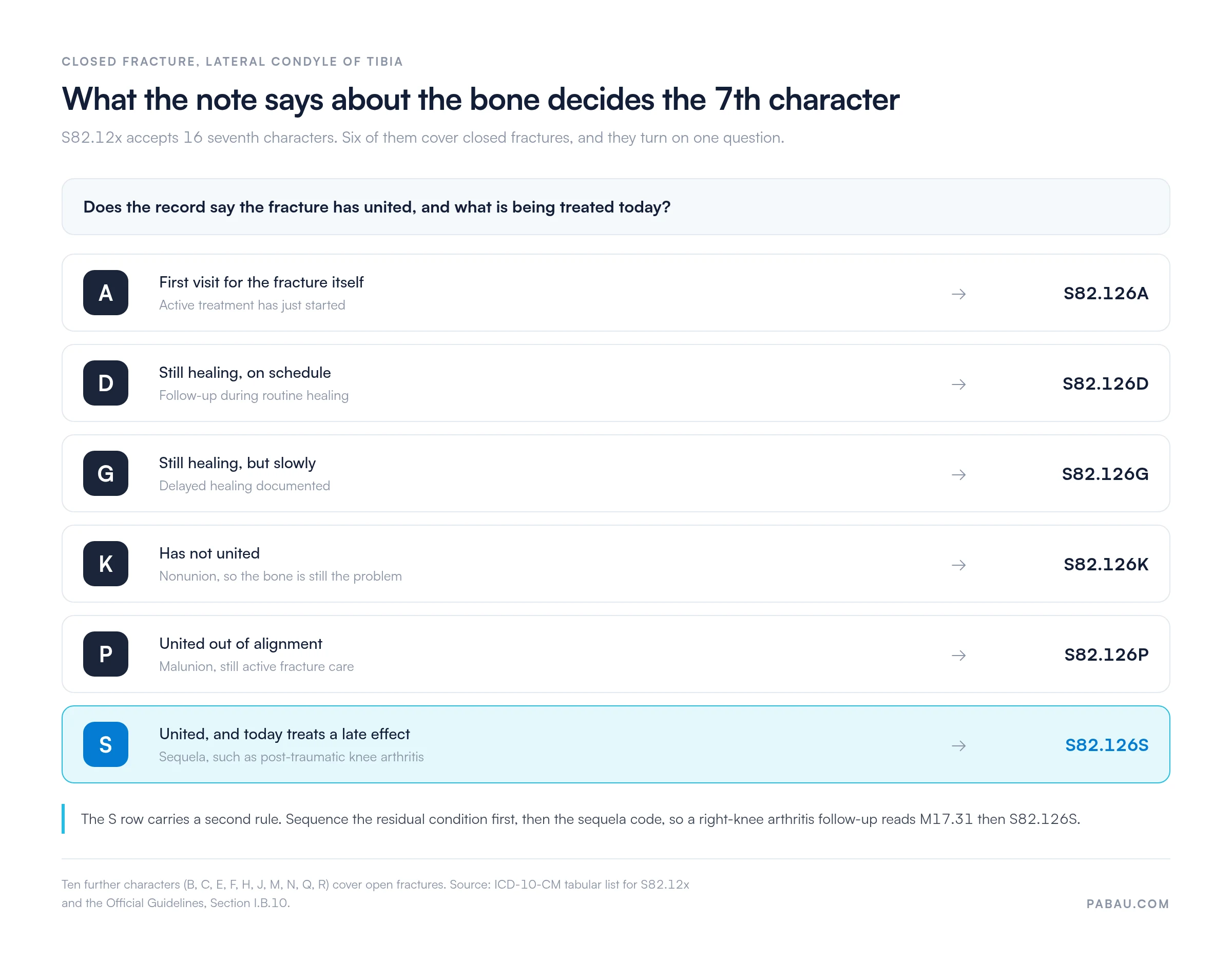
A second rule applies alongside the 7th character. A sequela code needs a companion code naming the residual condition. Per ICD-10-CM Official Guidelines Section I.B.10, the residual condition is sequenced first and the sequela code second. That order surprises coders who expect the injury code to lead. Codes commonly paired with S82.126S include:
So a follow-up for post-traumatic arthritis of the right knee after a healed lateral condyle fracture reports M17.31 first, then S82.126S. Never submit S82.126S on its own when the visit addresses a specific late effect. A sequela code arriving alone invites a documentation request.
Watch how the clinical note describes the bone. A note that still calls the fracture healing supports the D character. A note that calls it nonunion points to K instead. S82.126S needs the record to state that the fracture has united.
The S82.12x family covers lateral condyle tibia fractures across displacement and laterality. After the 7th character, the wrong sibling inside that family is the next thing to check. Both mistakes come back as the same handful of common denial codes on the remittance.
Two limits are worth stating. S82.126S never substitutes for a side-specific code when the chart does name the side. It also does not cover a chart that never named the fractured bone. Where the fracture site is undocumented, the S82.9 unspecified-lower-leg codes apply instead.
Documentation carries as much weight as code choice on a sequela claim. The note has to prove that an old fracture healed and that today’s complaint descends from it. Six elements carry that burden:
There is no time limit on a sequela code. A fracture that healed nine years ago still supports S82.126S today, provided the note connects the two. Payers therefore read the causal statement closely.
The CMS ICD-10 codes page publishes the annual ICD-10-CM Official Guidelines for Coding and Reporting, which govern every S82.126S encounter. Five rules decide whether the claim clears:
At a sequela encounter, external cause codes from the V, W, X and Y chapters are not reported. Those codes document the mechanism of the original injury, and they belong to the initial and subsequent encounters only.
Coders still meet these codes when they check prior-visit documentation in a tool such as the AAPC Codify ICD-10-CM lookup. Recognizing the usual suspects saves time.
Motor vehicle mechanisms draw a V-chapter code instead, matched to the patient’s role and the collision type. Place of occurrence (Y92), activity (Y93) and external cause status (Y99) codes follow the same rule as the fall codes.
Report them once, at the initial encounter, and never at the sequela visit. Some payer contracts spell out which external cause codes an initial fracture claim must carry, so read the contract before dropping them.
S82.126S is a billable code in the current CMS ICD-10-CM tabular list. Payers generally accept it alongside a correctly sequenced residual condition code and supporting documentation.
Sequela visits are almost always outpatient, so the reimbursement question is usually the CPT pairing rather than an inpatient grouper. The codes below turn up most often at these encounters:
Check every pairing against the current AMA CPT codebook before submission. Rates move with payer, geography and provider type, so treat no ICD-CPT combination as guaranteed payment. Medical necessity still has to read through from the residual condition to the service billed.
Knee manipulation under anesthesia is the item on that list with the heaviest documentation trail. The reference for 27570 sets out what the note must show before a payer accepts it against a sequela diagnosis.
In most practices this workload sits with one person and a lot of tab-switching. A coder reads the progress note, looks the code family up in a browser, then decides on the 7th character. Filing means logging into a separate clearinghouse. Rejections come back days later with a reason code and no context.
Pabau, practice management software for orthopedic and physical therapy practices, keeps that chain in one place. ICD-10 and CPT catalogs sit inside the chart, so the code goes on the encounter while the note is open. Pabau’s medical claims management then checks the pairing before anything leaves the building.
The Claim.MD clearinghouse integration connects the practice to thousands of US payers. That covers electronic submission, real-time eligibility checks and ERA processing, with no second clearinghouse login.
The outcome is a shorter loop between documentation and payment. Sequela claims like S82.126S go out with their companion code attached, so the practice spends its week on patients instead of on resubmissions.
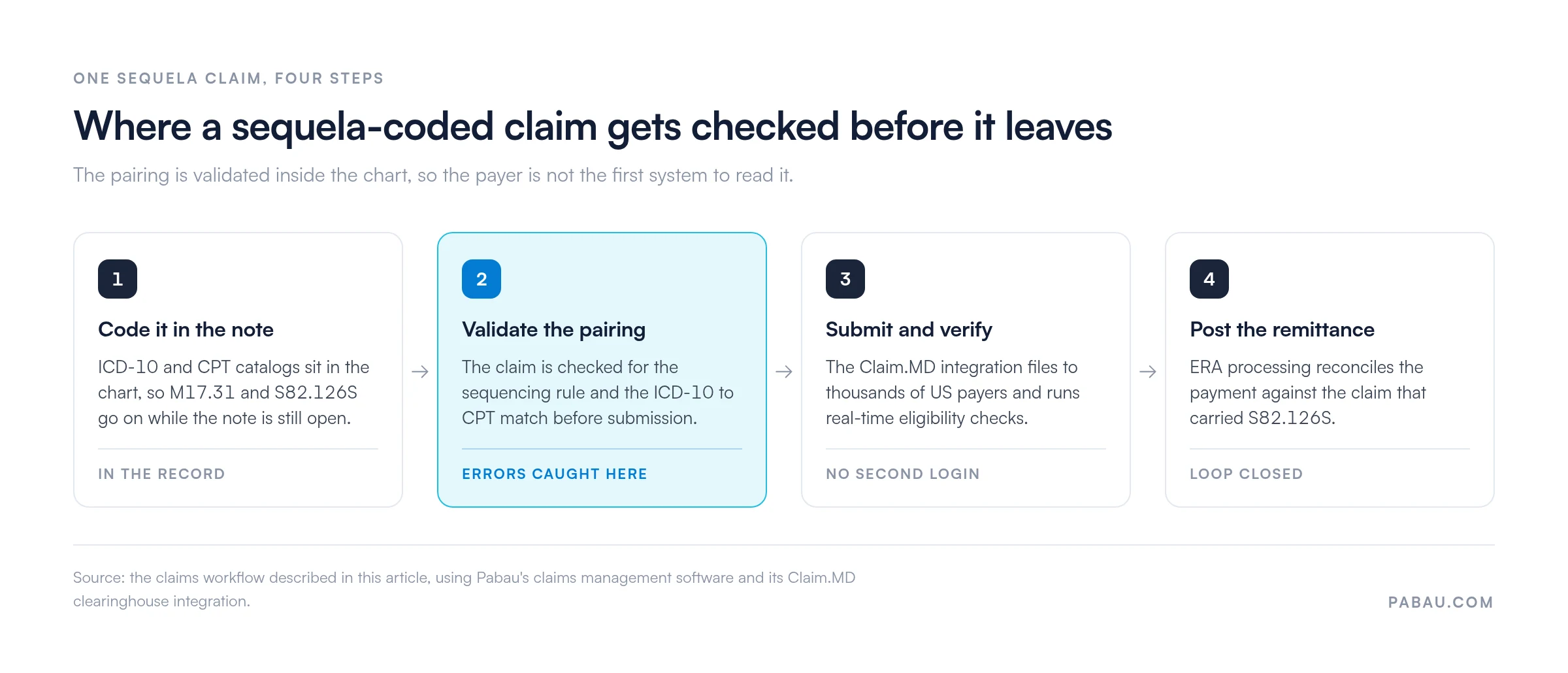

Pabau files to thousands of US payers through Claim.MD, so sequela-coded claims like S82.126S go out clean. You get ICD-10 and CPT validation, real-time eligibility checks and ERA processing, with no separate clearinghouse login.

ICD-10 code S82.126S answers one narrow scenario. The patient has a late effect of a healed, nondisplaced lateral condyle tibia fracture, and the side is not documented.
Three errors are worth guarding against. The first is reporting the code without a companion condition code. The second is sequencing it ahead of that code instead of after it. The third is reaching for it when the record supports K, P or D.
Practices carrying high volumes of orthopedic and physical therapy sequela claims gain most from validation at submission time. Pabau’s claims management software, connected to the Claim.MD network, catches ICD-10 pairing errors before the payer sees them. Book a demo to see the sequela workflow running on your own claims.

Need a complete reference for fracture coding errors? Denial codes in medical billing covers the most common payer rejection patterns affecting orthopedic and musculoskeletal claims.
Managing claims submission for a physical therapy practice? Electronic remittance advice (ERA) processing explains how 835 remittance files map to your sequela claims and payment reconciliation workflow.
Want to understand how ICD-10 integrates with your clearinghouse? 837 file format and electronic claims explains the data structure that carries ICD-10-CM codes – including S82.126S – from your EHR to the payer.
S82.126S is a billable ICD-10-CM code for a nondisplaced fracture of the lateral condyle of an unspecified tibia, sequela. It reports a visit for a late effect of that fracture, such as post-traumatic knee arthritis, stiffness or instability, once the bone itself has healed.
Second. ICD-10-CM Official Guidelines Section I.B.10 puts the residual condition first and the sequela code after it. A follow-up for post-traumatic arthritis of the right knee therefore reports M17.31, then S82.126S.
Only laterality. S82.124S covers the right tibia and S82.125S the left, both as sequela of a nondisplaced lateral condyle fracture. S82.126S is the unspecified-side code, and it fits only when the record genuinely does not name a side.
Use K when the fracture has gone to nonunion and P when it has healed in malunion. Both describe a bone that is still the clinical problem, which counts as active fracture care. S82.126S applies only after the fracture has united.
All three describe the same fracture at different stages. S82.126A covers the initial encounter for a closed fracture. S82.126D covers a subsequent encounter with routine healing. S82.126S applies once the fracture has healed and the visit treats a resulting late effect.
None. External cause codes from the V, W, X and Y chapters are reported at initial and subsequent encounters only. At an S82.126S visit the claim carries the residual condition code and S82.126S, and nothing describing the original mechanism.
S82 covers fractures of the lower leg, including the ankle. It spans the upper end of the tibia, the tibial shaft, the fibula, and bimalleolar and trimalleolar fractures. Each is subdivided by site, displacement, laterality and 7th character.