ICD-10 Code Y76.0: Diagnostic obstetric and gynecological devices
ICD-10 Code Y76.0: Definition and billable status ICD-10 Code Y76.0 is a valid, ...

Last Updated: Oct 23, 2026
Billable Code Specific Code
S76.202S is the billable ICD-10-CM code for unspecified injury of adductor muscle, fascia and tendon of left thigh, sequela.
Choose D instead of S and the record misstates the phase of care. Drop the 7th character altogether and the payer rejects the code as invalid. Both mistakes are easy to avoid once you can read S76.202S position by position.
Let Pabau's smart automation suggest the right codes, reduce claim denials, and keep your practice compliant—effortlessly.
Automate repetitive tasks and focus on what matters most—your patients.
Reduce coding errors and ensure compliance with the latest regulations.
Clean claims, fewer denials, and faster reimbursements.
Powerful insights and reporting to help your practice thrive.
HIPAA compliant SOC 2 certified GDPR-compliant Trusted by 4,000+ clinics worldwide

ICD-10 code S76.202S is billable and covers an unspecified injury of the adductor muscle, fascia and tendon of the left thigh, sequela.
The 7th character S means sequela, a late effect treated after the original adductor injury has finished healing.
Character D applies only while active treatment continues, so using D on a resolved injury is the most common denial cause on these claims.
A sequela claim needs the left-side laterality, the original injury date, and a written link between the two.
Practice management software like Pabau keeps ICD-10-CM codes attached to the encounter and submits US claims through the Claim.MD clearinghouse.
S76.202S is a specific, billable ICD-10-CM code, valid for the current fiscal year under the CMS ICD-10-CM code set. The table below holds the facts worth confirming before a claim goes out.
Every character in S76.202S carries a meaning, and misreading one position produces the wrong code. The breakdown below maps each position to the decision behind it.
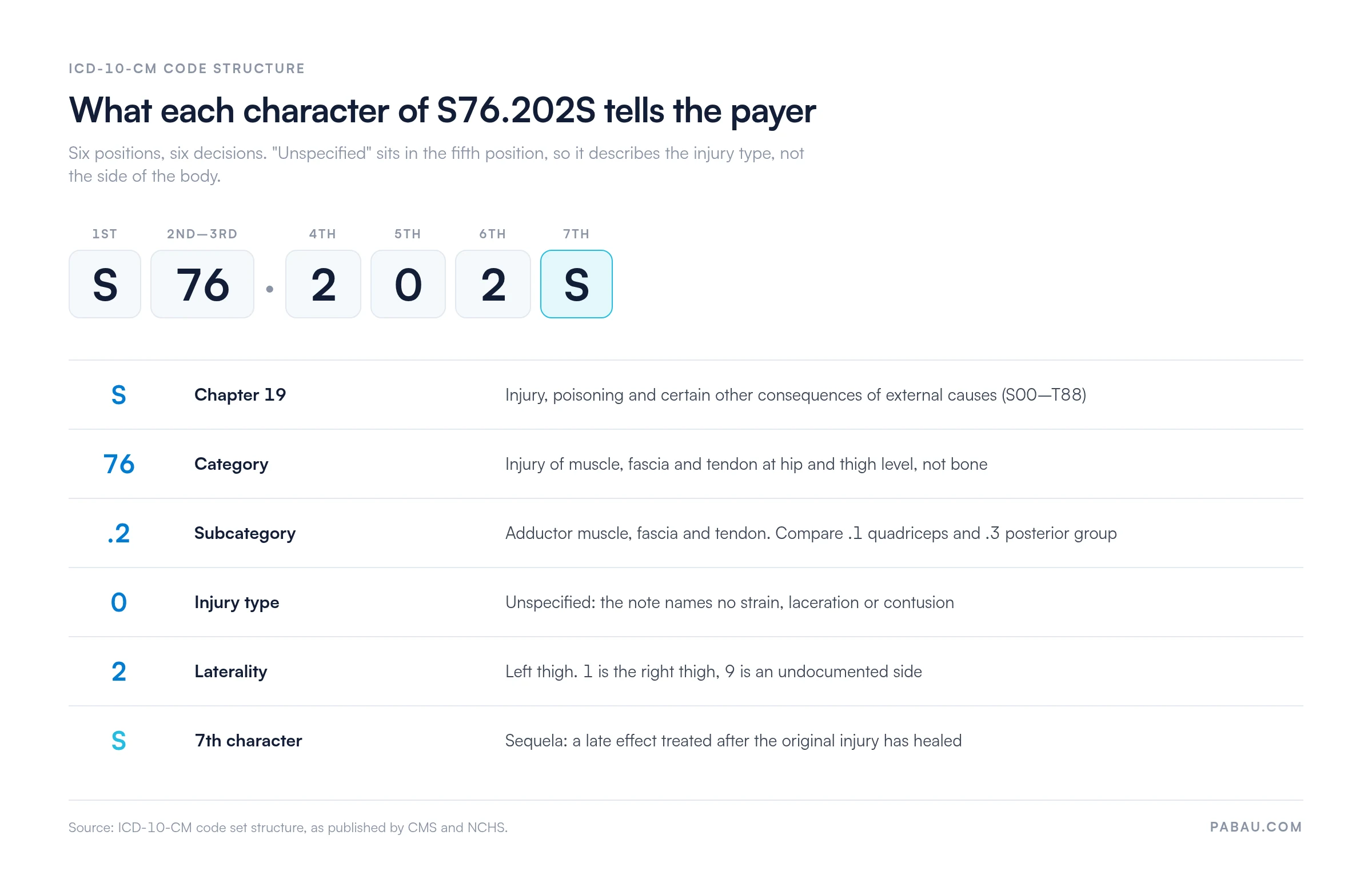
That fifth character trips up more coders than any other. “Unspecified” in the description does not mean the side is unknown.
The left thigh is stated outright by the sixth character. What went undocumented was the mechanism, whether the adductor was strained, lacerated, or bruised.
S76.202 accepts three 7th characters, A, D and S. Each one tells the payer which phase of care the visit belongs to.
The CDC/NCHS ICD-10-CM official tool lists all three for this subcategory. Choosing between them is a reading of the record, not a preference.
A and S are rarely confused. The line between D and S is the one that gets crossed.
Reach for S76.202S once the original injury has healed and only its after-effects remain under treatment.
ICD-10-CM Official Guidelines Section I.B.10 defines a sequela as a late effect. It is a condition arising from a prior injury, once the acute phase of that injury is complete.
All three of these have to hold before the S applies:
S76.202D stays in play while active treatment of the original injury continues. That includes therapy inside a documented acute plan, and follow-up imaging during the healing window. Duration alone does not move you to sequela. A six-month course of active rehabilitation is still a subsequent encounter.
The practical trigger is a word in the note. Once the clinician writes “resolved”, “healed”, or “no longer acutely active”, any related ongoing complaint becomes a sequela.
S76.202 without a 7th character is not billable, and payers reject it as an invalid code at intake. It sits at the bottom of a five-tier hierarchy, and only the bottom tier is claimable.
The AAPC ICD-10-CM code browser is a quick way to walk those tiers when documentation runs thin.
Notice that the rejection for a truncated code is not a clinical denial. It comes back as an invalid code, usually before a human at the payer has looked at the visit. That makes it cheap to prevent and annoying to fix, because the whole claim has to be corrected and resubmitted.
A sequela claim has to prove a causal chain, not just a current complaint. That is a heavier documentation load than an initial or subsequent encounter carries.
Guidelines Section I.B.10 also sets the sequencing: the residual condition is coded first, then the sequela code follows it.
For S76.202S, the record needs four elements:
It helps to see where a sequela claim can break. Here is the path a single visit takes:
A truncated code fails at step four, fast and cheaply. Missing causal statements survive all five steps, then fail at review, sometimes months after payment. That second failure is the expensive one.
Put the date of the original adductor injury in the same note that assigns S76.202S. Auditors reviewing sequela claims look for a traceable prior injury. A note that mentions ‘the prior strain’ with no date leaves them no anchor to check against. That alone can trigger a documentation denial, even when the clinical reasoning is sound.
S76.202S sits in a tight family of adductor codes, and the near misses matter as much as the code itself. Move the injury type to laceration and the side to right, and the code becomes S76.221A for an initial encounter.
Two questions separate them: was the injury type documented, and which side was it? Run those two questions against the table before you commit.
The adductor-versus-hamstring mix-up is the classic one. Adductors run down the medial thigh and hamstrings sit at the back, so S76.2xx and S76.3xx cover different muscle groups.
Groin pain can come from either, and a note reading “posterior medial thigh” does not settle it. Query the provider, then pull the matching code from our diagnostic code library.
Adductor sequela claims come back for a short and predictable list of reasons. Each one is caught by a check that takes seconds.
Tracking these separately is worth the effort. Sequela denials have their own causes, so lumping them into a general denial report hides the pattern.
Sort rejections by CARC code and the repeat offender in your practice usually shows up within a billing cycle.
Run five checks before the claim goes out. Is the 7th character S rather than D? Is the full seven-character code present? Does the laterality match the clinical note? Is the original injury date in the same encounter note? Is the causal link written in the provider’s own words? Two minutes of checking prevents most sequela rejections.
Two histories account for most S76.202S visits: a sports-related acute strain, and a traumatic contusion from a fall or a direct blow. Both can leave something behind once the acute phase closes.
The adductor group runs along the medial thigh and handles hip adduction and rotational stability. It includes the adductor longus, adductor magnus, adductor brevis, gracilis, and pectineus.
Acute strains most often hit the adductor longus at its proximal musculotendinous junction. Without full rehabilitation, scar tissue can cut flexibility and leave chronic medial thigh pain long after healing.
In practice, four presentations lead to a sequela encounter:
All four share one billing feature. The functional deficit has to be measured and written down, because that measurement is what justifies the therapy you go on to bill.
The sequela decision usually gets made twice. A clinician writes the note, then a coder reads it days later and works out which 7th character the wording supports. If the note never says “healed” or “resolved”, the coder either guesses or raises a query, and the claim waits.
Practice management software like Pabau keeps that decision in one place. The ICD-10-CM and CPT lookup libraries sit inside the client record. So the code gets attached to the service at the encounter, not reconstructed later.
Pabau’s claims management software then pre-fills the claim form from the record, and checks the required fields before the send button unlocks.
On the US pipeline, claims route to the Claim.MD clearinghouse, with eligibility checks, claim-status tracking, and remittance posting in the same place.
When a sequela claim comes back short paid, you can see which line the payer refused without opening a second system.

Pabau lets sports medicine and physical therapy practices assign ICD-10-CM codes inside the client record, then submit and track US claims through the Claim.MD clearinghouse. See how that fits the way your practice already works.

The clinical picture barely changes between a D claim and an S claim. One sentence in the note changes: whether the original injury is still under treatment or has finished healing. Get that sentence written and the 7th character picks itself.
So move the check upstream, into the encounter rather than the billing review. Ask for the healing status, the side, and the date of the original injury while the patient is still in the room. Sequela claims that carry all three rarely come back.
If your practice codes musculoskeletal sequela visits every week, fixing the note template pays off faster than appealing denials one at a time. Book a demo to see how Pabau keeps ICD-10-CM codes on the encounter and gets the claim out the same day.

Need to understand how clearinghouse claim submission works? Claim.MD clearinghouse overview explains how electronic claim routing reduces rejection rates for musculoskeletal and injury codes.
Handling a high volume of injury claim denials? Denial codes in medical billing covers the most common CARC and RARC codes that appear on rejected musculoskeletal claims.
Want a clean claim checklist before submission? What makes a clean claim outlines the payer requirements that prevent sequela and injury code rejections at intake.
Trying to read why a sequela line was refused? Electronic remittance advice explained shows how to trace a denial back to the documentation element that failed.
There is no time limit. ICD-10-CM guidelines set no cut-off on when a sequela code applies, so a residual condition treated two years later still codes as sequela. Payers will still expect the original injury date to appear in the record.
Usually not. Code the residual condition first, such as the chronic pain or the motion restriction, then follow it with S76.202S. The sequela code goes second unless it already names the residual condition itself.
Report one when the record documents how the original injury happened. The external cause code takes the same 7th character S for a sequela encounter. It can never be the first-listed diagnosis, and ICD-10-CM does not require external cause reporting nationally.
Rehabilitation codes, most often 97110 for therapeutic exercise, 97140 for manual therapy, and 97530 for therapeutic activities. The diagnosis supports medical necessity for those services, so the documented functional deficit has to match the treatment billed.