ICD-10 Code S42.444P: Medial epicondyle fracture, right humerus
ICD-10 Code S42.444P: full descriptor and code validity ICD-10 Code S42.444P car...

Last Updated: Oct 13, 2026
Billable Code Specific Code
S73.024D is the billable ICD-10-CM code for obturator dislocation of right hip, subsequent encounter.
The 7th character D marks a follow-up visit, after the patient has already received active treatment for the dislocation. It covers monitoring, medication adjustment, and rehabilitation progress. That character is what separates S73.024D from S73.024A for the initial encounter and S73.024S for a sequela.
Let Pabau's smart automation suggest the right codes, reduce claim denials, and keep your practice compliant—effortlessly.
Automate repetitive tasks and focus on what matters most—your patients.
Reduce coding errors and ensure compliance with the latest regulations.
Clean claims, fewer denials, and faster reimbursements.
Powerful insights and reporting to help your practice thrive.
HIPAA compliant SOC 2 certified GDPR-compliant Trusted by 4,000+ clinics worldwide

S73.024D is the billable ICD-10-CM code for obturator dislocation of the right hip at a follow-up encounter.
The 7th character D applies only after active treatment is complete, so a new provider still managing the injury codes A.
Documentation must confirm the obturator dislocation type, right laterality, prior active treatment, and the purpose of this visit.
Obturator dislocation is an anterior subtype, so a note recording only a hip dislocation maps to an unspecified code.
Pabau’s claims management software and structured clinical records help practices pick the right 7th character at the point of care.
ICD-10 code S73.024D is the specific, billable diagnosis code for obturator dislocation of the right hip at a subsequent encounter.
It sits in ICD-10-CM chapter S00-T88, injury, poisoning, and certain other consequences of external causes. Billable means the code carries a valid 7th character and can go on a claim without further specification. The CMS ICD-10-CM code files list S73.024D in the FY2026 code set, which runs from October 1, 2025 through September 30, 2026.
The code carries three clinical facts at once, and all three have to appear in the record:
The table below summarizes the key administrative and billing properties of S73.024D for quick reference during claim preparation.
The 7th character D denotes a subsequent encounter. The patient has already received active treatment for the obturator hip dislocation and is returning for follow-up care. Per the CDC/NCHS ICD-10-CM guidelines, a subsequent encounter covers:
Using A where D belongs, or the reverse, signals a documentation mismatch to the payer’s edit software. That usually triggers a denial or an audit flag. The table below sets out the decision logic for each 7th character in this family.
A common error is applying D at the first orthopedic visit after an ED reduction. The orthopedist is seeing the patient for the first time, but is still providing active treatment, so A remains correct. D applies once active treatment is complete and the visit is purely monitoring or aftercare. The AAPC ICD-10-CM coding guidelines clarify how provider continuity affects 7th character selection.
The four phases below map each visit to its 7th character, including the visit that gets miscoded most often.
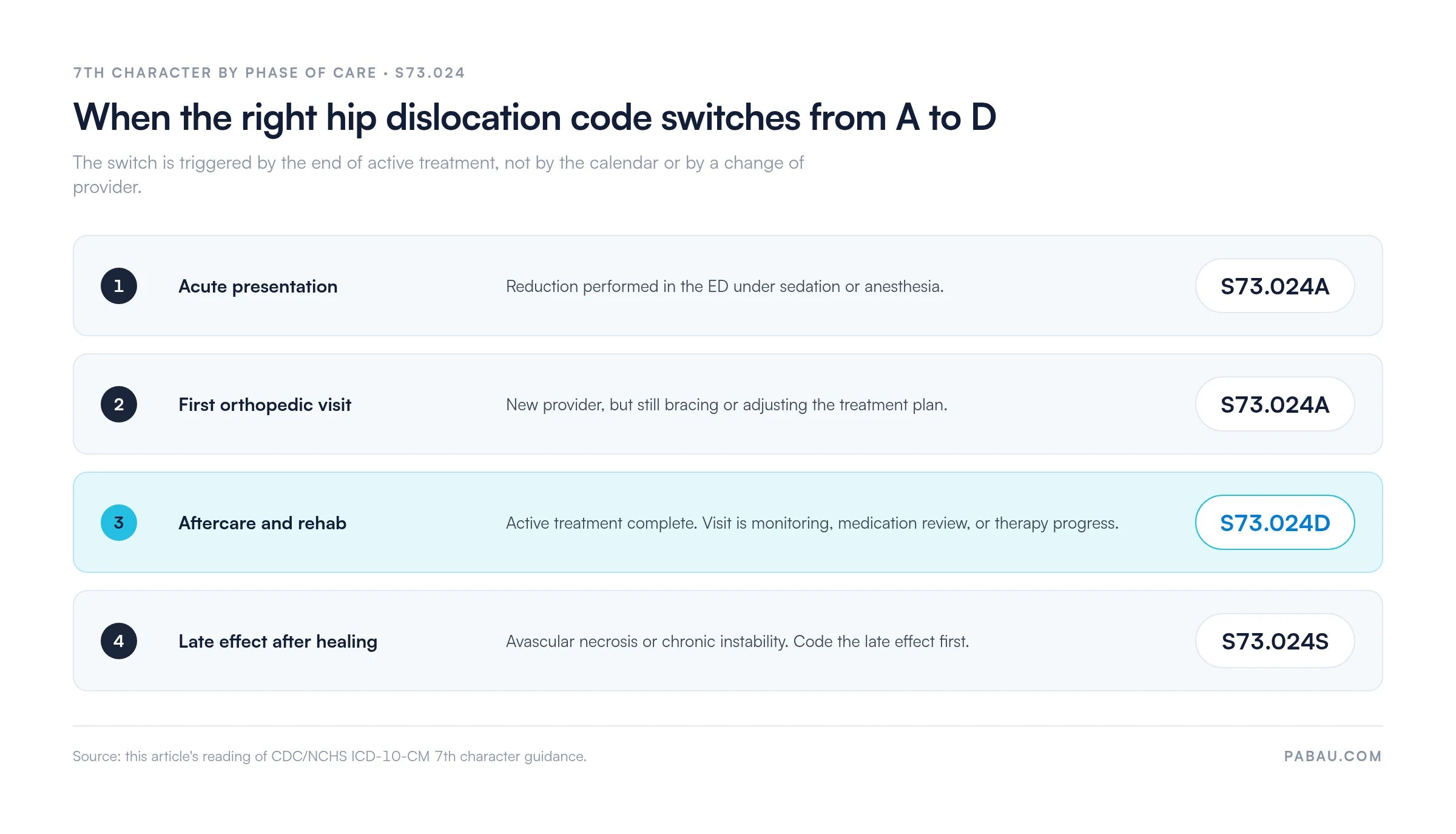
The A/D/S logic is the same across every traumatic injury code in chapter S00-T88. Fracture and sprain codes in the same block follow it too. When a chart covers several injuries, check each one against the wider ICD-10-CM codes index.
S73.024D sits within a nested hierarchy. Understanding each level helps coders confirm they have reached the most specific valid code before submitting a claim. The full tree for this code is:
Category S73 covers both dislocations and sprains of the hip joint and its ligaments. Only codes at the 7th-character level (S73.024A, S73.024D, S73.024S) are billable. The parent code S73.024 without a 7th character is non-billable and will be rejected.
Obturator dislocation is an anterior dislocation subtype where the femoral head displaces anteriorly and inferiorly, coming to rest near the obturator foramen. It accounts for a small proportion of all hip dislocations, which are predominantly posterior (roughly 90% of traumatic hip dislocations). Correct coding depends on the clinician documenting the dislocation direction explicitly. Anterior alone is not enough, because anterior dislocations split into obturator (inferior) and iliac (superior) subtypes.
Mechanisms typically involve forced abduction and external rotation of the hip, often from dashboard-type motor vehicle injuries or sports trauma. Presentation includes the leg held in abduction, flexion, and external rotation, which distinguishes it clinically from posterior dislocation (adduction, internal rotation, flexion). Treatment is closed reduction under sedation or anesthesia. Protected weight-bearing and physical therapy follow, and that is the phase S73.024D covers.
Records that carry injury type and laterality forward from the initial encounter cut coding errors at the follow-up visit.
S73.024D belongs to a family of closely related hip dislocation codes. Selecting the wrong sibling is the second most common billing error in this category, after 7th character misuse. The table below maps the key laterality and dislocation-type variants.
The following alternate clinical descriptions are mapped to S73.024D in the ICD-10-CM alphabetic index. Any of these terms in the medical record supports this code, provided the documentation also confirms right laterality and subsequent encounter status.
Four documentation elements must be in the medical record to support ICD-10 code S73.024D on audit. Missing any one of them gives a payer grounds for a medical necessity denial.
Structured records that carry injury type, laterality, and treatment history across visits make this task easier for clinicians and coders. Discrete fields also cut the time spent querying providers before a claim goes out. Practices working from free-text notes alone tend to lose the laterality or the encounter purpose. Those two elements are the ones most often missing from denied claims.
Run a pre-billing documentation check specifically for 7th character codes. Before submitting any S73.024D claim, confirm the chart names the dislocation subtype and the laterality. It also needs a reference to prior active treatment and the purpose of today’s visit. A four-point checklist takes under two minutes and prevents the most common denial reason for this code family.
S73.024D is not a high-volume code. Claims in the hip dislocation category still attract close payer scrutiny, because injury severity and treatment costs are high. The tips below address the most common submission errors.
A clearinghouse that validates codes before claims reach the payer catches 7th character mismatches early. Practice management software like Pabau routes US claims through Claim.MD, which runs eligibility checks and screens each claim against payer edits. Reading the remittance advice that comes back also tells a coding team which element failed. The fix then lands in the record rather than in a blind resubmission.
Track the reason codes attached to S73.024D rejections over a 90-day period. The pattern usually shows whether the problem is 7th character selection, missing documentation, or a payer-specific coverage edit. Once the pattern is known, the remedy is a documentation change rather than a resubmission queue. Building clean claim habits at the documentation stage costs less than correcting denials afterward. The WHO ICD-10 browser holds the international framework that the US ICD-10-CM adaptation is built on.
Orthopedic practices, sports medicine practices, and rehabilitation providers share one problem on hip dislocation follow-ups. ICD-10 code S73.024D has to be supported by documentation from a prior encounter, often made at a different facility. Where systems are disconnected, or notes are free text, that context goes missing between visits.
Pabau’s claims management software ties clinical documentation to claim preparation. When a practitioner writes up a follow-up visit, the structured note captures injury type, laterality, and encounter context in discrete fields. The coder pulling that record already holds all four documentation elements in a form that maps onto the claim. Pabau’s Claim.MD integration reaches thousands of US payers, and it validates ICD-10 combinations against payer-specific edits before the claim is submitted.
In multi-location orthopedic and rehabilitation groups, patients move between sites between visits. Pabau’s multi-location record access lets the follow-up provider at any site open the initial treatment documentation. That removes the usual reason D is billed when A is still correct, which is a provider who could not see the prior record. To see how Pabau handles ICD-10 workflows in your practice, book a demo.

Pabau connects clinical documentation to claim preparation. The record supports the right ICD-10 code and the right 7th character every time.

The 7th character on S73.024D is decided by the state of treatment, not by the visit number or by which provider is holding the chart. Get that judgment right at the point of care and the claim follows. Get it wrong and no amount of resubmission fixes a note that never recorded the prior treatment.
The practical move is to make the four documentation elements a required step in the follow-up template, rather than something the coder chases afterward. Book a demo to see how Pabau captures injury type, laterality, and encounter purpose before the claim goes out.

Want the wider view of how coding fits the billing cycle? What is medical billing walks through the full path from patient encounter to payment.
Want to understand how clearinghouse validation works? How Claim.MD clearinghouse works explains how real-time eligibility and edit checks catch ICD-10 errors before claims reach the payer.
Looking to reduce denials across your practice’s full billing cycle? Denial management in healthcare outlines how to track, categorize, and remediate the most common claim rejection patterns.
ICD-10 code S73.024D is the billable diagnosis code for obturator dislocation of the right hip at a subsequent encounter. The patient has already received active treatment for the dislocation. This visit covers follow-up care such as monitoring, rehabilitation, or medication adjustment.
Yes. S73.024D is a billable, specific ICD-10-CM code valid for submission on HIPAA-covered transactions. It is part of the FY2026 code set and can be submitted directly on a claim without additional specification.
S73.024A is used for the initial encounter, when the patient is receiving active treatment for the obturator right hip dislocation for the first time. S73.024D is used for subsequent encounters, after active treatment has been rendered and the visit is for follow-up, monitoring, or rehabilitation. Using A when the patient has already been treated, or D for a first active treatment visit, is a claim error.
The 7th character D in ICD-10-CM denotes a subsequent encounter, meaning the patient has previously received active treatment for the condition coded. For traumatic injury codes in the S00-T88 chapter, D applies once the active treatment phase is complete. It covers follow-up visits for wound care, cast removal, medication adjustment, and rehabilitation.
Obturator dislocation is an anterior hip dislocation subtype where the femoral head displaces anteriorly and inferiorly toward the obturator foramen. It is less common than posterior dislocation and is typically caused by forced abduction and external rotation of the hip. The presentation includes the leg held in abduction and external rotation, distinguishing it from the adduction and internal rotation seen in posterior dislocation.
Use subsequent encounter (D) when the original condition is still being actively monitored or managed and the injury itself has not fully resolved. Use sequela (S) when the original injury has healed but a late effect persists and is now the focus of care. Avascular necrosis of the femoral head and chronic hip instability are the usual examples. For S, a separate code identifies the specific late effect.
Follow-up office visits for hip dislocation typically pair with evaluation and management CPT codes 99213 through 99215, depending on medical decision-making complexity. Physical therapy rehabilitation visits pair with therapeutic exercise, neuromuscular re-education, and other rehab procedure codes as appropriate to the services rendered. Verify current AMA CPT tables for specific pairing rules, as reimbursement amounts vary by payer and geographic locality.