ICD-10 Code Y76.0: Diagnostic obstetric and gynecological devices
ICD-10 Code Y76.0: Definition and billable status ICD-10 Code Y76.0 is a valid, ...

Last Updated: Oct 23, 2026
Billable Code Specific Code
S72.436N is the billable ICD-10-CM code for nondisplaced fracture of medial condyle of unspecified femur, subsequent encounter for open fracture type IIIA, IIIB, or IIIC with nonunion.
The 7th character N carries three clinical facts at once, and the record has to prove all three. Drop one and the claim comes back denied, because the code no longer matches the note.
Let Pabau's smart automation suggest the right codes, reduce claim denials, and keep your practice compliant—effortlessly.
Automate repetitive tasks and focus on what matters most—your patients.
Reduce coding errors and ensure compliance with the latest regulations.
Clean claims, fewer denials, and faster reimbursements.
Powerful insights and reporting to help your practice thrive.
HIPAA compliant SOC 2 certified GDPR-compliant Trusted by 4,000+ clinics worldwide

ICD-10 code S72.436N covers a nondisplaced medial condyle femur fracture, coded at a subsequent encounter after an open type III injury ends in nonunion.
The 7th character N stands for three facts at once. The record must show a subsequent encounter, an open type III fracture, and confirmed nonunion.
The sixth digit sets displacement and laterality together, so 1 through 3 are displaced codes and 4 through 6 are nondisplaced.
S72.436N is valid for HIPAA-covered transactions from October 1, 2025 through September 30, 2026. Check the CMS tabular list each fiscal year.
Practice management software like Pabau pre-fills the claim from the medical record and checks required fields before you send it.
According to the CDC/NCHS ICD-10-CM web tool, the code is billable for FY2026 and valid for all HIPAA-covered transactions. Its full clinical description reads: Nondisplaced fracture of medial condyle of unspecified femur, subsequent encounter for open fracture type IIIA, IIIB, or IIIC with nonunion.
The code is live for the current fiscal year, so the constraint is clinical rather than administrative. Three facts have to hold at the same time. The fracture was nondisplaced, the injury was an open type III, and the bone has stopped healing.
Here is the whole code in one view.
Every segment of the code encodes something specific. Misread one segment and you have submitted a different diagnosis. Here is what each position means.
Notice what the sixth digit is doing. Displacement is not set by the .43 subcategory, which covers displaced and nondisplaced fractures alike. It is set by the digit that follows.
S72.431 through S72.433 are displaced, and S72.434 through S72.436 are nondisplaced. That same digit also carries the side, which is why six codes look almost interchangeable in a code tree.
The grid below walks the two steps in order, so you can see how displacement, side, and healing status land you on one code.
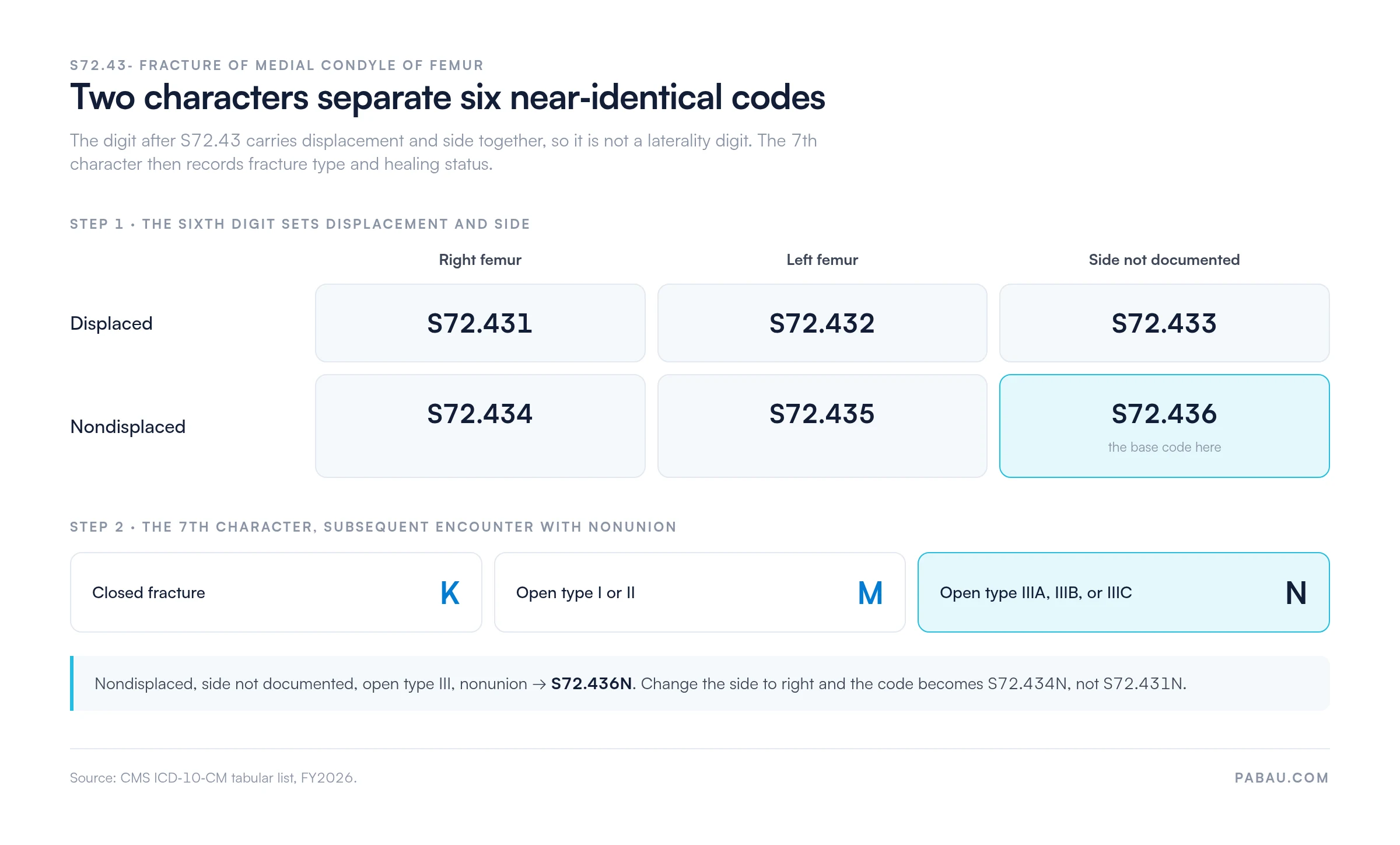
The 7th character N carries three pieces of information at the same time. All three have to be documented before the character applies.
Using N when only one or two of those conditions apply is a coding error. If the fracture healed routinely despite the open type III injury, character F is correct. Where healing is slow but nobody has called it a nonunion, J applies instead. N is reserved for confirmed nonunion.
The Gustilo-Anderson classification grades open fracture severity by wound size, soft tissue damage, and vascular injury.
Gustilo and Anderson published it in 1976, and Gustilo and colleagues refined the type III subdivisions in 1984. For S72.436N to apply, the injury must have been graded type IIIA, IIIB, or IIIC at initial treatment.
Coders cannot assign a Gustilo type themselves. The operating surgeon has to record the grade in the operative note. A wound described only as “large” or “contaminated” will not support the type III characters on its own.
Those characters are C, F, J, N, and R. Where the surgical documentation stops short of a grade, query the provider before coding.
Nonunion means the fracture has definitively failed to heal. Clinically it is confirmed when radiographic union has not occurred after roughly three to six months, with no progressive signs of healing on serial imaging.
The exact threshold shifts with the fracture site and with patient factors, so the treating physician sets it, not the coder.
ICD-10-CM then draws a three-way distinction among healing outcomes at subsequent encounters.
Malunion, coded with P, Q, or R, is a separate outcome. The fracture has healed, but in an abnormal position. Nonunion and malunion are mutually exclusive, so a fracture that consolidated poorly takes R rather than N.
Check the radiology report before assigning N. “Nonunion” should appear explicitly in the radiologist’s or surgeon’s documentation. “Delayed healing” or “healing is slow” does not meet the threshold. If the term nonunion is absent from the clinical record, query the treating provider.
S72.436N is a subsequent-encounter code, and encounter type is where fracture coding fails most often. The trigger is the purpose of the visit rather than the phase of treatment or the time elapsed.
That distinction comes straight from CMS ICD-10-CM coding guidance.
A patient transferred between facilities while still in active treatment keeps the initial-encounter character at the receiving facility. The subsequent range starts once active treatment gives way to routine management.
A worked example makes the switch concrete. A patient arrives with an open medial condyle fracture graded IIIB and goes to surgery that night. That admission is coded C for an initial encounter.
Five months later, imaging shows no union. The surgeon writes “nonunion of the medial condyle” in the note, and the side is never stated anywhere in the record. That visit is S72.436N.
Laterality and healing status drive almost every choice inside this family. The table below lists the alternatives coders reach for most often, and what separates each one from S72.436N.
The AAPC Codify ICD-10-CM lookup tool is useful for confirming a pick once laterality is documented.
If you need the neighboring femur and lower-limb entries, the wider set is indexed in our diagnostic codes library.
S72.436N cannot be assigned from incomplete notes. Seven elements have to appear in the medical record first. Miss one and the assignment turns into an audit risk, because the code claims more than the note proves.
When all seven are present, the assignment is defensible. When one is inferred instead of documented, it is not. Build the seven into your orthopedic note template and the query rate falls on its own.
These four mistakes cause most of the trouble with this code. Each one ends in either a denial or an audit flag.
Reworking a denied fracture claim always costs more than preventing it. If these denials are already stacking up in your queue, read our guide to denial management. It covers the appeal path and how to keep the backlog moving.
The code is only one field on the claim. Knowing where it sits in the sequence tells you where a denial actually came from.
In most orthopedic practices this still runs by hand. A coder reads the operative note, hunts for the Gustilo grade, and checks the healing status. Then they retype the code into a claim form and hope the required fields are all filled. Every hop between systems is another chance to transpose a digit.
Practice management software like Pabau removes some of those hops. Our claims management software pre-fills the claim from the medical record, so the diagnosis and charge lines carry what the chart already holds.
Full ICD-10-CM and CPT lookup libraries sit behind a search icon inside the claim, refreshed with each official release. You can confirm S72.436N against the current list without opening a second tab.
It also checks that claim-required fields are complete before the send button unlocks. That catches the blank membership number or missing authorization that would otherwise bounce.
On the US pipeline it connects to Claim.MD for real-time eligibility checks, claim status tracking, and ERA remittance posting. What it will not do is tell you which 7th character the note supports. That judgment stays with the coder, which is why the five-line check above still matters.

Pabau’s claims management software pre-fills the claim from the medical record, checks required fields, and connects to Claim.MD for eligibility checks and ERA posting. See how it fits your orthopedic billing.

S72.436N is a narrow code, and the narrowness is the point. Three facts have to line up in the record before the character N is defensible, and two of the three come from someone else’s note. So the coder’s real job on this code is knowing when to stop and query.
If you take one habit away from this page, make it that query. Defaulting to unspecified laterality is quicker today and expensive later. A code that claims less than the chart supports still reads as unsupported to an auditor. The five-line check takes under a minute, and it catches the two errors that generate most of these denials.
Book a demo to see how Pabau pre-fills fracture claims from the medical record and flags the fields a payer will ask for.

Need to understand the full ICD-10 revision cycle? What is medical billing explains how ICD-10-CM updates flow from CMS into your billing workflow each fiscal year.
Seeing repeated denials on fracture claims? Revenue cycle management fundamentals covers the denial appeal process and how to build a cleaner claim pipeline.
Want to read a denial before you appeal it? Denial codes in medical billing decodes the reason codes payers return on fracture and encounter-type errors.
Yes. When treatment of the nonunion is the reason for the visit, S72.436N is the condition chiefly responsible for the encounter, so it is reported first. Any additional codes for comorbidities or complications follow it.
No. S72.436N is for traumatic fractures. A fracture caused by disease or repetitive load is coded from category M84 instead, which separates stress fractures from pathologic ones.
Not quite. S72.4 covers the whole lower end of the femur, including supracondylar and bicondylar fractures. The medial condyle is one site within it, coded at S72.43, so a chart that says only “distal femur” does not support S72.436N.
The character always reflects the status documented at that visit. Once the surgeon records union after nonunion repair, an open type III fracture moves to F for routine healing. Nothing about the base code S72.436 changes.