

ICD-10 code S61.201A: Open wound of left index finger without nail damage
ICD-10 code S61.201A covers a left index finger wound of unstated type ICD-10 co...

Last Updated: Oct 16, 2026
Billable Code Specific Code
S72.111P is the billable ICD-10-CM code for displaced fracture of greater trochanter of right femur, subsequent encounter for closed fracture with malunion.
The 7th character does most of the work here. P packs three facts into one letter: the visit is a follow-up, the fracture was closed, and the bone healed crooked. Swap that letter for D, K, or Q and the claim describes a different patient.
Let Pabau's smart automation suggest the right codes, reduce claim denials, and keep your practice compliant—effortlessly.
Automate repetitive tasks and focus on what matters most—your patients.
Reduce coding errors and ensure compliance with the latest regulations.
Clean claims, fewer denials, and faster reimbursements.
Powerful insights and reporting to help your practice thrive.
HIPAA compliant SOC 2 certified GDPR-compliant Trusted by 4,000+ clinics worldwide

ICD-10 code S72.111P covers a displaced fracture of the right greater trochanter. It applies at a subsequent visit, after the closed fracture healed with malunion.
The 7th character P carries three facts at once: a subsequent encounter, a closed fracture, and malunion healing.
Malunion means the bone healed in poor alignment, so it takes P. Nonunion means it never healed, and that takes K.
There is no S72.119. Under S72.11, unspecified laterality is S72.113 when displaced and S72.116 when it is not.
Practice management software like Pabau puts a searchable ICD-10 library in the record and checks required claim fields before submission.
S72.111P is not a new code. It has been valid since ICD-10-CM took effect on October 1, 2015, and it carries through to the FY2026 code set.
You can check the current files on the CMS ICD-10 code release page. Because it is billable and specific, it stands on its own on a claim.
Every segment carries a specific clinical meaning, and reading them in order decodes any S72 variant quickly.
Look closely at what the 6th character does. It carries displacement and side together, so 1 means displaced and right, while 4 means nondisplaced and right. That is why S72.119 does not exist.
The habit of reading 9 as unspecified comes from other subcategories and does not apply here. Under S72.11, an unspecified femur is S72.113 when the fracture is displaced and S72.116 when it is not.
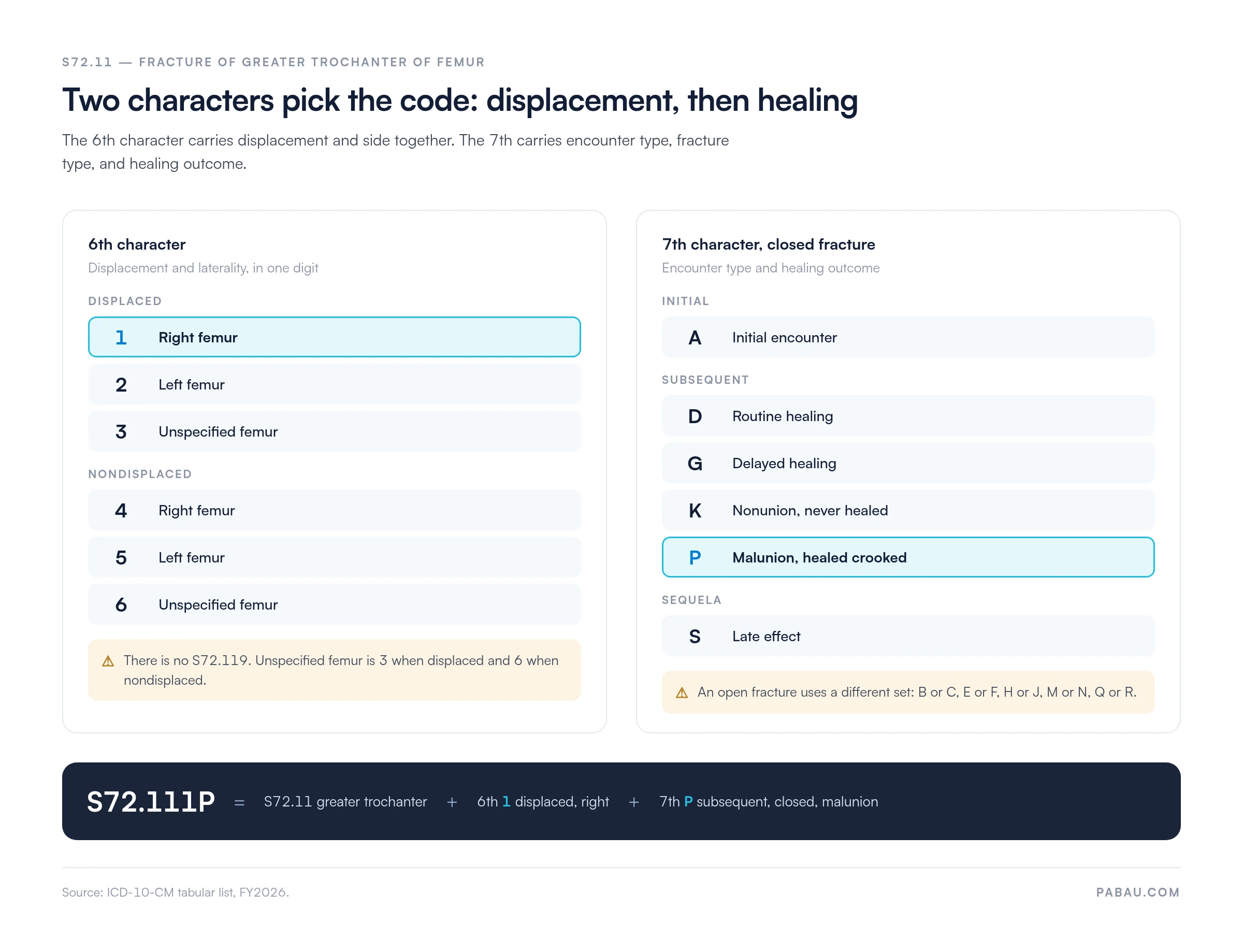
Three facts sit inside that one letter: encounter type, fracture type, and healing outcome. Get any of the three wrong and the code is wrong, even though the first six characters are perfect.
Here is the full set that applies to S72.
Notice the pattern in the closed column. A, D, G, K, and P all describe closed fractures, and each one names a different phase or outcome.
Character P applies only to closed fractures. If the original injury was open Type I or II, the malunion character is Q instead. For open Type IIIA, IIIB, or IIIC with malunion, it is R.
The code sits at the bottom of a clean parent-to-child chain, and only the bottom rung is billable. According to the CDC/NCHS ICD-10-CM web tool, the path runs as follows.
None of the parent codes are billable by themselves. A claim submitted at S72, S72.1, or S72.11 comes back as non-specific. The full seven characters are what make the code valid, and the 7th is not optional padding.
Both options live under the same subcategory. S72.11 covers displaced and nondisplaced fractures of the greater trochanter, and the 6th character separates them. S72.14 is a different injury altogether, an intertrochanteric fracture, so it is not the nondisplaced counterpart to anything in S72.11.
That distinction still needs explicit physician documentation. A radiology report noting a fracture, without characterizing displacement, does not support either branch on its own.
The ICD-10-CM Official Guidelines for Coding and Reporting settle the ambiguous case for you. A fracture documented without displacement status is coded to displaced.
So S72.111P is more often the correct pick than S72.114P when the note is thin. Querying the physician still beats defaulting, because the default is a fallback rather than a finding.
The S72.111 stem shares its 7th character options with the left-sided and unspecified variants. Picking between them is a documentation-matching exercise, not a clinical judgment call.
That one line is the whole distinction, and mixing the two up is the most consequential error on an S72 claim. The two states take different 7th characters, and they can trigger different payer review paths.
Neither state can be inferred from how the patient feels. A coder cannot read pain or a limp as malunion. The treating physician has to write the healing status down, usually with imaging behind it, before either character goes on a claim.
Run a quarterly audit on your S72 subsequent-encounter claims. Filter for 7th characters P and K, then open the physician note behind each one. You are looking for the word malunion or nonunion in the physician’s own wording, with imaging to back it up. A healing-status character with no note behind it is the first item a reviewer pulls.
Six elements have to be traceable to the record, one for each decision the code makes. Work down the list and the code either holds up or it does not.
The path is short, and only two steps involve any judgment.
A worked example makes the sequence concrete. A patient returns a few months after a fall, and imaging shows the right greater trochanter united out of position. The physician writes “malunion” in the note.
The claim then carries S72.111P alongside the procedure code for the radiograph. The original injury was closed, so P stays correct no matter how much time has passed.
Before you submit, five quick checks catch almost every avoidable rejection:
S72.111P is a diagnosis code, so it needs a paired procedure code before the claim is complete. Which one depends on what happened at that visit, not on the fracture history.
Our reference library of CPT codes carries the full descriptors if you need to check one.
Two rows in that table are easy to swap by accident. 27244 is the plate and screw option, while 27245 is the intramedullary implant, so the operative note decides which one you bill.
Imaging is the usual companion at a malunion visit, and CPT code 73502 covers it. Payer coverage policies can still change which procedure codes are reimbursable next to S72.111P, so treat the rows above as typical rather than settled.
Longer-term help at home after a malunion falls outside CPT altogether. HCPCS code T1020 covers personal care services on a per diem basis, and state Medicaid programs are the usual payer.
Most of these are pattern errors rather than knowledge errors. They happen when a coder reaches for the code that was right last time.
None of that judgment disappears when the workflow goes digital. Coders still read the note in the physician’s language and turn it into ICD-10-CM specificity. What software can remove is the retyping, and retyping is where digits get transposed.
Practice management software like Pabau moves the lookup inside the record. Pabau’s claims management software carries ICD-10-CM, CPT, and HCPCS libraries of more than 20,000 codes, refreshed with each official release.
The claim form then pre-fills from the encounter itself. The procedure code attached to the service lands on the charge line, and the diagnosis slots are seeded from the patient’s recorded problem list.
Pabau also checks that the fields the payer requires are filled before the claim can be sent, including membership and authorization numbers.
In the US it routes through the Claim.MD clearinghouse, which adds eligibility checks, electronic remittance posting, and claim-status tracking. So fewer claims bounce on a blank field, and you see the reason faster when one is rejected.
One boundary is worth stating plainly. No part of that pipeline decides whether P is the right 7th character for your patient. It checks the claim for completeness, not the coding for clinical accuracy. The malunion call stays with the physician and the coder.

Pabau’s claims management software puts ICD-10-CM and CPT lookup inside the patient record. It pre-fills the claim from the encounter and checks required fields before you submit. See how it fits an orthopedic or physical therapy workflow.

S72.111P rewards a habit more than it rewards a lookup. Read the 6th character off the displacement statement, take the 7th from the healing statement, and the code assembles itself. Guess at either one and you have described a patient the note does not support.
The trade-off worth remembering is speed against a query. Sending a defaulted code today is quicker than asking the physician one question. A denial three weeks later costs far more than that question would have. Ask it.
If retyping codes between systems is where your fracture claims lose time, that is a fixable problem. Book a demo to see how Pabau keeps coding and claim submission inside the patient record.

Need a system for handling fracture claim denials? Denial management in healthcare covers the common rejection patterns and how practices build a response workflow.
Want to know what makes a claim clean the first time? Clean claim breaks down the fields a payer checks before it accepts a submission.
Curious how a clearinghouse routes ICD-10 claims? Claim.MD clearinghouse explains electronic routing, eligibility checks, and remittance processing.
Looking for a billing compliance framework? Medical billing compliance outlines the documentation standards and audit risk areas behind fracture claims.
Not in the way ICD-10-CM groups hip fractures. The greater trochanter is part of the proximal femur, so surgeons often call this injury a hip fracture. ICD-10-CM files it under S72.1, pertrochanteric fracture, apart from the femoral neck codes in S72.0. Code from the documented site rather than from the word hip.
No. The ICD-10-CM Official Guidelines state that aftercare Z codes are not used for injuries. Follow-up care for a fracture is reported with the acute injury code plus the subsequent-encounter 7th character. That is exactly what P does, so S72.111P stands on its own for the malunion visit.
For as long as the malunion is still being treated or monitored. ICD-10-CM sets no day count on subsequent-encounter characters, because they describe the phase of care rather than elapsed time. Once treatment finishes and only late effects remain, move to the sequela code S72.111S.
Yes. When the malunion is the reason the patient came in, S72.111P is sequenced first. It moves to a secondary position only if another condition drove the visit. Whichever diagnosis you sequence first should support the service billed at that encounter.



