ICD-10 Code Y76.0: Diagnostic obstetric and gynecological devices
ICD-10 Code Y76.0: Definition and billable status ICD-10 Code Y76.0 is a valid, ...

Last Updated: Oct 23, 2026
Billable Code Specific Code
S72.022Q is the billable ICD-10-CM code for displaced fracture of epiphysis (separation) (upper) of left femur, subsequent encounter for open fracture type I or II with malunion.
Let Pabau's smart automation suggest the right codes, reduce claim denials, and keep your practice compliant—effortlessly.
Automate repetitive tasks and focus on what matters most—your patients.
Reduce coding errors and ensure compliance with the latest regulations.
Clean claims, fewer denials, and faster reimbursements.
Powerful insights and reporting to help your practice thrive.
HIPAA compliant SOC 2 certified GDPR-compliant Trusted by 4,000+ clinics worldwide

ICD-10 Code S72.022Q is the official descriptor for a displaced fracture of the epiphysis (separation) (upper) of the left femur. It applies to a subsequent encounter for an open fracture of type I or II with malunion. The code is billable and valid for FY2026.
The 7th character Q is reserved for subsequent encounters where an open type I or II fracture has healed in a malunited position. The closed-fracture equivalent is P, not Q.
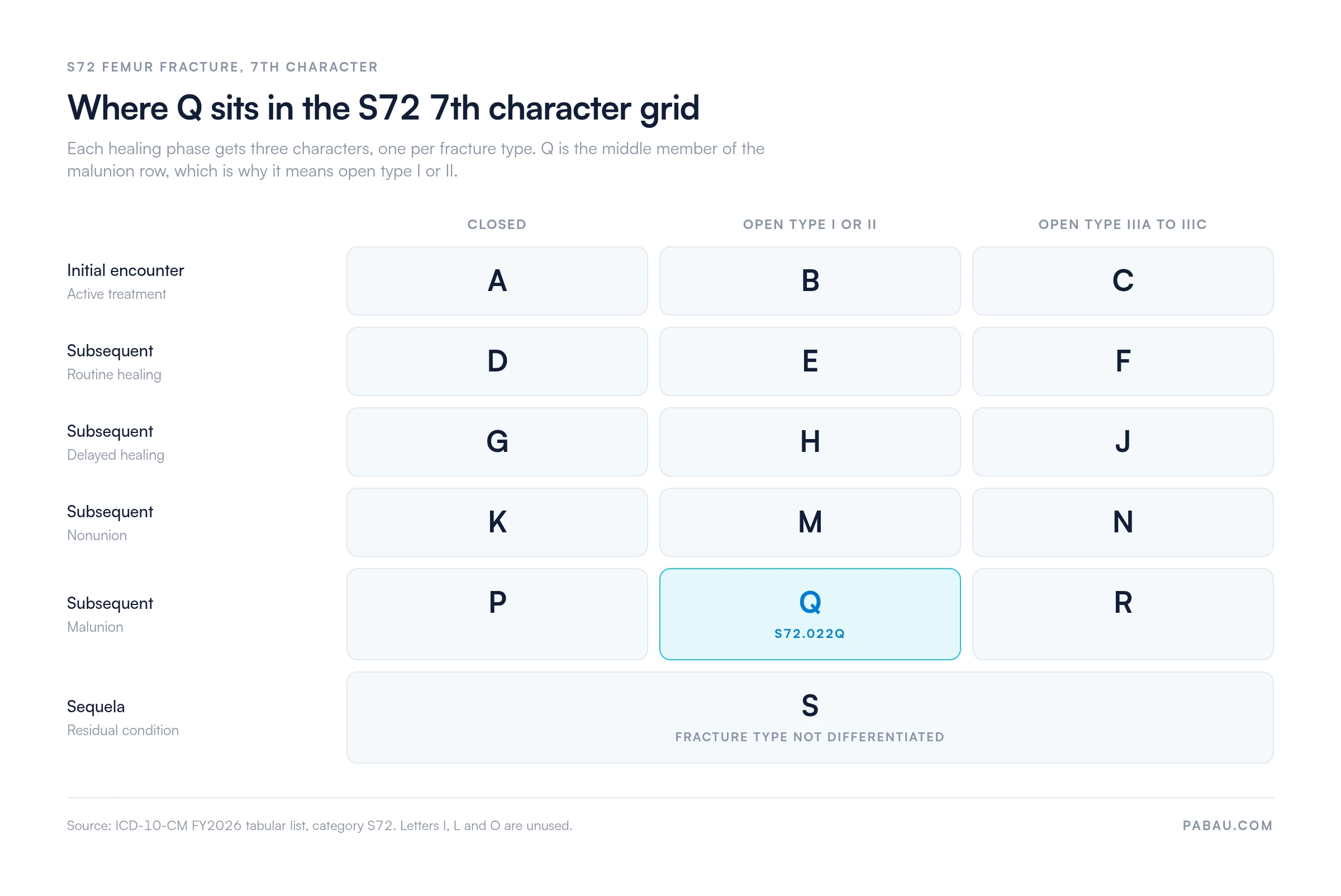
S72 extensions run in repeating triplets across each healing phase: closed, open type I or II, then open type IIIA to IIIC. That is why P, Q and R all mean malunion.
Accurate coding requires documentation confirming laterality, displacement, an open fracture of Gustilo-Anderson type I or II, the subsequent encounter stage, and evidence of malunion.
Pabau’s claims management software helps orthopedic and physical therapy practices submit S72.022Q claims accurately through the Claim.MD clearinghouse integration.
ICD-10 Code S72.022Q is a billable, specific ICD-10-CM code valid for the FY2026 fiscal year, effective October 1, 2025. It reports a displaced fracture of the epiphysis (separation) (upper) of the left femur at a subsequent encounter. So the original fracture was open, graded type I or II, and it has since healed with malunion.
Per the CMS ICD-10-CM code set, S72.022Q sits within the injury chapter (S00-T88). It also falls under the hip and thigh injury range (S70-S79), and specifically within S72, fractures of the femur. So the code is maintained jointly by CMS and the National Center for Health Statistics (NCHS) via the official ICD-10-CM tool.
Every character in S72.022Q carries clinical meaning. So reading the string segment by segment is how coders catch a wrong character before the claim goes out.
Displacement and side are encoded together in the 6th character rather than in separate positions. Within S72.02, the values 1, 2 and 3 mean displaced right, displaced left and displaced unspecified. Likewise, the values 4, 5 and 6 mean nondisplaced right, nondisplaced left and nondisplaced unspecified. So S72.025Q is the nondisplaced left match for this code, and S72.021Q is the displaced right one.
The 7th character causes most S72 coding errors: its extensions run in repeating triplets, not the simpler A, D, G, K, P, S pattern used elsewhere. Each healing phase gets three characters, one each for closed, open type I or II, and open type IIIA-IIIC fractures. The same triplets run through every S72 subcategory. A displaced left subtrochanteric fracture that was open type I or II and is healing routinely takes S72.22XE.
Q is the middle member of the malunion triplet P, Q, R, so it carries the open type I or II reading. The grid below plots every S72 extension by healing phase and fracture type.
Per the ICD-10-CM Official Guidelines, a subsequent encounter applies once the patient has received definitive treatment and is now in routine follow-up care. The open or closed status refers to the original fracture, not today’s skin condition — so a long-healed wound does not turn an open fracture closed, which affects whether the claim passes a payer’s edits.
Because Q is an open fracture character, the grade of the original open injury decides whether Q is correct or whether R applies instead. ICD-10-CM uses the Gustilo-Anderson classification, which grades open fractures by wound size, contamination and soft tissue damage.
Types I and II map to the Q character for malunion. Types IIIA, IIIB and IIIC map to the R character instead. If the provider documents an open fracture but never records a Gustilo grade, the Official Guidelines set a default: the coder uses the type I or II characters. So that default makes Q the workhorse open fracture extension in practice, and it is also why so many charts need a query before the grade can be trusted.
Malunion means the fracture has healed, but in an unacceptable anatomical position. Bone fragments united, unlike nonunion, where they never bridged. The alignment, however, is functionally or structurally abnormal.
For S72.022Q, the physician’s documentation must confirm malunion explicitly. For example, radiographic evidence such as an X-ray or CT showing bony union in malalignment, plus a clinical note describing the functional consequence, supports the Q designation. Without that documentation, a coder cannot choose Q over the routine-healing character. So malunion is a common audit trigger in orthopedic billing, and reviewers often flag codes unsupported by imaging reports.
Ask providers to record two things in the same sentence: the Gustilo grade of the original open fracture and the healing complication. A note reading ‘open type II femoral epiphyseal fracture, now malunited on imaging’ resolves both halves of the 7th character at once. That single phrasing is the fastest way to stop S72.022Q claims being queried on audit.
ICD-10 Code S72.022Q belongs to a family of related codes that differ by one variable each. Picking the wrong sibling is the second most common error, after 7th character mistakes.
The AAPC Codify ICD-10-CM lookup and ICD List both provide the full S72 hierarchy with crosswalk tools for complex multi-fracture encounters. Pabau’s ICD-10-CM code library covers the neighboring categories a femur fracture chart often needs, including external cause codes.
The upper femoral epiphysis is the growth plate region at the proximal end of the femur. In skeletally immature patients, this is where slipped capital femoral epiphysis, or SCFE, occurs. But in adults, epiphyseal fractures of the upper femur typically follow high-energy trauma, or arise in bone already weakened by disease.
An open fracture at this site is uncommon. It almost always follows high-energy trauma, such as a motor vehicle collision or a fall from height. That matters for the clinical picture as well as for coding, because open proximal femoral fractures carry a higher infection risk and a higher rate of problems while healing. That is exactly why the malunion characters exist as a separate group.
A displaced fracture means the bone fragments have shifted out of their normal anatomical alignment. For coders, displacement is established by the treating clinician in the encounter documentation. You cannot infer it from imaging reports alone, because the physician must describe the fracture as displaced. So many of these patients go on to physical therapy or rehabilitation, where each visit is another subsequent encounter to code.
Five documentation elements must all be present before a coder can assign S72.022Q with confidence, and missing any one leaves the code open to challenge.
The open fracture element is hardest to prove, since the original injury is often documented elsewhere — an emergency department record, a transfer note, or an operative report from another facility. That history must carry forward into the subsequent encounter note, or the coder has no basis for choosing an open fracture character.
Coders should query the treating physician if any of these five elements are missing or unclear, since a query at the point of encounter costs far less than a payer audit. Practices using claims management software with built-in documentation checklists can add these five elements to their encounter templates.
Nearly every error with this code involves swapping in a neighboring 7th character. So the list below runs from the most common mistake to the least.
S72.022Q is valid for HIPAA-covered electronic transactions and can be submitted for reimbursement in FY2026. But for inpatient stays, the MS-DRG assignment depends on the principal diagnosis and the full set of secondary codes reported, so it cannot be predicted from this code alone. Instead, verify grouping against the current MS-DRG definitions manual rather than assuming an aftercare DRG.
For outpatient billing, S72.022Q typically accompanies CPT procedure codes for fracture care management, physical therapy or corrective osteotomy. The diagnosis code rarely drives prior authorization on its own, but the associated procedure codes often do. So practices should verify eligibility before each subsequent encounter visit. Pabau’s Claim.MD clearinghouse integration provides real-time eligibility verification for S72.022Q claims across thousands of US payers, and it also supports electronic remittance advice, or ERA.
Building a clean claim for fracture aftercare codes starts well before submission. So flagging the 7th character at the charge capture stage catches a P-for-Q swap while the note is still open. Corrected and secondary claims remain available afterwards, but reworking a denial still costs the practice more than checking one character did.
Practices matching legacy claims may need to map S72.022Q back to its ICD-9-CM equivalent. The General Equivalence Mappings, or GEMs, published by CMS, provide the official crosswalk. But ICD-9-CM had far less detail than ICD-10-CM, so the codes below are close matches rather than exact equivalents.
In ICD-9-CM, malunion was reported as a complication code alongside the fracture site code, rather than folded into the fracture code itself. Open and closed status also sat in a different character position entirely. So this structural difference means one-to-one crosswalk precision is not possible, and coders should review the CMS GEMs files directly when matching legacy records. ICD-10-CM instead folds site, fracture type and healing complication into a single code. That is one reason accurate 7th character selection carries more weight than ICD-9 coding decisions did.
When reconciling ICD-9 to ICD-10 for orthopedic malunion cases, check both the forward GEMs mapping and the reverse. GEMs are approximate by design. A single ICD-9 code may map to dozens of ICD-10 codes once the open, closed and healing-status characters are expanded. Read the clinical record to pick the most specific match, not the first GEMs suggestion.
In most orthopedic practices, the 7th character is decided twice. A clinician writes the note, then a coder rereads it days later, often without the emergency department record that first established the fracture as open. So working from the follow-up note alone is how P, Q and R get swapped, and it is why fracture aftercare claims come back.
Practice management software like Pabau keeps the whole injury history in one place. The original injury details, the Gustilo grade, the imaging that confirmed malunion and the diagnosis code all live on the same patient record. So the coder works from the full history rather than a single follow-up note. Custom encounter templates can also prompt for laterality, displacement, fracture type and healing status before the note is signed.
From there, claims go out through Pabau’s Claim.MD clearinghouse integration with real-time eligibility checks and automated ERA posting. As a result, fewer codes are corrected after submission, and fewer encounters need a query after the fact. So the result is a shorter path from a signed note to a paid claim.

Pabau connects with the Claim.MD clearinghouse to submit ICD-10 coded claims to thousands of US payers, with real-time eligibility checks and automated ERA processing. Fewer denials, faster reimbursement.

Malunion coding is where orthopedic billing gets detailed. ICD-10 Code S72.022Q is valid for FY2026 and billable for one specific scenario: a displaced epiphyseal fracture of the upper left femur, seen at a subsequent encounter, where the original fracture was open, graded type I or II, and has healed in malalignment. So read the 7th character as a position in a triplet, not as a single letter, and the closed-versus-open distinction stops being a guess. Closed malunion is P, open type I or II is Q, and severe open malunion is R.
Pabau’s claims management software and Claim.MD clearinghouse integration give orthopedic and rehabilitation practices the tools to submit S72.022Q claims accurately the first time. Book a demo to see how Pabau handles fracture aftercare billing workflows from documentation through to electronic remittance.

Want fewer fracture claims coming back? Denial management in healthcare sets out how to work denials by reason code and stop the same error repeating.
Want to reduce claim denial rates across your practice? Electronic remittance advice (ERA) processing explains how automated ERA workflows identify denial patterns and accelerate payment reconciliation.
Looking for a complete billing compliance framework? What is revenue cycle management outlines the full RCM cycle from coding through reimbursement for outpatient and orthopedic practices.
ICD-10 Code S72.022Q is a billable ICD-10-CM code describing a displaced fracture of the epiphysis (separation) (upper) of the left femur. It applies at a subsequent encounter for an open fracture of type I or II that has healed with malunion. The code is valid for FY2026 claims under HIPAA-covered electronic transactions.
Yes. S72.022Q is a billable, specific ICD-10-CM code valid for the FY2026 edition, effective October 1, 2025. It can be used as the primary or secondary diagnosis code for reimbursement purposes in HIPAA-covered claims.
Use a subsequent encounter designation once the patient has received definitive treatment and is now receiving routine care during healing or recovery. This includes fixation monitoring, physical therapy follow-ups, hardware removal visits, and outpatient rehabilitation appointments related to the original fracture.
Malunion means the fracture healed, but in a malaligned position. Nonunion means the fracture never united, with no bony bridging across the fracture site. For an open type I or II femur fracture, malunion takes the 7th character Q, while nonunion takes the M character. Both selections require clinical and radiographic documentation.
The closest codes are S72.022P for the same malunion after a closed fracture, and S72.022R for malunion after an open type IIIA to IIIC fracture. Also close are S72.022M for nonunion of the same open fracture, S72.021Q for the right femur, and S72.022B for the initial encounter.