

ICD-10 Code S42.444P: Medial epicondyle fracture, right humerus
ICD-10 Code S42.444P: full descriptor and code validity ICD-10 Code S42.444P car...

Last Updated: Oct 13, 2026
Billable Code Specific Code
S70.222S is the billable ICD-10-CM code for blister (nonthermal), left hip, sequela.
S70.222S sits in category S70, superficial injury of hip and thigh. That category belongs to the S70-S79 block, injuries to the hip and thigh. Those codes follow CMS ICD-10-CM coding guidelines, and the National Center for Health Statistics maintains the classification.
Let Pabau's smart automation suggest the right codes, reduce claim denials, and keep your practice compliant—effortlessly.
Automate repetitive tasks and focus on what matters most—your patients.
Reduce coding errors and ensure compliance with the latest regulations.
Clean claims, fewer denials, and faster reimbursements.
Powerful insights and reporting to help your practice thrive.
HIPAA compliant SOC 2 certified GDPR-compliant Trusted by 4,000+ clinics worldwide

S70.222S is a billable ICD-10-CM code for blister (nonthermal), left hip, sequela. It has been valid on CMS-1500 and UB-04 claims since ICD-10-CM took effect in 2015.
The 7th character ‘S’ marks a sequela encounter. That means a condition arising from a prior injury, not one that is active or still healing.
Documentation must link the current condition to a prior nonthermal blister of the left hip. Without that link, payers reject the sequela designation.
Pabau’s claims management software supports ICD-10 code validation and claim submission through its Claim.MD clearinghouse integration. Claim.MD checks format and completeness, and it does not select codes.
ICD-10 Code S70.222S describes a nonthermal blister of the left hip treated as a sequela. A sequela is a late effect or complication of a prior injury, not an active injury still under treatment.
The code is billable and specific under ICD-10-CM. It supports reimbursement on its own, with no parent or placeholder code alongside it.
Nonthermal blisters differ from burns or heat-related blisters. They arise from friction, pressure, or mechanical trauma, not from temperature exposure. A thermal blister falls under a different code category entirely, so the distinction decides which code you reach for.
The CDC/NCHS ICD-10-CM web tool confirms S70.222S as valid for the 2026 coding year. No annual edit has changed its description or its billable status.
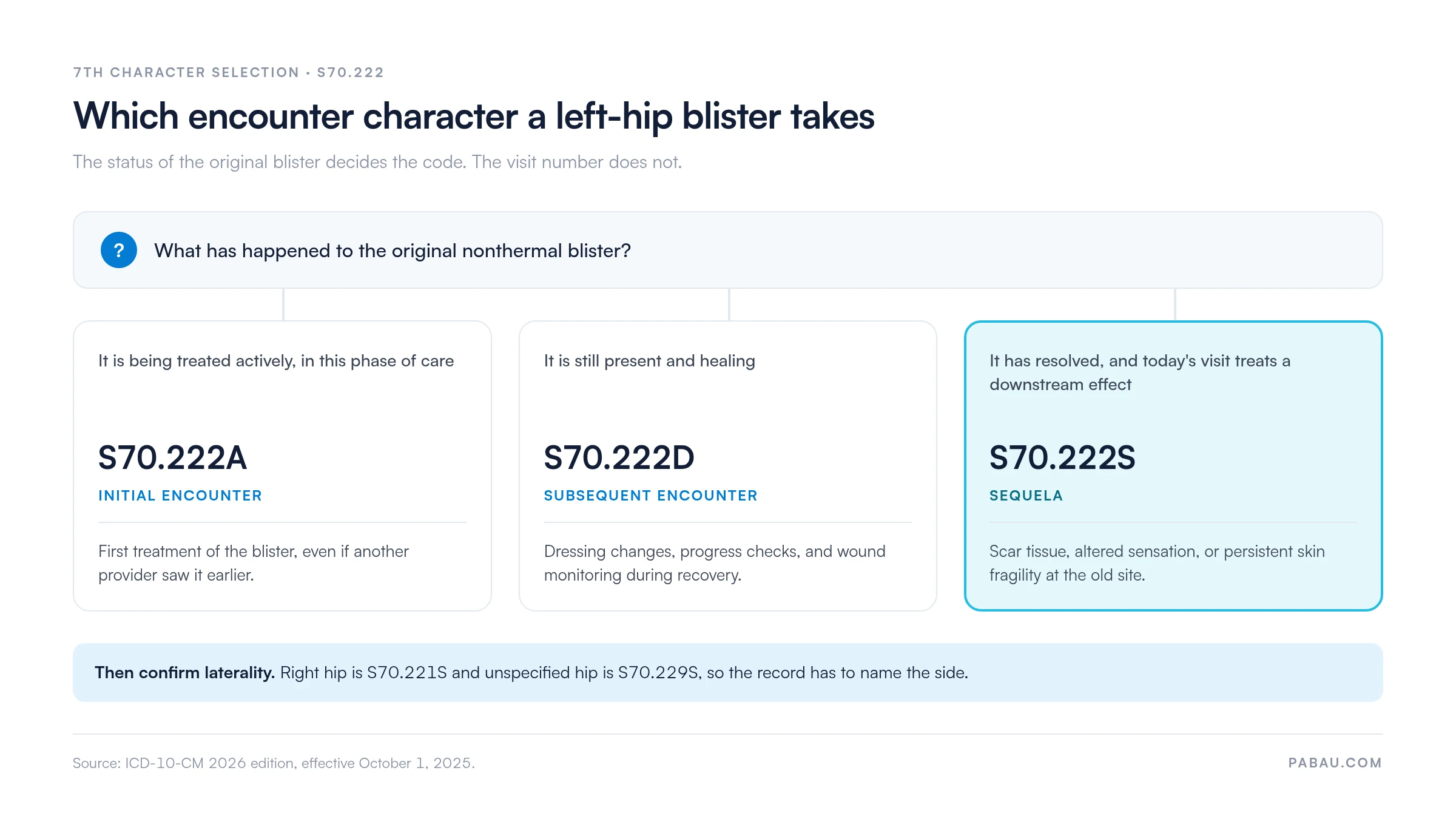
ICD-10-CM injury codes in the S00-T88 chapter require a 7th character extension to indicate the type of encounter. For S70.222, three options exist. The 7th character is not optional. Without it, the code is incomplete and non-billable.
The ‘S’ character is the most frequently misapplied of the three. Coders sometimes use it interchangeably with ‘D’ (subsequent), but the clinical distinction is significant. A subsequent encounter (D) means the blister itself is still present and healing.
A sequela encounter (S) means the original blister has resolved, and a residual condition now exists because of it. Using ‘S’ while the blister is still active creates a coding error that payers audit.
When you are torn between ‘D’ and ‘S’, ask whether the original injury has resolved. Choose ‘D’ while the blister is still present or healing. Choose ‘S’ once it has fully healed and today’s visit treats a downstream complication. Document that resolution explicitly in the record to support the sequela designation.
The encounter-type decision governs which of the three S70.222 variants applies. It turns on the patient’s current status in relation to the original injury, not on the diagnosis alone. The chart below routes each case to its character.
Per AAPC ICD-10-CM guidance, sequela codes are reported alongside the sequela condition code itself. The sequela code (S70.222S) identifies the nature and cause of the late effect. An additional code for the residual condition may also apply, such as a scar or nerve sensitivity. It depends on what the clinician treats at this visit.
S70.222S sits within a structured hierarchical path in the ICD-10-CM classification system. Understanding the parent structure helps coders confirm they are at the correct level of specificity. It also surfaces any coding note that a parent category carries down.
Laterality enters the code at the sixth character, which is why S70.22 carries no side and S70.222 does. The S70 category covers only superficial injuries.
More severe hip injuries fall under other categories in the S70-S79 block, including fractures, dislocations, and muscle or tendon damage. Superficial injury codes are often secondary diagnoses when a structural injury is the primary complaint.
Sequela coding carries a heavier documentation burden than initial or subsequent encounter coding. The medical record must support four specific elements for S70.222S to pass payer scrutiny.
Sequela documentation belongs inside the billing workflow rather than after it. When the intake form prompts the clinician for prior injury details, the coder has the causal link on file. That happens before anyone builds the claim.
Coding software and electronic health records often allow search by synonym or alternate clinical description. The following terms map to S70.222S and may appear in documentation or coding lookups.
These synonyms are clinically equivalent to the official description. When a provider documents ‘late effect of friction blister, left hip’, the correct code is S70.222S. A coding tool that indexes synonyms helps confirm an assignment made from plain-language documentation.
S70.222S is paired with CPT procedure codes reflecting the care delivered during the encounter. Because this is a sequela code, the visit usually involves evaluation and management, wound assessment, or scar management rather than acute wound treatment.
Burn dressing codes such as 16020 do not belong on this claim, because a nonthermal blister is not a burn. That is the same thermal distinction the code description draws, and payers apply it on the procedure side too.
CPT pairing appropriateness is payer- and context-dependent. A pairing that is clinically accurate in one scenario may trigger a medical necessity review under another payer’s policy. Always verify against the applicable Local Coverage Determination before submitting. Pairing S70.222S with an E&M code is the most common billing pattern here, usually 99213 or 99214.
Sequela codes introduce billing considerations that differ from standard injury encounter codes. Getting these right reduces claim rejections and avoids post-payment audits.
Practices submitting claims electronically can catch sequela errors before the payer sees them. Practice management software like Pabau runs that check as the claim goes out. Pabau’s claims management software validates ICD-10 codes against CMS-accepted code lists. An incomplete code such as S70.222 with no 7th character is flagged rather than rejected.
S70.222S belongs to the S70.22x family, which covers nonthermal blisters of the hip by laterality and encounter type. Coders look up sibling codes alongside S70.222S to verify laterality, or when documentation describes bilateral involvement.
ICD-10-CM guidelines require the most specific laterality available. Using S70.229S when the record clearly documents left-side involvement is a documentation-to-coding mismatch that invites payer audits. The wider ICD-10-CM code library applies the same laterality rule across other injury categories. Review denial patterns across these sibling codes with a structured claim denial management process, so a systematic error surfaces before it repeats.
Sequela coding errors are rarely random. They cluster in three places.
Each one has a workflow fix rather than a training fix. Platforms that tie coding to clinical documentation handle the first two. When the clinician’s note prompts for prior injury details, the billing module can pull that note through. The coder then sees the clinical picture before choosing a 7th character.
Pabau’s Claim.MD clearinghouse integration handles the third. Claims run through a pre-submission check for format compliance, billable status, and completeness before they reach the payer. S70.222 with no 7th character is flagged there, before the payer can reject the claim. Billing teams working through high volumes of injury sequela codes spend less time on rework.

Pabau connects clinical documentation to claim submission through the Claim.MD clearinghouse, which validates ICD-10 codes before they reach the payer. See how it works for your practice.

S70.222S is a narrow code, and its narrowness is what makes it easy to get wrong. Fix the documentation and the code assignment follows. Ask the clinician to state that the original blister resolved, name the side, and say what today’s visit is treating.
The trade-off worth remembering is specificity. S70.229S will pass a format check. It also contradicts a record that names the left hip, and that mismatch is what auditors look for. Book a demo to see how Pabau validates injury sequela codes before a claim leaves your practice.

Need to understand clearinghouse claim validation? Claim.MD clearinghouse overview explains how electronic claim validation works between practice software and payers.
Want to reduce front-end claim rejections? Clean claim submission requirements covers the documentation and formatting rules payers check before adjudicating a claim.
Handling insurance eligibility before the visit? Insurance eligibility verification outlines how to confirm coverage details before submitting sequela claims.
S70.222S is a billable diagnosis code for a nonthermal blister of the left hip, coded as a sequela. The original blister has resolved, and the patient is being treated for a late effect of it. The ‘S’ 7th character marks that sequela encounter, separating it from initial (A) and subsequent (D) encounters.
Yes. S70.222S is a billable and specific ICD-10-CM code, valid on both CMS-1500 and UB-04 claim forms. It has been in ICD-10-CM since the code set took effect in 2015, and the 2026 edition carries it unchanged. No additional specificity code is needed to support reimbursement.
Four elements have to be in the record. A prior nonthermal blister of the left hip is documented. The original blister has resolved. The current condition is causally linked to that prior injury. The left hip is named explicitly. Missing any one of them leaves the sequela designation unsupported.
The ICD-10 code for a nonthermal blister of the right hip sequela is S70.221S. It follows the same 7th character rules and documentation requirements as S70.222S. Laterality is the only clinical distinction between the two codes.
The most common pairings are evaluation and management codes 99213 and 99214, used for sequela management visits. Wound care codes such as 97597 or 97602 apply when the late effect involves skin breakdown or fragility at the prior blister site. Burn dressing codes like 16020 do not apply, because a nonthermal blister is not a burn.




