ICD-10 Code Y76.0: Diagnostic obstetric and gynecological devices
ICD-10 Code Y76.0: Definition and billable status ICD-10 Code Y76.0 is a valid, ...

Last Updated: Oct 23, 2026
Billable Code Specific Code
S62.161S is the billable ICD-10-CM code for displaced fracture of pisiform, right wrist, sequela.
One detail decides the claim. The 7th character must be S, and not the D used for routine follow-up. Swap those two and the encounter reads as ordinary healing, which is a different clinical story and a different payer decision.
This page walks through how the code is built and which 7th characters are legal. It also covers the five sibling codes, and what the note has to prove.
Let Pabau's smart automation suggest the right codes, reduce claim denials, and keep your practice compliant—effortlessly.
Automate repetitive tasks and focus on what matters most—your patients.
Reduce coding errors and ensure compliance with the latest regulations.
Clean claims, fewer denials, and faster reimbursements.
Powerful insights and reporting to help your practice thrive.
HIPAA compliant SOC 2 certified GDPR-compliant Trusted by 4,000+ clinics worldwide

S62.161S is the billable ICD-10-CM code for a displaced fracture of the pisiform, right wrist, sequela.
The parent code S62.161 is not billable, because every S62 fracture code needs a 7th character.
Seven 7th characters are valid on S62.161, not three, and the full set is A, B, D, G, K, P and S.
The sixth digit carries displacement and side together, so there is no separate laterality digit and no 9.
Pair S62.161S with a code for the residual condition, and document the causal link in the assessment.
S62.161S is a valid, billable ICD-10-CM diagnosis code. Its official description is Displaced fracture of pisiform, right wrist, sequela. It holds for the FY 2026 code set, and it goes on claims to Medicare, Medicaid and commercial payers under HIPAA-covered transactions.
Strip the S off and you have S62.161, which no payer will accept.
Before a payer checks the code for you, the CDC/NCHS ICD-10-CM web tool confirms year-specific codes straight from the tabular list.
Read the code left to right and each segment adds one fact. The sixth digit is the one that trips coders up, because it does two jobs at once.
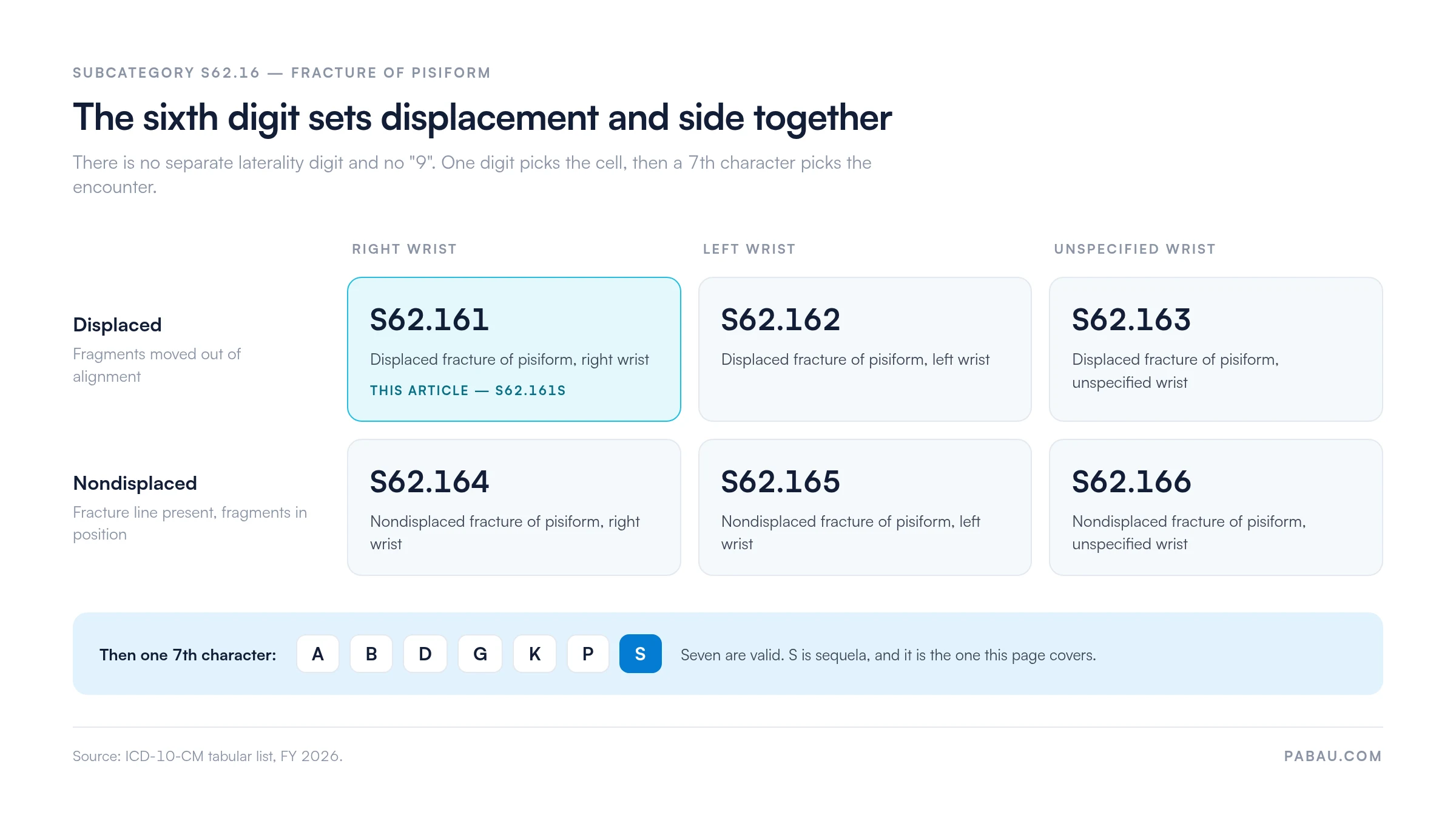
That sixth digit is where the confusion starts. It is not a plain laterality digit, and there is no 9 for an unspecified side. Values 1 to 3 cover displaced fractures, right then left then unspecified. Values 4 to 6 repeat that run for nondisplaced fractures. So S62.160 and S62.169 do not exist, however often they turn up in code lists.
The grid below maps all six codes onto the two axes the digit actually encodes.
ICD-10-CM defaults to displaced when the note stays silent. That default hands you a billable code, but it does not protect the claim. A payer that finds “displaced” coded with no imaging or operative note behind it can deny or ask for records. State displacement in the assessment and the question never comes up.
The pisiform is the smallest of the eight carpal bones. It sits in the proximal row on the ulnar side of the wrist, wrapped inside the tendon of the flexor carpi ulnaris. That makes it a sesamoid bone, so it transmits force rather than carrying axial load directly.
Most of these fractures follow a fall on an outstretched hand, a direct blow to the ulnar wrist, or repeated stress in sport. Racket sports, golf and baseball produce more than their share.
What comes after the fracture is the part that ends up on a sequela claim. Chronic ulnar-side wrist pain, grip weakness, pisotriquetral arthritis and flexor carpi ulnaris irritation all outlast the bone healing. Those residual problems are the reason to reach for S62.161S instead of the A or D variants.
Every fracture code in the S62 block needs a 7th character, and S62.161 has seven legal options. Plenty of reference pages show only A, D and S as options. That shortfall costs claims, because an open fracture or a nonunion gets forced into the wrong bucket.
Both characters cover active treatment, and the skin is what separates them.
B applies where the fracture site communicates with the outside, which is rare in the pisiform but possible after a crush injury. A covers the rest of the active phase.
Either one holds for as long as active treatment continues, even if a second provider takes over partway through.
All four describe a visit after active treatment ended, and healing status picks between them.
D is the routine case, covering a cast check, a therapy review or wound monitoring. G says healing is slower than expected. K says the fracture has not united at all, and P says it united crooked.
Coders who only know D under-report the harder cases, which matters because the note almost always says which one applies. A radiology line reading “nonunion at six months” is the difference between S62.161D and S62.161K.
S62.161S applies when the fracture is behind the patient but its consequences are not. Grip strength has not come back, the ulnar wrist still hurts, or the pisotriquetral joint has degenerated.
A sequela encounter takes two codes. One names the residual condition being treated, and S62.161S explains where it came from.
The choice between D and S is clinical, never chronological. Months elapsed since the injury do not enter into it. What the patient came in for does, and that is the single question to ask before picking a character.
The ICD-10-CM Official Guidelines for Coding and Reporting are maintained jointly by CMS and the National Center for Health Statistics. Four of their rules govern a claim like this one.
In practice, that first rule decides how the claim lines up. The wrist pain or the arthritis leads, and S62.161S follows it as the explanation.
The hierarchy earns its keep twice. It shows which digit to change when the documentation changes, and it shows which injuries belong somewhere else entirely.
Two notes sit at the S62 category level, and they behave differently. An Excludes1 note is a hard stop, while an Excludes2 note simply says the two conditions are separate.
Each of the other five S62.16 codes describes the same small bone. Displacement, side, or both is what changes. The sequela form of each one takes the same S in the seventh position.
One trap sits in that table. S62.164 is not the fallback for missing documentation, because the default runs the other way. Reach for a nondisplaced code only where the record confirms the fragments held position.
S62.163 and S62.166 are the ones to avoid whenever the chart names a side. Payers read an unspecified-side wrist code as a documentation problem, because almost every wrist X-ray is labeled.
Our ICD-10-CM code index covers the neighboring carpal subcategories, and the AAPC Codify lookup shows the full S62 range in one screen.
A sequela claim stands or falls on the causal link. Either the note draws a line from the old fracture to today’s problem, or it does not. Reviewers looking at S62.161S check for five specific elements.
Write the causal link in plain language. “Chronic ulnar wrist pain secondary to displaced pisiform fracture sustained [date]” belongs in the assessment, not just “wrist pain.” Reviewers looking at an S62.161S claim search for exactly that sentence, and missing it is the fastest route to a medical necessity denial.
Coding sits in the middle of this process, not at the end. Following one S62.161S claim from the exam room to the remittance shows where it tends to stop.
A scrubber catches the first two points on that list. Whoever reads the note has to catch the other three. That is why practices with a working denial management process see fewer of these claims come back.
Five errors account for most of the lost claims on displaced pisiform fractures. The list below runs in rough order of what each one costs.
Most of what goes wrong above happens between the note and the claim. The provider writes the causal link into the assessment. The coder reads it a day later, and the residual condition code gets left off because the two live in different systems.
Practice management software like Pabau keeps them in one record. Diagnosis codes attach to the treatment note as it is written, so the coder sees the causal sentence and the code side by side. Pabau’s software for billing teams then validates the diagnosis string before submission, which is where a missing 7th character shows up cheaply.
Claims go out through our Claim.MD integration, which reaches thousands of US payers for electronic submission and real-time eligibility checks. So problems on a sequela claim surface the same day. You correct a character instead of appealing a denial three weeks later.

Pabau attaches diagnosis codes to the treatment note and validates them before submission. Claims reach thousands of US payers through our Claim.MD integration, so sequela claims come back to you less often.

The hard part of S62.161S was never looking it up. It is proving, in the note, that today’s wrist problem traces back to a fracture that healed a year ago. Get that one sentence into the assessment and the code follows almost by itself.
Specificity cuts both ways, and that is the trade-off worth remembering. S62.161S claims displacement, a right wrist and a causal chain, so a reviewer can check all three. That is a good bargain where the record supports it, and an expensive one where it does not.
Sequela coding is also where any split between the clinical note and the billing screen shows up first. Book a demo to see how Pabau ties diagnosis coding to the note it came from.

Need to understand the full claims submission workflow? Claim.MD clearinghouse overview covers how electronic claim submission and payer connectivity work for US practices.
Managing denials on injury-related claims? Denial codes in medical billing explains common CARC denial reason codes and how to respond to them.
Want to understand clean claim requirements? Clean claim standards outlines the documentation and coding requirements that prevent rejections before they happen.
Yes. ICD-9-CM used 814.04 for a closed fracture of the pisiform and 814.14 for an open one. Neither carried a laterality or displacement axis, and late effects mapped to 905.2 rather than to a sequela character.
S62.161S is a valid HIPAA diagnosis code, so Medicare accepts it. Coverage is decided by the service you bill alongside it, not by the diagnosis. Check the local coverage determination for the procedure or therapy code before you submit.
S62.161S applies for as long as the residual condition persists and the note ties it to the original fracture. ICD-10-CM sets no time limit on the S character. A patient seen five years later still codes as a sequela encounter.
Use S62.164S, the sequela code for a nondisplaced pisiform fracture of the right wrist. Carrying S62.161S forward when the imaging said nondisplaced creates an inconsistency an auditor can see.
S62.163S covers a displaced pisiform sequela with an unspecified side. Expect questions, though. Wrist imaging almost always records laterality, so an unspecified-side code reads as missing documentation rather than genuine uncertainty.