ICD-10 code S61.201A: Open wound of left index finger without nail damage
ICD-10 code S61.201A covers a left index finger wound of unstated type ICD-10 co...

Last Updated: Oct 16, 2026
Billable Code Specific Code
S55.919S is the billable ICD-10-CM code for laceration of unspecified blood vessel at forearm level, unspecified arm, sequela.
The near miss is S55.919D, the subsequent-encounter code for a wound that is still healing. Pick the wrong one and the claim bounces on a sequela edit.
Let Pabau's smart automation suggest the right codes, reduce claim denials, and keep your practice compliant—effortlessly.
Automate repetitive tasks and focus on what matters most—your patients.
Reduce coding errors and ensure compliance with the latest regulations.
Clean claims, fewer denials, and faster reimbursements.
Powerful insights and reporting to help your practice thrive.
HIPAA compliant SOC 2 certified GDPR-compliant Trusted by 4,000+ clinics worldwide

S55.919S is a billable ICD-10-CM code for the sequela of a laceration of an unspecified blood vessel at forearm level, unspecified arm.
It is valid for HIPAA-covered transactions from October 1, 2025 through September 30, 2026.
The seventh character S means the original wound has healed and a late effect remains, so it never fits active treatment.
Sequence the residual condition first and S55.919S second, because payers reject sequela codes listed as the principal diagnosis.
Practice management software like Pabau submits these claims, tracks their status, and posts remittance advice in one place.
The code describes a healed laceration of an unspecified forearm blood vessel, in an arm the record does not identify.
The CDC’s ICD-10-CM web tool lists it as billable and specific, so it needs no further extension on a HIPAA-covered transaction. The FY2026 edition took effect on October 1, 2025, and runs through September 30, 2026.
Two parts of the description say “unspecified”, the vessel and the arm. Payers accept that when the record genuinely cannot support more detail.
Lean on it habitually and claims start landing in manual review, so note why laterality is unknown.
Sequela means a late effect of the injury, and that is different from a later visit for it. The CMS ICD-10-CM guidelines define it as a residual condition that arises after the acute phase of the injury has ended. Read the S as “seen again” and the denial follows.
Three seventh characters attach to S55.919, and each one marks a different point in the episode. The table below pairs them with the documentation that supports each.
One test settles most cases. If the wound is still healing in any way, S55.919D is the code. Reach for S55.919S only once healing is finished and a residual condition brings the patient back. Record the healed status in the note every time you assign it.
The tree explains the payer edits. S55.919S is a seventh-character extension of a non-billable parent, and that parent sits two levels under the forearm vessel category. Knowing the branch also tells you where the more specific codes live.
The AAPC Codify ICD-10-CM lookup shows the full laterality set under S55.91. Right arm is S55.911, left arm is S55.912, and unspecified arm is S55.919. Use the specific code whenever the record names the side.
S55.919S applies when the original laceration has healed and a residual condition brings the patient back. That residual condition is the primary diagnosis. S55.919S goes on the next line as the injury that caused it.
Sequencing is where the money is. The guidelines never allow the sequela code as the first-listed diagnosis, because it explains history rather than the reason for the visit. Reverse the two lines and the claim comes back.
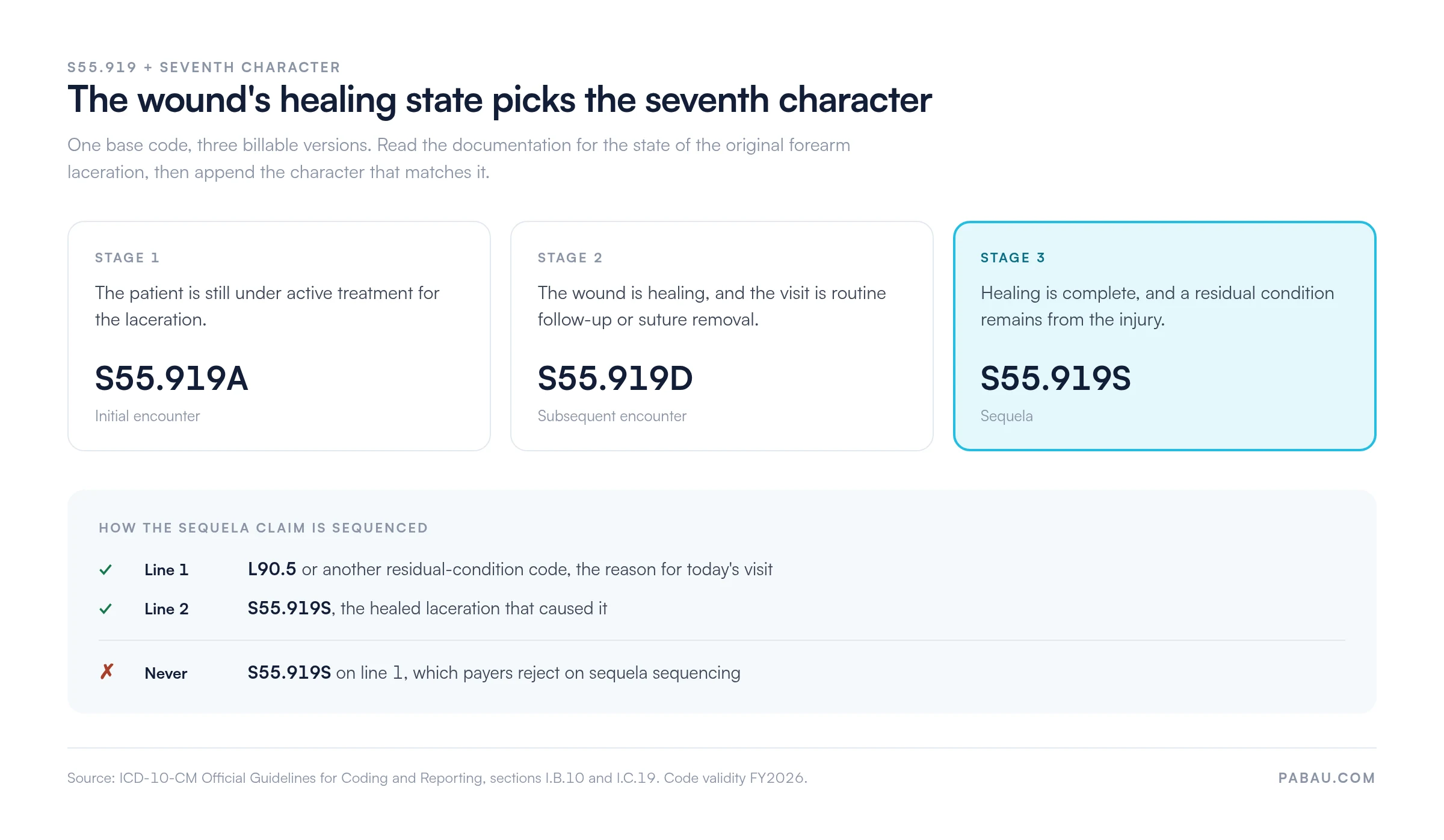
Write the healed status into the note before you assign S55.919S. Auditors look for proof that the acute phase ended. One line does it: ‘the forearm laceration is fully healed, and the patient now presents with scar contracture as a direct late effect.’ That sentence is what your billing team quotes when the payer asks.
S55 carries two Excludes2 notes, and both change what can sit on the same claim.
Excludes2, category S55: injury of blood vessels at wrist and hand level (S65.-), and injury of brachial vessels (S45.1-S45.2).
Excludes2 means “not included here”, not “never together”. A patient with a forearm vessel injury and a brachial vessel injury gets both codes. What the note does not do is stretch S55.919S to cover a wrist or an upper-arm vessel.
The same S pattern runs through the whole injury chapter, from S00 to T88. The residual condition leads, and the injury code with S explains where it came from.
Sitting next to S55.919S are codes that a slightly better note would have earned. Scan them before you submit.
Confirm any of these against AAPC Codify’s S55.919S entry before the claim goes out, since billable status can change with the annual update. Our diagnostic codes index covers the neighboring families if the record points somewhere else.
S55.919S is accepted on CMS-1500 forms and 837P electronic claims for FY2026. A clean one follows the same five steps every time.
Three problems stall these claims most often. Sequencing errors send the sequela code out first. Thin documentation leaves the payer no evidence that the wound healed. An unspecified arm on a record that names the side invites a review.
Five lines, thirty seconds, and most sequela rejections never happen.
When one does slip through, the rejection usually names its own cause.
Patterns like these repeat, so treat them as a queue rather than one-off rejections. Sound denial management means filtering rejections by code each quarter and fixing the top three causes.
Filter your ERA or clearinghouse rejection report by S55.919S once a quarter, then rank the CARC reasons. Sequela coded as principal, missing proof of healing, and wrong laterality usually account for most of them. Fix those three and the rest is noise.
Most billing teams handle S55.919S across two systems. The diagnosis lines live in the clinical record, and the claim lives with the clearinghouse. Status updates then arrive by email, or not at all until someone logs in.
Pabau’s claims management software keeps both in one place. You check eligibility before the visit and submit the claim from the encounter it belongs to. Its status then updates inside the patient file. Field-completeness checks catch the blank boxes that get a claim rejected before a human reads it.
Remittance advice posts back to the same place, so a denial and its CARC reason sit next to the claim that triggered it. Your coder can see the pattern without exporting a report. The judgment on sequencing stays with your team, which is where it belongs.

Pabau submits your claims, checks eligibility, tracks status, and posts remittance advice against the encounter. Your billing team sees a denial and its CARC reason without leaving the patient file.

S55.919S is a small decision with a predictable failure mode. The wound has to be healed, and the residual condition has to lead the claim. Get those two right and the code behaves.
The harder part is holding that discipline across a year of claims. Write the healed status into the note while the patient is still in the room. Query laterality before the claim leaves, not after the denial lands.
If your claims and your clinical notes live in different systems, that discipline costs more than it should. Book a demo to see how Pabau puts the claim, its status, and its remittance advice beside the encounter that produced it.

Need to understand how clearinghouse validation works? Claim.MD clearinghouse overview explains how electronic claim submission and field checks work before a payer sees the claim.
Want to reduce denials on injury codes? Denial codes in medical billing maps common CARC reason codes to the coding errors that trigger them.
Looking to strengthen your billing compliance process? Superbill documentation guide covers how to structure superbills that support accurate ICD-10 code assignment and payer audit readiness.
Yes, when the record identifies how the injury happened. Assign the external cause code with the seventh character S so it matches the injury code. A cause code carrying A or D on a sequela claim is a mismatch payers can edit against.
There is no time limit. Guideline I.B.10 allows a sequela code whenever the residual condition presents, whether that is months or decades after the laceration. What matters is the healed status of the original wound, not the calendar.
No. Aftercare Z codes do not apply to injuries, because the seventh character already identifies the type of encounter. Use S55.919D for follow-up while the wound heals, and S55.919S once it has healed and a late effect remains.
No. Place of occurrence, activity, and external cause status codes are reported only at the initial encounter. Activity codes do not apply to sequela at all. On an S55.919S claim, the external cause code with the S character is the only chapter 20 code you need.