ICD-10 Code S66.308A: Extensor muscle injury, other finger
ICD-10 Code S66.308A: Definition and code hierarchy ICD-10 Code S66.308A is the ...

Last Updated: Oct 14, 2026
Billable Code Specific Code
S53.431S is the billable ICD-10-CM code for radial collateral ligament sprain of right elbow, sequela. It applies once the original sprain has resolved and the patient presents with a residual condition caused by that injury.
Coders often reach for S53.431D instead, because both codes follow the acute visit. The 'S' suffix asks for more. The note must show the original sprain has healed, and must link the current complaint to it. S53.431S is valid for the FY2026 edition, effective October 1, 2025.
Let Pabau's smart automation suggest the right codes, reduce claim denials, and keep your practice compliant—effortlessly.
Automate repetitive tasks and focus on what matters most—your patients.
Reduce coding errors and ensure compliance with the latest regulations.
Clean claims, fewer denials, and faster reimbursements.
Powerful insights and reporting to help your practice thrive.
HIPAA compliant SOC 2 certified GDPR-compliant Trusted by 4,000+ clinics worldwide

S53.431S is the billable FY2026 ICD-10-CM code for a right elbow radial collateral ligament sprain, sequela.
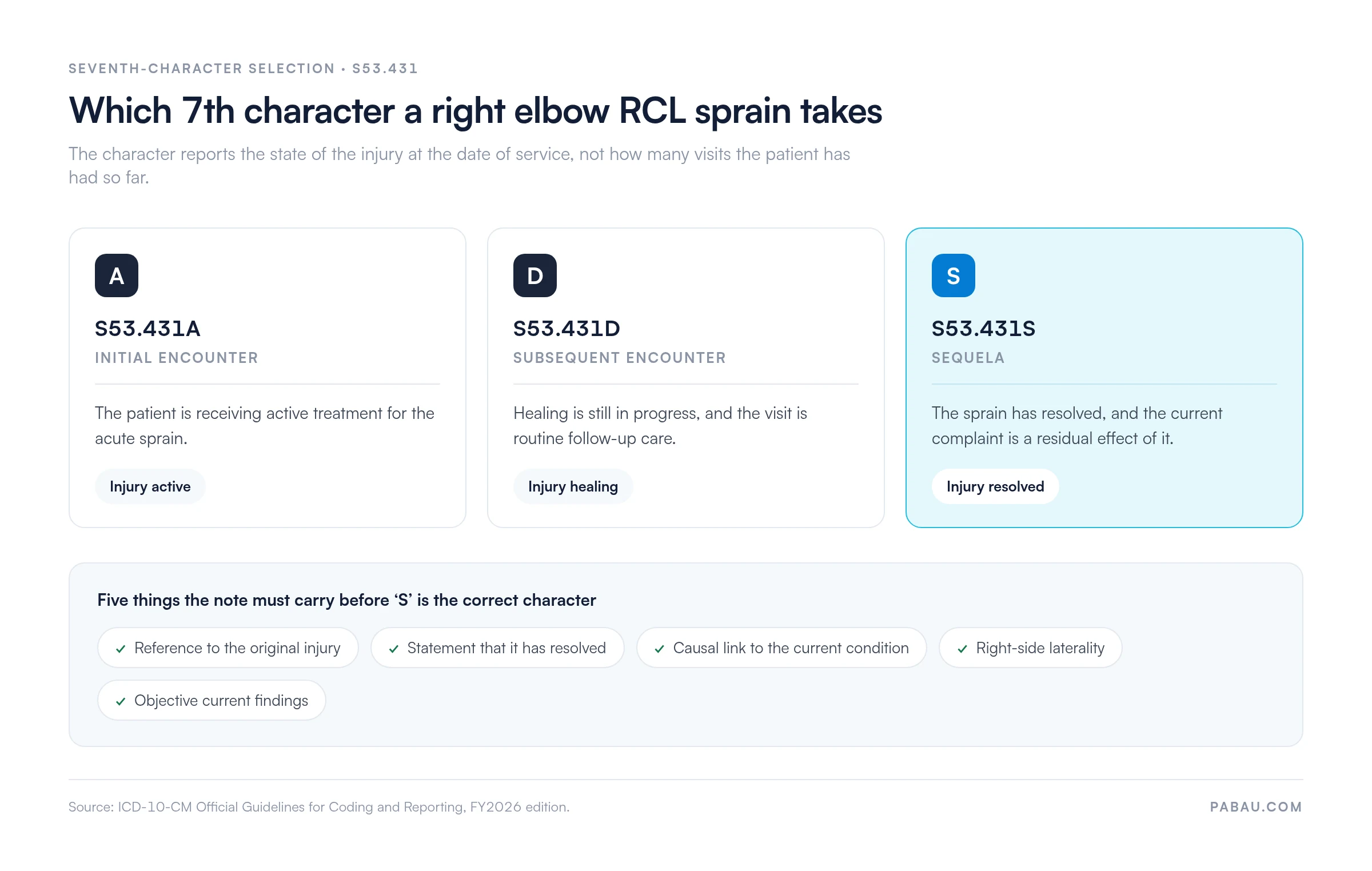
The 7th character ‘S’ means sequela, so the original injury has resolved and the current condition is its residual effect.
S53.431D covers active healing, while S53.431S needs documented linkage between the original injury and the current complication.
A sequela claim needs five elements in the note, including the original injury date and right-side laterality.
Pabau’s claims management software supports ICD-10-CM coding workflows and electronic claim submission through the Claim.MD clearinghouse integration.
ICD-10 code S53.431S is the billable diagnosis code for a radial collateral ligament sprain of the right elbow recorded as a sequela. It applies once the acute sprain has resolved and the patient returns with a residual problem caused by that injury.
The radial collateral ligament (RCL) is the lateral stabilizer of the elbow joint. It runs from the lateral epicondyle of the humerus to the annular ligament and ulna. A sprain of this structure is a distinct diagnosis from ulnar (medial) collateral ligament injuries. Laterality and encounter type both have to be captured at the most specific level available.
The quick-reference facts for this code are listed in the table below.
Yes. S53.431S is a billable and specific ICD-10-CM code, valid for use in HIPAA-covered electronic healthcare transactions as confirmed by the CDC/NCHS ICD-10-CM official tool. It can be used as a principal or secondary diagnosis code on claim forms, including the CMS-1500 and 837P electronic formats.
Billability applies to the FY2026 edition, effective October 1, 2025. The code was not introduced in a more recent update cycle, and it has been part of the S53 family for prior editions as well. Always verify the edition in force at the date of service, not the date of billing.
The 7th character ‘S’ designates sequela, which is the late effect or residual condition arising as a direct result of a previous acute injury. Per the CMS ICD-10-CM Official Guidelines, sequela coding applies once the acute phase has ended. The patient then presents with a complication causally linked to that injury.
Injury codes use a mandatory 7th character to specify encounter type. The three options for S53.431 are compared below.
A common documentation error is applying S53.431D when the patient returns for ongoing physical therapy months after the acute injury. If the original injury has left the active healing phase and the therapy addresses residual impairment, the correct code is S53.431S.
When selecting between S53.431D and S53.431S, ask whether the original injury is still actively healing. If the clinician’s note documents the sprain as resolved and the current visit addresses a residual symptom, sequela (S) is correct. If the note describes ongoing healing or active treatment of the original tear, subsequent encounter (D) applies. Payer auditors look specifically for this distinction when reviewing elbow injury claims.
The panel below maps each character to the state of the injury on the date of service. It also lists what the note has to carry before ‘S’ holds up.
S53.431S sits at the most specific level within the S53 category. Walking the parent path helps coders confirm they have selected a billable code rather than a non-billable header. The hierarchy from broadest to most specific is shown below.
Coders working with elbow ligament injuries regularly need sibling codes for the contralateral elbow, unspecified presentations, and medial (ulnar) collateral ligament injuries. The table below covers the most relevant codes alongside S53.431S. Verify the current edition on the AAPC ICD-10-CM code lookup before billing.
When the chart note specifies the radial (lateral) ligament and the affected side, S53.431S is always preferable to the unspecified alternatives. Payers increasingly apply specificity edits that reject unspecified elbow sprain codes where the documentation supports a more precise selection.
Sprain codes also stop short of joint displacement. When imaging shows a lateral subluxation of the ulnohumeral joint and the chart never records a side, a follow-up visit codes to S53.143D.
The diagnosis code S53.431S is paired with CPT procedure codes that reflect the care delivered at the sequela visit. The patient presents with a residual condition rather than an acute injury. The paired procedures therefore cover evaluation, rehabilitation, and sometimes imaging to assess chronic changes. Our CPT code reference covers the procedure side of these pairings in more detail.
The CPT codes below represent commonly associated procedure categories. Verify specific codes and payer policies against the AMA CPT database before billing, as coverage rules vary by payer.
Physical therapy claims using 97110 or 97530 alongside S53.431S should include a plan of care that references the original injury date. That plan also has to tie the current functional deficits back to the prior sprain.
Three presentation types call for the sequela character, and one closely related presentation does not. The scenarios below are drawn from common elbow injury coding situations in orthopedics, sports medicine, and physical therapy practices.
Supporting S53.431S in the medical record takes more than selecting the correct code. Payers — particularly Medicare Administrative Contractors — review sequela claims carefully, because the ‘S’ suffix implies a causal chain between a resolved injury and the current presentation. Thin documentation is a primary driver of denial management work on these codes.
The clinical note must contain all of the following elements:
A clearinghouse edit adds a second validation layer before the claim reaches the payer. It cannot substitute for a complete clinical note, because the causal chain is a documentation judgment that no automated edit can reconstruct.
Sequela coding for elbow ligament injuries is one of the higher-risk areas for claim denials and payer audits in orthopedic and sports medicine billing. Most errors fall into three categories: wrong encounter type, missing causal linkage, and insufficient code specificity. The practices below address each of them.
The ICD-10-CM Official Guidelines specify that the residual condition is sequenced first, followed by the sequela code for the nature of the sequela. The code for the original injury with the ‘S’ suffix then explains the cause. Some payers require both codes in certain claim scenarios, so confirm your payer’s sequela policy before submitting.
Some billing departments keep using S53.431D for physical therapy visits long after the acute injury has clinically resolved. The reasoning is that the patient is still “treating” the elbow. This is incorrect. The 7th character must reflect the encounter type at the time of service, not a convenience label. Using ‘D’ for what is functionally a sequela visit misrepresents the encounter and creates audit exposure.
Confirm the code is still active in the current edition before billing it. That check matters most after a payer contract update or a new fiscal year. The ICD List code lookup answers this quickly. Descriptors rarely change at this specificity level. Edition-year mismatches between the date of service and the billing system’s code table are a known source of rejections.
The radial collateral ligament (RCL) is the primary lateral stabilizer of the elbow. It attaches at the lateral epicondyle of the humerus and blends into the annular ligament that encircles the radial head. Its role is to resist varus stress at the elbow joint.
The ulnar collateral ligament (UCL) on the medial side resists valgus forces instead. It is the more commonly cited injury in overhead-throwing athletes, colloquially known as a “Tommy John” injury. RCL sprains turn up more often after falls on an outstretched hand and in certain contact sports.
Coding laterality is straightforward when the note specifies right or left. The distinction between RCL (S53.43x) and UCL (S53.44x) codes matters because payers may apply different coverage policies to lateral versus medial elbow ligament procedures. A left elbow UCL sprain under active treatment is coded S53.442A.
Always cross-reference the side documented in the imaging report against the clinician’s note and the code selected. A note that says ‘right elbow’ while the MRI report references ‘left’ is a red flag. It will surface in payer audits and should be corrected before claim submission. Laterality discrepancies between documents are one of the top reasons elbow ligament claims are flagged for medical record review.
In most practices the original injury date lives in a note written months earlier, sometimes by a different clinician. The coder opens a second system to find it, retypes the date into the current note, and picks a 7th character from memory. A sequela claim assembled that way is one transcription slip away from a denial.
Practice management software like Pabau keeps the whole patient history in one record, so the original encounter sits beside the one being coded today. The clinician can pull the injury date and the discharge note into the current entry without leaving the chart. That makes the causal statement a payer wants easy to write while the patient is still in the room.
Our claims software for coders then validates ICD-10 and CPT combinations before the claim leaves the practice, and submits electronically through the Claim.MD clearinghouse. Fewer sequela claims come back for documentation review, and the ones that do arrive with the audit trail already attached.

Pabau validates ICD-10 and CPT code pairings before claims leave your practice, then submits them electronically. You get fewer denials, faster reimbursement, and a cleaner audit trail on sequela visits.

Choosing S53.431S is the easy part. The claim stands or falls on the note. It must show the original sprain resolved, tie the current presentation to it, confirm the right side, and record objective findings. Without those four things in writing, a correct code still gets denied.
So the work belongs at the point of documentation, not at the point of coding. Build the causal sentence into the note template for post-discharge elbow visits and the 7th character stops being a guess. Book a demo to see how Pabau keeps the original injury record and the current claim in the same place.

Coding another elbow injury with the sequela character? ICD-10 code S51.029S applies the same 7th-character logic to an elbow laceration, including the documentation a late-effect claim needs.
Working on elbow and orthopedic claim submissions? Claim.MD pricing and clearinghouse features covers how the clearinghouse integration handles eligibility checks, ERA remittances, and denial reasons for musculoskeletal claims.
Want to reduce sequela-related denials across your practice? Denial codes in medical billing breaks down the CARC codes most commonly returned on ICD-10 sequela claims and how to respond to each.
ICD-10 Code S53.431S is the billable diagnosis code for radial collateral ligament sprain of the right elbow, sequela. It is used once the original acute sprain has resolved. The patient then presents with a residual condition causally linked to the prior injury. That can be chronic lateral instability, persistent pain, or reduced range of motion. The ‘S’ suffix is the 7th character for sequela under the ICD-10-CM Official Guidelines.
Yes. S53.431S is a billable and specific ICD-10-CM code valid for HIPAA-covered electronic transactions in the FY2026 edition, effective October 1, 2025. It can be used as a principal or secondary diagnosis on CMS-1500 and 837P claim forms.
S53.431A (initial encounter) is used while the patient is actively receiving treatment for the acute sprain. S53.431D (subsequent encounter) applies when the injury is still healing and the patient returns for routine follow-up care. S53.431S (sequela) is used only after the original sprain has resolved. The current presentation is then a residual complication of that injury rather than an ongoing acute condition.
Use the sequela suffix when the clinician’s note documents that the original injury has healed. The current symptoms must be a direct late effect of that prior sprain. Those symptoms typically include stiffness, instability, chronic pain, or functional limitation. If healing is still in progress, use the ‘D’ suffix instead. The clinical note must establish the causal relationship, explicitly or unmistakably.
Common pairings include CPT 99213/99214 for office evaluation of residual elbow symptoms. Physical therapy for late-effect weakness or range-of-motion deficits uses 97110 (therapeutic exercises) and 97530 (therapeutic activities). Elbow imaging uses 73070/73080. Verify all pairings against current AMA CPT documentation and individual payer coverage policies before billing.
The radial collateral ligament (RCL) is the lateral stabilizer of the elbow, coded under S53.431x (right) and S53.432x (left). The ulnar collateral ligament (UCL) is the medial stabilizer, coded under S53.44x. The two ligaments sit on opposite sides of the joint and are injured by different mechanisms. Selecting the wrong ligament code, even when both are sequela codes, is a specificity error that can trigger a documentation audit.