ICD-10 code S61.201A: Open wound of left index finger without nail damage
ICD-10 code S61.201A covers a left index finger wound of unstated type ICD-10 co...

Last Updated: Oct 16, 2026
Billable Code Specific Code
S53.194D is the billable ICD-10-CM code for other dislocation of right ulnohumeral joint, subsequent encounter.
Let Pabau's smart automation suggest the right codes, reduce claim denials, and keep your practice compliant—effortlessly.
Automate repetitive tasks and focus on what matters most—your patients.
Reduce coding errors and ensure compliance with the latest regulations.
Clean claims, fewer denials, and faster reimbursements.
Powerful insights and reporting to help your practice thrive.
HIPAA compliant SOC 2 certified GDPR-compliant Trusted by 4,000+ clinics worldwide

S53.194D covers other dislocation of right ulnohumeral joint, subsequent encounter, and is billable for FY2026.
The 7th character D marks a subsequent encounter: follow-up visits, physical therapy sessions, and cast or splint checks.
The sixth character carries both the injury type and the side, so S53.191 is a subluxation rather than a right-side dislocation.
The most common error is billing S53.194A on a follow-up visit, which triggers denials and audit queries.
Practice management software like Pabau submits and tracks these claims through its Claim.MD clearinghouse integration.
ICD-10 code S53.194D is a valid, billable ICD-10-CM diagnosis code. Specifically, its official full descriptor is Other dislocation of right ulnohumeral joint, subsequent encounter. The code is active for all HIPAA-covered transactions during FY2026. That fiscal year, in turn, runs from October 1, 2025 through September 30, 2026, per the CMS ICD-10-CM code files.
S53.194D carries every specificity element the code set asks for: laterality, joint, dislocation type, and encounter type. As a result, it is reportable as a standalone principal or secondary diagnosis, with no further extension. In addition, payers and clearinghouses accept it in all HIPAA-covered electronic transactions.
Breaking the official descriptor into its parts shows what S53.194D captures and why each element matters. Indeed, coders who skip this anatomy tend to mis-select laterality or confuse the joint involved.
Approximate synonyms that show up in clinical documentation include right elbow dislocation follow-up, right humeroulnar joint dislocation, and right ulnohumeral articulation dislocation. In each case, the note supports S53.194D once it identifies the encounter type, per the CDC/NCHS ICD-10-CM coding tool.
For example, in physical therapy, this code recurs across multiple visits spanning weeks or months of follow-up care after the initial reduction.
The 7th character is the most consequential element of S53.194D for billing. In fact, getting it wrong is the leading cause of claim denials on elbow dislocation codes. Specifically, the ICD-10-CM Official Guidelines for Coding and Reporting (Section I.C.19) define three encounter types for injury codes:
A key nuance: subsequent encounter does not mean the patient’s second visit. Instead, it means any visit where active treatment is no longer the purpose of care.
A patient whose elbow was reduced in the ED and who returns two weeks later for physical therapy is already in subsequent-encounter territory. In other words, the visit number is irrelevant.
Document the phase of care in every note. A line like ‘patient returns for follow-up physical therapy after right elbow dislocation reduced on [date]’ tells the coder which 7th character applies. It also defends the choice on audit.
The parent chain helps coders navigate to the right code and spot a non-billable parent submitted by mistake. Specifically, S53.194D sits in the following hierarchy:
Submitting S53.194 or S53.19 without a 7th character causes claim rejection, because neither is billable. Either way, the AAPC ICD-10-CM code lookup is a quick way to confirm billable status before submission.
Reading the code one position at a time also prevents the sibling mix-up covered in the next section.
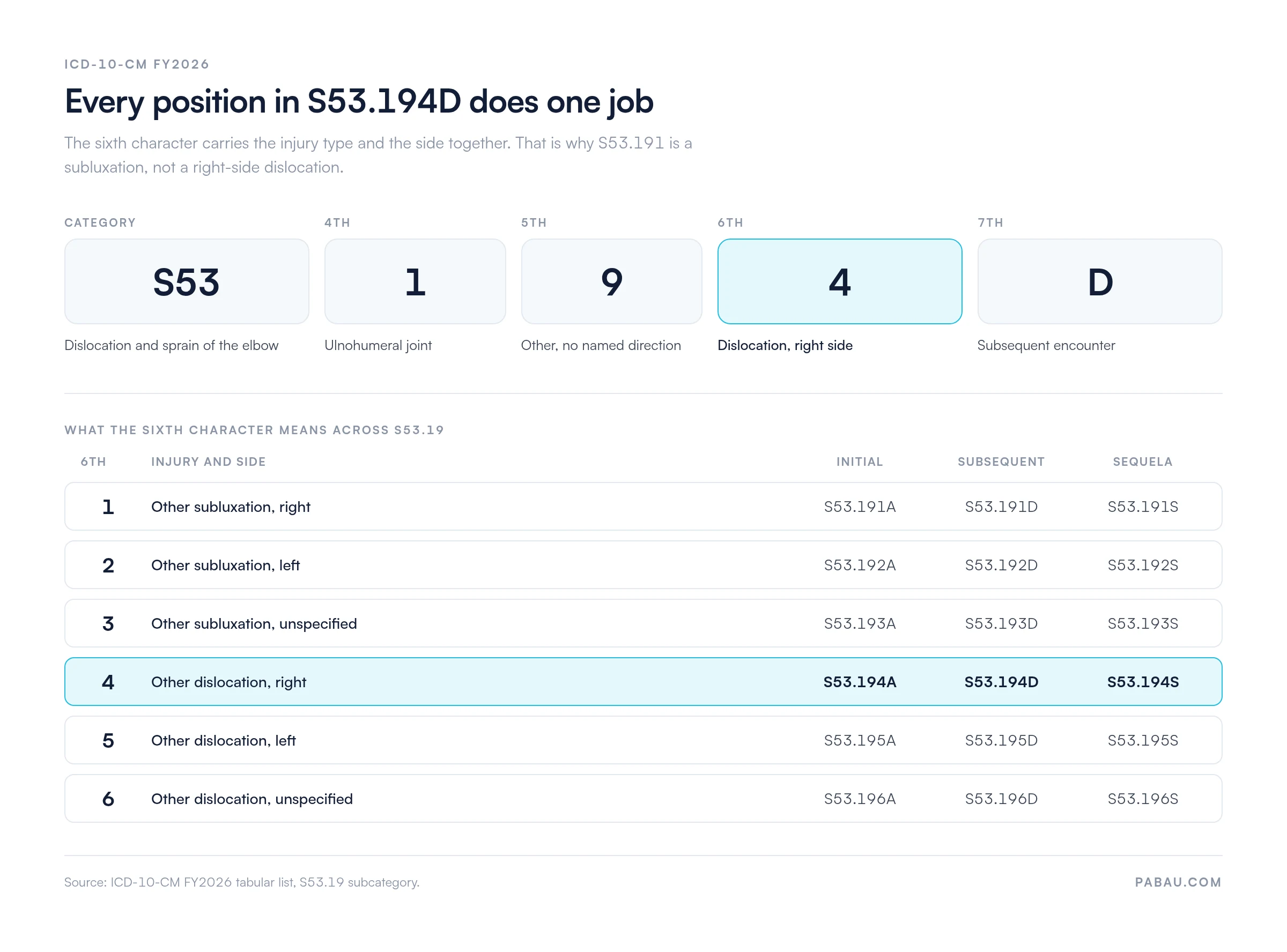
The S53.19 subcategory covers other subluxation and dislocation of the ulnohumeral joint. Specifically, the sixth character sets the injury type and the side together, and the 7th sets the phase of care.
S53.191x and S53.194x sit one digit apart and are the pair coders swap most often. Specifically, S53.191 reports a subluxation of the right joint, which is a partial displacement, while S53.194 reports a complete dislocation on the same side.
Verify the sixth character against the FY2026 tabular list before billing. For reference, the official files are published by CDC/NCHS each October.
When the record does name a direction, the code moves out of S53.19 altogether. For instance, an anterior dislocation of the ulnohumeral joint at a follow-up visit is S53.116D where the side is not documented. A lateral subluxation with no side recorded in the note points to S53.143D.
S53.194D applies across post-reduction settings. In each case, the common thread is that the dislocation has been treated and the patient is now in recovery or rehabilitation.
Practices working across orthopedics, physical therapy, and sports medicine need one written rule for the switch from initial to subsequent. Otherwise, two clinicians reading the same chart will code the visit differently.
For a claim carrying S53.194D to survive audit, the note must support every element of the descriptor. As a result, a missing element gives a coder grounds to downcode and a payer grounds to deny. There are four checkpoints:
Three errors account for most denials on right ulnohumeral dislocation codes. Fortunately, each has a clear fix.
A fifth pattern is worth flagging. Specifically, coders sometimes default to a general elbow sprain code, such as S53.40xD, when the note is ambiguous about whether a dislocation occurred.
A named ligament and a documented side support a specific sprain code instead. An ulnar collateral ligament sprain of the left elbow in active treatment is S53.442A.
Query the provider instead of dropping to a lower-specificity code. Ambiguity that survives to the claim comes back as a rejection, and our guide to common denial codes covers the reason codes that follow.
Build one encounter-type rule into your orthopedic coding workflow. Character A covers reduction, manipulation, or the first assessment of the injury. Character D covers follow-up visits, physical therapy, and routine monitoring. Character S covers a residual condition left by the original injury. Print the rule, post it, and audit it quarterly.
S53.194D carries forward into FY2026 without modification. Indeed, no code changes, descriptor revisions, or excludes notes were applied to the S53.19 subcategory on October 1, 2025. As a result, the code stays valid for HIPAA-covered transactions through September 30, 2026.
Verify code status at the start of each fiscal year against the official tabular list, however stable a code looks. The S53 category covers dislocations and sprains across the elbow, and adjacent codes in the block have changed in prior cycles.
In practice, an annual code review built into the billing calendar catches those changes before the first denial arrives.
In most orthopedic and physical therapy practices, the diagnosis code is keyed once into the chart and again into a separate billing portal. The claim then sits in a queue nobody owns until a rejection arrives weeks later.
Practice management software like Pabau keeps the coded encounter and the claim in the same record. Specifically, Pabau’s claims management software passes the claim to the Claim.MD clearinghouse and reports each payer response back against the visit that produced it.
That does not choose the 7th character for you. Instead, your coder still reads the note and decides whether the visit is initial, subsequent, or sequela. What changes, though, is the feedback loop. As a result, a rejected S53.194D claim surfaces against the encounter itself, rather than in a spreadsheet a month later.

Pabau keeps the coded encounter and the claim in one record. The Claim.MD integration submits your claims and reports each payer response back against the visit it came from.

The failure point with S53.194D is rarely the code itself. Instead, it is the 7th character, and the sixth one sitting in front of it. In short, a written rule covering initial, subsequent and sequela removes most of the follow-up denials.
S53.194D is billable, unchanged for FY2026, and supported by documentation your clinicians are probably already writing. In the end, what it asks of you is an honest read of why the patient is in the room today. Book a demo to see how Pabau submits and tracks musculoskeletal claims once your coder has made that call.

Working through a neighboring elbow code? ICD-10 code S53.116D covers anterior ulnohumeral dislocation, where the note names the direction but not the side.
Coding an elbow ligament injury instead? ICD-10 code S53.442D handles an ulnar collateral ligament sprain of the left elbow at a subsequent encounter.
Rejections piling up on musculoskeletal claims? Denial management in healthcare sets out how to work a denial queue and stop the same reason code recurring.
Evaluating the Claim.MD clearinghouse? Our Claim.MD clearinghouse guide explains how the integration handles 837P submissions and returns ERAs for orthopedic practices.
ICD-10 code S53.194D is the ICD-10-CM diagnosis code for other dislocation of right ulnohumeral joint, subsequent encounter. It is billable, and it reports follow-up care after the initial treatment of a right elbow dislocation. Orthopedic reviews, physical therapy sessions and cast checks all fall under it. The D designates a subsequent encounter under the ICD-10-CM 7th character system.
Yes. S53.194D is a valid, billable ICD-10-CM code accepted in all HIPAA-covered transactions for FY2026, which runs from October 1, 2025 through September 30, 2026. Its parent codes S53.194, S53.19 and S53 are not billable, because they lack the specificity the 7th character provides.
Use S53.194A (initial encounter) while the patient is in active treatment for the dislocation. That covers the ED visit where the joint was reduced and the first orthopedic assessment. It also covers any visit whose purpose is direct management of the acute injury. Use S53.194D from the first follow-up visit onward, once active treatment has ended. The transition depends on the purpose of care, not the visit number.
Yes. Physical therapy for rehabilitation of a right elbow dislocation is a standard application of S53.194D. The patient has completed active treatment, the reduction, and is now receiving subsequent care. Each session during the rehabilitation phase carries this code. The note has to record the follow-up nature of the visit and the right elbow as the affected side.
The ulnohumeral joint is the articulation between the trochlea of the humerus, the upper arm bone, and the trochlear notch of the ulna. It forms the primary hinge of the elbow and controls flexion and extension. It is distinct from the radiohumeral joint and the proximal radioulnar joint. A dislocation here is the most common type of elbow dislocation in adults and adolescents.