ICD-10 Code S42.444P: Medial epicondyle fracture, right humerus
ICD-10 Code S42.444P: full descriptor and code validity ICD-10 Code S42.444P car...

Last Updated: Oct 13, 2026
Billable Code Specific Code
S52.692R is the billable ICD-10-CM code for other fracture of lower end of left ulna, subsequent encounter for open fracture type IIIA, IIIB, or IIIC with malunion.
Only the letter R carries all three of those facts at once. Change the letter and you change the injury, the encounter type, or the healing outcome the claim reports.
It also covers documentation requirements and the CPT codes most often paired with this diagnosis. Whether you use claims management software or manual workflows, the tables below let you check your selection before you submit. Practices still filing on paper carry this code on the CMS-1500 form, in the service lines.
Let Pabau's smart automation suggest the right codes, reduce claim denials, and keep your practice compliant—effortlessly.
Automate repetitive tasks and focus on what matters most—your patients.
Reduce coding errors and ensure compliance with the latest regulations.
Clean claims, fewer denials, and faster reimbursements.
Powerful insights and reporting to help your practice thrive.
HIPAA compliant SOC 2 certified GDPR-compliant Trusted by 4,000+ clinics worldwide

ICD-10 code S52.692R covers other fracture of the lower end of the left ulna. It applies to a subsequent encounter, open fracture type IIIA, IIIB, or IIIC, with malunion.
S52.692R is a fully billable ICD-10-CM code valid for FY2026 and accepted in all HIPAA-covered transactions.
The 7th character R is required. S52.692 on its own is non-billable and payers will reject it.
Do not treat H as a substitute for R, because S52.692H means an open type I or II fracture with delayed healing.
Malunion must be attested by the treating physician. Coders cannot infer it from an imaging report alone.
S52.692R is a valid, billable ICD-10-CM diagnosis code effective for FY2026. According to the CDC/NCHS ICD-10-CM web tool, the code carries no age or sex exclusions. It is accepted in every HIPAA-covered transaction.
Every element of this code carries clinical weight. Misreading any component produces a coding error that can trigger a denial or an audit finding.
Without the 7th character, S52.692 is non-billable. Payers reject it as an incomplete code. The 7th character is not optional, and it is structurally required for claim submission.
S52.692 supports sixteen 7th characters. Each one combines an encounter type, a fracture openness, and a healing outcome. The table below shows every valid extension. Choosing the wrong letter is one of the most common sources of claim denial for distal left ulna fracture encounters.
ICD-10 code S52.692R uses the 7th character R, the last letter in the subsequent-encounter run. The alphabet is not continuous here. ICD-10-CM fracture extensions skip I, L, and O so that they cannot be misread as the numerals 1 and 0.
Read the table as a grid rather than a list. There are four healing outcomes: routine healing, delayed healing, nonunion, and malunion. Each outcome has one letter for each of the three fracture types. Malunion runs P for closed, Q for open type I or II, and R for open type III.
These three codes sit within a few letters of each other and describe different patients. Several coding cheat sheets circulate with them transposed, so verify against the tabular list rather than a summary. The table below shows what actually separates them.
Two questions settle the choice. Did the operative note record a Gustilo type III, or a type I or II? Has the bone united in a bad position, or has it simply not finished healing? Answer both from the chart and only one letter survives.
The same R logic runs through the neighboring radius codes, where S52.356R marks an open type III malunion. Forearm injuries often damage both bones, so a single encounter can need one R code for each.
The Gustilo-Anderson classification determines which 7th character applies to open fractures. Ramon Gustilo and John Anderson published it in 1976 and expanded it in later work.
It grades open fractures by wound size, contamination, periosteal stripping, and vascular injury. Type determination is an intraoperative judgment, so coders rely entirely on the surgeon’s documented classification.
All three subtypes share the same 7th character pool because ICD-10-CM treats IIIA, IIIB, and IIIC as a single coding tier. The distinction between subtypes still matters for surgical planning and prognosis.
For coding purposes, documenting any of the three satisfies the same requirement. What cannot be omitted is the type III designation itself.
Surgeons sometimes document ‘open fracture’ without naming the Gustilo-Anderson type. Query the operative note before you submit. An open fracture with no stated type falls back to the type I or II characters, which means Q rather than R for a malunion. That single letter changes the severity the claim reports.
The healing outcome encoded in the 7th character is where coders most often go wrong on subsequent encounter claims. Routine healing, delayed healing, nonunion, and malunion are clinically distinct states. Each one takes a different letter, so the wrong outcome changes the code entirely.
Every outcome in this table has a Gustilo III letter. There is no missing option, and no reason to fall back on a closed-fracture character when the chart documents an open type III injury. The closed equivalents are D, G, K, and P, in the same order.
The critical distinction for S52.692R is that malunion means the bone has united, but in the wrong position. Nonunion, coded N for this fracture type, means the bone has not united at all. These are opposite clinical states, and they usually call for different surgical interventions.
Distal ulna malunion usually shows up first as lost forearm rotation or a painful wrist. A documented range of motion assessment at the follow-up visit gives the physician the functional evidence to attest to it.
The same malunion logic reaches the carpal bones, where S62.163P marks a closed pisiform fracture healed in malposition.
The ICD-10-CM Official Guidelines for Coding and Reporting (FY2026) define three encounter types for fractures. “Subsequent encounter” does not simply mean any follow-up visit, because the term has a specific technical meaning.
The same convention runs across the injury chapter, which is why S60.931D reads as aftercare rather than a new injury.
For S52.692R, the R character is correct when three things are true. Active treatment for the open fracture has ended. The fracture was classified intraoperatively as Gustilo type IIIA, IIIB, or IIIC. The treating physician has documented malunion as the healing complication.
Rehabilitation visits in this phase carry the same diagnosis code as the physician’s follow-up. Good physical therapy software holds that 7th character on the patient record, so nobody re-derives it from scratch at every session.
Following the hierarchical chain helps coders confirm they are in the right code family and spot adjacent codes for related fracture types. The CMS ICD-10 codes page publishes the full tabular list with annual updates.
Adjacent codes in the same family include S52.691R for the right ulna and S52.699R for unspecified laterality.
Coding S52.691R when the chart documents the left ulna is among the most common mismatch flags in orthopedic coding audits. Further up the bone, up the bone, S52.266R applies the same malunion letter to a nondisplaced ulnar shaft fracture.
Documentation language in operative notes and discharge summaries rarely mirrors ICD-10-CM code descriptions exactly.
Coders need to recognize the clinical phrases that map to this code. The index terms and approximate synonyms below all lead to S52.692R in the Alphabetic Index.
An operative note may say “malunited left distal ulnar fracture following open injury.” That language maps to S52.692R, provided the Gustilo type III classification is also documented. If only one of those two clinical facts appears in the chart, the code is unsupported.
S52.692R pairs with different procedure codes depending on whether the encounter is surgical or non-surgical. Coders working in sports medicine software or orthopedic EHR environments meet these combinations most often. The AAPC Codify ICD-10-CM lookup provides crosswalk data for verifying medical necessity pairing.
When a subsequent encounter leads to a decision to perform corrective osteotomy, that surgical visit takes an initial encounter character for the corrective procedure. The diagnosis code family stays the same, but the 7th character changes.
Make sure the procedure and evaluation-and-management codes match the scenario documented at that specific visit.
Supporting S52.692R on audit takes four specific elements in the clinical record. Miss any one of them and a payer or auditor has grounds to downcode or deny the claim.
A structured aftercare note that prompts for all four elements removes most of the guesswork. Build it around fracture site and laterality, Gustilo type where the injury is open, current healing status, and any complication.
A SOAP progress note layout handles this well, provided those items sit in discrete fields rather than free-text narrative.
Fracture coding errors usually begin in the note rather than at the claim stage. When laterality, Gustilo type, and healing status live in free-text narrative, the coder has to read around them and guess. Every guess becomes a query, and every query delays payment.
Practice management software like Pabau lets you turn those four elements into structured fields on the aftercare template.
Clinicians pick the laterality and the Gustilo type at the point of care, so the coder inherits a complete record instead of reconstructing one. Medical records management keeps that history attached to the patient across every subsequent visit.
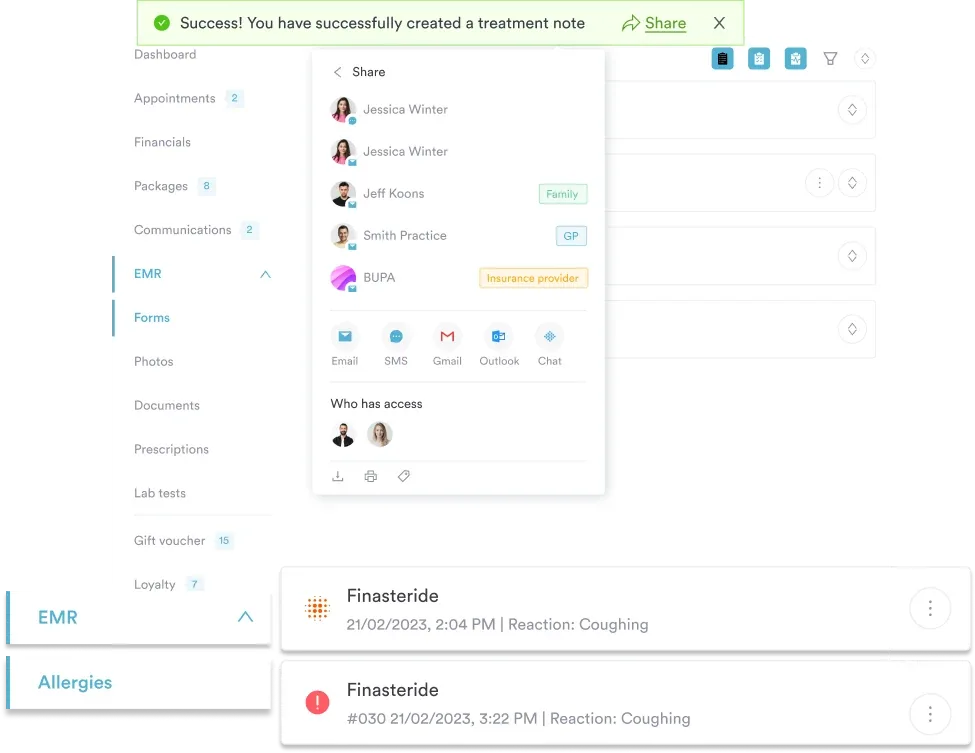
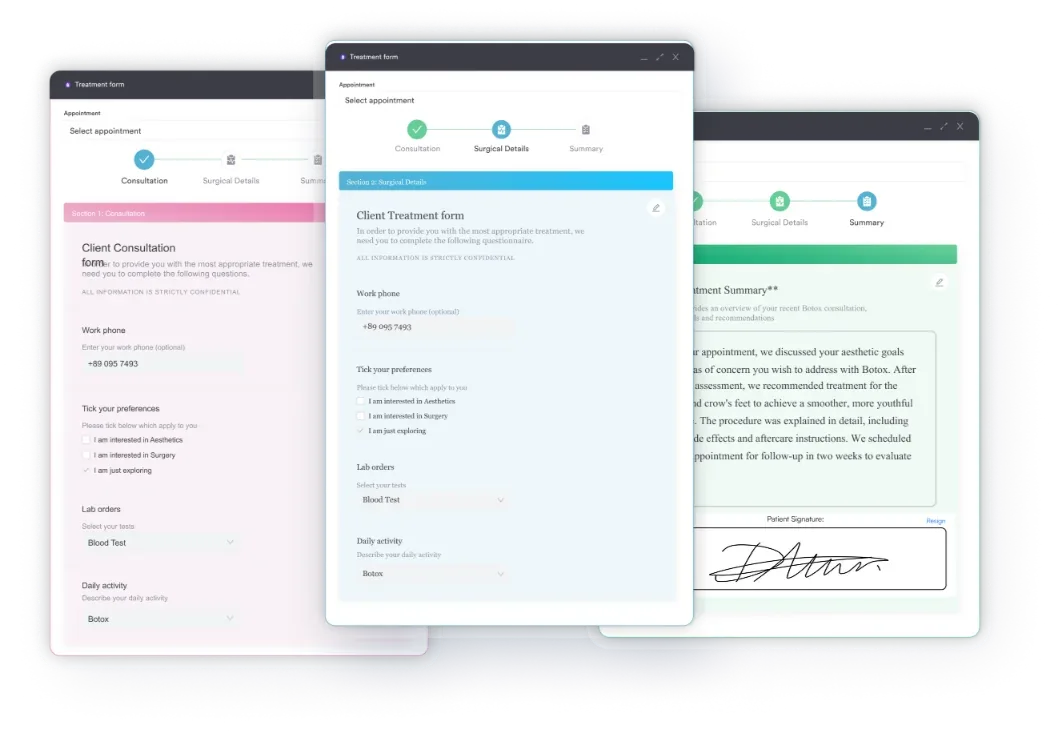
The same logic applies before the patient arrives. Digital intake and consent forms capture injury history and prior treatment in fields you define. The first note then already carries the detail an open fracture claim needs. Fewer post-encounter queries follow. Coverage verification at that same intake point surfaces the deductible position, which changes what the practice collects at the desk.
On the billing side, Pabau’s claims management tools track what you submitted and where it sits with the payer. Orthopedic and sports medicine teams can spot a pattern of 7th character denials early, rather than discovering it a quarter later in an audit.

Pabau’s claims management tools help orthopedic and sports medicine practices submit accurate ICD-10 codes and track claim status. Fewer denials come back over the wrong 7th character.

The safest habit with this code family is to read the chart before you reach for the letter. Documentation decides the 7th character, and it never works the other way around.
If the operative note names no Gustilo type, R is not yours to use. Query the surgeon and accept the short delay. A queried claim that pays in full beats a fast claim recouped at audit.
Practices that solve this at the template level stop relitigating it on every claim. Building the four documentation elements into the aftercare note is a one-time job with a lasting payoff. Read the practice management software overview, or book a demo to see how Pabau catches documentation problems before they become denials.

Coding a forehead brow lift procedure? CPT code 15824 covers rhytidectomy of the forehead, known as a brow lift, and its billing pathways.
Coding a proximal ulna injury instead? S52.271A covers the initial encounter for a Monteggia fracture of the right ulna.
Need the sequela code for a healed forearm injury? S52.591S shows how the S character works once the fracture is no longer the active problem.
Documenting a wrist dislocation that left lasting effects? S63.004S applies the same sequela convention outside the fracture range.
Coding a cheek, chin, or neck lift? CPT code 15828 covers rhytidectomy of the cheek, chin, and neck within the five-code rhytidectomy family.
S52.692R is a billable diagnosis code for other fracture of the lower end of the left ulna. It applies to a subsequent encounter for an open fracture of Gustilo-Anderson type IIIA, IIIB, or IIIC, with malunion. It carries five facts at once: fracture site, laterality, encounter type, open fracture classification, and healing complication.
Yes. S52.692R is a fully billable ICD-10-CM diagnosis code, valid for FY2026 and accepted in all HIPAA-covered transactions. The parent code S52.692 is non-billable on its own and payers will reject it, so the 7th character R is required for claim submission.
They describe different injuries and different outcomes. S52.692R covers a subsequent encounter for an open fracture of Gustilo type IIIA, IIIB, or IIIC with malunion. S52.692H covers a subsequent encounter for an open fracture of type I or II with delayed healing. If you need type III with delayed healing, the correct letter is J.
Type IIIA is a high-energy injury with adequate soft tissue coverage despite extensive laceration. Type IIIB involves extensive soft tissue loss, periosteal stripping, and exposed bone requiring flap coverage. Type IIIC is any open fracture with arterial injury requiring repair. All three share the same ICD-10-CM 7th character pool, so the subtype matters clinically but not for letter selection.
Malunion means the fracture has healed, but in an incorrect anatomical position. For an open Gustilo type III fracture of the left distal ulna, that is S52.692R. Nonunion means the fracture has failed to heal at all, which is S52.692N for the same injury. The two states need different documentation and usually different surgical management.
Common pairings include 25650 for closed treatment of an ulnar styloid fracture and 25652 for open treatment of the same injury. Office-based subsequent encounters usually take 99213 or 99214. The CPT code depends on the procedure or service delivered at that encounter, not on the ICD-10 diagnosis alone.