ICD-10 code S61.201A: Open wound of left index finger without nail damage
ICD-10 code S61.201A covers a left index finger wound of unstated type ICD-10 co...

Last Updated: Oct 16, 2026
Billable Code Specific Code
S52.614D is the billable ICD-10-CM code for nondisplaced fracture of right ulna styloid process, subsequent encounter for closed fracture with routine healing.
The 7th character D reports follow-up care where the fracture is healing as expected. Delayed healing takes G, a confirmed nonunion takes K, and malunion takes P.
Let Pabau's smart automation suggest the right codes, reduce claim denials, and keep your practice compliant—effortlessly.
Automate repetitive tasks and focus on what matters most—your patients.
Reduce coding errors and ensure compliance with the latest regulations.
Clean claims, fewer denials, and faster reimbursements.
Powerful insights and reporting to help your practice thrive.
HIPAA compliant SOC 2 certified GDPR-compliant Trusted by 4,000+ clinics worldwide

S52.614D is a billable ICD-10-CM code valid for FY2026 (effective October 1, 2025 through September 30, 2026), exempt from POA reporting.
The 7th character D reports a subsequent encounter for a closed fracture with routine healing. Use it at follow-up visits when the record shows the fracture healing as expected.
Do not confuse S52.614D (routine healing) with S52.614G (delayed healing) or S52.614K (nonunion). Each one reports a different healing trajectory and a different documentation burden.
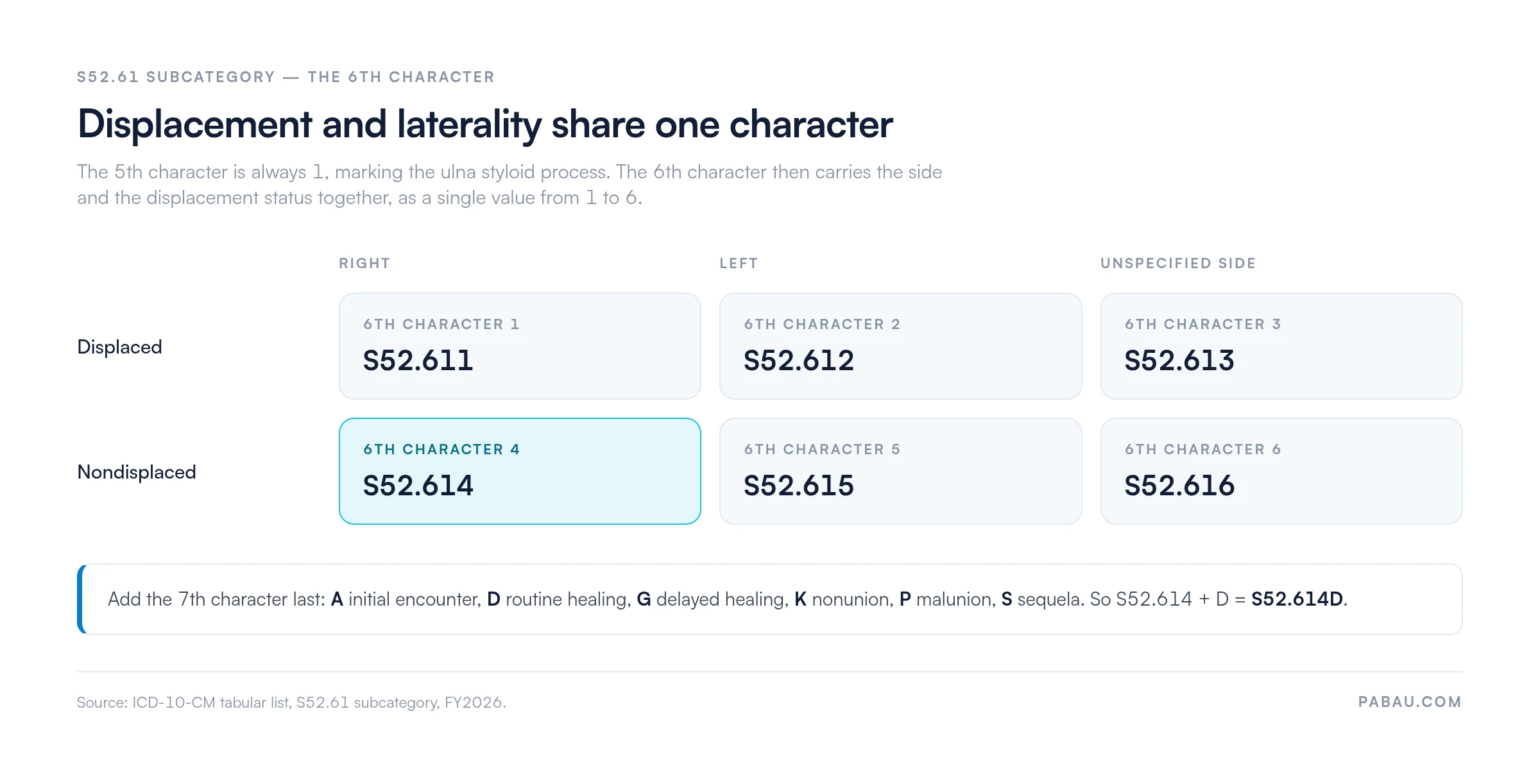
Laterality and displacement both live in the 6th character, so a note that omits “right” or “nondisplaced” forces a less specific code.
Pabau’s claims management software supports ICD-10-CM code documentation and claim submission workflows for orthopedic and musculoskeletal practices.
ICD-10 Code S52.614D reports a nondisplaced fracture of the right ulna styloid process at a subsequent encounter for a closed fracture with routine healing. It is a billable, specific ICD-10-CM code, valid for HIPAA-covered electronic transactions throughout fiscal year 2026. The code became effective on October 1, 2025 and expires September 30, 2026.
According to the CMS ICD-10-CM code files, the code is present-on-admission (POA) exempt. Inpatient facilities therefore do not need to supply a POA indicator when submitting it.
The ulna styloid process is a small bony projection at the distal (lower) end of the ulna. It sits on the medial side of the wrist, just proximal to the triangular fibrocartilage complex (TFCC). It anchors the ulnar collateral ligament and the TFCC itself.
A fall on an outstretched hand (FOOSH) often fractures the styloid process alongside a distal radius fracture. Isolated styloid fractures also occur. Orthopedic and physical therapy coders therefore meet this code family often.
The grid below lays out all six values in the subcategory, so you can read the side and the displacement status off one axis each.
Each character segment of S52.614D carries a discrete clinical meaning. Reading the code left to right tells you the anatomical site, the fracture characteristics, and the encounter type. The table below decodes every segment.
The 7th character is where most coding errors occur. The CDC/NCHS ICD-10-CM web tool lists the full 7th character set for this code. The ICD-10-CM Official Guidelines for Coding and Reporting define several options for fractures of the forearm. Each one represents a different encounter type and healing trajectory after the initial visit.
“Subsequent encounter with routine healing” means the patient is in the recovery phase after the initial treatment, and the fracture is healing as expected. The ICD-10-CM Official Guidelines, Section I.C.19.a, define a subsequent encounter as one that follows active treatment. The patient is now receiving routine care while the injury heals.
Cast changes, removal of a fixation device, medication adjustment, and scheduled imaging follow-ups all fall under this definition. The 7th character only moves away from D when the record documents a complication such as delayed healing, nonunion, or malunion.
Those six characters cover closed fractures. The same subcategory also carries open-fracture characters. B and C apply to initial encounters, E and F to routine healing, and H and J to delayed healing. M and N report nonunion, while Q and R report malunion. Pick from the closed set only when the record describes a closed fracture.
Key distinction: D is the default for a closed fracture in follow-up care. Move to G, K, or P only when the clinician has documented delayed healing, nonunion, or malunion by name. Coders should not infer a complication from an imaging report on their own.
S52.614D is a billable and specific ICD-10-CM code valid for HIPAA-covered electronic transactions. Practices using claims management software can submit it without modification for the full FY2026 cycle. The code is POA exempt, so acute-care hospitals do not record a present-on-admission indicator for it on inpatient claims.
Billable status alone does not settle coverage on every claim type. HCPCS code V2103 falls under a Part B benefit category that excludes routine eyewear. Payment there turns on a documented cataract surgery with an intraocular lens, once per surgical eye.
Practice management software like Pabau submits these claims electronically through its Claim.MD integration. That covers 837P submission, real-time eligibility verification, and ERA/835 remittance processing for musculoskeletal fracture codes.
DRG assignment for S52.614D falls under the musculoskeletal Major Diagnostic Category (MDC), as confirmed in the CMS MS-DRG v43.0 definitions manual. The grouping depends on the patient’s full claim profile, including whether a complication or comorbidity (CC or MCC) is present.
Do not assume a single DRG without reviewing that profile. Denials in this code family often stem from an incorrect 7th character. Others fail because the note’s healing status does not match the character submitted.
Run a quarterly audit of your subsequent encounter fracture claims. Filter by 7th character D, G, K, and P, then check that each claim has a clinical note stating the healing status it reports. Payers increasingly request documentation on audit for delayed healing and nonunion designations.
S52.614D belongs to a structured family of codes covering the full range of ulna styloid process fracture scenarios. The table below maps those variants by laterality and displacement status. Our ICD-10-CM code directory lists the neighboring codes if you need to check one of them.
Every row uses the subsequent encounter with routine healing (D) character, so the comparison stays like for like.
The three primary encounter variants for this fracture represent sequential phases of care, not interchangeable synonyms. S52.614A is the initial encounter code. It applies from the first visit through any encounter where active clinical decision-making is occurring for the fracture, including surgery.
S52.614D applies once active treatment has finished and the patient is back for routine follow-up while the fracture heals. S52.614S applies when the patient presents for a sequela after active treatment has ended. A sequela is a complication or late effect that developed as a consequence of the fracture.
These three codes share the same fracture and differ only in how healing is progressing. Choosing between them is the single most common decision point on a follow-up claim for this injury. The table below shows what each one reports and what the note has to say to support it.
Delayed healing and nonunion are separate findings, and no single ICD-10-CM character combines them. A record that describes slow healing without a confirmed nonunion supports G, never K.
The approximate ICD-9-CM predecessor for S52.614D is 813.43, closed fracture of distal end of ulna (alone). ICD-9-CM could not specify the styloid process, displacement status, encounter type, and healing trajectory in one code.
The crosswalk is approximate, not equivalent. On historical data comparisons or legacy appeals, treat it as a general anatomical match. It is not a clinically precise translation, so check any figure it produces before you rely on it.
Accurate coding for this fracture depends on the clinical note supplying every element the code encodes. Missing one leaves the coder with a less specific code that may not pass payer edits. Laterality, displacement status, and healing trajectory all have to appear in the note.
Denials in the S52.614 family cluster around a handful of repeatable errors. Catching them before submission saves rework and keeps your appeals queue small, which is the point of good denial management.
In most orthopedic and physical therapy practices, the encounter note and the claim live in separate systems. A coder reads the follow-up note and picks between the D, G, and K characters. The billing screen where that code gets typed shows none of the supporting documentation. That split is where a routine-healing visit quietly ships as a delayed-healing claim.
Pabau keeps the clinical note, the diagnosis code, and the claim on the same patient record. The coder can see what the clinician wrote about healing progress while selecting the 7th character, and the claim carries that note forward. The Claim.MD integration then submits the 837P, runs eligibility checks, and posts ERA/835 remittances back against the same record.
The outcome is fewer 7th-character corrections after the fact. Your team spends less time reworking denials and gets paid on the first submission more often. Every Pabau subscription includes the full billing toolset, with no feature tiers to unlock.

Pabau integrates with Claim.MD to support ICD-10-CM claim submission, real-time eligibility checks, and ERA processing for musculoskeletal practices. See how it handles fracture code documentation end to end.

The most common failure point with ICD-10 Code S52.614D is the 7th character. Coders who apply A to every follow-up visit generate preventable denials. So do coders who read D as a delayed-healing code. D is the routine-healing character. Confirm laterality, state displacement, and record how healing is progressing, and the code selects itself.
Pabau’s billing workflows and Claim.MD clearinghouse integration support orthopedic and musculoskeletal practices. ICD-10-CM codes go out accurately, and edits get caught before the claim reaches the payer. To see how Pabau handles fracture code documentation and billing, book a demo with our team.

Need guidance on submitting clean claims for fracture codes? Clean claim submission covers the documentation and formatting requirements that prevent rejections at clearinghouse edits.
Dealing with a pattern of denials on musculoskeletal codes? Denial management in healthcare outlines a structured workflow for identifying, appealing, and preventing recurring claim denials.
Want to understand how ICD-10 codes feed into reimbursement? Medical billing fundamentals explains how diagnosis codes connect to claim submission and payment cycles.
ICD-10 Code S52.614D is the billable diagnosis code for a nondisplaced fracture of the right ulna styloid process. It covers a subsequent encounter for a closed fracture with routine healing. Apply it at follow-up visits after active treatment, when the record shows the fracture healing as expected.
Yes. S52.614D is a billable and specific ICD-10-CM code valid for HIPAA-covered transactions during FY2026, effective October 1, 2025 through September 30, 2026. It is present-on-admission (POA) exempt.
S52.614A is the initial encounter code, used from the first visit through any encounter involving active treatment decisions. S52.614D is the subsequent encounter code, applied at follow-up visits after active treatment while the fracture heals routinely. Using A for a follow-up visit generates a duplicate initial encounter edit.
S52.614D reports a subsequent encounter with routine healing, meaning the fracture is progressing as expected. S52.614G reports a subsequent encounter with delayed healing, which requires the clinician to document that healing is slower than expected. A confirmed nonunion is a third code, S52.614K.
Delayed healing means the fracture is progressing toward union, but more slowly than expected for the injury type and patient profile. For this fracture, delayed healing takes the G character, not the D character. The clinician’s documented statement governs, and the guidelines set no minimum number of weeks.
Use a subsequent encounter character once active treatment has finished and the patient returns for routine care during healing. Cast changes, fixation device removal, and scheduled imaging follow-ups all qualify. Pick D when healing is routine, and switch to G, K, or P when the note documents delayed healing, nonunion, or malunion.
Yes. S52.615D covers a nondisplaced fracture of the left ulna styloid process, subsequent encounter for closed fracture with routine healing. S52.616D is the unspecified laterality equivalent. Displaced variants on the left side use S52.612D.