ICD-10 code S61.201A: Open wound of left index finger without nail damage
ICD-10 code S61.201A covers a left index finger wound of unstated type ICD-10 co...

Last Updated: Oct 16, 2026
Billable Code Specific Code
S52.579R is the billable ICD-10-CM code for other intraarticular fracture of lower end of unspecified radius, subsequent encounter for open fracture type IIIA, IIIB, or IIIC with malunion.
Only the 7th character carries that detail. Swap R for N and the claim now says the bone never healed at all. That is a different diagnosis, a different treatment plan, and often a different payer decision. So it pays to read the descriptor one piece at a time, starting with the hierarchy above the code.
Let Pabau's smart automation suggest the right codes, reduce claim denials, and keep your practice compliant—effortlessly.
Automate repetitive tasks and focus on what matters most—your patients.
Reduce coding errors and ensure compliance with the latest regulations.
Clean claims, fewer denials, and faster reimbursements.
Powerful insights and reporting to help your practice thrive.
HIPAA compliant SOC 2 certified GDPR-compliant Trusted by 4,000+ clinics worldwide

ICD-10 code S52.579R covers a follow-up visit for an intraarticular fracture of the distal radius that healed out of alignment.
The original injury must have been graded Gustilo type IIIA, IIIB, or IIIC, and the record must not name the side.
The code is billable and valid for FY2026, which runs from October 1, 2025 through September 30, 2026.
Malunion (R) and nonunion (N) are opposite radiographic findings, so a note that supports neither needs a provider query.
Claims management software like Pabau sends the CMS-1500 or 837P, checks eligibility in real time, and posts the remittance back.
S52.579R sits at the bottom of a chain that starts with the whole injury chapter and narrows to one healing outcome. Reading that chain from the top is the quickest way to confirm you are in the right block before you pick a 7th character.
That 9 in S52.579 is about laterality, not about the fracture itself. It covers records that never say left or right. When the side is documented, the correct base codes are S52.571 for the right radius and S52.572 for the left. A left-side nonunion after a type I or II open fracture, for example, takes ICD-10 code S52.572M.
Defaulting to the unspecified form is a specificity problem when the chart plainly says “right distal radius”. Some payers flag exactly that on post-payment review.
S52.579 takes 16 valid 7th characters, and R is correct in only one situation. The character records three facts at once. It says whether the visit is initial or subsequent, how the wound was graded, and how the bone healed.
Get one of those wrong and the code describes a patient you never saw.
For S52.579R to be right, three facts have to hold on the day of the visit. The encounter is a follow-up rather than the first treatment episode.
The original fracture was an open wound graded Gustilo type IIIA, IIIB, or IIIC. And imaging shows the bone healed in the wrong position. Change any one of them and a different character applies.
Wrong-character claims then bounce back under the usual medical billing denial codes, most often a medical necessity or specificity edit.
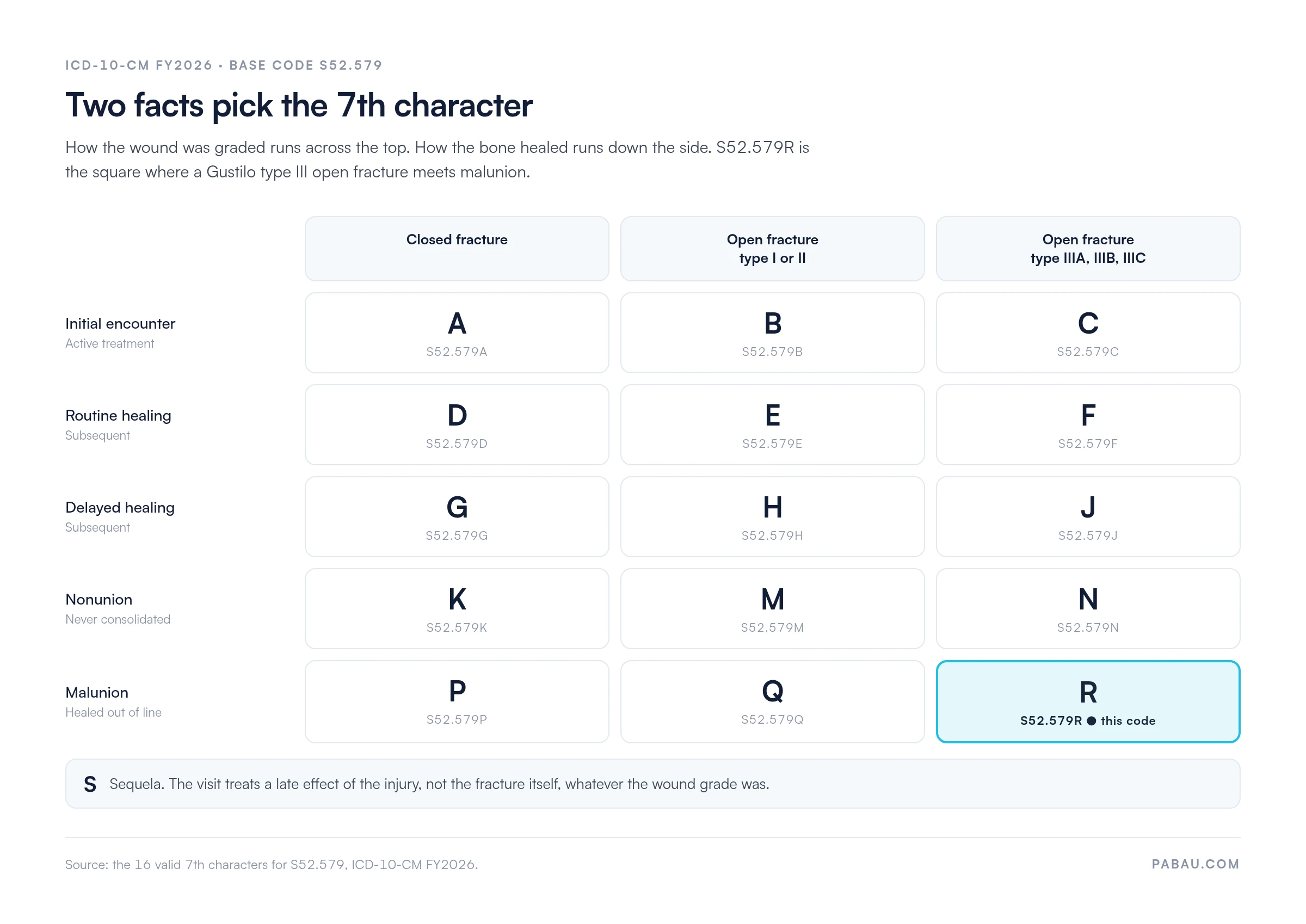
The Gustilo-Anderson classification grades open fractures by how much soft tissue the injury destroyed. Type III is the severe end of that scale, and it is the only grade that leads to S52.579R.
Coders in orthopedic and trauma settings meet the grade constantly, in operative reports and emergency department notes.
ICD-10-CM folds IIIA, IIIB, and IIIC into one character position, because all three draw on the same set. That set is C at the initial encounter, then F, J, N, or R afterwards, depending on how the bone healed. So the operative or emergency report has to state the Gustilo grade in writing. A note that says “large open wound” with no grade will not support R. The fix is a provider query, not a best guess.
These two outcomes sit one letter apart in the code set and describe very different wrists. Malunion means the fracture consolidated, but in a deformed, angulated, or shortened position. Nonunion means it never consolidated at all. Both are subsequent encounters, so the encounter type will not separate them for you.
Radiographs settle the question. Malunion needs a reading that shows bone bridging across the fracture site, plus alignment that is clearly abnormal.
Nonunion needs a reading that shows no bridging, or a site that still moves. A note saying the fracture is “not healing well” supports neither, so it earns a query before anyone assigns a character.
Run a quarterly report on your S52.579K and S52.579N claims. A cluster of nonunion codes from one provider on radius fractures is worth a documentation review. The radiology reading has to say the bone never consolidated. Malunion (R/P/Q) and nonunion (K/M/N) are not interchangeable, and payers audit the pairing.
Every code below shares the same base descriptor and differs only in encounter type and healing outcome. Scanning the family is a quick way to confirm you picked the right letter.
That matters most when a patient moves from delayed healing to malunion between visits.
When the record does name a side, the equivalents are S52.571R for the right distal radius and S52.572R for the left.
Both are more specific than S52.579R, so use them wherever the chart supports it. The AAPC code search and the CDC ICD-10-CM tool list every sibling with its official descriptor.
The 7th character is only part of the picture. The rest of the code narrows the scenario further, and all five conditions below have to hold at the same time.
In practice, the code shows up in orthopedic and hand surgery practices, and in rehabilitation notes written months after the injury.
Physical and occupational therapists treating a stiff, deformed wrist are working from the same diagnosis the surgeon assigned. The character has to match the phase of care, not the specialty of the person documenting it.
A clean claim needs the record to back up every element of the descriptor. One missing element is enough to lose the code on review. CMS coding guidance is explicit that specificity has to be earned in the documentation, not assumed by the coder.
S52.579R goes out on the CMS-1500 form for professional billing, or as an 837P in the electronic equivalent. The diagnosis sits in Box 21, and Box 24E points each procedure line back at it. The route itself is short, and the stalls are predictable.
The provider documents the follow-up. The coder assigns S52.579R plus the procedure codes. The claim scrubs against payer edits, then the clearinghouse forwards it to the payer. Payment or denial comes back as an electronic remittance advice (ERA), the 835 file, which posts against the original invoice.
Not every line on a patient’s account moves through that professional route. A state Medicaid supply code like T4534 carries no Medicare Part B rate, bills monthly against a unit cap, and needs its own supporting diagnosis.
What goes on the claim beside the diagnosis depends on what actually happened at the visit. The usual pairings are:
Where the malunited joint surface has worn out, the surgical plan can escalate to a prosthetic replacement, reported with CPT code 25441. Either way, check the payer’s local coverage determination or benefit policy for distal radius malunion before the case is booked. Coverage rules for corrective procedures often ask for more than the diagnosis code alone.
Practices migrating old records, or arguing a legacy claim, sometimes need the ICD-9-CM equivalent. The closest approximate match is 813.52, other open fractures of the distal end of the radius, alone.
Some mappings pair it with 733.81 for malunion of fracture. The official crosswalk is the GEMs (General Equivalence Mappings) files published by CMS.
GEMs crosswalks are approximate by design. ICD-9-CM had no 7th character, so encounter type, wound grade, and healing status all disappear in the mapping.
Use it for record migration and legacy reference, never as proof of clinical equivalence. For current billing, only the ICD-10-CM code is valid under HIPAA.
On a dispute involving ICD-9-CM data, download the CMS GEMs forward and backward mapping files from cms.gov. The backward map lists every approximate ICD-9 code for S52.579R. It also carries mapping flags: approximate, no-map, scenario, and combination. Quote those flags when you explain the limits of a crosswalk to a payer or a legal team.
Most of the risk on a code like this sits in the handoffs. The provider writes the note, someone else picks the 7th character, and a third person keys the claim into a portal. By the time a remittance comes back rejected, the encounter is weeks old and nobody remembers the wrist.
Practice management software like Pabau keeps those steps on one record. Our claims management software connects to Claim.MD, our US clearinghouse partner, which reaches thousands of payers. From the client record, staff can run a real-time eligibility check, then send the CMS-1500 or 837P without retyping a single field.
Claim status and the returned ERA land back on the same invoice. So the coder, the biller, and the front desk read one timeline instead of three. A rejected fracture claim then sits next to the note that produced it.
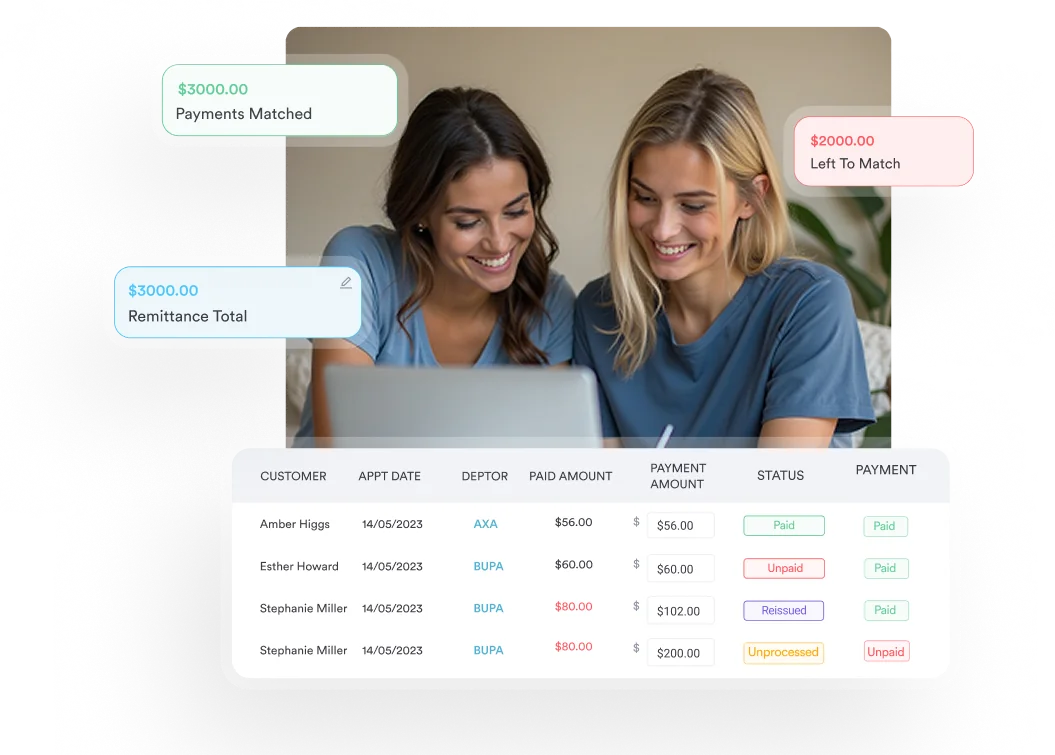

Pabau’s claims management sends CMS-1500 and 837P claims through Claim.MD, runs real-time eligibility checks, and posts the returned remittance back to the invoice.

S52.579R is a narrow code, and the narrowness is the whole point. Three documented facts have to line up: a follow-up visit, a Gustilo type III open wound, and radiographic malunion. When they do, the claim tells the payer exactly what happened to that wrist.
Every letter around R describes a patient with a different problem. So the habit worth building is simple. Read the assessment and the radiology report together before you commit to a character. A query costs a day, while a wrong letter can cost the whole encounter series.
If your team is still retyping coded encounters into a clearinghouse portal, that retyping is where the errors start. Book a demo to see how Pabau carries a fracture encounter through to a submitted claim and a posted payment.

Same malunion, different part of the radius? ICD-10 code S52.356R covers malunion after an open fracture of the radial shaft.
Chart names the side and the styloid? ICD-10 code S52.511P handles a displaced right radial styloid fracture that healed with malunion.
Treating a late effect rather than the fracture? ICD-10 code S52.591S shows how the sequela character works on a distal radius injury.
Need the routine follow-up character instead? ICD-10 code S52.529D walks through a subsequent encounter for a torus fracture of the distal radius.
Not usually. ICD-10-CM sets no national requirement for external cause codes, so reporting is optional unless a payer or a state registry asks for it. Where the record documents how the injury happened, adding the matching V, W, X, or Y code still helps trauma registries.
Yes. When the malunion is the reason for the visit, S52.579R goes first on the claim. If the wrist is incidental to another condition, sequence that condition first. S52.579R then rides along as a secondary diagnosis.
No. The ICD-10-CM guidelines say aftercare Z codes do not apply to injuries. Fracture follow-up uses the acute injury code with a subsequent-encounter 7th character, which is exactly what the R in S52.579R does.
No. The character tracks the phase of care, not the person delivering it. A surgeon meeting the patient for the first time still reports a subsequent encounter, provided active treatment for the fracture has already finished.
Yes. Corrective surgery does not change the diagnosis, so S52.579R stays on the claim while the procedure carries its own CPT code. Check the payer’s coverage policy for malunion correction before the case is scheduled.