ICD-10 code S61.201A: Open wound of left index finger without nail damage
ICD-10 code S61.201A covers a left index finger wound of unstated type ICD-10 co...

Last Updated: Oct 16, 2026
Billable Code Specific Code
S52.326K is the billable ICD-10-CM code for nondisplaced transverse fracture of shaft of unspecified radius, subsequent encounter for closed fracture with nonunion.
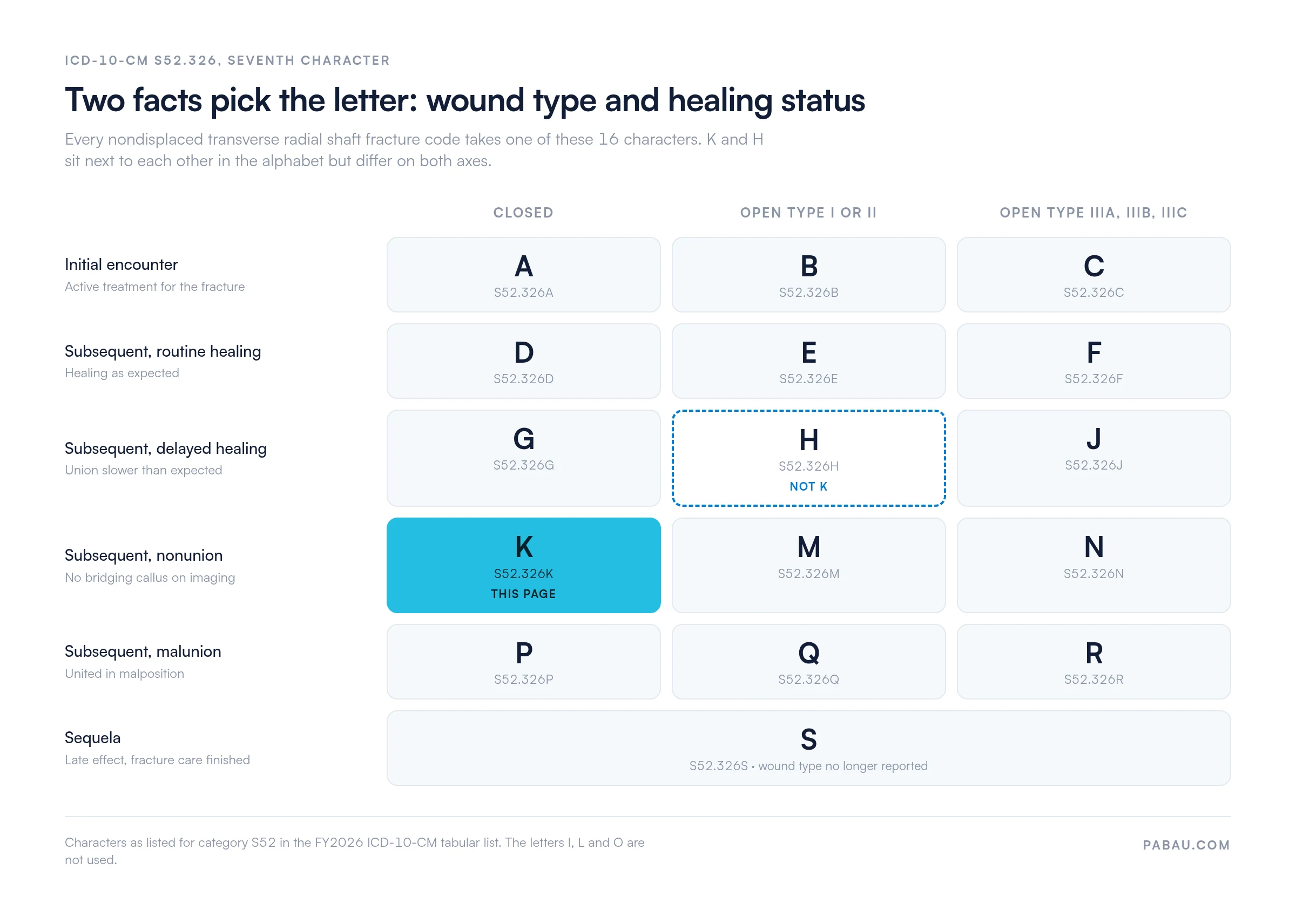
In fact, swap K for H and the claim reports something else entirely. H means an open type I or II fracture with delayed healing, so two facts change at once. Specifically, this page covers the code's billable status, all 16 seventh-character options, the laterality codes that outrank it, and the CPT pairings for nonunion repair.
S52.326K is valid in the FY2026 ICD-10-CM code set. In particular, that set is maintained jointly by the Centers for Medicare and Medicaid Services (CMS) and the National Center for Health Statistics (NCHS). Indeed, Medical billing for fractures turns on this last character more than any other field on the claim.
Let Pabau's smart automation suggest the right codes, reduce claim denials, and keep your practice compliant—effortlessly.
Automate repetitive tasks and focus on what matters most—your patients.
Reduce coding errors and ensure compliance with the latest regulations.
Clean claims, fewer denials, and faster reimbursements.
Powerful insights and reporting to help your practice thrive.
HIPAA compliant SOC 2 certified GDPR-compliant Trusted by 4,000+ clinics worldwide

S52.326K is a billable ICD-10-CM code for a nondisplaced transverse fracture of the radial shaft, reported at a subsequent encounter with nonunion.
The 7th character K carries three facts: closed fracture, subsequent encounter, and nonunion.
K is not the open-fracture or delayed-healing character. In contrast, H reports an open type I or II fracture with delayed healing.
Use S52.324K for the right radius and S52.325K for the left, and keep S52.326K for records that never name the side.
The parent code S52.326 is not billable alone, so every S52 fracture claim needs all seven characters.
Practice management software like Pabau carries ICD-10-CM and CPT lookup libraries, and checks required claim fields before submission.
S52.326K can go on a claim exactly as it stands. In fact, the seventh character is what makes it billable, and the parent code S52.326 will not pass without one.
Code validity is refreshed each October, so check the fiscal year against the CMS ICD-10 codes page before you submit. Once the code is confirmed, the work moves to the last character.
K marks a subsequent encounter for a closed, ununited fracture: active treatment has ended, but the bone has not joined.
In short, twelve of the 16 characters describe a subsequent encounter, split by healing status and fracture type. The set skips I, L and O, so letters jump from H to J and K to M.
Use the CDC/NCHS ICD-10-CM web tool to confirm the current character set — the letters only help once the note states healing status.
In short, nonunion means the fracture has not joined. Specifically, imaging shows a persistent fracture line with no bridging callus, past the point at which union should have happened. In contrast, delayed healing means union is still moving, only slower than expected. Malunion means the bone joined in the wrong position.
In short, all three are subsequent encounters for the same injury, and each takes its own character:
The wound at the time of injury moves the letter as well. In short, the K character covers closed fractures only. In contrast, nonunion of an open type I or II wound takes M, and a type IIIA, IIIB or IIIC wound takes N.
Notably, H sits next to K in the alphabet, and the two get swapped on claims. H reports an open type I or II fracture with delayed healing, so it differs from K on two counts, not one. If the note describes a closed fracture that has stopped healing, H is the wrong character.
Specifically, three anatomical facts sit in front of the seventh character, and each one has to appear in the record.
S52.32 splits by displacement first and side second. Therefore, reading the group in order is the quickest way to catch a displacement error before it reaches the claim.
In short, every one of those six takes the same 16 seventh characters. So the nondisplaced, closed, nonunion follow-up reads as S52.324K on the right, S52.325K on the left, and S52.326K when the record does not say.
In short, a subsequent encounter is any visit after active treatment has ended. Once the patient has had definitive treatment, such as a cast, a reduction or fixation, every follow-up is a subsequent encounter. Visit number does not matter, because the ICD-10-CM Official Guidelines tie the character to the phase of care.
Reach for ICD-10 code S52.326K when all four of these hold at the time of the visit:
Here is how that plays out. For example, a patient breaks the radial shaft in January and comes out of a cast in March. Then, at the October visit the film shows an unchanged fracture line and no callus, and the physician writes nonunion. If that note never names an arm, the encounter codes to S52.326K.
In contrast, change one of those four elements and a sibling code takes over:
Check the AAPC ICD-10-CM code lookup for the full sibling set when displacement or laterality is in doubt.
Write the imaging finding into the note. A line reading persistent fracture line through the radial shaft with no bridging callus at nine months, consistent with nonunion, supports the K character. In fact, fracture follow-up on its own does not, and elapsed time never establishes nonunion by itself.
Specifically, the sixth character 6 means the record does not say which radius. As a result, payers screen unspecified codes in pre-payment edits, and Medicare Advantage plans screen them hardest.
The Official Guidelines do not ban unspecified laterality. They do require the most specific code the documentation supports, so the side belongs in the note whenever anyone knows it.
There is a second reason to query the provider. In addition, a nonunion repair billed on the same claim needs an RT or LT modifier on the procedure line. That side has to come from the same record. As a result, a claim that pairs an unspecified-laterality diagnosis with a sided procedure contradicts itself, and payer edits catch that pattern.
In short, laterality and displacement are two of the most common triggers for orthopedic claim edits. Both are worth catching before submission rather than after the payer returns the claim.
In fact, reading the hierarchy is a quick way to confirm you are at the right level of specificity. It also prevents the most common error on these claims, which is billing the parent code.
As a result, S52.326 submitted bare fails claim validation before it reaches the payer. In fact, that rule runs across every S52 fracture code, not just the transverse shaft group.
Section I.C.19 of the ICD-10-CM Official Guidelines for Coding and Reporting governs injury codes, fractures included. Specifically, four of its rules bear directly on this code.
Specifically, two exclusion notes sit on the S52 category. They decide whether a second injury can be reported on the same claim.
Each element of S52.326K has to be written down somewhere in the chart, because coders may not assume any of them. Notably, two elements slip more often than the rest: displacement and the closed status. Both were settled months earlier at the initial encounter, and the follow-up note rarely repeats them.
Instead, query the physician whenever an element is missing. A coder cannot assign nonunion from an imaging report alone, however clear the film looks. Instead, the physician has to acknowledge the finding in the clinical note first.
Practices that rehabilitate these patients after repair can hold displacement, wound status and healing status in structured note fields. Those details then carry forward to each follow-up visit instead of being retyped.
Specifically, nonunion of the radial shaft has its own CPT family, separate from the 256xx group used for the lower end of the radius. In fact, site matters here as much as it does on the diagnosis side. The codes below are the ones that turn up on these claims, and AMA CPT codebook descriptors govern the precise indication for each.
The two graft rows follow a bundling rule that supply codes do not share. Codes 25405 and 25420 include obtaining the autograft, so 20900 is not reported alongside them. A skin substitute product such as HCPCS code Q4107 bills per square centimeter and requires a qualifying wound care procedure on the same claim.
Indeed, CPT codes are maintained by the American Medical Association (AMA). Treat the pairings above as context, then verify them against the current codebook and the payer’s own policy. Some plans also require prior authorization for nonunion repair, which is worth reading before the visit rather than after the denial.
In short, denials on these claims usually trace back to one of five details. Run this list while the note is still open:
If a claim does come back denied, start with the seventh character and then the note behind it. The remittance advice narrows the search, because denial codes name the field the payer rejected. The procedure line is worth a second look too. As a result, a sided modifier next to an unspecified diagnosis is an easy edit for a payer to catch.
ICD-10-CM replaced ICD-9-CM for HIPAA-covered transactions on October 1, 2015. The General Equivalence Mappings are approximate, and no single ICD-9-CM code matches S52.326K, because ICD-9-CM carried neither laterality nor a seventh character.
Specifically, the GEMs are published by CMS and NCHS, and they serve research and data migration rather than current-year claims. In addition, ResDAC publishes separate guidance on using ICD codes in Medicare research files. Code from the current fiscal year tabular list instead.
Where the clinical record and the billing system sit apart, the diagnosis gets typed twice. A coder reads the follow-up note, picks S52.326K, then re-enters it in a separate system along with the payer, provider and authorization details. As a result, every re-entry is a chance to drop the last character.
Pabau, our practice management platform, removes that second pass. The claim form pre-fills from the patient record, so the codes attached to the visit land on the charge lines as they were coded.
Search icons open the ICD-10-CM and CPT lookup libraries whenever a coder wants to confirm a character, and both libraries refresh with each official release. In addition, the Send button stays locked until the claim’s required fields are complete, membership and authorization numbers included.
In the US, claims route through the Claim.MD clearinghouse, with real-time eligibility checks, ERA posting and claim-status tracking on one screen. Remittances land against the visit they belong to, so a short payment is visible the same week.
Pabau’s claims management software does not read the note or decide whether K is the right character, so that judgment stays with the coder. In short, what it removes is the retyping, the half-filled claim, and the wait on a paper remittance.
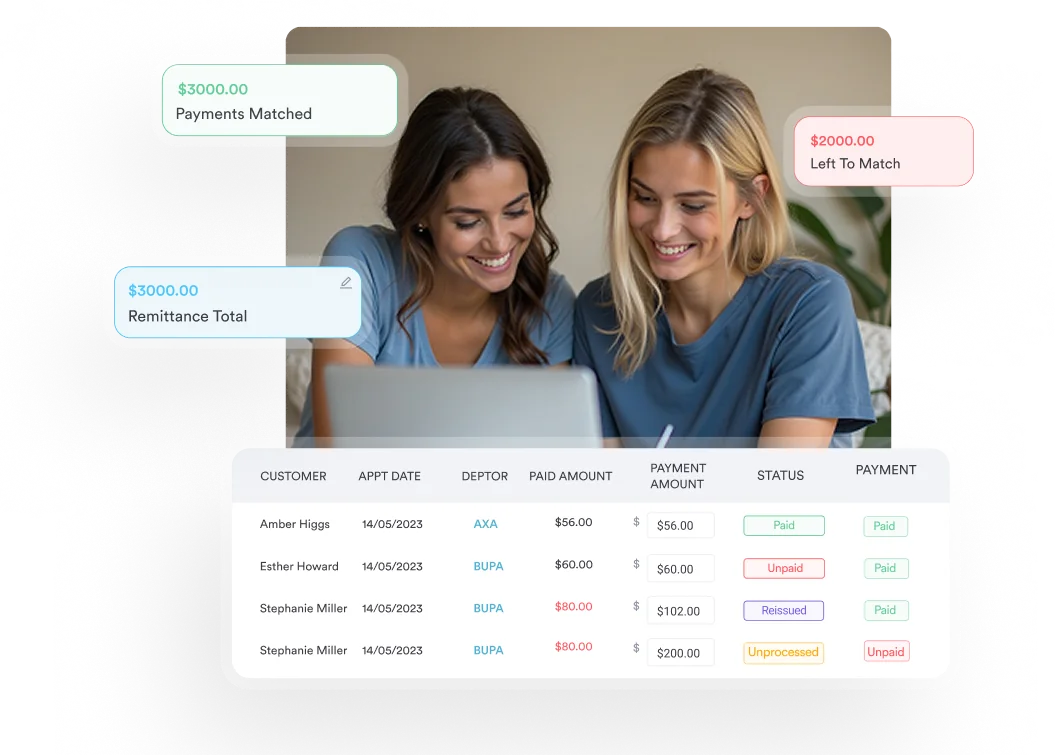

Pabau pre-fills the claim from the patient record, then checks that every required field is complete before submission. In the US, Claim.MD handles eligibility checks, ERA remittances and claim-status tracking.

S52.326K is a narrow code, and that is the point of it. One fracture pattern, one displacement status, one closed wound, one healing outcome, one phase of care.
Indeed, the pair worth watching is K against H, two letters that sit next to each other in the character set. In contrast, H describes an open fracture that is still healing, which is a different injury altogether. A closed radial shaft fracture that has stopped healing is always K, on the side the chart supports.
In short, Pabau keeps the coding, the invoice and the claim on one patient record. Book a demo to see how a fracture claim leaves your practice with its codes, charges and required fields already complete.

Need to verify how the 837 electronic claim file handles ICD-10 codes? 837 file format guide explains how diagnosis codes map to claim loops in electronic submissions.
Want to know how a fracture claim gets denied, and how to appeal it? Denial codes in medical billing covers the common remittance reason codes and the appeal route for each.
Need the rules behind a compliant submission? Medical billing compliance sets out the documentation and submission standards for HIPAA-covered claims.
Following the money from note to payment? What is revenue cycle management walks the chain from documentation through to remittance.
S52.326K is a billable ICD-10-CM code for a nondisplaced transverse fracture of the shaft of the unspecified radius, subsequent encounter for closed fracture with nonunion. It covers a follow-up visit where a closed, nondisplaced transverse shaft fracture has failed to unite. In short, it is valid in the FY2026 code set.
Use S52.324K when the record names the right radius and S52.325K when it names the left. Keep S52.326K for records that genuinely do not identify the side. Instead, assigning unspecified laterality while the chart names the arm is a query opportunity, not a coding choice.
Displaced transverse shaft fractures code to S52.321 on the right, S52.322 on the left, and S52.323 when the side is not recorded. In addition, the nondisplaced codes are S52.324, S52.325 and S52.326. All six take the same 16 seventh characters, so a displaced closed nonunion on the right reads as S52.321K.
No. Care for a nonunion stays at a subsequent encounter, so the character remains K for a closed fracture. In fact, the claim does not revert to A because an operation was performed. A is for active treatment of the fracture itself.
No. The phase of care sets the character, not the calendar. Instead, keep reporting K while the nonunion is being treated or monitored. Move to S52.326S once only the late effects of the original injury remain.