ICD-10 code S61.201A: Open wound of left index finger without nail damage
ICD-10 code S61.201A covers a left index finger wound of unstated type ICD-10 co...

Last Updated: Oct 16, 2026
Billable Code Specific Code
S43.226S is the billable ICD-10-CM code for posterior dislocation of unspecified sternoclavicular joint, sequela.
Let Pabau's smart automation suggest the right codes, reduce claim denials, and keep your practice compliant—effortlessly.
Automate repetitive tasks and focus on what matters most—your patients.
Reduce coding errors and ensure compliance with the latest regulations.
Clean claims, fewer denials, and faster reimbursements.
Powerful insights and reporting to help your practice thrive.
HIPAA compliant SOC 2 certified GDPR-compliant Trusted by 4,000+ clinics worldwide

ICD-10 Code S43.226S is posterior dislocation of unspecified sternoclavicular joint, sequela. It is also a billable, specific code valid for HIPAA-covered transactions in FY2026.
The joint is the sternoclavicular joint, where the clavicle meets the sternum. However, the acromioclavicular joint sits under a different subcategory, S43.1.
Sequencing runs one way only. Code the residual condition first, then S43.226S. The injury code with 7th character S is never the principal or first-listed diagnosis.
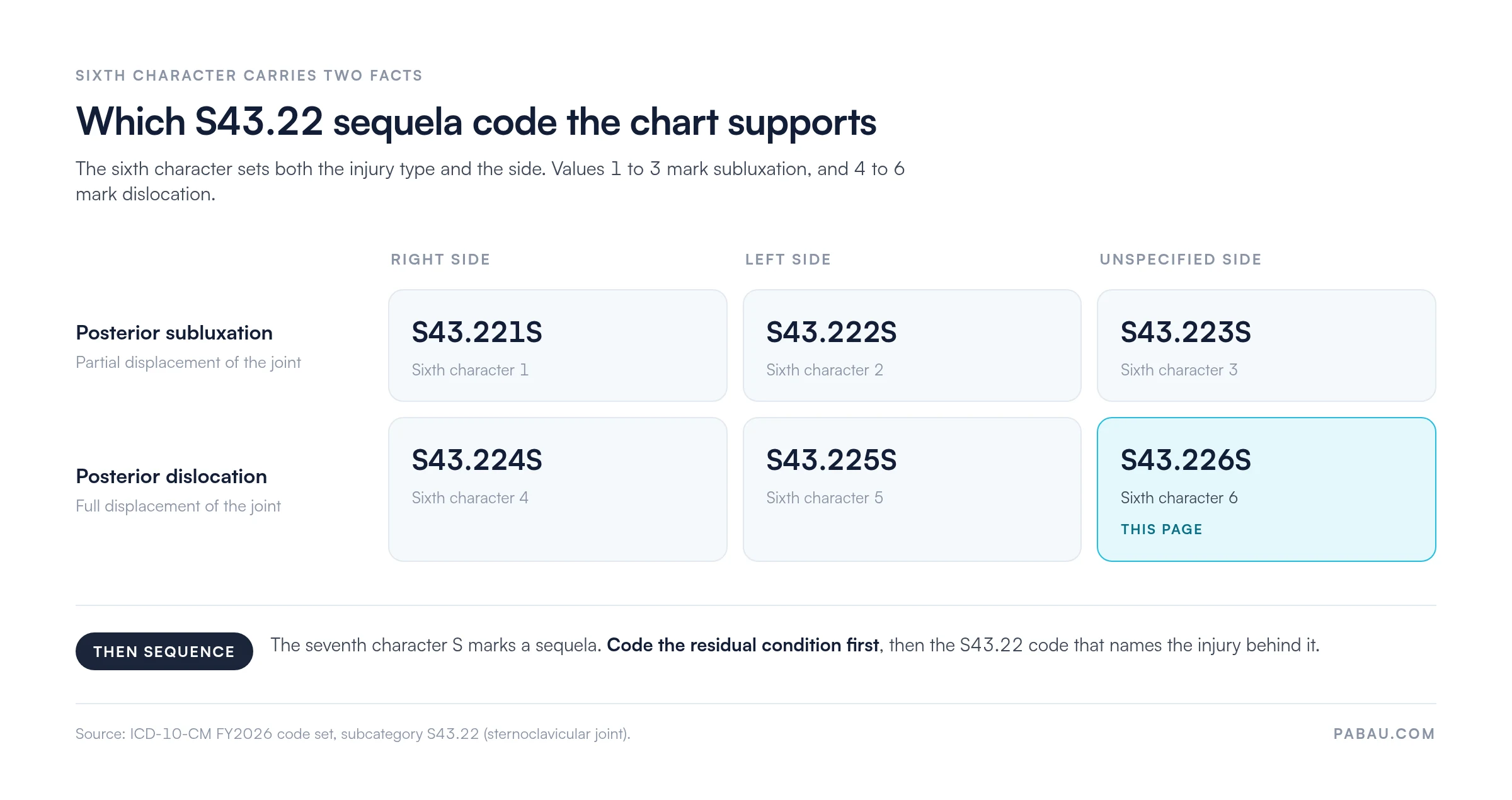
The right and left posterior dislocation sequela codes are S43.224S and S43.225S. By contrast, S43.221S through S43.223S describe subluxation, not dislocation.
Because posterior sternoclavicular dislocation can compress the trachea, esophagus, or great vessels, the acute injury becomes an emergency, and that in turn shapes the sequelae you later code.
Practice management software like Pabau validates ICD-10-CM entries before submission, so a reversed sequela pair gets caught in-house rather than by the payer.
ICD-10 Code S43.226S covers posterior dislocation of unspecified sternoclavicular joint, sequela. Overall, it is a billable, specific ICD-10-CM code valid for HIPAA-covered electronic transactions in FY2026, effective October 1, 2025 through September 30, 2026.
One detail decides whether this code is correct at all. S43.2 is the sternoclavicular joint, where the medial clavicle meets the sternum. The acromioclavicular joint at the top of the shoulder is coded under S43.1 instead. Mixing the two sends the claim out describing a different injury.
The code sits in the S00-T88 injury chapter, inside category S43 (Dislocation and sprain of joints and ligaments of shoulder girdle). Per the CMS ICD-10-CM code set, it is a valid seven-character code. It is not a stand-alone diagnosis, though, and the sequencing section below explains why. In addition, this reference covers code details, hierarchy, 7th character rules, sibling codes, and documentation requirements.
The table below gives every fact a coder or biller needs before submitting this code.
Verify the current edition annually via the CDC/NCHS ICD-10-CM web tool before submitting claims, as codes are updated each October 1.
S43.226S sits at the bottom of a five-level classification tree. Each parent level narrows the specificity of the injury. Therefore, coders must use the most specific billable code the documentation supports. The chain from S43.226S back to the chapter level is shown below.
Two things stand out in that chain. Notably, S43.2 names the sternoclavicular joint, not the acromioclavicular joint.
The 6th character inside S43.22 carries two facts at once, the direction of the injury and the side. Values 1 through 3 mark subluxation, while 4 through 6 mark dislocation. The grid below pairs each value with the code it produces.
Knowing the parent chain helps coders confirm they are submitting a billable code rather than a header that will be rejected. In addition, the wider ICD-10-CM code reference shows the same five-level structure repeating across other injury categories.
The 7th character records what this visit is treating, not when the injury happened. ICD-10-CM uses three encounter-type characters for injury codes in the S40-S49 range. As a result, choosing the wrong one triggers claim denials and audit flags.
The sequencing rule for that S character runs one way only. Per section I.B.10 of the ICD-10-CM Official Guidelines for Coding and Reporting, sequela coding takes two codes in a fixed order. The residual condition comes first, such as chronic sternoclavicular instability, post-traumatic arthritis, or dysphagia. The injury code carrying the S, S43.226S, is sequenced second.
Chapter 19 guideline I.C.19.a says the same thing for injuries. The S is added only to the injury code, never to the code for the residual condition. Its job is to identify which injury produced that condition. So S43.226S cannot be a principal diagnosis, a first-listed diagnosis, or the only diagnosis on a claim. It always follows the condition code. The AAPC ICD-10-CM coding resources reflect the same order.
Separating the three encounter types comes down to one test. The 7th character follows the purpose of the visit, not the age of the injury. A patient injured two years ago who is still in active management uses S43.226D. In contrast, the same patient who develops chronic instability after healing uses S43.226S, sequenced behind the instability code.
Spell out the causal link in every sequela note. Write: chronic sternoclavicular instability secondary to posterior dislocation sustained [date]. Then code the instability first and S43.226S second. Without that statement, payers reclassify the visit as a subsequent encounter (D) and reject the sequela code.
The sternoclavicular joint connects the medial end of the clavicle to the manubrium of the sternum and the first costal cartilage. It is the only bony joint between the arm and the axial skeleton. Specifically, posterior dislocation drives the medial clavicle backwards behind the sternum, usually after high-energy trauma or a posterolateral blow to the shoulder.
That direction is what makes the injury unusual. Anterior dislocations are far more common and sit under S43.21. In contrast, posterior dislocations are rare, and they point the clavicle straight at the structures behind the sternum. The S43.22 subcategory exists separately for exactly that reason.
This is the point that separates the sternoclavicular joint from the acromioclavicular joint clinically. A retrosternal clavicle can compress the trachea, the esophagus, the brachiocephalic vessels, or the subclavian vessels. As a result, airway compromise, dysphagia, and vascular injury are all documented consequences.
Acute cases therefore go to emergency imaging and often to reduction with thoracic surgical cover. By contrast, an acromioclavicular separation carries none of that mediastinal risk. For coders, this matters twice. It explains why the posterior descriptor is worth coding precisely, and it widens the list of residual conditions you might sequence ahead of S43.226S.
The unspecified qualifier in this code, 6th character 6, applies when the record does not document which side is affected. The code set carries that option for records where laterality cannot be established. Document the side at every encounter, though, and S43.224S or S43.225S becomes available instead.
S43.226S is one of three posterior dislocation sequela codes in the S43.22 family. The other three 6th characters in that family describe subluxation, which is a partial displacement rather than a full dislocation. Reading the 6th character correctly is what keeps these apart.
That last row is deliberate. The acromioclavicular joint has its own subcategory, S43.1, with children such as S43.11- for subluxation and S43.12- and S43.13- for dislocation graded by displacement. There is no S43.22- code for the acromioclavicular joint, so a chart documenting an acromioclavicular injury never lands on S43.226S.
Four errors show up repeatedly on this code. In fact, each one is easy to catch at the point of entry and expensive to catch after a denial.
A code validation step inside the chart catches all four before submission. In turn, that is cheaper than an appeal, and it keeps the sequela pair intact on the claim.
Documentation is what decides whether a sequela claim for S43.226S survives review. Accordingly, per the ICD-10-CM Official Guidelines for Coding and Reporting, the record must support the causal relationship between the current condition and the original injury. The checklist below covers the elements payers look for.
The same causal documentation standard applies in every other diagnostic category that carries sequela codes. In other words, a sequela code needs an explicit causal narrative. Two diagnoses sitting on the same problem list will not carry the claim on their own.
Coders who trained on ICD-9 will know the term late effect. ICD-10-CM replaced it with sequela across the whole code set. The concept is identical: a condition that follows a prior disease or injury and persists after the acute phase ends. No minimum interval is specified, so a sequela can appear days or decades later.
If a provider writes late effect in the chart, the coder can map it to the sequela code without a physician query. The change is administrative, not clinical. However, what the coder still needs is the statement tying the current condition back to the dislocation.
When mining old records for sequela coding, search for the original injury under S43.226A or its laterality-specific counterpart, S43.224A or S43.225A. That first encounter note supplies the date and the mechanism your causal documentation chain rests on.
Accuracy on a sequela claim depends on code selection and on order. The residual condition being treated goes in the first diagnosis position. S43.226S goes in the next position, where it identifies the injury that caused that condition. Reversing the pair, or submitting S43.226S alone, is a sequencing error the payer will act on.
Common denial reasons for S43.226S claims include:
One more split catches practices out. Any brace or support dispensed at a sequela visit leaves the physician claim and goes to the DME MAC on its own DMEPOS supplier claim. Billing a knee orthosis under HCPCS code L1810 shows the pattern: that supplier line needs a diagnosis from LCD L33318 plus a KX modifier.
Practices with recurring sequela denials get further by working the pattern than the single claim. In fact, a systematic approach to denial management in healthcare catches the sequencing errors that repeat across a whole code family.
A practice coding S43.226S today usually checks the joint, the 6th character, and the diagnosis order by hand. That happens after the visit, often in a batch, and often by someone who was not in the room. As a result, the four errors listed earlier survive that process comfortably.
Practice management software like Pabau moves the check to the point of entry. Our claims management software validates ICD-10-CM entries against a built-in code catalog as the clinician records them. A wrong 7th character or an incomplete sequela pair surfaces while the chart is still open, so no claim reaches the payer unchecked.
Submission runs from the same record. Pabau connects to the Claim.MD clearinghouse for electronic claims in the United States, reaching thousands of US payers via CMS-1500 and 837P formats. Denials and appeals are tracked in the same place, so you can see which codes cost you money.
Overall, the outcome is fewer rejected sequela claims and less rework for the billing team. Coders spend their time on the charts that genuinely need a query, rather than on avoidable resubmissions.

Pabau validates ICD-10-CM entries at the point of care and submits through the Claim.MD clearinghouse. Orthopedic, sports medicine, and physical therapy practices catch reversed sequela pairs and wrong 7th characters before the payer does.

S43.226S is a precise code, and the precision is the whole point. It names the sternoclavicular joint, a posterior dislocation, an unspecified side, and a sequela encounter. Get the joint wrong, however, and you have coded a different injury at the other end of the clavicle.
Order matters just as much. The residual condition leads, S43.226S follows, and the note has to say that one caused the other. Without that causal statement the claim is exposed to denial or reclassification, however well the code itself is chosen.
Pabau validates ICD-10-CM entries before submission and tracks the denials that arrive anyway, so orthopedic and rehabilitation teams see which codes cost them money. To see how Pabau handles injury code workflows, book a demo with the team.

Coding a sequela at the other end of the clavicle? ICD-10 code S42.032S covers a displaced lateral end clavicle fracture, sequela, and shows the same 7th-character rules on a fracture code.
Want the documentation standard payers audit against? Medical billing compliance sets out the record-keeping that supports a causal statement on any sequela claim.
Want to reduce claim errors before they reach the payer? Denial management in healthcare outlines systematic prevention and appeal strategies for high-denial code categories.
S43.226S is the ICD-10-CM code for posterior dislocation of unspecified sternoclavicular joint, sequela. The trailing S is the 7th character for a sequela encounter. It applies when the patient is treated for a residual condition left by a prior posterior sternoclavicular dislocation. However, note the joint carefully: S43.2 is the sternoclavicular joint, not the acromioclavicular joint.
Yes, but never on its own. S43.226S is a billable, specific code valid for HIPAA-covered transactions in FY2026, effective October 1, 2025 through September 30, 2026. It cannot be a principal or first-listed diagnosis. The residual condition is coded first, and S43.226S is sequenced after it.
The direct parent is S43.226, posterior dislocation of unspecified sternoclavicular joint, without a 7th character. Above that sits S43.22, posterior subluxation and dislocation of sternoclavicular joint. Above that is S43.2, subluxation and dislocation of sternoclavicular joint, then category S43 for the shoulder girdle.
It requires a companion code, and S43.226S is the second of the pair. Code the residual condition first, such as chronic shoulder pain or joint instability. Then report S43.226S to identify the injury behind it. Submitting S43.226S alone or in the first position is a sequencing error.
The medial clavicle can move behind the sternum and press on the trachea, the esophagus, or the great vessels. As a result, airway compromise, dysphagia, and vascular injury are all reported. That is why acute cases go to urgent imaging and often to reduction with surgical cover.