Pabau Engage inbox

Pabau Engage is here: every patient conversation in one inbox.

Learn more
Book a demo Book a demo
ICD-10-CM Code

ICD code S42.433S Displaced lateral epicondyle fracture, unspecified humerus

Billable Code Specific Code


Code Definition

S42.433S is the billable ICD-10-CM code for displaced fracture (avulsion) of lateral epicondyle of unspecified humerus, sequela.

It sits in the S42.4 block covering fractures of the lower end of the humerus, and it is valid for FY2025 and FY2026 claims. The sequela character limits it to encounters after the fracture has healed, where a residual late effect brings the patient back. The unspecified laterality limits it further, to records that never name the injured side. Where a side is documented, S42.431S (right) or S42.432S (left) applies instead.

Chapter
S00-T88 Injury, poisoning and certain other consequences of external causes
Category
S42 Fracture of shoulder and upper arm
Group
S42.433 Displaced fracture (avulsion) of lateral epicondyle of unspecified humerus
Billable
Yes
Code also known as
lateral elbow fracture, avulsion fracture elbow, epicondyle avulsion
Save time. Improve accuracy. Get paid faster.
Automate coding with Pabau

Let Pabau's smart automation suggest the right codes, reduce claim denials, and keep your practice compliant—effortlessly.

  • AI-powered code suggestions
  • Real-time compliance checks
  • Faster claims, fewer denials
Why practices choose Pabau
Save hours every week

Automate repetitive tasks and focus on what matters most—your patients.

Improve accuracy

Reduce coding errors and ensure compliance with the latest regulations.

Get paid faster

Clean claims, fewer denials, and faster reimbursements.

Grow with confidence

Powerful insights and reporting to help your practice thrive.

HIPAA compliant SOC 2 certified GDPR-compliant Trusted by 4,000+ clinics worldwide

Key takeaways
Found our content helpful?

Key takeaways

S42.433S codes a displaced avulsion fracture of the lateral epicondyle at the sequela stage, on a humerus whose side the record does not state.

The S character applies only when the fracture is fully healed and a residual late effect is the documented reason for the visit.

Use S42.433S only when the documentation omits laterality altogether. If the note names a side, code S42.431S for right or S42.432S for left.

S42.436S is the nondisplaced counterpart at the same unspecified laterality. Pair S42.433S with a secondary code naming the sequela, such as M25.629.

ICD-10 Code S42.433S: Quick reference summary

ICD-10 Code S42.433S reports a displaced avulsion fracture of the lateral epicondyle at the sequela stage, on a humerus whose side the record never names.

It is billable for FY2025 and FY2026 claims. The table below is the at-a-glance reference for coders and billers. Confirm the code against the CDC/NCHS ICD-10-CM web tool for the applicable fiscal year.

Field Value
Code S42.433S
Full descriptor Displaced fracture (avulsion) of lateral epicondyle of unspecified humerus, sequela
Code system ICD-10-CM (US Clinical Modification)
Billable Yes – valid for FY2025 and FY2026
ICD-10-CM chapter Chapter 19: Injury, Poisoning, and Certain Other Consequences of External Causes (S00-T88)
Block S42.4 – Fracture of lower end of humerus
7th character S = Sequela
Laterality Unspecified – the record does not name a side
Laterality-specific alternatives S42.431S (right humerus), S42.432S (left humerus)
Nondisplaced equivalent S42.436S

What does S42.433S mean? Code descriptor explained

S42.433S means a displaced avulsion fracture of the lateral epicondyle of the humerus at the sequela stage of care, with the injured side not documented. Each element of the descriptor carries a specific coding obligation.

  • Displaced: The fractured bone fragment has shifted from its anatomical position. Radiographic or operative confirmation of displacement is required. Without documented displacement, the nondisplaced codes apply instead: S42.434S for right, S42.435S for left, and S42.436S when the side is not documented.
  • Avulsion: The mechanism is tensile, not compressive. A ligament or extensor tendon pulls a bony fragment away from the epicondyle, most often during a valgus stress event or forced pronation. Avulsion type must be clinically or radiographically noted; generic “fracture of humerus” documentation does not satisfy this element.
  • Lateral epicondyle: The bony prominence on the lateral (outer) side of the distal humerus, where the common extensor tendon originates. This is anatomically distinct from the medial epicondyle (coded under S42.44x) and the olecranon of the ulna.
  • Unspecified humerus: This is the laterality slot, and filling it is a coding decision rather than an omission. S42.433S is correct only when the clinical record does not state whether the left or the right humerus was fractured. A note that names a side points to S42.431S or S42.432S instead.
  • Sequela: The 7th character S signals that the original fracture is healed. The current visit is for a residual condition caused by that fracture, such as chronic pain, post-traumatic stiffness, or malunion. At this stage, medical necessity rests on the sequela rather than on the healed fracture.

Missing any one of these five elements in the medical record creates an audit vulnerability. Payers have the right to request records and deny the claim if the code’s specificity is not supported by documentation.

Anatomy: The lateral epicondyle of the humerus

The lateral epicondyle is the bony projection on the outer (lateral) side of the distal humerus, just proximal to the capitellum. It serves as the origin of the common extensor muscle group, including extensor carpi radialis brevis, extensor digitorum, extensor digiti minimi, and extensor carpi ulnaris.

Avulsion fractures at this site occur when tensile force exceeds the bone’s yield strength. In children and adolescents, the lateral epicondyle is an apophysis, a secondary ossification center. That makes it particularly vulnerable during valgus stress injuries or elbow dislocation events. In adults, the same mechanism can occur during falls on an outstretched hand or direct trauma. Displacement matters clinically because a widely displaced fragment may impede elbow extension, entrap within the joint, or fail to heal in anatomical position. Those outcomes are the late effects that bring the patient back under S42.433S.

Knowing the mechanics helps clinicians write a note that carries the code. “Lateral elbow pain after old fracture” gives a payer almost no detail to work with. A stronger note reads: “residual post-traumatic extensor weakness at the lateral epicondyle following a prior displaced avulsion fracture, now fully healed on imaging.” That version names the site, the mechanism, the late effect, and the healing status.

The sequela (S) 7th character, and when it applies

The 7th character for S42.433 determines the encounter stage. Three options exist, and choosing the wrong one is the leading cause of denied claims on this code family. The CMS ICD-10-CM coding guidelines define each encounter type precisely.

7th Character Encounter Type When to Use Clinical Scenario Example
A Initial encounter First time receiving active treatment for the fracture (surgery, casting, splinting, ED management) Patient arrives at ED after a fall; fracture confirmed and splinted
D Subsequent encounter Fracture is still healing; routine follow-up, cast change, hardware check, X-ray during healing phase Two weeks post-op: wound check, ROM assessment while fracture consolidates on imaging
S Sequela Fracture is healed (confirmed on imaging); patient presents for a residual condition caused by the original injury Eight months post-injury: elbow stiffness and chronic lateral pain; imaging confirms healed fracture with mild malunion

The critical distinction between D and S is fracture healing status, not time elapsed. A fracture still consolidating on X-ray at six months remains a D encounter. A fracture healed at three months but presenting with post-traumatic contracture is an S encounter. Per ICD-10-CM Official Guidelines Section I.C.19, the sequela code (S42.433S) is sequenced first, followed by a secondary code identifying the nature of the sequela. Where the record does not name a side, that secondary code is also unspecified, for example M25.629 for stiffness of an unspecified elbow.

S42.433S in the ICD-10-CM hierarchy: Parent codes and block

S42.433S sits on a defined path through the ICD-10-CM tabular list. Tracing that chain from category down to the billable code shows why the adjacent codes are so easily confused. The full ICD-10-CM code library lets you check where a neighboring code sits before you assign one.

Level Code Description
Chapter S00-T88 Injury, Poisoning, and Certain Other Consequences of External Causes
Block S40-S49 Injuries to the shoulder and upper arm
Category S42 Fracture of shoulder and upper arm
Sub-category S42.4 Fracture of lower end of humerus
Group S42.43 Fracture (avulsion) of lateral epicondyle of humerus
Code (base) S42.433 Displaced fracture (avulsion) of lateral epicondyle of unspecified humerus
Billable code S42.433S Displaced fracture (avulsion) of lateral epicondyle of unspecified humerus, sequela

S42.433S is confirmed valid and billable in the FY2025 ICD-10-CM tabular list. Validity for FY2026 should be verified against the CDC/NCHS ICD-10-CM web tool at the start of each fiscal year (codes effective October 1).

S42.433S vs the laterality-specific alternatives

The S42.43x family contains six sequela codes that differ only by displacement status and laterality. Selecting the wrong one is among the most frequent reasons claims for lateral epicondyle fractures are denied or returned for correction.

Code (Sequela) Descriptor Displacement Laterality
S42.431S Displaced fracture (avulsion) of lateral epicondyle of right humerus, sequela Displaced Right
S42.432S Displaced fracture (avulsion) of lateral epicondyle of left humerus, sequela Displaced Left
S42.433S Displaced fracture (avulsion) of lateral epicondyle of unspecified humerus, sequela Displaced Unspecified (THIS CODE)
S42.434S Nondisplaced fracture (avulsion) of lateral epicondyle of right humerus, sequela Nondisplaced Right
S42.435S Nondisplaced fracture (avulsion) of lateral epicondyle of left humerus, sequela Nondisplaced Left
S42.436S Nondisplaced fracture (avulsion) of lateral epicondyle of unspecified humerus, sequela Nondisplaced Unspecified

Two distinctions are worth fixing in your own workflow. First, S42.433S and S42.436S share unspecified laterality and differ only on displacement status. A record silent on both elements supports neither code cleanly. Second, do not confuse any S42.43x code with S42.44x (fracture of medial epicondyle) or with S52.0x (olecranon fracture of the ulna). Both involve the elbow region but code to entirely different anatomical sites.

The chart below runs all three checks in the order the record answers them, from healing status through to displacement.
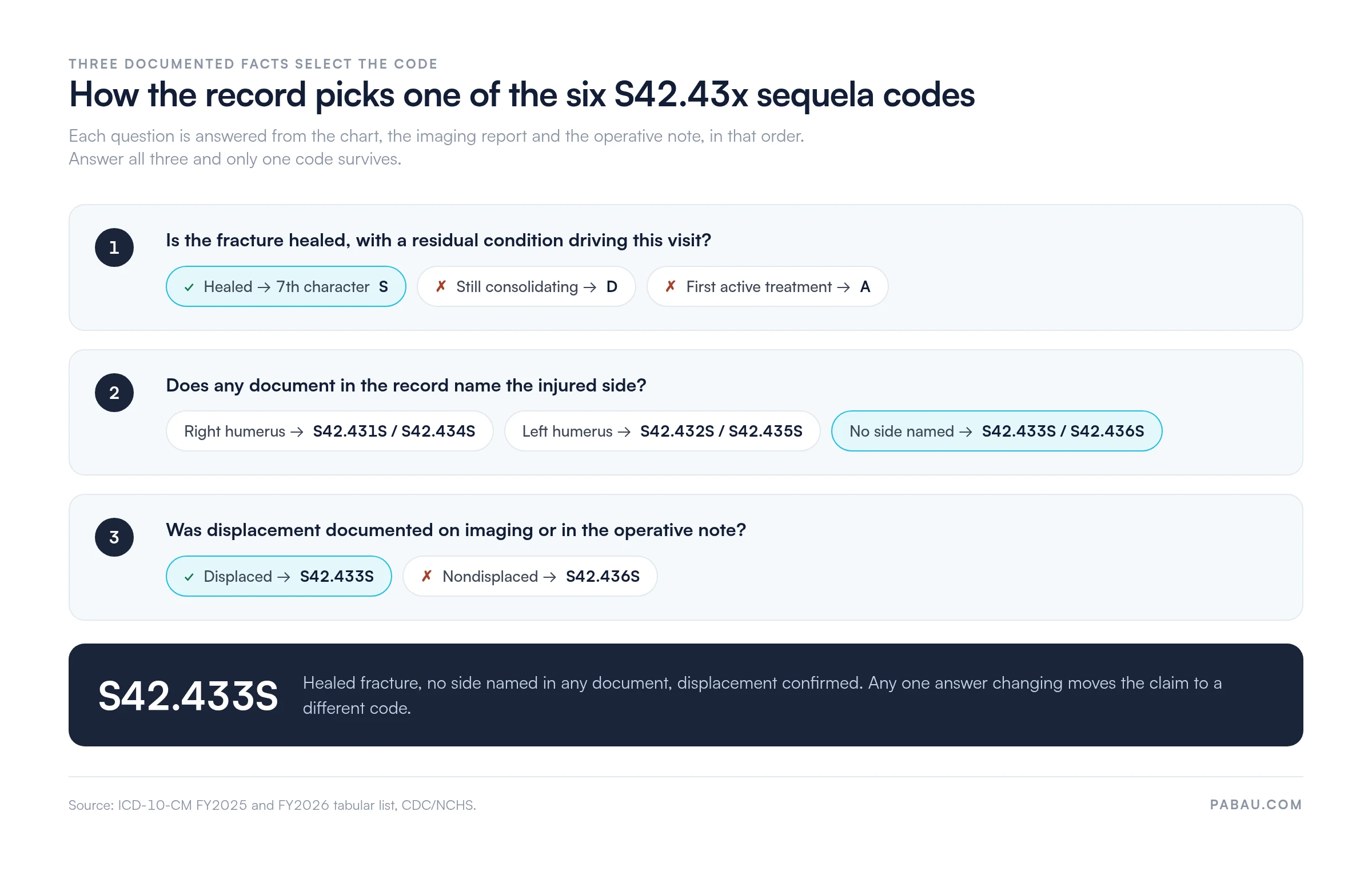
Three-step decision chart for the S42.43x sequela codes: healed fracture gives 7th character S, right humerus gives S42.431S or S42.434S, left gives S42.432S or S42.435S, no side named gives S42.433S or S42.436S, and documented displacement gives S42.433S
Healing status, laterality and displacement each narrow the field, and S42.433S survives only when all three answers line up. Codes from the CDC/NCHS ICD-10-CM tabular list.

Documentation requirements to support S42.433S

The clinical record must explicitly support every component of ICD-10 Code S42.433S. A chart note that vaguely references “old elbow fracture with ongoing symptoms” will not withstand payer scrutiny. The seven checks below are what a reviewer looks for once the claim is pulled.

  • No side named anywhere: S42.433S is defensible only when no source in the record names a side. Check the current note, the original operative report, and the imaging report before you settle on the unspecified code. If any of them says left or right, code S42.432S or S42.431S instead.
  • A documented query attempt: Payers read repeated unspecified-laterality claims as a documentation-quality problem. Record that you queried the treating clinician, and record the response, so the unspecified code is an evidenced decision rather than a shortcut.
  • Fracture site specificity: The note must name the lateral epicondyle, not generic “humerus fracture” or “elbow fracture.” Radiology reports and operative notes are acceptable supporting evidence, but the treating clinician’s note must reference them.
  • Displacement status: The original fracture must have been documented as displaced, confirmed by imaging or operative report. If displacement was not documented at the time of injury, S42.433S cannot be retroactively assigned.
  • Healing confirmation: Because S is the sequela character, the record must confirm the fracture is healed. This is typically via a comparative X-ray or clinical statement (“fracture healed on imaging dated [date]”).
  • Nature of the sequela: The specific late effect must be named: post-traumatic stiffness, malunion, chronic lateral epicondyle pain, extensor weakness, or another residual condition. ICD-10-CM guidelines require the sequela itself to be coded separately as a secondary diagnosis.
  • Avulsion mechanism: ICD-10-CM Official Guidelines do not require mechanism documentation for sequela encounters. Even so, the original treatment record should name the avulsion type to support the base code assignment.

Coding guidelines: ICD-10-CM official rules for S42.433S

ICD-10-CM Official Guidelines Section I.C.19 governs traumatic fracture coding, including sequela encounters. Six of its rules bear directly on how S42.433S is assigned and sequenced.

  • Sequela defined: A sequela is a condition produced as a direct result of a disease or injury. For fractures, the sequela is the residual condition that persists after the fracture itself has healed. The sequela code (S42.433S) is not assigned during active fracture treatment.
  • Sequela code sequencing: Per Official Guidelines, the sequela code is sequenced first. A code for the nature of the sequela follows as a secondary diagnosis. For example: S42.433S first, then M25.629 (stiffness of unspecified elbow, not elsewhere classified) as secondary.
  • Unspecified laterality is a last resort: Section I.B.13 tells coders to select a laterality-specific code whenever the classification offers one. S42.433S is the correct assignment only where no document in the record identifies a side. Query the clinician before you default to it.
  • Keep the sequela code consistent: If the fracture code is unspecified for laterality, the secondary sequela code usually has to be unspecified too. A claim pairing S42.433S with a left-sided or right-sided sequela code contradicts itself, and payers do notice.
  • Active vs healed distinction: An active fracture with complications uses the 7th character D rather than the sequela character. That covers delayed union, nonunion, and malunion during the healing phase, each paired with an appropriate complication code. The S character is reserved for encounters after healing is complete and a residual condition drives the visit.
  • Pathological fracture exclusion: S42.433S does not cover fractures due to underlying disease (osteoporosis, neoplasm). Pathological fractures code to the M84.x series. Traumatic origin must be established for S42.433S assignment.

Payer requirements and prior authorization for S42.433S

Payer requirements for sequela-stage fracture encounters vary by plan, but several standards apply broadly. Checking eligibility before the encounter catches most of them early. A sequela claim is often submitted months after the original injury was treated, so coverage may have changed since.

  • Medical necessity documentation: Payers require evidence that the sequela condition is actively managed. A chart note documenting “patient reports some discomfort” without a treatment plan will not satisfy medical necessity thresholds. The note should include objective findings (ROM measurements, strength testing) and a specific intervention plan.
  • Unspecified-code scrutiny: Some commercial payers apply extra review to unspecified-laterality diagnoses, particularly on repeat therapy claims. Expect a records request, and keep the query trail in the encounter file so the code selection can be defended.
  • Prior authorization triggers: Physical and occupational therapy services billed alongside S42.433S commonly require prior authorization from commercial payers and Medicare Advantage plans. Authorization is typically tied to the therapy CPT code, not the diagnosis code itself.
  • Proof of prior treatment: Many payers request records confirming the fracture was treated during its active phase. If the fracture was treated at a different facility, records should be obtained and retained in the current encounter file before sequela coding begins.
  • Medicare Part B coverage: Medicare covers physician follow-up and medically necessary therapy for sequela conditions. Documentation must demonstrate that the sequela condition is functionally significant and that skilled therapy is required. Routine maintenance therapy without skilled intervention does not meet coverage criteria.

Payers return electronic remittance advice (ERAs) on these claims. The adjustment reason codes on those ERAs identify denial patterns, which lets a practice improve its documentation before resubmission.

Common claim denial reasons for S42.433S

Denial patterns for ICD-10 Code S42.433S cluster around six predictable errors. Addressing these upstream, before submission, prevents the rework cycle that erodes revenue. Practices seeing the same rejections month after month can work through denial management in healthcare for a root-cause and resubmission framework.
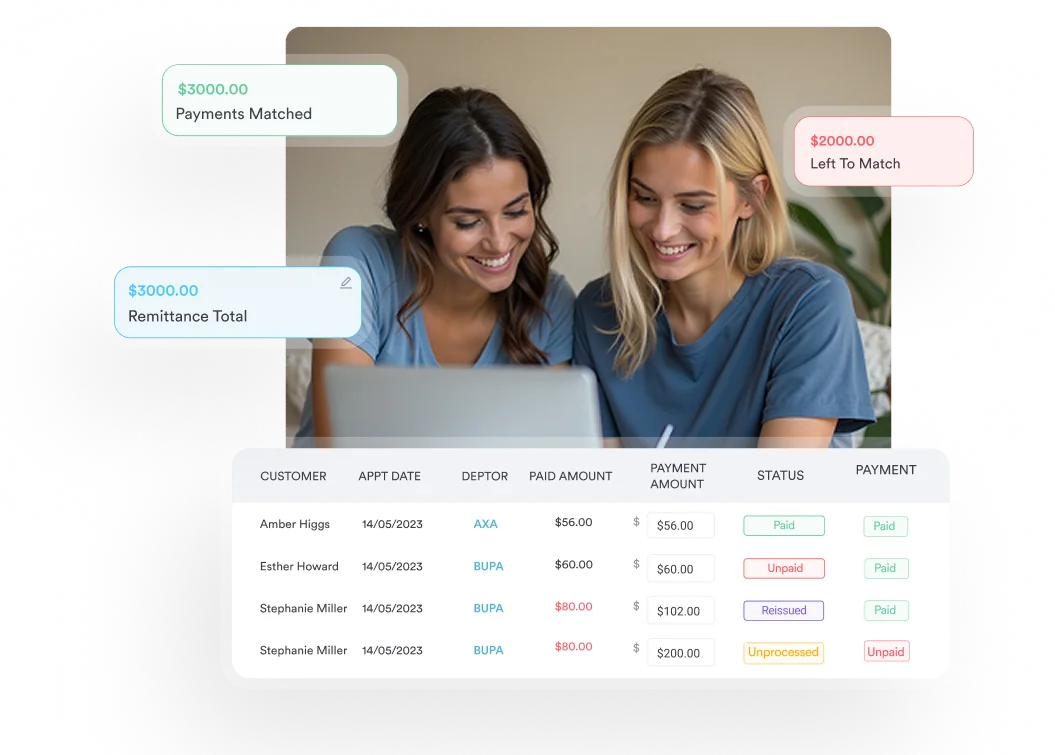
Pabau billing dashboard showing ICD-10 code entry integrated with claim submission
Pabau’s billing module keeps diagnosis coding and claim submission in one place. A sequela code like S42.433S is checked before the claim leaves the practice.
  • Unspecified laterality on a documented side (most common): The claim carries S42.433S, but the encounter note or imaging report names the left or right elbow. Fix: run a laterality cross-check against every source document before transmission, and switch to S42.432S or S42.431S when a side appears.
  • Wrong 7th character: Using S42.433D (subsequent encounter) when the fracture has already healed, or using A when this is not the first active treatment visit. Fix: confirm fracture healing status on current imaging before assigning S, and verify the treatment timeline with the clinical note.
  • Displacement status undocumented: The coder selects the displaced code (S42.433S) but the record does not state displacement. Fix: query the treating clinician to confirm and document displacement in the current note, or use the nondisplaced unspecified code (S42.436S) if appropriate.
  • Sequela not linked to fracture: The encounter note documents chronic elbow pain but does not connect it to the prior fracture. Without an explicit causal link, payers treat S42.433S as unsupported. Fix: the clinician’s note must state that the current condition is a residual consequence of the prior fracture.
  • Missing secondary sequela code: S42.433S is submitted alone without a secondary code naming the nature of the late effect. Per ICD-10-CM guidelines, the sequela condition (for example M25.629) must accompany S42.433S. Fix: always pair S42.433S with the appropriate secondary diagnosis code.
  • No radiology confirmation of healing: Some payers require imaging documentation confirming the fracture has healed before accepting a sequela claim. Fix: retain comparative imaging in the encounter file and note the imaging date in the chart.

CPT codes commonly associated with S42.433S

Sequela-stage encounters for a displaced lateral epicondyle fracture typically involve therapy, physician follow-up, and imaging. The CPT codes below are those most commonly billed alongside ICD-10 Code S42.433S. Because the diagnosis carries no laterality, take extra care with CPT modifiers and with the body-site detail in the treatment note. See the AAPC Codify ICD-10-CM lookup for a crosswalk tool that verifies CPT-to-ICD pairings.

CPT Code Description Use case with S42.433S
97161-97163 Physical therapy evaluation (low/moderate/high complexity) Initial PT evaluation for sequela-stage ROM deficit or weakness
97110 Therapeutic exercise Strengthening of extensor musculature at the lateral epicondyle
97140 Manual therapy techniques Joint mobilization for post-traumatic elbow stiffness
99213-99215 Office or outpatient E&M visit, established patient Orthopedic follow-up visit for sequela assessment and management planning
73070 Radiologic examination, elbow; 2 views Imaging to confirm fracture healing status at sequela-stage visit
24341 Repair, tendon or muscle, upper arm or elbow Surgical revision for malunion or extensor mechanism repair, where clinically indicated

CPT pairing with S42.433S must reflect documented medical necessity. Billing therapeutic exercise (97110) requires a treatment note justifying skilled intervention, not just supervision of home exercises. Payers audit CPT-to-ICD pairings against LCD (Local Coverage Determination) policies, which vary by Medicare Administrative Contractor.

Pro Tip

Check your MAC’s LCD for physical therapy services before billing 97110 or 97140 with S42.433S. Some contractors require functional outcome measures (DASH, PRWE) documented at the start of each therapy episode to support medical necessity for elbow sequela claims. Build this into your intake workflow to prevent retro-denial requests.

How Pabau keeps S42.433S claims consistent before submission

A laterality mismatch usually surfaces after the payer finds it. The coder works from the encounter note, assigns S42.433S, and the imaging report naming the left elbow sits unread in a separate system. The correction arrives weeks later as a denial.

Practice management software like Pabau holds the imaging result, the operative history and the diagnosis on one patient record. The coder reads every source document before the claim is built, which is the check that decides between S42.431S, S42.432S and S42.433S.

Pabau’s denial-reducing claims management software then scrubs the claim before it leaves the practice. It tests the 7th character against the documented healing status. It also flags an unspecified-laterality code sitting on a record that names a side, so the correction happens in-house rather than on an ERA.

Streamline your orthopedic and musculoskeletal billing

Pabau’s claims management software helps practices submit accurate ICD-10-CM codes, track claim status, and reduce denials from laterality and 7th-character errors. See how it works for your specialty.

Pabau claims management dashboard

Conclusion

ICD-10 Code S42.433S is billable, but it is a fallback rather than a first choice. It applies when a displaced avulsion fracture of the lateral epicondyle has healed and the patient returns with a documented residual condition. It also requires that no document in the record names which humerus was injured. Where a side appears anywhere in the chart, S42.431S or S42.432S is the correct code.

Two errors dominate. One is a wrong 7th character. The other is an unspecified code sitting on a record that does name a side. The same habit catches both, which is reading the imaging report and the operative note before the encounter note.

Build that step into your pre-submission review and the S42.43x family stops generating rework. Book a demo to see how Pabau checks laterality and 7th-character consistency before a sequela claim reaches the payer.

Continue your research

Continue your research

Need a framework for managing fracture billing denials? Denial management in healthcare covers root-cause analysis and resubmission workflows for coding-specificity denials.

Looking for the denial codes that accompany ICD-10 errors? Denial codes in medical billing lists the CARC and RARC codes most commonly returned on laterality and 7th-character denials.

Want to understand the clearinghouse submission process? Claim.MD clearinghouse explains how electronic claim submission and real-time ERA processing work for US orthopedic and therapy practices.

Frequently asked questions

What does ICD-10 Code S42.433S mean?

ICD-10 Code S42.433S is the billable diagnosis code for a displaced fracture (avulsion) of the lateral epicondyle of unspecified humerus, sequela. The S character confirms the original fracture has healed. The patient is presenting for a residual condition, such as post-traumatic stiffness, malunion, or chronic lateral elbow pain. “Unspecified” means the record does not state whether the left or the right humerus was injured.

Is S42.433S a billable ICD-10-CM code?

Yes, S42.433S is a fully billable ICD-10-CM code confirmed valid in the FY2025 tabular list and expected to remain valid for FY2026. Billable does not mean preferred. Use a laterality-specific code whenever the record supports one. Coders should verify annual validity using the CDC/NCHS ICD-10-CM web tool, as codes are updated each October 1.

When should I use S42.433S instead of S42.431S or S42.432S?

Use S42.433S only when no document in the record identifies the injured side. S42.431S covers the right humerus and S42.432S covers the left, and ICD-10-CM Official Guidelines expect a laterality-specific code whenever the classification offers one. Before defaulting to S42.433S, check the current note, the imaging report, and the original operative record, then query the treating clinician. Keep the query and its response on file, because payers apply extra scrutiny to repeated unspecified-laterality claims.

What is the difference between S42.433S and S42.436S?

Both codes describe a sequela of a lateral epicondyle fracture of unspecified humerus, and they differ only on displacement. S42.433S is the displaced code; S42.436S is the nondisplaced code. Displacement has to be confirmed in the imaging or operative record from the original injury. If the record is silent on displacement as well as on laterality, query the clinician rather than guessing between the two.

When should the sequela (S) 7th character be used for fracture codes?

The S character applies when the fracture is fully healed, confirmed on imaging or clinical examination. The patient must be presenting for a residual condition caused by the original fracture. If the fracture is still consolidating or healing complications are active, the D (subsequent encounter) character applies instead. Time elapsed since injury alone does not determine which character to use.

What are the most common reasons for claim denial with S42.433S?

Six denial reasons dominate. The first is using the unspecified code when the record does name a side. Next come a wrong 7th character, undocumented displacement status, and no stated link between the sequela and the prior fracture. The last two are a missing secondary code, and no radiology confirmation that the fracture has healed. Each of these is preventable with a pre-submission documentation checklist.

Is S42.433S valid for FY2026?

S42.433S is valid for FY2025 and remains valid for FY2026. Because ICD-10-CM codes are updated annually on October 1, coders should confirm validity against the official CDC/NCHS ICD-10-CM release before each new fiscal year begins. No deletions or revisions to the S42.43x block are anticipated based on the current CMS update cycle.
Found our content helpful?
×