ICD-10 Code S82.242H: Displaced spiral tibial shaft fracture, delayed healing
ICD-10 Code S82.242H: Definition and code details ICD-10 Code S82.242H designate...

Last Updated: Oct 15, 2026
Billable Code Specific Code
S31.031S is the billable ICD-10-CM code for puncture wound without foreign body of lower back and pelvis with penetration into retroperitoneum, sequela.
The 7th character S reports it at the sequela stage, so the wound has healed and the visit addresses a late effect. It is billable through September 30, 2026.
Every puncture wound code in this group sits on the same anatomy, so site and laterality never decide the pick. Two yes-or-no questions decide it instead. Was a foreign body retained, and did the wound break into the retroperitoneum? Both answers come out of the operative, imaging, or emergency note.
Let Pabau's smart automation suggest the right codes, reduce claim denials, and keep your practice compliant—effortlessly.
Automate repetitive tasks and focus on what matters most—your patients.
Reduce coding errors and ensure compliance with the latest regulations.
Clean claims, fewer denials, and faster reimbursements.
Powerful insights and reporting to help your practice thrive.
HIPAA compliant SOC 2 certified GDPR-compliant Trusted by 4,000+ clinics worldwide

ICD-10 code S31.031S covers a puncture wound of the lower back and pelvis that reached the retroperitoneum, with no foreign body left in the wound. The 7th character S marks it as a sequela.
Two yes-or-no questions separate the four puncture wound codes in this group. Was a foreign body retained, and did the wound penetrate the retroperitoneum?
The anatomic site is identical in S31.030, S31.031, S31.040 and S31.041, so wound site and laterality never decide which one you pick.
The closest neighbor of S31.031S is S31.041S, which differs only on foreign body. S31.040S differs on both axes at once.
S31.031S is billable and HIPAA-valid for FY2026, from October 1, 2025 through September 30, 2026.
A sequela claim carries two codes: the residual condition first, then S31.031S as the cause.
Practice management software like Pabau keeps ICD-10 lookup and structured notes in the chart, so the penetration and foreign body details reach the claim.
ICD-10 code S31.031S is the billable ICD-10-CM diagnosis code for puncture wound without foreign body of lower back and pelvis with penetration into retroperitoneum, sequela. It is valid from October 1, 2025 through September 30, 2026 (FY2026), per the CDC/NCHS ICD-10-CM official code database.
Three separate facts are built into that description. “Without foreign body” means no object was retained in the wound. “Sequela” means today’s visit is for a late effect of that wound rather than for the wound itself.
“With penetration into retroperitoneum” means the wound track reached the retroperitoneal space behind the peritoneum. That space holds the kidneys, ureters, pancreas, and great vessels.
The code sits in category S31, open wound of abdomen, lower back, lumbar spine, pelvis, and external genitals. Retroperitoneal penetration is the clinically serious half of the description, because it puts retroperitoneal organs in the injury path. Only a note documenting that penetration supports the final digit 1 rather than 0.
Once you have settled on S31.031, the 7th character is the last decision left. All three extensions share the same base description, including the retroperitoneal penetration, and only the encounter type changes. Picking the wrong character produces a denial that can only be fixed by resubmitting the claim.
Coders often reach for S31.031D when the wound itself has healed but the patient now presents with pain or scarring caused by it. That visit calls for S31.031S. Per Section I.B.10 of the FY2026 ICD-10-CM official guidelines, sequela coding applies once the acute phase is over.
Sequela coding needs two things to be true at the same time. The original wound must be healed, and the current problem must be a direct result of it. A follow-up visit for an injury that is still being treated is a different scenario with a different 7th character.
Two questions settle this code. First: is the wound still being treated? If it is, the 7th character is A or D, not S. Second: does the record state that the wound penetrated the retroperitoneum? If it does not, the sixth digit is 0 and the code is S31.030S.
All four puncture wound codes for this region carry the same anatomic site, the lower back and pelvis. There is no site or laterality choice to make between them. They split on two yes-or-no questions instead, and each question changes a different digit. Laid out as a grid, the four codes sit in the four corners.
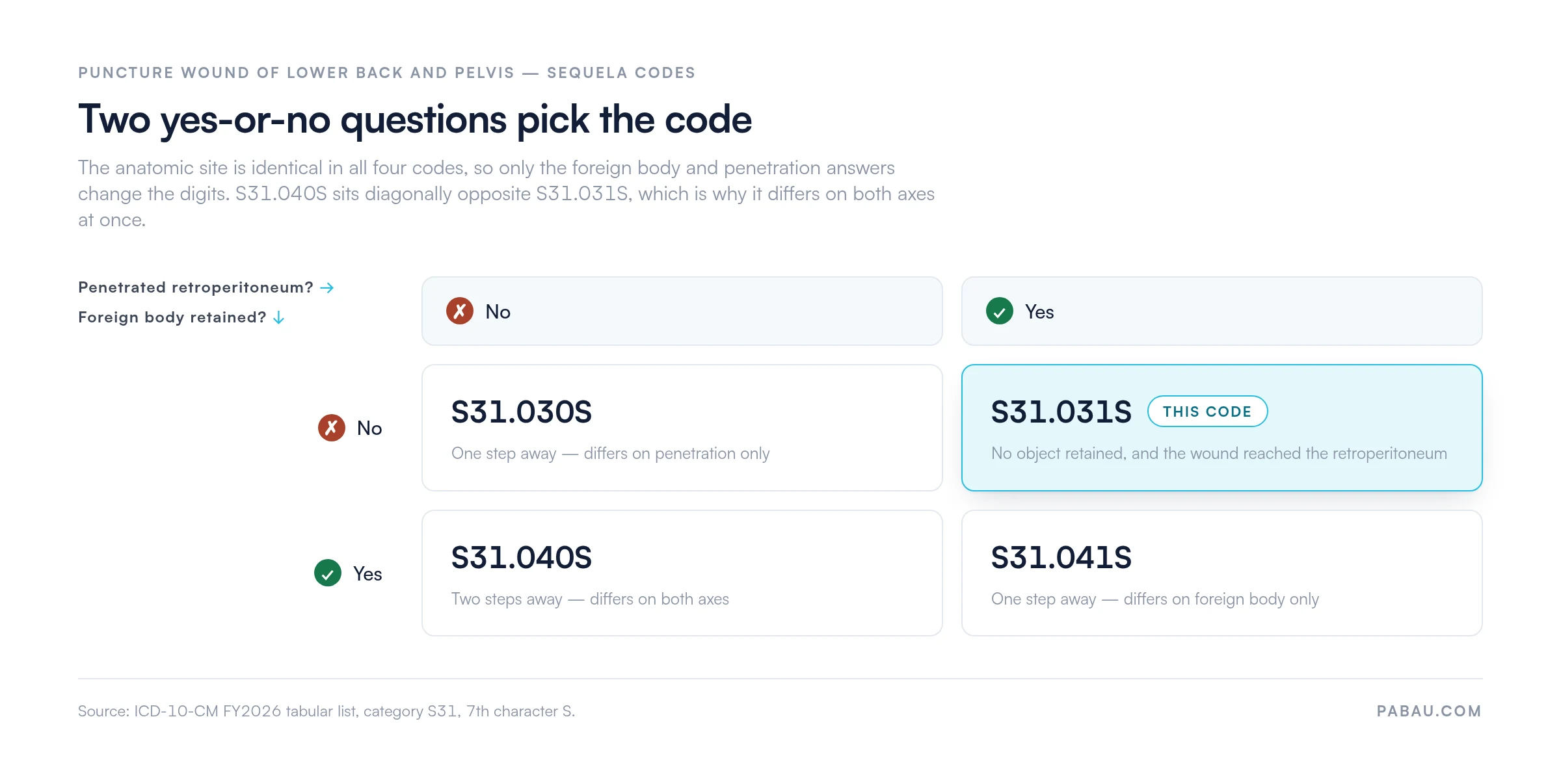
The grid explains the distances between the four codes. S31.041S is the one-step neighbor of S31.031S, because it shares the penetration status and differs only on the retained foreign body. S31.030S is the other one-step neighbor. The official descriptions below show how each combination reads on a claim.
A wound in this region that the record cannot type as a puncture does not belong in this group at all. Those fall to S31.000S and S31.001S, the unspecified open wound codes, split by the same penetration question. Lacerations use S31.01- and S31.02-, and open bites use S31.05-, each divided the same way.
Every element of the code description has to be supported somewhere in the chart. Reviewers check four points before they accept a penetrating wound sequela claim.
An S31.031S claim is therefore a two-code claim. The residual condition comes first, then S31.031S as its cause. Leaving off the residual condition code is the most common reason these claims fail a records review.
S31.031S sits at the bottom of a defined hierarchical path. Walking down it is the fastest way to confirm you are in the right group before you attach a 7th character.
Each decision lands on its own digit. The fifth digit carries wound type and foreign body status, the sixth carries retroperitoneal penetration, and the 7th character carries the encounter.
Parent code S31.031 is not billable on its own, because the subcategory requires a 7th character. Only the extended codes carrying A, D, or S can go on a claim.
Category S31 carries one Excludes1 note and two Excludes2 entries. An Excludes1 violation is a hard claim error. An Excludes2 note says the two conditions are separate, so both may be reported when both are documented.
Only the amputation note blocks the code outright. The pelvic fracture and the hip wound may both be reported alongside it. Cross-reference the tabular list through the AAPC ICD-10-CM code lookup before you finalize any combination, since excludes notes change with each annual release.
External cause codes record how the original injury happened. Most payers encourage them on traumatic wound claims, some state Medicaid programs require them, and workers’ compensation carriers expect them. A sequela claim without one can be pulled for manual review.
On a sequela encounter, the external cause code takes the 7th character S as well, because it describes the same prior injury. An initial-encounter code such as W45.0XXA becomes W45.0XXS on the sequela claim.
Practices migrating legacy data, or reporting on records that predate the transition, need the backward mapping. The General Equivalence Mappings maintained by CMS are the official source for moving between ICD-9-CM and ICD-10-CM in either direction.
The acute open wound codes in the ICD-9-CM 879 range are not late effect codes, which makes them the wrong target for S31.031S. Because ICD-9-CM had no 7th character system, every sequela mapping stays approximate, so the GEM files should govern migration work.
Sequela wound claims behave differently from active injury claims at the payer end. Five patterns account for most of the rejections, and each one is preventable at the point of coding.
Validation before submission is what keeps these claims moving. Clearinghouse edits catch a missing 7th character before the claim leaves the practice. Reviewing the denial codes billers see on wound sequela claims helps a billing team build prevention into its own process.
A clean claim matters more here than usual, because a records request adds weeks to the payment cycle. Tracking traumatic injury follow-up as its own segment also surfaces payer-specific denial patterns much faster.
A wrong code on this claim is almost always a documentation problem first. Suppose the note never records that the wound reached the retroperitoneum, or never confirms that it has healed. The coder falls back to a safer code, the claim goes out with the wrong sixth digit, and the denial lands weeks later.
Practice management software like Pabau closes that loop at the point of care. Its claims software for practices keeps ICD-10 lookup inside the patient record. Coders confirm S31.031S and its residual condition partner without leaving the chart.
Urgent care, physical therapy, and surgical follow-up all see traumatic wound sequelae regularly. Catching the code before submission removes most of their back-end correction work.

Pabau’s claims management software includes built-in ICD-10 code lookup, structured clinical notes, and Claim.MD clearinghouse validation. Your team submits accurate wound sequela claims on the first attempt.

Site specificity plays no part in this code. Two other facts decide it. One is whether an object stayed in the wound. The other is whether the track reached the retroperitoneum.
Both facts live in the operative or imaging note, not in the diagnosis line. So the fix for a denied S31.031S claim usually sits upstream of the coder. Give the clinician a place to record penetration and healed status, and the code stops being a judgment call.
Sequence the residual condition first, keep S31.041S and S31.030S straight as the one-step neighbors, and these claims stop coming back. Book a demo to see how wound sequela claims move from clinical note to submission in Pabau.

Need guidance on ICD-10 denial prevention? Denial management in healthcare covers the most common claim rejection patterns and how to address them systematically.
Submitting claims through a clearinghouse? Claim.MD clearinghouse overview explains how Pabau’s clearinghouse partner validates codes before payer submission.
Want to understand the full billing cycle? How superbills work in medical billing explains how ICD-10 codes flow from clinical documentation through to claim submission.
S31.031S is the billable ICD-10-CM code for a puncture wound without foreign body of the lower back and pelvis with penetration into the retroperitoneum, sequela. Nothing was retained in the wound, and the wound track reached the retroperitoneal space. The S means the current visit is for a late effect of that healed injury.
Yes. S31.031S is a billable, specific ICD-10-CM code valid for HIPAA-covered transactions. It is active for FY2026, from October 1, 2025 through September 30, 2026, per the CDC/NCHS annual code release. The parent code S31.031 is not billable without a 7th character.
Only retroperitoneal penetration. Both codes describe a puncture wound without foreign body of the lower back and pelvis at the sequela stage. S31.030S applies when the wound did not reach the retroperitoneum, and S31.031S applies when it did. The anatomic site is identical, so site and laterality never decide between them.
Only the retained foreign body. Both codes describe a puncture wound of the lower back and pelvis that penetrated the retroperitoneum, reported as a sequela. S31.031S applies when no object remained in the wound, and S31.041S applies when one did. That makes S31.041S the closest neighbor of S31.031S, not S31.040S.
S31.040S differs from S31.031S on both axes at once. It describes a puncture wound with a retained foreign body that did not penetrate the retroperitoneum. Comparing those two directly hides both decisions a coder has to make. The one-step neighbors, S31.030S and S31.041S, are the useful comparisons.
All three share one base description and differ only by encounter type. S31.031A covers initial encounters while the wound is actively treated. S31.031D covers subsequent encounters during healing. S31.031S applies once the wound has healed and the patient presents with a residual condition caused by it.
Category S31 carries one Excludes1 note, for traumatic amputation of part of the abdomen, lower back, and pelvis (S38.2-, S38.3-). Those codes are never reported with S31.031S. The Excludes2 notes cover open wound of hip (S71.0-) and open fracture of pelvis (S32.1- through S32.9 with 7th character B). Either of those may be coded alongside S31.031S when the record documents both injuries.
External cause codes record how the original injury happened, with the 7th character set to S for a sequela encounter. Common pairings include W45- for an object entering through the skin, W26- for bladed instruments, and X99- for assault by a sharp object. Activity codes (Y93-) and external cause status codes (Y99-) add context that many payers expect.