ICD-10 code S61.201A: Open wound of left index finger without nail damage
ICD-10 code S61.201A covers a left index finger wound of unstated type ICD-10 co...

Last Updated: Oct 16, 2026
Billable Code Specific Code
S22.061G is the billable ICD-10-CM code for stable burst fracture of T7-T8 vertebra, subsequent encounter for fracture with delayed healing.
The 7th character carries that meaning on its own. G marks a follow-up visit where the provider has documented that healing has stalled, and D marks one where healing is on track.
Let Pabau's smart automation suggest the right codes, reduce claim denials, and keep your practice compliant—effortlessly.
Automate repetitive tasks and focus on what matters most—your patients.
Reduce coding errors and ensure compliance with the latest regulations.
Clean claims, fewer denials, and faster reimbursements.
Powerful insights and reporting to help your practice thrive.
HIPAA compliant SOC 2 certified GDPR-compliant Trusted by 4,000+ clinics worldwide

S22.061G is a billable ICD-10-CM code for a stable burst fracture of the T7-T8 vertebra with delayed healing.
It became valid on October 1, 2025, as part of the FY2026 ICD-10-CM edition.
The 7th character G means a subsequent encounter where the provider has documented delayed healing, not simply that time has passed.
The note must state four things: a stable burst fracture, the T7-T8 level, a subsequent encounter, and delayed healing.
Practice management software like Pabau submits S22.061G on CMS-1500 and UB-04 claims through its Claim.MD clearinghouse integration.
ICD-10 Code S22.061G is a billable, specific diagnosis code within the ICD-10-CM code set, and it is valid in HIPAA-covered transactions. It became effective on October 1, 2025, as part of the FY2026 edition. The code may be submitted on both CMS-1500 (professional) and UB-04 (institutional) claim forms.
According to the CMS ICD-10 codes page, ICD-10-CM codes are updated annually on October 1 for the new fiscal year. S22.061G carries no end date in the current FY2026 release, confirming it remains active for claims submitted through September 30, 2026.
T7 and T8 are the seventh and eighth thoracic vertebrae in the mid-thoracic spine. The thoracic segment runs from T1 (at the base of the neck) to T12 (at the lower chest). T7-T8 sit at the apex of the normal thoracic kyphotic curve, making them susceptible to axial loading injuries.
A burst fracture occurs when axial compressive force causes the vertebral body to fail in multiple directions, including the posterior wall. This distinguishes it from a simple compression fracture, which typically involves only anterior column collapse. The “stable” designation means the posterior ligamentous complex remains intact, so neurological risk is lower than with an unstable burst fracture.
Providers must document the stability classification explicitly. A coder cannot infer “stable” from imaging alone. The treating physician’s note must use the term, or clearly describe the clinical criteria that establish stability.
The 7th character is the most consequential coding decision for the entire S22.061 code family. It specifies both the type of encounter and the healing status. Getting it wrong creates a coding error that can delay payment and trigger a documentation audit.
The CDC/NCHS ICD-10-CM official coding tool defines G as a subsequent encounter where the provider documents delayed healing. The ICD-10-CM Official Guidelines for Coding and Reporting address this in Section I.C.19. Delayed healing is a clinical determination made by the treating provider, and a coder cannot assign it independently.
D versus G does not turn on how much time has passed. A visit six months after the injury still takes D if healing is progressing normally. It takes G once the provider has documented a healing problem. Two questions in the note settle which one applies.
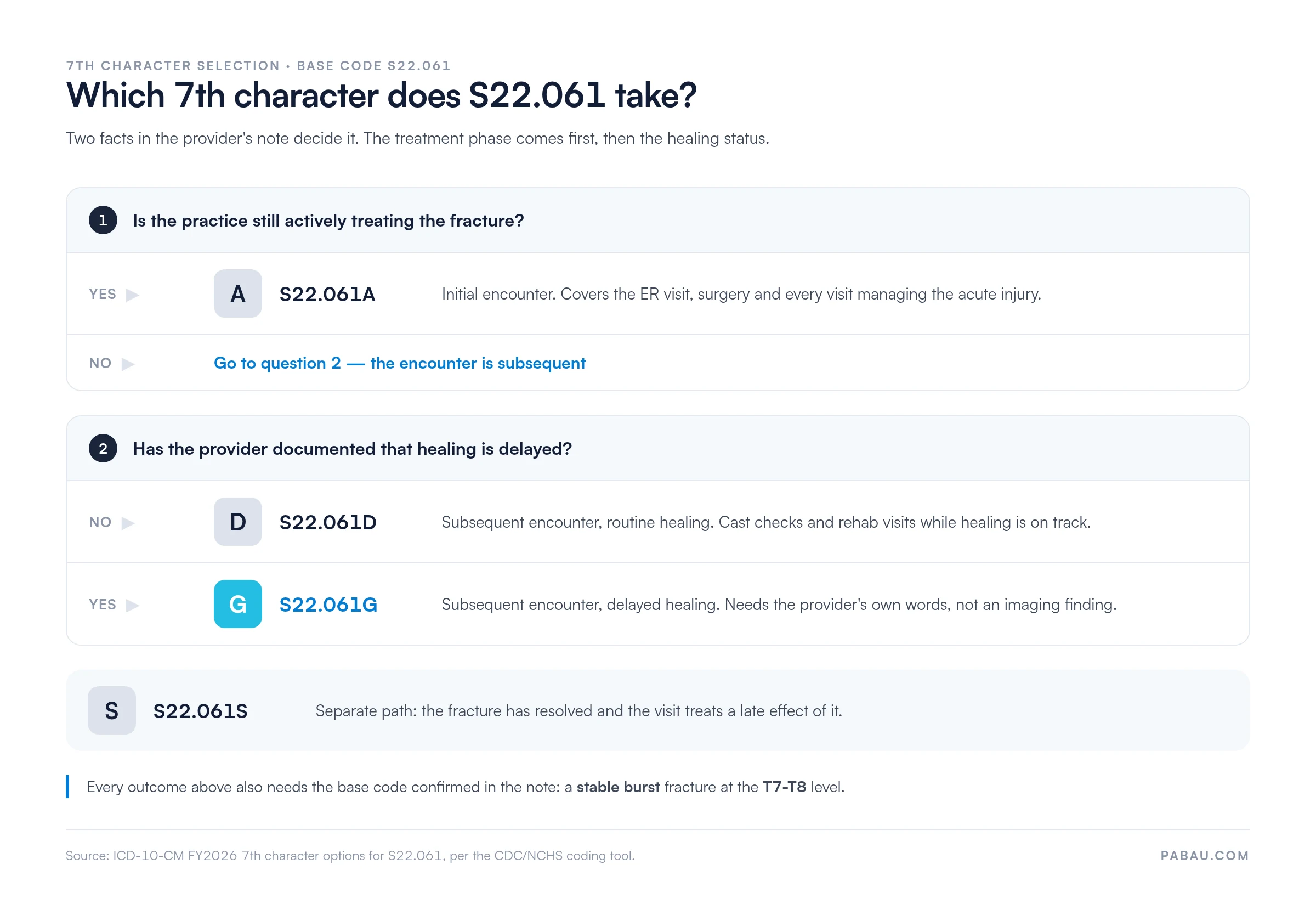
Where the note answers neither question clearly, query the provider before assigning any 7th character.
Coders frequently misapply the initial versus subsequent encounter distinction. Under ICD-10-CM guidelines, the 7th character A applies to every encounter where the patient is receiving active treatment for the fracture.
Active treatment covers the emergency department visit, the surgical procedure, and any follow-up where the physician is still managing the acute injury. Subsequent encounters, D or G, begin once treatment gives way to monitoring and healing management.
For S22.061G specifically, three conditions must be met at the same time:
If any of these three conditions is missing from the documentation, S22.061G is not the correct code. The appropriate fallback is S22.061D if healing is routine, or re-querying the provider if the encounter type or healing status is unclear.
Supporting S22.061G requires documentation that addresses four specific areas. Missing any one of them gives a payer grounds to deny the claim or request additional information.
Achieving a clean claim submission for S22.061G depends on the provider note supporting all four elements before the claim goes out. Coders should not assign G on imaging findings alone. If the radiologist notes “slow fracture callus formation” but the treating provider does not characterize healing as delayed, the documentation does not support G.
S22.061G sits within a structured ICD-10-CM hierarchy. Understanding the parent codes helps coders navigate related fracture scenarios and select adjacent-level codes when the documentation shifts.
Adjacent codes in the S22.06 group include S22.062x (unstable burst fracture of T7-T8) and S22.068x (other fracture of T7-T8). For neighboring vertebral levels, S22.051x covers T5-T6 and S22.071x covers T9-T10. Each requires the same 7th character logic.
Excludes1 note: S22 codes exclude fractures identified as pathological, which route to M84.4x for pathological fracture not elsewhere classified. A stress fracture routes to M84.3x instead. If the documentation points to a non-traumatic origin, the S22 category is not appropriate.
Burst and compression fractures are frequently confused in documentation and in coding. They involve different anatomical mechanisms and map to different ICD-10-CM codes. Assigning the wrong fracture type can affect both the code’s validity and downstream MS-DRG assignment.
The coder’s role is to reflect what the physician documents, not to interpret imaging independently. If a radiologist reports a burst morphology but the treating physician documents a compression fracture, the physician’s clinical diagnosis governs the code selection. When documentation is ambiguous, query the provider rather than defaulting to one or the other.
For inpatient hospital billing, S22.061G maps to MS-DRGs in the spinal disorders and injuries group. The specific assignment depends on the principal diagnosis and on whether an MCC or CC is present. In most inpatient scenarios S22.061G is a secondary diagnosis. It influences the DRG severity tier rather than driving the primary assignment.
The delayed healing designation (character G) affects reimbursement by increasing the complexity of the coding episode compared with routine subsequent encounters (character D). Payers may scrutinize the G designation more closely than D, making thorough documentation of delayed healing particularly important.
The AAPC coding community and AHIMA documentation guidance both flag thoracic fracture codes as a frequent source of 7th character errors. These are the four most common mistakes with S22.061G, and how to correct each one.
Each of these errors can trigger a denial and a rework cycle that delays payment. Confirming the diagnosis code at the point of care catches most of them before the claim goes out. The check is whether the code matches the documented encounter type and healing status.
Before assigning S22.061G, run a three-point check on the clinical note: (1) Does it name T7 or T8 specifically? (2) Does it explicitly call the fracture stable and burst-type? (3) Does the provider’s own language describe delayed or abnormal healing? If any answer is no, query the provider or hold the claim. Submitting with an unsupported G character is faster in the short term but creates denial and audit risk.
A delayed-healing claim usually lives in two places. The 7th character sits in the chart note, and the claim status sits with the clearinghouse. When a payer questions the G character, someone reconciles the two by hand.
Practice management software like Pabau keeps both in one record. Pabau handles medical claims management alongside the chart, submitting CMS-1500 and UB-04 claims through the Claim.MD clearinghouse. That clearinghouse reaches thousands of US payers, and eligibility is checked before the claim goes out.
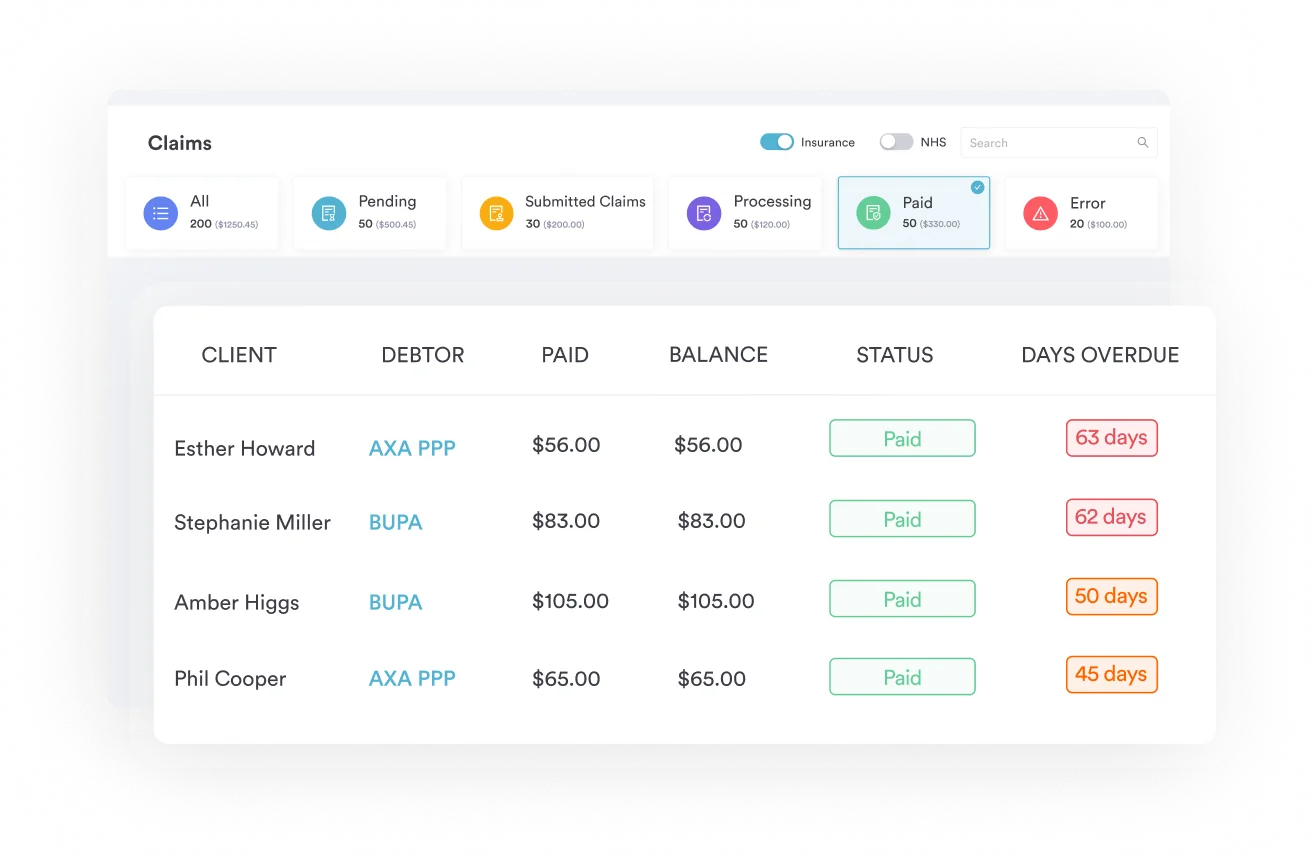
The status of every S22.061G submission stays visible from claim to remittance. A returned claim keeps its adjustment reason codes beside the note that supported the G character. The correction then starts from the record instead of a rebuild.

Pabau’s claims management software connects to the Claim.MD clearinghouse, supporting accurate ICD-10-CM code submission on CMS-1500 and UB-04 forms across thousands of US payers.

Finding S22.061G in the code set is straightforward. Getting the provider’s note to carry all three of its components takes more work. The note needs the stable burst classification, the T7-T8 level, and a stated delay in healing. Any one of them missing collapses the rationale for G.
The practical move is to settle the 7th character before the claim leaves the practice. One query to the provider now costs less than an appeal after the denial. Book a demo to see how Pabau tracks ICD-10-CM submissions from the chart note through to remittance.

Need to understand how claims move from code to payment? Claim.MD clearinghouse overview covers how electronic claims are validated and routed to payers.
Dealing with denials on spinal fracture claims? Denial codes in medical billing explains the most common CARC codes and how to respond to each one.
Want to verify eligibility before submitting a fracture claim? Insurance eligibility verification walks through the pre-claim steps that prevent avoidable denials.
ICD-10 Code S22.061G is a billable ICD-10-CM diagnosis code for a stable burst fracture of the T7-T8 vertebra. It applies at a subsequent encounter where the treating provider has documented delayed healing. The code became effective on October 1, 2025 (FY2026). It is valid on CMS-1500 and UB-04 claim forms in HIPAA-covered transactions.
Character D indicates a subsequent encounter where the fracture is healing routinely and as expected. Character G indicates a subsequent encounter where the treating provider has documented that healing is delayed or not progressing at a normal rate. The distinction is clinical rather than time-based. A visit many months post-injury still uses D if healing is on track. G applies only when the provider has explicitly documented delayed healing.
A burst fracture involves failure of the posterior vertebral wall under axial loading, and codes to S22.061x at the T7-T8 level. A compression fracture involves only anterior column collapse, with the posterior wall intact. At T7-T8 it maps to S22.060x, the wedge compression fracture code. A non-traumatic collapse maps to M48.5x instead. The provider’s documentation and the fracture classification determine which code applies.
The clinical note must document four elements explicitly. The fracture type is a stable burst fracture. The vertebral level is T7, T8, or T7-T8. The encounter is subsequent, meaning active treatment has concluded. The treating provider has stated that healing is delayed or abnormal. Imaging findings alone are not sufficient. If any element is missing, the coder should query the provider before assigning G.
Use the initial encounter character A, coded as S22.061A, for every visit where the patient is receiving active treatment. That includes the emergency department, surgical encounters, and early follow-up appointments where active management continues. Switch to subsequent encounter codes (D or G) only when active treatment has concluded and the visit is focused on monitoring healing and managing recovery. If healing is delayed at that point and the provider documents it, G is correct.
Yes. S22.061G became effective on October 1, 2025, as part of the FY2026 ICD-10-CM edition. It carries no end date in the current release, so it is valid for claims submitted through September 30, 2026. Always verify current status against the CDC/NCHS ICD-10-CM official tool for the fiscal year applicable to the date of service.