ICD-10 Code S42.444P: Medial epicondyle fracture, right humerus
ICD-10 Code S42.444P: full descriptor and code validity ICD-10 Code S42.444P car...

Last Updated: Oct 13, 2026
Billable Code Specific Code
S08.89XD is the billable ICD-10-CM code for traumatic amputation of other parts of head, subsequent encounter.
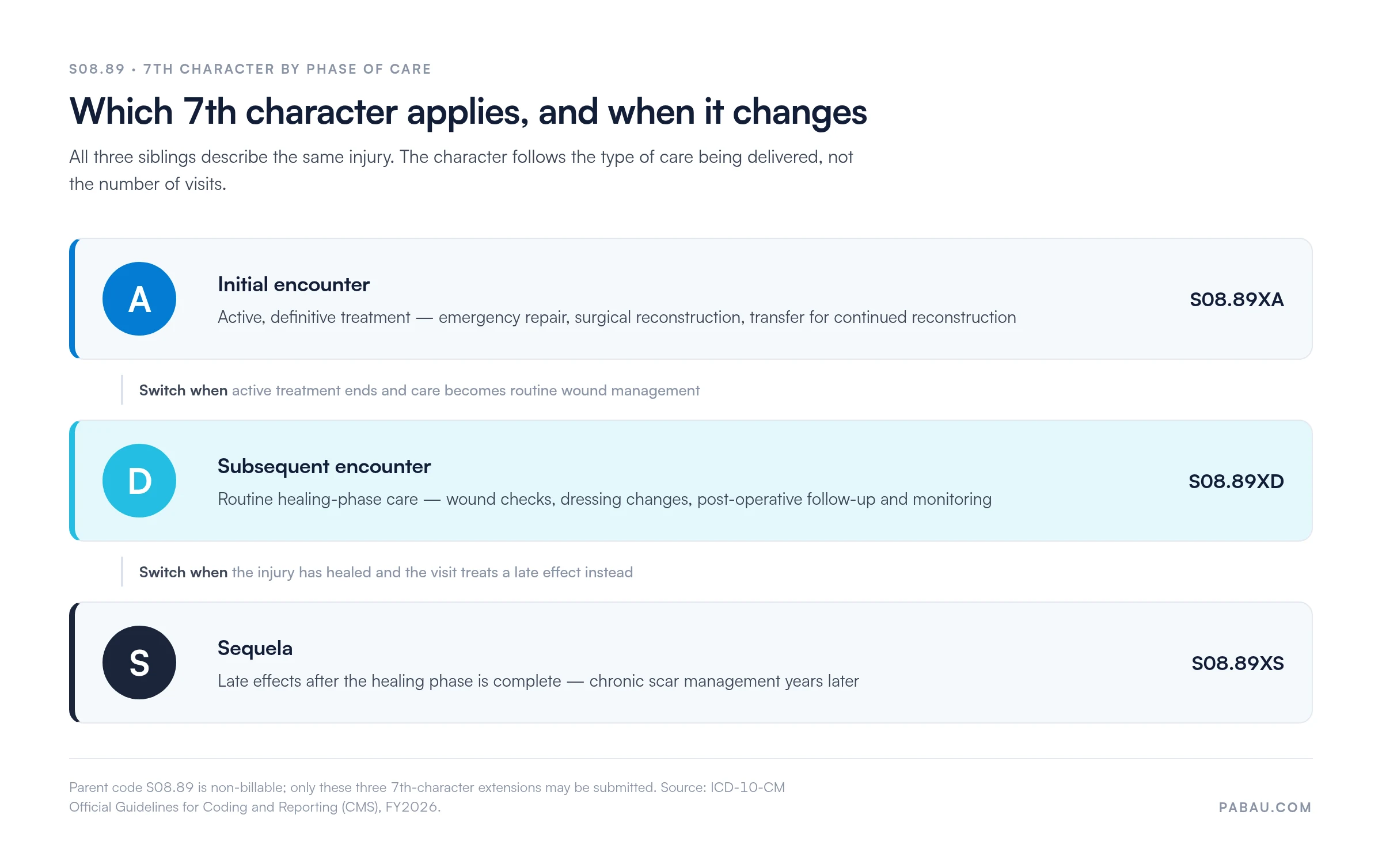
The 7th character D places the patient in the healing phase, receiving routine follow-up rather than active treatment. Its two siblings, S08.89XA and S08.89XS, cover the same injury at other phases of care.
Let Pabau's smart automation suggest the right codes, reduce claim denials, and keep your practice compliant—effortlessly.
Automate repetitive tasks and focus on what matters most—your patients.
Reduce coding errors and ensure compliance with the latest regulations.
Clean claims, fewer denials, and faster reimbursements.
Powerful insights and reporting to help your practice thrive.
HIPAA compliant SOC 2 certified GDPR-compliant Trusted by 4,000+ clinics worldwide

ICD-10 code S08.89XD is a billable ICD-10-CM code for traumatic amputation of other parts of the head, subsequent encounter.
The 7th character D means the patient is receiving routine care during the healing phase, not active initial treatment.
Its two siblings, S08.89XA and S08.89XS, describe the same injury at the initial and sequela phases of care.
The code is valid for fiscal year 2026 HIPAA transactions, and it is exempt from present on admission reporting.
Practice management software like Pabau links the clinical note to the claim, so coders pick the right 7th character.
S08.89XD is a billable, specific diagnosis code under the ICD-10-CM Clinical Modification system. It is valid for submission of HIPAA-covered transactions for fiscal year 2026. The table below summarizes the reference fields coders and billers need at a glance.
Each character in S08.89XD carries a specific meaning. Coders who know the structure can confirm at a glance whether they have the right code for the clinical scenario in front of them.
The placeholder X in the sixth position is a structural requirement of ICD-10-CM. Without it, the 7th character cannot occupy its correct position and the code becomes invalid. This is a frequent formatting error on electronic claims.
The 7th character extension is where most coding errors happen on injury codes. All three sibling codes under S08.89 describe the same injury. The encounter type is what tells a payer where the patient sits in their care journey.
“Subsequent encounter” does not mean the second visit for the injury. It means the patient is past the active-treatment phase. A patient seen three times for active surgical care of a traumatic head amputation carries S08.89XA on all three visits. The code shifts to S08.89XD only when active treatment gives way to routine wound management and monitoring. The flow below marks the point where each character stops applying.
The hierarchy tells coders whether they are working in the right chapter and category. S08.89XD sits inside a well-defined injury structure, from the chapter down to the billable extension.
S08.89 itself is non-billable. Claims submitted with the parent code will be rejected. Only the full 7th-character extensions (S08.89XA, S08.89XD, S08.89XS) are valid for billing.
Coders working with this code should know the broader S08 category. The table below covers the direct siblings under S08.89 and the closest related codes in the S08 parent category. The AAPC ICD-10-CM lookup tool is useful for exploring the full S08 category, and ICD List offers a free hierarchical browser for verifying sibling relationships.
The S08.1XXD family covers traumatic amputation of the ear specifically. S08.89XD applies to other parts of the head that no more specific code describes. Confirm that no more specific code fits before you assign it.
Payers scrutinize injury code documentation closely. A claim carrying S08.89XD without supporting clinical documentation risks denial, downcoding, or an audit flag. The ICD-10-CM Official Guidelines for Coding and Reporting set out what must support an injury code on a HIPAA-covered transaction. The guidelines are maintained by the Centers for Medicare and Medicaid Services.
The clinical record should contain all of the following before S08.89XD is assigned:
Strong documentation also supports clean claim submission when these visits reach a clearinghouse. Incomplete documentation is the single largest driver of denials on subsequent-encounter injury codes. Coders who flag a thin record before submission, rather than coding from a partial chart, cut the rework their team has to absorb later.
The three sibling codes map directly to clinical phases of care. Which one applies is a documentation question rather than a matter of judgment. The table below maps common clinical scenarios to the correct 7th character.
The transfer scenario is the one worth spelling out. A patient moves to a specialist for reconstruction after initial wound closure, and the visit count suggests a subsequent encounter. The 7th character follows the type of care instead. While active surgical reconstruction is underway, S08.89XA stays correct even at a later stage.
Flagging a 7th character mismatch before submission costs far less than appealing after payment. A mismatch usually returns as one of the common denial codes tied to invalid or unsupported diagnosis reporting.
Confirm the clinical notes state ‘healing phase’, ‘follow-up’, or ‘post-operative monitoring’ before you assign the D character. Then document the absence of active intervention, not just the purpose of the visit. That gives payers the clinical context they need to adjudicate the claim.
Practices migrating legacy data or working with older records may need to map ICD-9-CM codes to their ICD-10-CM equivalents. The official General Equivalence Mappings (GEMs) exist for exactly this purpose. For traumatic head amputation, the approximate crosswalk is as follows.
The crosswalk to 873.8 is approximate. ICD-9-CM used no encounter-type extensions, so the mapping is one-to-many. Always pick the 7th character from clinical documentation rather than defaulting to the GEMs mapping alone.
Yes. S08.89XD is valid for fiscal year 2026. It is an active, billable code with no pending deletions or modifications under the current ICD-10-CM update cycle. Practices can confirm code status and any mid-year updates through the CDC/NCHS ICD-10-CM official web tool.
Refresh your ICD-10 code library at the start of each fiscal year, on October 1, to capture code additions, deletions and description changes. Submitting a deleted or modified code because the library was never updated is a preventable denial.
Most coding errors on injury codes like S08.89XD trace back to documentation rather than knowledge. A clinician records the encounter phase correctly in the chart. The biller choosing the code later cannot see that language, so the wrong 7th character goes out on the claim.
Practice management software like Pabau closes that distance. Its cleaner claims management keeps the clinical documentation layer attached to the billing submission workflow. When a provider documents a post-operative follow-up, the coder or billing team sees that context at the point of claim creation. D-versus-A mismatches get caught while the claim is still editable.
Claims then route through Claim.MD, Pabau’s US clearinghouse partner. It validates codes against current ICD-10-CM catalogs before they reach a payer, and it runs real-time eligibility checks on injury-related claims. Cleaner submissions move faster through adjudication and generate fewer appeal cycles.

Pabau connects clinical documentation to billing submission, so your team assigns the right encounter type and submits clean claims through the Claim.MD clearinghouse network. See how it works in a personalized demo.

S08.89XD is a narrow code, and the narrowness is the point. It applies to one patient in one phase: healing after a traumatic amputation of other parts of the head. Treat the 7th character as the phase of care rather than a visit counter, and the code almost picks itself.
The trade-off worth remembering is that a coder can only be as precise as the chart allows. Investing in the phrasing clinicians use, and in a workflow that carries it to the claim, prevents more denials than any appeal process. Book a demo to see how Pabau keeps trauma follow-up claims accurate before they reach a payer.

Need guidance on denial management for injury codes? Denial management workflows in healthcare covers how to identify and resolve the most common claim denial patterns before they affect revenue.
Looking for a clean claim submission checklist? Clean claim submission guidelines outlines the documentation and formatting requirements payers expect on injury-related claims.
Want to understand how ICD-10 fits into your broader billing cycle? Revenue cycle management explained traces the full financial workflow from patient registration to payment posting.
S08.89XD is a billable ICD-10-CM diagnosis code for traumatic amputation of other parts of the head during a subsequent encounter. The patient is receiving routine care during the healing phase, not active initial treatment. The D 7th character is what designates that healing-phase follow-up context.
Yes. S08.89XD is a billable, specific ICD-10-CM code valid for fiscal year 2026 HIPAA-covered transactions. Its parent code, S08.89, is non-billable. Only the 7th-character extensions S08.89XA, S08.89XD and S08.89XS can be used on claims.
All three describe the same injury, traumatic amputation of other parts of the head, at different phases of care. S08.89XA covers initial or active treatment. S08.89XD covers subsequent encounters during the healing phase, such as wound checks and follow-up visits. S08.89XS covers sequela, meaning the late effects of a fully healed injury.
The 7th character D designates a subsequent encounter across ICD-10-CM injury codes. It indicates the patient is no longer receiving active or definitive treatment for the injury. Care is now routine, covering wound monitoring, dressing changes or post-operative check-ups during the healing phase.
Yes. S08.89XD is active and valid for fiscal year 2026, with no reported code changes in the current ICD-10-CM update cycle. It is also exempt from present on admission reporting. Practices can verify current status through the CDC/NCHS ICD-10-CM web tool at icd10cmtool.cdc.gov.
The parent code is S08.89, traumatic amputation of other parts of head. S08.89 is non-billable and cannot be submitted on claims. All billing must use one of the three billable 7th-character child codes: S08.89XA, S08.89XD, or S08.89XS.
The clinical record must establish that the patient is in the healing phase. Document the wound status, confirm that no active surgical intervention is being performed, and note that the visit is a follow-up or monitoring appointment. Explicit language such as “post-operative follow-up” gives payers the context needed to adjudicate S08.89XD correctly.