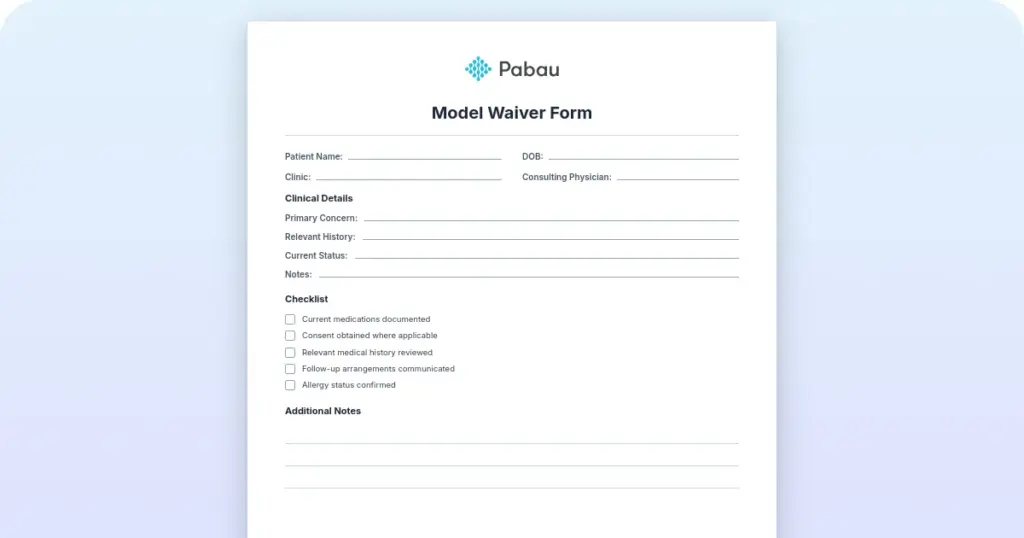
Obagi Blue Peel Radiance: Consent form and aftercare guide
An Obagi Blue Peel Radiance consent form records that your patient understood a ...

3
Last Updated: Sep 29, 2026
Billable Code Specific Code
Q84.1 is the billable ICD-10-CM code for congenital morphological disturbances of hair, not elsewhere classified.
Coders reach for Q84.1 when a dermatologist or hair specialist documents a structural hair shaft abnormality — such as monilethrix or pili annulati — that doesn't map to any other specific ICD-10-CM code. The correct diagnosis code keeps billing accurate and patient records consistent over time.
The "not elsewhere classified" (NEC) designation tells coders that Q84.1 applies when the clinical documentation describes a congenital hair morphology disorder that doesn't map to a more specific ICD-10-CM code. It's the right code when the condition is structural and congenital, but the specific disorder name isn't listed elsewhere in the classification.
Let Pabau's smart automation suggest the right codes, reduce claim denials, and keep your practice compliant—effortlessly.
Automate repetitive tasks and focus on what matters most—your patients.
Reduce coding errors and ensure compliance with the latest regulations.
Clean claims, fewer denials, and faster reimbursements.
Powerful insights and reporting to help your practice thrive.
HIPAA compliant SOC 2 certified GDPR-compliant Trusted by 4,000+ clinics worldwide

ICD-10 Code Q84.1 describes congenital morphological disturbances of hair, not elsewhere classified, and is a fully billable ICD-10-CM diagnosis code valid for claim submission.
Conditions coded under Q84.1 include monilethrix (beaded hair) and pili annulati (ringed hair), both of which are rare autosomal-dominant hair shaft disorders present from birth.
Q84.1 became effective on October 1, 2025 under the 2026 ICD-10-CM edition; always confirm the current fiscal year code set before submitting claims.
Pabau’s claims management software and digital documentation tools help dermatology and hair practices code rare congenital diagnoses accurately and submit clean claims first time.
Use this table as a fast reference for code validity before submitting a claim. All figures reflect the 2026 ICD-10-CM edition, verified against the CDC/NCHS ICD-10-CM web tool.
Q84.1 is an umbrella code covering congenital structural disorders of the hair shaft that don’t have their own dedicated ICD-10-CM codes. Dermatology and hair practice teams working on clinical documentation for these patients need to understand which conditions Q84.1 covers before selecting it for a claim.

The following synonyms and conditions are included in the official ICD-10-CM tabular list under Q84.1:
Monilethrix is a rare autosomal-dominant hair shaft disorder in which the hair develops alternating nodes and internodes, giving it a “beaded” appearance under microscopy. The condition typically presents in early childhood.
Affected hairs are fragile and break easily at the narrow internodes, resulting in sparse, brittle hair, most prominently on the scalp occiput and nape. Because monilethrix is congenital and affects hair morphology, it maps directly to ICD-10-CM Q84.1 under the congenital morphological disturbances category.
Coding note: document the specific clinical finding (monilethrix / beaded hair) in the medical record. A diagnosis supported by dermoscopy or trichoscopy findings strengthens the clinical basis for using Q84.1 and supports payer review.
Pili annulati is a congenital hair shaft anomaly characterized by alternating light and dark bands visible along the hair shaft, producing a ringed or banded appearance. The alternating pattern results from air-filled cavities within the cortex of the hair shaft.
The condition is generally benign and often autosomal-dominant, with variable penetrance. Hair fragility can occur in some cases but isn’t universal.
Coders should document “pili annulati” or “ringed hair” in the record and select ICD-10 Code Q84.1 as the primary diagnosis when the condition is the reason for the encounter, since no more specific code exists in ICD-10-CM.
Understanding what Q84.1 explicitly excludes is as important as knowing what it includes. Using the wrong code when an excludes note applies is a common cause of claim denial. Good claims management practices start with applying excludes rules correctly before submission.

Key coding notes for Q84.1 per the ICD-10-CM tabular list:
Always verify the most current excludes notes using the AAPC Codify ICD-10-CM lookup or the official CMS tabular list, as notes can change between fiscal years.
When documenting a congenital hair disorder, specify the exact clinical finding in the chart note before selecting Q84.1. If the record only states ‘hair abnormality’ or ‘hair disorder’ without specifying morphological disturbance or a named condition (monilethrix, pili annulati), a payer may downcode or deny on grounds of insufficient specificity. Trichoscopy or dermoscopy findings cited in the record provide strong support for Q84.1 as the appropriate diagnosis code.
A patient management system keeps a child’s congenital diagnosis connected to every appointment that follows it.
Understanding where ICD-10 Code Q84.1 sits within the broader ICD-10-CM hierarchy helps coders navigate to the correct code and distinguish it from sibling codes. The ICD-10-CM classification organizes codes in a parent-child structure from broad chapter down to specific billable code — the same layout that applies to entirely unrelated codes, from Q84.1 here to I32 elsewhere in the classification. A coding error surfaces as a cash flow problem weeks later, which is why the healthcare revenue cycle is measured end to end. Practices that bill a narrow set of services keep a coding guide covering that set rather than the whole schedule.
The hierarchy for Q84.1 is:
Q84 is the non-billable parent. It can’t be submitted on a claim. Q84.1 is one of several billable child codes under Q84. Practices using dermatology EMR software benefit from code search tools that display this hierarchy clearly, reducing the risk of submitting the non-billable parent instead of the specific child code.
Before finalizing a diagnosis of Q84.1, coders should review the full sibling code set to confirm Q84.1 is the most accurate choice. Practices managing skin and hair conditions across multiple patients benefit from having this crosswalk visible in their coding workflow.
Key distinction between Q84.0 and Q84.1: Q84.0 applies when the primary finding is absence of hair (alopecia) from birth. Q84.1 applies when the hair is present but structurally abnormal in its morphology.
If the condition presents as both hair absence and structural abnormality, clinical documentation should guide the selection of the code that best captures the primary reason for the encounter. Consult the WHO ICD-10 browser for the international classification context alongside the US-specific ICD-10-CM tabular list.
Q84.1 is a billable, specific ICD-10-CM code, meaning it can appear on a claim form as the primary or secondary diagnosis code. Payers follow HIPAA standard transaction sets, which require ICD-10-CM diagnosis codes on professional and institutional claims, and Q84.1 satisfies this requirement.
Using a structured patient intake workflow helps ensure the clinical detail supporting Q84.1 is captured at the point of care, not reconstructed after the fact.

Documentation requirements for successful reimbursement using Q84.1:
Practices coding Q84.1 should note that payer acceptance is determined by individual insurance contracts, not solely by CMS classification. Q84.1 being billable in ICD-10-CM doesn’t guarantee reimbursement from every payer.
Verify coverage requirements through individual payer portals before submitting, and maintain documentation that supports the medical necessity of the visit. If a payer requests supporting records, having a signed records release form on file keeps the request from stalling the claim.

Pabau helps dermatology and hair practice teams document congenital diagnoses accurately, submit cleaner claims, and reduce coding errors across every encounter.

Rare congenital codes like ICD-10 Code Q84.1 create a specific challenge for practice teams. Because the conditions are uncommon, coders may not have the code memorized, and documentation workflows may not prompt for the level of clinical detail payers require.
This is where integrated hair clinic management software and practice management platforms make a measurable difference.
Pabau supports coding accuracy for dermatology and hair practices through several connected workflows.
This means the clinical specificity that underpins a Q84.1 claim is already in the record before the billing team touches the encounter.
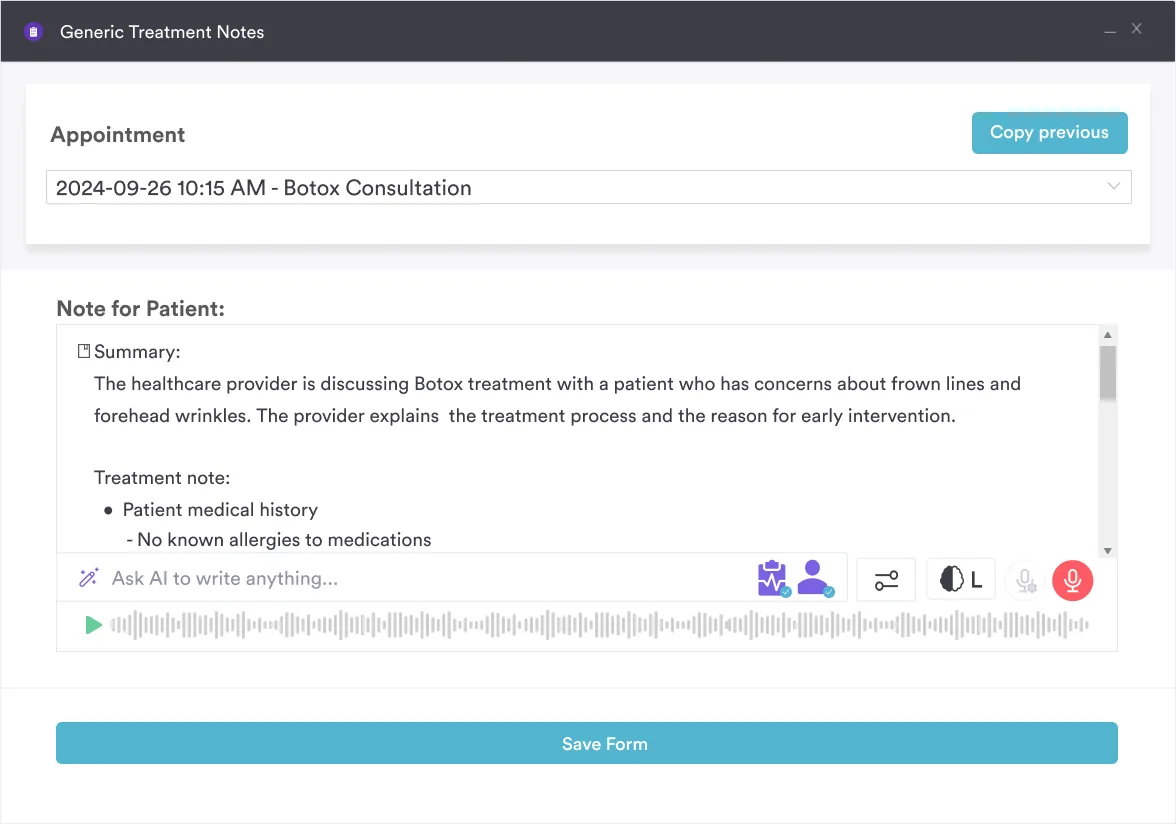
On the billing side, Pabau’s claims management software helps teams validate diagnosis codes against payer rules before submission, reducing the rate of denials on rare code sets where human error is most likely.
For multi-location skin and dermatology practices.
Flag Q84.1 encounters for a coding quality review the first time a clinician uses the code in your practice. Confirm the record contains the named condition (monilethrix or pili annulati), documents congenital onset, and specifies the diagnostic method. A single reviewed claim builds a template for every future Q84.1 encounter and reduces the risk of denials on subsequent submissions.
Dermatologists, trichologists, and hair clinic practitioners can reduce coding errors and support clean claims by building a consistent documentation checklist around Q84.1 encounters. The following framework reflects standard ICD-10-CM documentation guidance.
Practices already using compliance workflows for hair treatment can integrate these documentation elements into existing note templates. Note templates for procedures like CO2 laser aftercare follow the same logic: capture the clinical detail a payer or future clinician needs, without recreating it from memory.
For practices managing specialist skin workflows, integrating a structured note template for rare congenital diagnoses into the EHR reduces cognitive load on clinicians and produces consistent, code-ready documentation without adding time to the encounter. The right clinical form design makes a measurable difference to coding accuracy downstream.
Rare congenital codes like Q84.1 highlight the disconnect between what clinicians document and what billing teams need to submit a clean claim. The conditions covered by ICD-10 Code Q84.1 are uncommon enough that coding errors go unreviewed until a denial arrives.
Getting it right from the first encounter requires clinical specificity in the note, accurate code selection, and a workflow that connects the two.
Pabau helps dermatology and hair practice teams close that disconnect. The platform’s AI-assisted documentation captures the morphological detail that supports Q84.1, while the claims management tools validate diagnosis codes before submission.
If your practice handles rare congenital diagnoses and wants cleaner, faster billing, book a demo to see how Pabau supports specialist coding workflows end to end.

Coding a similarly rare diagnosis? ICD-10 Code M35.4 walks through diffuse eosinophilic fasciitis, another narrow code most coders rarely encounter.
Billing a complex neurosurgical case? Cerebellopontine angle tumour billing guide covers the pre-authorisation and documentation this complex neurosurgery claim needs.
ICD-10 Code Q84.1 is the billable ICD-10-CM diagnosis code for congenital morphological disturbances of hair, not elsewhere classified. It covers structural hair shaft disorders that are congenital in origin and do not have a more specific ICD-10-CM code, including monilethrix (beaded hair) and pili annulati (ringed hair).
Yes. Q84.1 is a billable, specific ICD-10-CM diagnosis code valid for claim submission in fiscal year 2026. It became effective on October 1, 2025. The parent code Q84 is not billable; only the child codes, including Q84.1, can appear on a claim.
Monilethrix is a rare autosomal-dominant congenital hair shaft disorder in which hairs develop alternating nodes and internodes, giving a beaded appearance. It is coded under ICD-10 Code Q84.1 (congenital morphological disturbances of hair, not elsewhere classified) because no more specific ICD-10-CM code exists for this condition.
Q84.0 is the code for congenital alopecia, meaning absence of hair from birth. Q84.1 covers congenital morphological disturbances, meaning hair is present but structurally abnormal. Use Q84.0 when the primary finding is hair absence; use Q84.1 when the hair shaft structure is abnormal (such as in monilethrix or pili annulati).
Pili annulati is a congenital hair shaft condition characterized by alternating light and dark banding along the hair shaft caused by air-filled cortical cavities. It is coded to ICD-10 Code Q84.1, as it falls under congenital morphological disturbances of hair not elsewhere classified. Document the specific diagnosis in the clinical record before submitting the code.
Yes, Q84.1 can be submitted on a claim for insurance reimbursement, as it is a billable ICD-10-CM code. However, individual payer coverage policies vary. Reimbursement depends on the patient’s plan, medical necessity documentation, and whether prior authorization is required. Verify payer-specific requirements before submission and ensure clinical documentation supports the diagnosis.