

ICD-10 code S61.201A: Open wound of left index finger without nail damage
ICD-10 code S61.201A covers a left index finger wound of unstated type ICD-10 co...

Last Updated: Oct 16, 2026
Billable Code Specific Code
O90.6 is the billable ICD-10-CM code for postpartum mood disturbance.
The code has been valid since October 1, 2024 and stays valid in the 2026 edition.
Let Pabau's smart automation suggest the right codes, reduce claim denials, and keep your practice compliant—effortlessly.
Automate repetitive tasks and focus on what matters most—your patients.
Reduce coding errors and ensure compliance with the latest regulations.
Clean claims, fewer denials, and faster reimbursements.
Powerful insights and reporting to help your practice thrive.
HIPAA compliant SOC 2 certified GDPR-compliant Trusted by 4,000+ clinics worldwide

ICD-10 Code O90.6 (postpartum mood disturbance) is a billable, specific ICD-10-CM code valid for HIPAA-covered transactions in the 2025 and 2026 editions.
O90.6 covers mild, transient mood disturbances (postpartum blues, maternity blues, postpartum dysphoria) lasting days, not weeks.
Excludes1 notes bar O90.6 from being reported with postpartum depression (F53.0) or puerperal psychosis (F53.1) on the same encounter.
Symptoms that persist beyond 10 to 14 days, or that impair functioning, point to F53.0 instead.
A documented symptom onset date, EPDS score, and functional assessment keep an O90.6 claim defensible on audit.
ICD-10 Code O90.6 is the diagnosis code for postpartum mood disturbance under the ICD-10-CM classification system. It is a billable, specific code, so it carries enough clinical detail to support a claim without an additional specificity digit. The current version took effect October 1, 2025 for the 2026 edition. It was also valid in the 2025 edition, effective October 1, 2024.
The code sits within the O85-O92 block (Complications predominantly related to the puerperium), under parent code O90 (Complications of the puerperium, not elsewhere classified). An anxiety-predominant presentation in the perinatal period falls outside O90.6 and takes an anxiety-specific code instead.
The ICD-10-CM Tabular List includes approximate synonyms for O90.6. These are alternate clinical terms that map to the same code. A coder searching under any of them is looking at O90.6, provided the condition meets the clinical criteria for a mild, transient presentation.
None of these synonyms implies a diagnosis of postpartum depression. They describe a physiologically expected response to hormonal shifts and the physical demands of childbirth, and the response resolves on its own. Once symptoms persist beyond 10 to 14 days or meet DSM-5-TR thresholds for a major depressive episode, the code shifts to F53.0.
The most consequential decision in postpartum mood coding is choosing between O90.6, F53.0, and F53.1. Each code covers a different severity tier, and they cannot be reported together. Reaching for O90.6 when F53.0 is clinically indicated undercodes the encounter and can signal incomplete clinical documentation.
The American College of Obstetricians and Gynecologists (ACOG) separates postpartum blues from clinical depression on symptom persistence and functional impairment. Blues typically peak around day three to five and resolve without treatment by day 10 to 14. They do not stop the patient caring for herself or her infant.
When symptoms persist, worsen, or disrupt functioning, run a structured assessment with a validated screening tool before you pick a code. The Edinburgh Postnatal Depression Scale (EPDS) is the usual choice, and its score belongs in the chart either way.
Code O90.6 when the patient has mild tearfulness, emotional lability, irritability, or mood fluctuation in the first two weeks postpartum. The record should show no sustained depressive episode, no functional impairment, and no DSM-5 major depressive episode criteria met. Code F53.0 when low mood persists beyond two weeks, functioning is impaired, neurovegetative symptoms appear, or a positive EPDS score triggers a diagnostic assessment.
The chart below puts the three sets of criteria side by side, so you can route a presentation to its code in one pass.
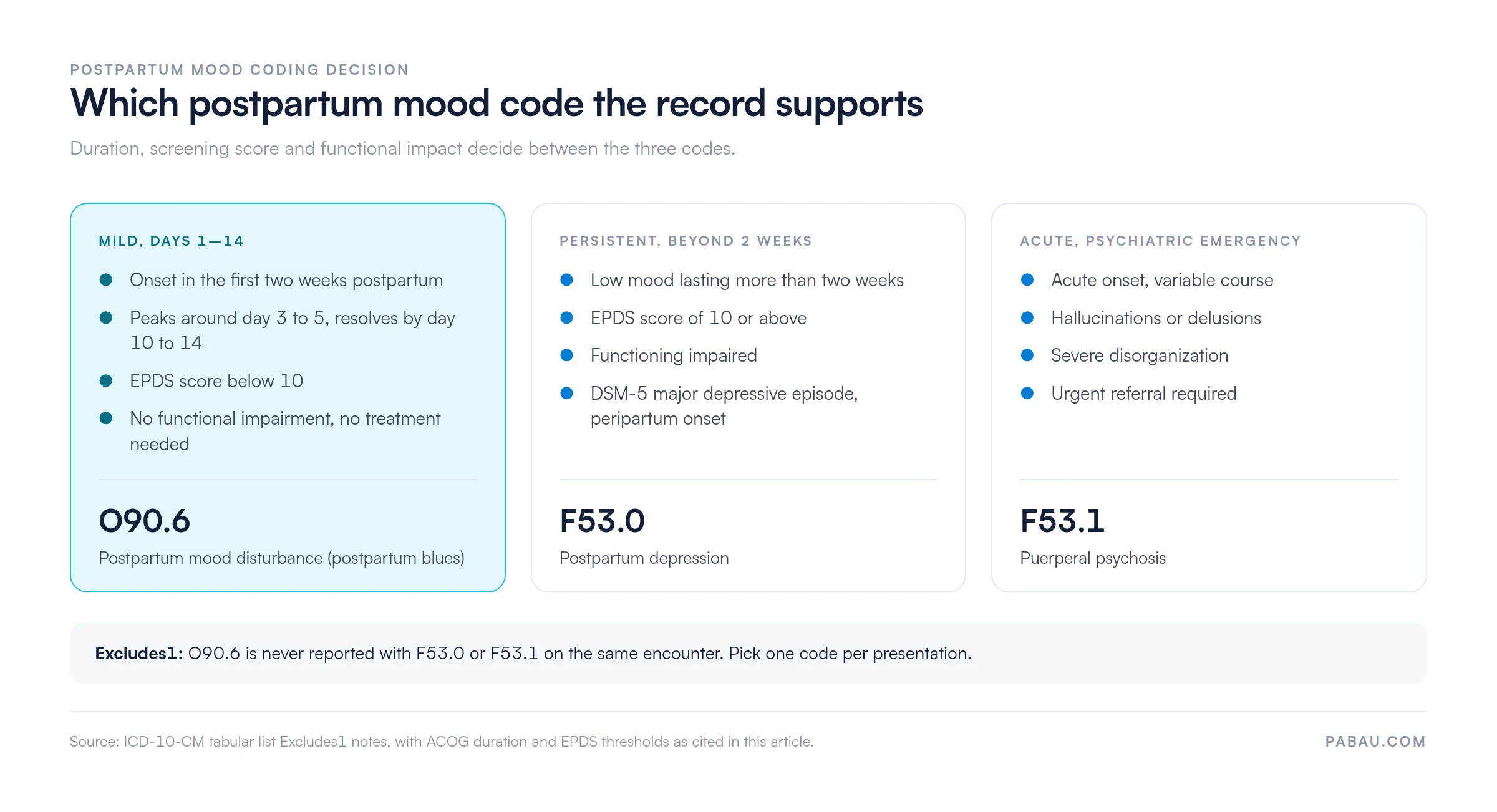
O90.6 carries Excludes1 notes for both F53.0 and F53.1. An Excludes1 note means the excluded condition cannot occur at the same time as the coded condition. These are structural prohibitions in ICD-10-CM, not coding preferences.
An Excludes2 note works differently. It signals that the excluded condition is not part of the coded condition, but may coexist and be coded separately. Excludes1 signals mutual exclusivity instead. A claim carrying O90.6 and F53.0 for the same encounter will likely hit a code edit or a denial at the clearinghouse. The CMS ICD-10-CM official guidelines carry the full Excludes1 interpretation rules.
Accurate documentation is what keeps an O90.6 claim defensible on audit. The chart note has to support the code, and it has to separate the presentation from a clinical depressive episode. Three omissions draw the most payer scrutiny on O90.6 claims: no symptom onset date, no severity assessment, and no language ruling out F53.0.
Where another postpartum complication appears on the same claim, confirm the sequencing before you submit. Postpartum malnutrition is one example, coded O25.3 when the record documents it within the puerperium. The condition chiefly responsible for the encounter takes the principal diagnosis position, which is rarely a mild mood disturbance.
Document the Edinburgh Postnatal Depression Scale (EPDS) score in every postpartum encounter. A score below 10 supports O90.6, and a score of 10 or above triggers a clinical assessment that may support F53.0. Recording the score creates an audit trail for your code selection, rather than leaving it to subjective language.
O90.6 is a billable, specific ICD-10-CM code valid for submission on HIPAA-covered electronic transactions. It can be reported on professional and institutional claims without additional code specificity. Coverage still varies with the benefit the claim runs through.
Some payers route postpartum mood codes through the behavioral health benefit rather than the obstetric one. Copay structures and prior authorization rules can differ between the two. So verify the patient’s benefit structure before the encounter. A claim billed under the behavioral health benefit may also fall under the Mental Health Parity and Addiction Equity Act.
Practice management software like Pabau submits O90.6 claims electronically through the Claim.MD clearinghouse. That route supports CMS-1500 and 837P claim formats across thousands of US payers. Pabau pairs it with claims software for practices that carries a built-in ICD-10 catalog. A coder picks O90.6 from a list instead of typing it into a free-text field.
When a payer denies an O90.6 claim, the electronic remittance advice in the ERA/835 file carries the CARC reason code. That code is the starting point for any appeal. Our reference on denial reason codes sets out what the common ones mean and what each needs before resubmission.
O90.6 sits in the ICD-10-CM obstetric chapter (Chapter 15: Pregnancy, Childbirth and the Puerperium). Its position in the hierarchy helps you find related codes and sequencing requirements. The hierarchy runs from broad to specific:
The parent category O90 covers other postpartum complications. Examples include disruption of a cesarean delivery wound (O90.0), a perineal obstetric wound (O90.1), and postpartum thyroiditis (O90.5). O90.6 is the only code in O90 that covers a mood presentation.
Postpartum conditions with a clinical psychiatric diagnosis, F53.0 and F53.1, sit outside the O90 block entirely. They belong to Chapter 5 (Mental, Behavioral and Neurodevelopmental Disorders). That split is a coding signal in itself. O90.6 lives in the obstetric chapter because it describes a physiological postpartum complication rather than a psychiatric disorder.
An OB/GYN or mental health practice needs two things from its software on a postpartum encounter. One is an ICD-10 reference at the point of documentation. The other is a clean path to claim submission.
Pabau captures structured clinical notes, so a provider records symptom onset, the EPDS score, and a functional assessment inside the patient record. Digital intake forms can carry the same mood screening questions, which puts structured answers in the chart before the clinician walks in. The coder then works from recorded detail instead of free text written after the fact.
On the billing side, Pabau routes O90.6 claims to the payer in the format that payer expects, through Claim.MD. ERA processing surfaces denial reason codes as soon as the payer responds. Appeal status is tracked in the same place, so nobody keeps a separate denial spreadsheet.
When you document a postpartum encounter, record the EPDS score in a structured field rather than in free text. That makes the score searchable across the patient’s record history, and it supports your audit defense if a payer ever questions the code.

Pabau connects directly to Claim.MD to submit ICD-10-coded claims across thousands of US payers. Built-in ICD-10 catalogs, ERA processing and denial tracking mean fewer manual steps and faster payment for postpartum encounters.

Postpartum mood coding rests on one judgment. Is this a transient physiological adjustment, or a clinical disorder? O90.6 is the right code for mild, self-limiting baby blues, and F53.0 is the right code for a clinical depressive episode. Excludes1 keeps them apart, so they are never reported together.
The code you pick shapes the claim, and it shapes the care pathway the patient lands on. Recording onset, severity, the EPDS score, and functional status at every postpartum encounter protects both. Book a demo to see how Pabau captures that documentation and submits the claim behind it.

Coding a clinical postpartum depressive episode instead? ICD-10 code F53.0 postpartum depression sets out the criteria, documentation and billing rules that apply once symptoms pass the two-week mark.
Need the wider depression code set? ICD-10 codes for depression walks through the depression code families and how to choose between them.
Working an O90.6 claim denial? Electronic remittance advice explains how to read the ERA/835 file and find the CARC reason code behind a rejection.
Want to reduce claim denials on postpartum encounters? Denial management in healthcare explains how to set up a structured workflow for tracking and appealing ICD-10-coded claim denials.
ICD-10 Code O90.6 is the billable ICD-10-CM diagnosis code for postpartum mood disturbance. It covers mild, transient mood changes in the immediate postpartum period, including postpartum blues, maternity blues, and postpartum dysphoria. The code is valid for HIPAA-covered electronic claim submissions in the 2025 and 2026 ICD-10-CM editions. It sits within parent category O90 (Complications of the puerperium, not elsewhere classified).
Yes. O90.6 is a billable, specific ICD-10-CM code valid for submission on HIPAA-covered electronic transactions, including CMS-1500 and 837P claim formats. Payer coverage policies vary. Some route postpartum mood codes through the obstetric benefit, and others through the behavioral health benefit. The behavioral health route may carry different prior authorization or parity requirements.
Yes. The ICD-10-CM Tabular List lists postpartum blues, maternity blues, and postpartum dysphoria as approximate synonyms for O90.6. All three terms describe the same mild, transient postpartum mood presentation and map to the same code. That holds only where the condition does not meet clinical criteria for postpartum depression (F53.0) or puerperal psychosis (F53.1).
Document the symptom onset date relative to delivery, the specific symptoms (tearfulness, lability, irritability), and the EPDS score. Add a brief functional assessment confirming no significant impairment. Then record a clinical impression confirming that DSM-5 major depressive episode criteria are not met. These elements create an audit-defensible record that distinguishes O90.6 from an F53.0 presentation.



