ICD-10 code S61.201A: Open wound of left index finger without nail damage
ICD-10 code S61.201A covers a left index finger wound of unstated type ICD-10 co...

Last Updated: Oct 16, 2026
Billable Code Specific Code
O67.8 is the billable ICD-10-CM code for other intrapartum hemorrhage.
The code sits within ICD-10-CM Chapter 15, Pregnancy, Childbirth and the Puerperium, which the Centers for Medicare and Medicaid Services (CMS) updates every year. Knowing where O67.8 sits, what its NEC qualifier means, and what documentation it needs keeps claims clean and helps you avoid denials on obstetric encounters.
Let Pabau's smart automation suggest the right codes, reduce claim denials, and keep your practice compliant—effortlessly.
Automate repetitive tasks and focus on what matters most—your patients.
Reduce coding errors and ensure compliance with the latest regulations.
Clean claims, fewer denials, and faster reimbursements.
Powerful insights and reporting to help your practice thrive.
HIPAA compliant SOC 2 certified GDPR-compliant Trusted by 4,000+ clinics worldwide

ICD-10 code O67.8 covers other intrapartum hemorrhage, bleeding during labor that doesn’t fit a more specific code in the O67 category.
O67.8 is a billable ICD-10-CM diagnosis code, valid for FY2026 claims submission on both CMS-1500 and UB-04 forms.
The NEC qualifier means O67.8 applies only when the hemorrhage doesn’t fit O67.0’s coagulation-defect definition or a more specific category.
Practice management software like Pabau keeps claims and documentation together, so missing information surfaces before an obstetric claim goes out.
Intrapartum hemorrhage is bleeding that happens after labor starts and before the placenta delivers. The O67 category exists for hemorrhage that’s “not elsewhere classified,” or NEC. That means the bleeding doesn’t trace back to a cause with its own code, like placental abruption (O45) or placenta previa (O44).
ICD-10 code O67.8 sits one level below O67 and captures every intrapartum hemorrhage under that NEC umbrella, except for the specific subtype covered by O67.0.
In practice, a coder selects it when the provider has documented significant blood loss during labor. The note can’t mention a coagulation defect, and no more specific code can apply.
NEC, or “not elsewhere classified,” is a coding instruction, not a clinical finding. It tells the coder that this code covers residual cases the classification hasn’t broken out into their own specific codes. For obstetric coders, that means checking two things before using O67.8:
If both checks are clear, O67.8 is the right assignment. Misapplying NEC codes on vague documentation is a common obstetric coding error, much like it does on O71.9 for unspecified obstetric trauma.
Three codes share the O67 parent category, and picking the wrong one is a common reason claims come back denied.
O67.9 should be avoided whenever documentation supports a more specific assignment. Payers and auditors scrutinize unspecified codes in maternal encounters, and a query to the attending physician can often move O67.9 up to O67.8 or O67.0.
Context matters in obstetric coding. ICD-10 code O67.8 doesn’t float on its own. It belongs to a nested hierarchy that determines how it’s sequenced, which excludes notes apply, and which official guidelines govern its use.
Chapter 15 codes apply exclusively to maternal records. Per CMS ICD-10-CM Official Guidelines Section I.C.15, Chapter 15 codes are never assigned to a newborn record. An O67.8 code on a neonatal encounter is a billing error that needs correcting before submission.
The O67 category also carries an Excludes1 note. Codes excluded from O67 by that note can’t be reported at the same time as O67.8.
Checking the tabular list for every applicable excludes note before final submission is a non-negotiable step in obstetric billing. Keeping documentation and claims management in one system makes that check part of the routine instead of an afterthought.
ICD-10-CM Chapter 15 has sequencing rules that work differently from most other chapters. Getting them right protects the claim and reflects what actually happened during the encounter.
When intrapartum bleeding is the reason for the admission, the ICD-10-CM guidelines call for sequencing that obstetric complication as the principal diagnosis. If O67.8 is the complication driving the encounter, it should sequence first.
The guidelines also call for reporting every condition that affects how the mother is managed as an additional diagnosis. That means O67.8 might be the principal code, with secondary codes for fetal status, transfusion procedures, or other maternal conditions reported alongside it.
Coordinating these multi-code encounters is one reason OB/GYN practice management software built for obstetric billing matters.
Timing decides the choice between O45, O46, O67, and O72 more than anything else. The CDC/NCHS ICD-10-CM tool lets coders cross-reference the tabular instructions and confirm timing-based distinctions before they submit.
O67.8 doesn’t exist in isolation. Obstetric coders working with intrapartum hemorrhage regularly run into adjacent codes in the same clinical neighborhood.
Billing teams running fertility clinic software deal with their own cluster of pregnancy-related codes in much the same way. Knowing the distinctions prevents upcoding, downcoding, and claims that go out wrong.
Here’s a useful way to think about it. The O45, O44, and O46 categories cover hemorrhage with a known, specific structural cause. The O67 category picks up hemorrhage during labor when that specificity is missing, or when the cause has no dedicated code of its own.
When documentation is ambiguous, querying the attending physician instead of defaulting to O67.9 produces cleaner claims. The same specificity trade-off shows up on O03.7 elsewhere in Chapter 15.
Intrapartum hemorrhage rarely shows up alone. An obstetric admission involving O67.8 often needs additional diagnosis codes to capture the full clinical picture and justify the level of care given.
O76 (abnormality in fetal heart rate and rhythm complicating labor and delivery) often gets reported alongside O67.8 when intrapartum hemorrhage triggers abnormal fetal monitoring findings.
The sequencing rule is straightforward. O67.8 typically sequences as principal when it drives the admission. O76 follows as an additional diagnosis, reflecting the fetal response to maternal hemorrhage.
When hemorrhage requires a blood transfusion, ICD-10-PCS procedure codes for the transfusion get added to the inpatient record alongside O67.8. On outpatient or facility claims, the transfusion CPT codes go with the diagnosis instead.
Documenting estimated blood loss (EBL) in the operative or delivery note is what supports medical necessity for any transfusion code billed alongside it.
Without EBL numbers, payers may query or deny the transfusion procedure. Practices with strong clinical record management can capture this detail at the point of care instead of reconstructing it after discharge.
Z3A gestational-age codes and Z37 outcome codes belong on virtually every obstetric delivery record. Missing them is a common clean-claim failure point for OB/GYN billing teams.
Reviewing your practice’s medical forms and documentation workflows can catch these omissions at the point of capture, rather than requiring a correction after submission.
ICD-10 code O67.8 is a valid, billable ICD-10-CM code for FY2026. You can use it as a principal or additional diagnosis on the CMS-1500 or UB-04, depending on the care setting.
The delivering physician’s professional services get billed on the CMS-1500. The diagnosis code O67.8 populates the diagnosis pointer field and links to the delivery CPT code, typically 59409, 59410, 59514, or 59515. Which one applies depends on vaginal versus cesarean delivery and global versus non-global billing.
Facility charges for the labor and delivery unit use the UB-04, where O67.8 appears in the principal or secondary diagnosis field alongside any procedure codes.
O67.8 is a valid code under CMS ICD-10-CM guidelines, but individual payer policies still vary. Medicaid managed care organizations and commercial insurers may have different rules about:
Always verify payer-specific edits before you submit. The AAPC ICD-10-CM code lookup provides crosswalk data and coverage notes that can surface payer-specific alerts during pre-billing review.
Practices running integrated EHR and billing workflows spend less manual effort catching these payer-specific edge cases before claims go out the door.
Some obstetric codes need a 7th character to specify trimester or fetal position, but O67.8 doesn’t. It doesn’t require a 7th-character extension in the current FY2026 ICD-10-CM tabular list, so submitting it as the 5-character code O67.8 is correct.
Appending characters that aren’t indicated creates a claim-edit error that delays payment. Check the official CDC/NCHS ICD-10-CM tool each fiscal year to confirm this stays true, since the tabular list updates annually.
Run a pre-submission audit on all obstetric claims with Chapter 15 codes. Confirm that Z3A gestational age and Z37 outcome codes are present on every delivery record before the claim transmits. Missing these codes is the fastest route to a clean-claim rejection that has nothing to do with the accuracy of O67.8 itself.
Knowing the code isn’t enough. What has to be in the chart before you can assign O67.8 is what separates compliant coding from an educated guess.
To assign ICD-10 code O67.8 compliantly, the medical record needs to show at least four things:
Query the attending physician whenever any of these show up:
AHIMA and AHA Coding Clinic both support using physician queries to clarify documentation before you finalize a code. A well-designed digital clinical documentation workflow makes it easier to embed structured query prompts at the point of care. That cuts down on the retrospective queries that delay billing cycles.
Practices focused on HIPAA-compliant medical record practices should also make sure any provider query and its response stay in the permanent record.
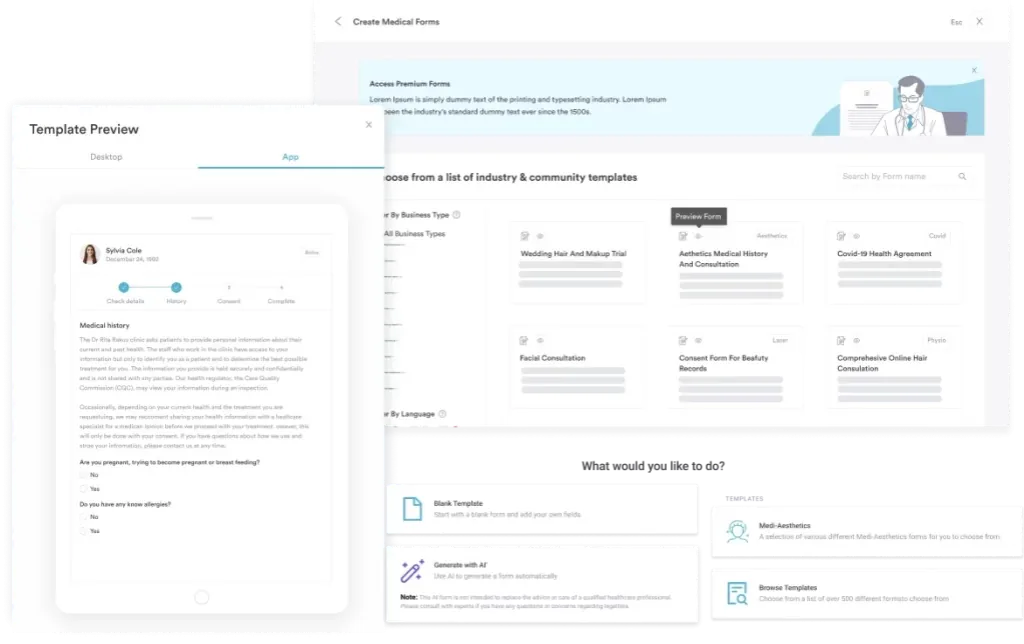
Most OB/GYN billing teams juggle separate systems for clinical notes, coding, and claims submission. A biller often has to jump between the chart, a coding reference, and a clearinghouse portal just to confirm a claim is ready. Gestational age, outcome codes, and EBL documentation all have to be in place before it goes out.
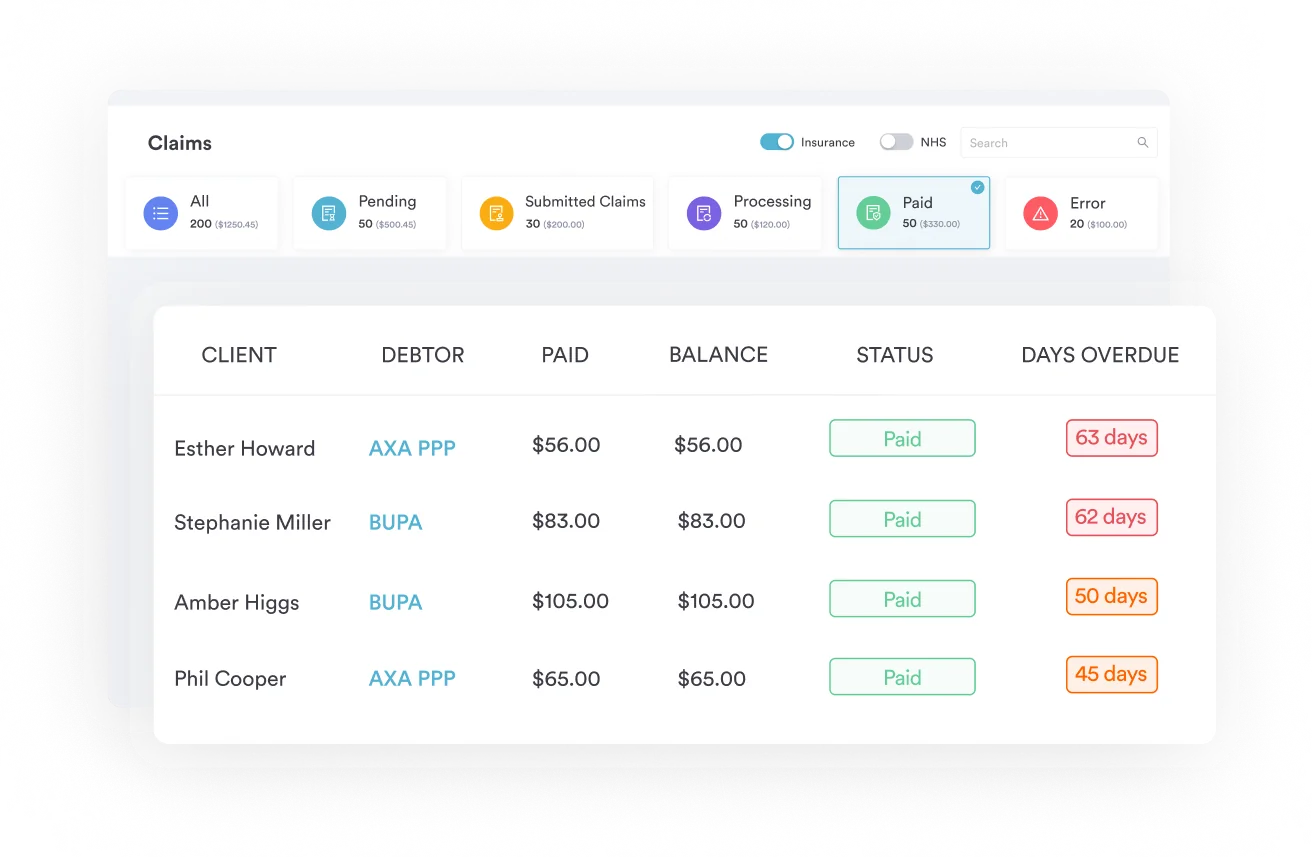
Pabau keeps the delivery record, the diagnosis and procedure codes, and the claim itself inside one system, so nothing needs re-entering between tools. Before a claim can be sent, Pabau’s claims management tools check that the payer’s required fields, like gestational age and outcome of delivery, are complete. The system holds the claim until they are. Accounts receivable aging shows which codes are slow to pay long before anyone calls it a denial problem.
A billing team can pull up a status dashboard and see where a claim sits, submitted, in review, or paid, without chasing separate portals. Catching a missing field this way happens before the payer ever sees it, not after a denial letter arrives.

Pabau’s claims management tools check that required payer fields are complete before an obstetric claim can be sent. A status dashboard then tracks it from submission through payment.

Intrapartum hemorrhage without a more specific cause still needs a valid, billable code, and O67.8 is it. Getting the assignment right comes down to three checks.
Confirm the bleeding is genuinely intrapartum, and rule out O67.0 whenever the record doesn’t document a coagulation defect. Finally, make sure the physician’s note carries enough timing and EBL detail to support the code before the claim goes out.
Practices managing a high volume of labor-and-delivery claims run into the same pattern again and again. A missing companion code or an incomplete field surfaces at the payer, not before.
Keeping documentation, coding, and claims submission in one system catches that earlier, before the claim ever reaches a denial queue. Book a demo to see how Pabau supports OB/GYN billing workflows.

Coding obstructed labor for a different presentation? O66.9 covers obstructed labor when the record doesn’t specify a cause.
Looking for the code covering weak contractions during labor? O62.2 walks through billing for uterine inertia.
Need the right code for vomiting during pregnancy? O21.8 covers cases that fall outside hyperemesis gravidarum’s own codes.
Charting a labor complication that isn’t hemorrhage? O75.0 explains when maternal distress during labor gets its own code.
Coding a patient’s breast cancer history? personal history of breast cancer code covers the code for a patient previously diagnosed with breast cancer that is now resolved.
No. O67.8 stays the same whether the delivery is vaginal or cesarean. The CPT code linked to the encounter changes with delivery method. The ICD-10-CM diagnosis code depends on timing and cause, not how the baby was delivered.
O67.8 itself doesn’t carry a severity component. Severity shows up through other documentation, like an estimated blood loss value, a transfusion procedure code, or a comorbid diagnosis such as anemia.
The coder makes that call based on what’s already documented. A coder can’t infer a missing clinical fact, like a coagulation defect, so an unclear chart means a query rather than a guess.
Coding follows the documented cause and onset. When the physician confirms bleeding started antepartum and continued into labor, the antepartum code usually applies instead of O67.8. If the note doesn’t make the onset clear, query the provider first.
Yes. O67.8 sequences as principal only when intrapartum hemorrhage is the reason for the encounter. If a patient is admitted for a different obstetric complication and hemorrhage develops afterward, O67.8 can be reported as a secondary diagnosis.