ICD-10 code S61.201A: Open wound of left index finger without nail damage
ICD-10 code S61.201A covers a left index finger wound of unstated type ICD-10 co...

Last Updated: Oct 16, 2026
Billable Code Specific Code
M96.4 is the billable ICD-10-CM code for postsurgical lordosis.
The code applies when an exaggerated inward curve of the spine develops after a surgical procedure. Postsurgical lordosis is coded apart from idiopathic or degenerative lordosis, which belong in the M40 block. Assigning M96.4 requires a documented surgical history and a physician statement linking the surgery to the curvature.
Let Pabau's smart automation suggest the right codes, reduce claim denials, and keep your practice compliant—effortlessly.
Automate repetitive tasks and focus on what matters most—your patients.
Reduce coding errors and ensure compliance with the latest regulations.
Clean claims, fewer denials, and faster reimbursements.
Powerful insights and reporting to help your practice thrive.
HIPAA compliant SOC 2 certified GDPR-compliant Trusted by 4,000+ clinics worldwide

ICD-10 Code M96.4 is a billable, specific diagnosis code for postsurgical lordosis, distinct from idiopathic or degenerative lordosis codes in Chapter 13.
The 2026 ICD-10-CM edition, effective October 1, 2025, confirms M96.4 as valid for reimbursement. Confirm it annually against the CMS update files.
Documentation must establish a causal relationship between a prior surgical procedure and the resulting inward spinal curvature, or the code will be unsupported.
Pabau’s claims management software helps orthopedic and physical therapy practices submit and track M96-category claims and spot denial patterns early.
ICD-10 Code M96.4 is a specific, billable diagnosis code for postsurgical lordosis under the 2026 ICD-10-CM classification. It is valid for encounters on or after October 1, 2025. The CDC/NCHS ICD-10-CM web tool confirms M96.4’s placement and billable status in the current tabular list.
Postsurgical lordosis is an abnormal, exaggerated inward curvature of the spine. It develops as a complication of a surgical procedure on the spine or the musculoskeletal system. It belongs to the category of postprocedural musculoskeletal disorders rather than to primary spinal deformity chapters. Many patients who undergo spinal decompression, fusion, or laminectomy develop some degree of curvature change. M96.4 applies when that change is a recognized lordotic deformity documented as surgically related. Physical therapy and orthopedic practices that treat these patients most often meet this code at postoperative follow-up visits.
Clinically, lordosis refers to the natural inward curve of the lumbar and cervical spine. When that curve becomes exaggerated following surgery, it can cause pain, restricted mobility, and secondary musculoskeletal strain. The surgical cause distinguishes M96.4 from codes in the M40 block (lordosis, not otherwise specified), which are used for non-postprocedural presentations.
Multiple alternate diagnostic terms map to M96.4 in the ICD-10-CM alphabetic index. Knowing these synonyms helps coders verify their index lookup path and ensures complete documentation when provider notes use clinical shorthand.
The AAPC ICD-10-CM lookup indexes these terms consistently under M96.4. None of the alternate terms create a separate billable code; they all route to the same M96.4 designation in the tabular list.
M96.4 coding guidelines follow the broader ICD-10-CM Official Guidelines for Coding and Reporting, particularly the postprocedural complication rules in Chapter 13. Several key points govern when this code is appropriate and how it sequences with other diagnoses.
Practices that submit M96-category claims regularly benefit from tracking denial patterns. In practice management software like Pabau, the Claim.MD integration surfaces CARC denial reasons on remittances. That lets coders spot M96.4 claim failures before they age into write-offs. For a closer look at why these claims fail, see the guide on denial management workflows.
Flag all M96-category claims for secondary review before submission. Payers frequently request operative reports when postprocedural complication codes appear without a matching prior-authorization or surgical claim on file. Attaching a brief cover note with the procedure date and the surgeon helps the payer match the claim to the surgical record.
Accurate documentation is the foundation of a defensible M96.4 claim. The physician’s notes have to do three things:
Without that link, payers may reclassify the claim under a non-postprocedural lordosis code or deny it outright. The table below sets out what a postoperative spine note needs to carry.
Per the CMS ICD-10-CM coding guidance, postprocedural complication codes require the physician (not the coder) to establish the causal relationship. Coders may not infer causation from proximity in time alone.
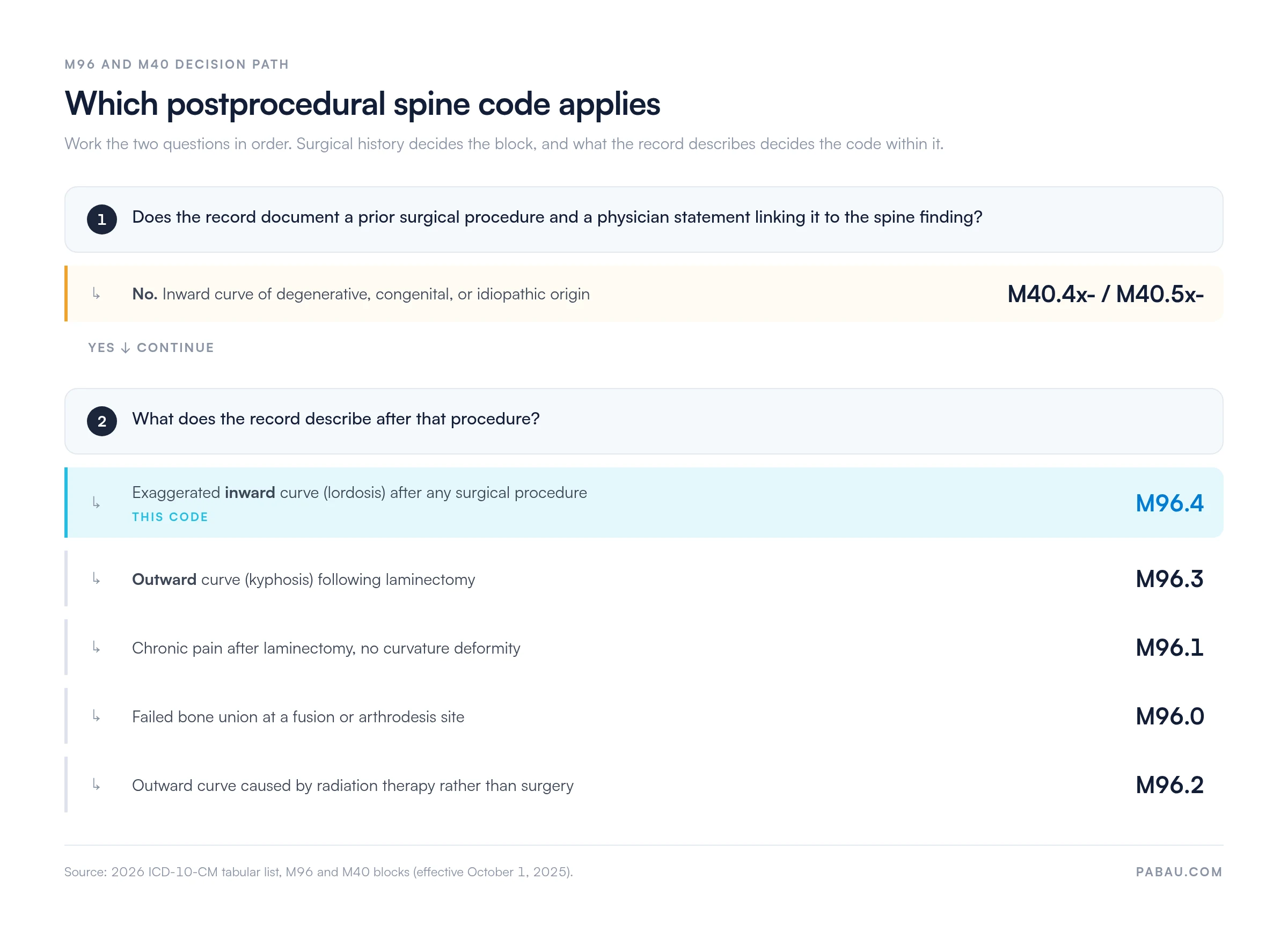
M96.4 sits within the M96 block alongside several sibling codes for other postprocedural musculoskeletal disorders. Selecting the most specific code requires distinguishing the type of spinal deformity and its procedural origin. The WHO ICD-10 browser provides the international classification context for the full M96 hierarchy.
Choosing between M96.4 and its sibling codes comes down to two questions. What type of curvature is present, and what caused it? Work them in that order and most postprocedural spine coding dilemmas resolve in a single pass through the record.
When in doubt about a complex postoperative spine case, AAPC and AHIMA recommend consulting a certified professional coder before submission. Where a patient carries two postprocedural diagnoses, sequencing follows the ICD-10-CM Official Guidelines and the circumstances of the encounter.
CPT codes paired with M96.4 vary with the service billed: evaluation, imaging, physical therapy, or corrective intervention. These are commonly associated pairings, not universally required combinations. Verify payer-specific medical necessity crosswalks before submission, because coverage policies differ. When a pairing is rejected, the remittance carries a reason code, and the reference on denial codes in medical billing explains what each one means.

Verify CPT-to-ICD-10 crosswalk coverage policies via the AAPC CPT-to-ICD-10 crosswalk before submitting claims. Payer-specific LCD policies may restrict which CPT codes are covered when billed with M96.4.
Run an ICD-10-CM eligibility check before every M96.4 encounter. Some payers require prior authorization when corrective procedures are billed alongside M96 postprocedural codes. A real-time eligibility check through your clearinghouse shows the authorization requirement while the claim is still being built.
Most orthopedic and physical therapy practices track postprocedural claims in a spreadsheet. A biller files the M96.4 claim, waits for the remittance, then copies the denial reason into a tab nobody opens until month end. By then the appeal window on the oldest claims has often closed.
Pabau is practice management software that files claims electronically through its Claim.MD integration and follows each one through to payment. Denial reasons come back as CARC codes attached to the claim itself. A biller can pull every rejected M96.4 claim into one list instead of reading remittances line by line.
That visibility is what turns a denial pattern into a fix. When one payer keeps rejecting M96.4 alongside a particular CPT code, the billing team sees it within days. The request for a clearer causal statement then goes back to the surgeon while the operative note is still fresh. That turnaround is where practices chasing fewer denied claims get their time back.

Pabau files M96-category claims through its Claim.MD integration and tracks each one from submission through to payment. Every denial reason lands on the claim it belongs to.

Postsurgical lordosis claims fail most often for one reason: the record never states that the surgery caused the curve. Once the physician writes that sentence, M96.4 is a straightforward code to assign. Confirm the causal statement is in the notes before the claim goes out, and check the code against the CMS update files each October.
The harder part sits after submission, because a postprocedural claim that is denied quietly costs more than one that is denied loudly. Book a demo to see how Pabau files M96-category claims and puts every denial reason in front of your billing team.

Need guidance on clean claim submission for postprocedural codes? What makes a clean claim walks through the elements payers require before processing any diagnosis code claim without rejection.
Tracking ICD-10 denial trends across your practice? Revenue cycle management fundamentals explains how denial tracking and remittance analysis fit into the full billing workflow.
Choosing a clearinghouse for electronic claim submission? The Claim.MD clearinghouse explains how a claim reaches the payer and how remittance data comes back.
ICD-10 Code M96.4 is a billable ICD-10-CM diagnosis code for postsurgical lordosis. The condition is an abnormal inward spinal curvature that develops as a complication of earlier surgery. It falls under Chapter 13, block M96, covering intraoperative and postprocedural musculoskeletal disorders.
Yes, M96.4 is a specific, billable code valid for reimbursement claims in the 2026 ICD-10-CM edition (effective October 1, 2025). No additional specificity digit is required.
M96.4 describes postsurgical lordosis (exaggerated inward curvature), while M96.3 describes postlaminectomy kyphosis (outward curvature following laminectomy specifically). The direction of the curvature and the specific procedure type distinguish the two codes.
The medical record must name the prior surgical procedure and its date, and describe the lordotic curvature. It also needs a physician statement establishing that the surgery caused the lordosis. Imaging reports supporting the curvature add further evidentiary weight.
Failed back surgery syndrome is coded under M96.1 (postlaminectomy syndrome, not elsewhere classified), which covers chronic pain and neurological symptoms persisting after laminectomy. It is a sibling code to M96.4 within the same M96 block but does not require a lordotic deformity.
Yes, M96.4 can be the principal diagnosis when postsurgical lordosis is the primary reason for the encounter. When it is a secondary finding documented alongside another condition, sequencing follows the ICD-10-CM Official Guidelines for postprocedural complications.