ICD-10 Code S66.308A: Extensor muscle injury, other finger
ICD-10 Code S66.308A: Definition and code hierarchy ICD-10 Code S66.308A is the ...

Last Updated: Oct 14, 2026
Billable Code Specific Code
M53.0 is the billable ICD-10-CM code for cervicocranial syndrome. The FY2026 tabular list gives it one inclusion term, posterior cervical sympathetic syndrome, better known as Barré-Liéou syndrome.
The condition follows injury to the sympathetic nerves of the neck, usually from arthritic change or compression by adjacent vertebrae. Documented symptoms include facial pain, dizziness, vertigo, ear pain and tinnitus alongside neck pain. Cervicogenic headache is not coded here, because the alphabetic index sends it to G44.86.
Let Pabau's smart automation suggest the right codes, reduce claim denials, and keep your practice compliant—effortlessly.
Automate repetitive tasks and focus on what matters most—your patients.
Reduce coding errors and ensure compliance with the latest regulations.
Clean claims, fewer denials, and faster reimbursements.
Powerful insights and reporting to help your practice thrive.
HIPAA compliant SOC 2 certified GDPR-compliant Trusted by 4,000+ clinics worldwide

ICD-10 code M53.0 (cervicocranial syndrome) carries exactly one official inclusion term in the FY2026 tabular list: posterior cervical sympathetic syndrome, also known as Barré-Liéou syndrome.
The condition is a sympathetic nerve syndrome, not a headache diagnosis. Documented symptoms typically include facial pain, dizziness, vertigo, ear pain and tinnitus alongside neck pain.
Cervicogenic headache is not coded here. The ICD-10-CM alphabetic index sends it to G44.86, which carries its own instruction to code the associated cervical spinal condition.
Text neck and forward head posture have no ICD-10-CM index entry at all. Coders assign whatever condition the provider documents, most often M54.2 cervicalgia.
Pabau’s structured clinical records and Claim.MD clearinghouse integration help practices capture the M53.0 symptom cluster and submit claims without manual rework.
ICD-10 code M53.0 is a billable, specific ICD-10-CM code valid for fiscal year 2026, effective October 1, 2025. Its official descriptor is “Cervicocranial syndrome.”
The tabular list gives the code one inclusion term, posterior cervical sympathetic syndrome, and that single term defines its scope.
Posterior cervical sympathetic syndrome is a disturbance of the sympathetic nerves of the neck. It produces facial pain, dizziness, vertigo, ear pain and neck pain rather than a headache in isolation.
Because M53.0 is a specific leaf-level code, no additional character is required for claim submission. The CDC/NCHS ICD-10-CM web tool confirms its billable status for FY2026. Coders should still verify against the official tabular list at each annual update cycle.
Cervicocranial syndrome, indexed as posterior cervical sympathetic syndrome, is a neurologic syndrome that follows injury to the sympathetic nerves of the neck. The injury usually results from arthritic change or from pinching by adjacent vertebrae. Because the affected nerves run alongside the cervical spine but serve the head, the symptom picture is autonomic rather than purely musculoskeletal.
The syndrome is widely known as Barré-Liéou syndrome, after the two clinicians who described it in the 1920s. The ICD-10-CM alphabetic index carries that eponym directly, listing “Barré-Liéou syndrome (posterior cervical sympathetic)” against M53.0.
Symptoms documented under M53.0 typically include the following.
That cluster is what separates M53.0 from the codes around it. Simple neck pain with no autonomic features is M54.2, and a headache referred from the cervical spine is G44.86. M53.0 earns its place only when the documented picture is the sympathetic syndrome itself.
The FY2026 tabular list prints one inclusion term under M53.0. Several further terms reach the same code through the alphabetic index, and those index entries are what coders rely on when provider wording varies.
Three terms that often get attached to M53.0 do not belong to it. Cervicogenic headache has its own code, G44.86. Text neck and forward head posture appear nowhere in the ICD-10-CM index, so neither one is a route into M53.0.
M53.0 belongs to a tabular hierarchy set out in the CMS ICD-10-CM classification. Reading the hierarchy tells a coder which parent and sibling codes exist, and how wide the M53 category runs. Our ICD-10-CM code library lists the neighboring codes in full.
The parent code M53 is a non-billable category code. Submitting M53 alone on a claim will be rejected, because only its subordinate codes carry enough specificity for reimbursement. Its siblings run from M53.1 through M53.9, and M53.0 is the only one describing a cervical sympathetic syndrome.
Several codes sit alongside M53.0 in the M53 category or serve as frequent differentials. Knowing when each applies prevents misassignment and reduces denial risk.
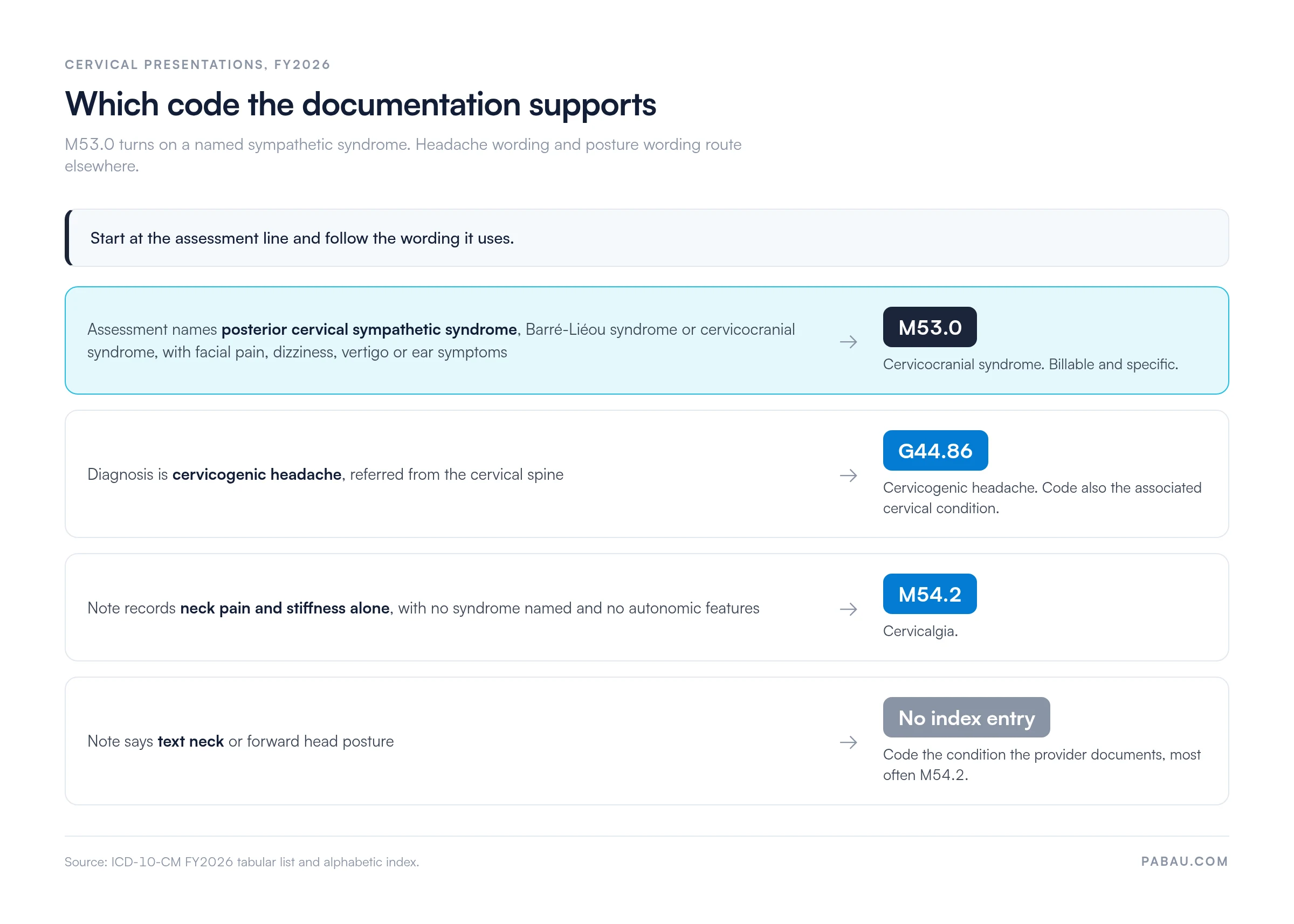
The decision that matters most is M53.0 against G44.86 and M54.2. Pick M53.0 only where the provider names the sympathetic syndrome or its eponym. Pick G44.86 where the diagnosis is cervicogenic headache, and M54.2 where the note records neck pain alone. The chart below follows each route from the assessment wording to the code.
M53.0 prints no excludes note of its own, so the binding instructions come from the block and chapter above it, plus the alphabetic index. ICD-10-CM treats each of them as a rule that governs assignment.
The chapter also carries a standing note to add an external cause code after the musculoskeletal code where the cause is known. Practices that see both cervical and headache presentations benefit from coding workflows that surface these conflicts at the point of documentation.
M53.0 is the right code when the assessment names posterior cervical sympathetic syndrome, Barré-Liéou syndrome, or cervicocranial syndrome, and the record supports that picture. The common error runs in the opposite direction: a note describing headache or posture gets coded M53.0 because the words look anatomically close.
The record should show more than neck pain. Payers reviewing M53.0 want to see the autonomic features that define the syndrome. They also want a plausible cervical cause, such as arthritic change, vertebral compression, or an earlier neck injury.
Useful entries include facial pain that crosses nerve territories and dizziness or vertigo tied to neck position. Ear pain or tinnitus without an otologic explanation counts too, as does any visual complaint. Noting what was ruled out matters just as much, because vestibular and ENT causes are the differentials a reviewer will look for.
G44.86 has been a billable ICD-10-CM code since October 1, 2021, and it sits under G44.8, other specified headache syndromes. The alphabetic index lists exactly one cervicogenic entry, under Headache, and it points to G44.86.
That code also instructs coders to report the associated cervical spinal condition where it is known. So a patient with cervicogenic headache and documented cervical spondylosis is coded G44.86 plus M47.812, not M53.0. Where the same patient separately carries a documented sympathetic syndrome, M53.0 can join them as the cervical condition.
Run a quick audit of every encounter your practice has coded M53.0 in the past year. If the assessment line reads “cervicogenic headache”, “text neck”, or “neck pain”, the claim is carrying the wrong code. G44.86 or M54.2 is almost certainly the right one. Fixing the template that feeds those assessment lines stops the pattern repeating.
Accurate documentation is the primary defense against M53.0 claim denials. Reviewers want evidence of a named syndrome with autonomic features, not a single symptom. The record should address five elements.
Structured clinical records with templated cervical assessment fields capture these five elements more consistently. When providers complete a structured encounter note, coders spend less time querying for missing detail before submission. Building that template before volumes scale is what stops the same denial repeating.
Where M53.0 appears on an inpatient claim, it groups under the cranial and peripheral nerve disorder DRGs rather than a back or neck DRG. That grouping is a useful sanity check on the code’s scope. CMS treats M53.0 as a nerve condition, which is exactly what the inclusion term describes.
Legacy 723.2 data still shows up in older records and in long-running claim histories. When migrating or auditing historic data, treat 723.2 as the same clinical entity and apply the same documentation standard.
M53.0 is not confined to a single specialty. Several disciplines encounter the syndrome, each with slightly different documentation expectations.
ICD-10 code M53.0 is accepted by Medicare and most commercial payers as a valid diagnosis code for medically necessary care. Coverage is not universal and varies by payer policy, specialty, and state-level local coverage determinations. The guidance here reflects general coding practice; verify specific payer policies before relying on M53.0 for a given plan.
Submitting M53.0 claims through a clearinghouse reduces the error rate on these pairings. Pabau’s Claim.MD integration validates each ICD-10 and CPT combination against payer rules before transmission. A pairing that fails the check comes back to the coder rather than to the payer as a denial.
Medicare’s Local Coverage Determinations govern M53.0 reimbursement for chiropractic services. Chiropractors should confirm that their MAC’s active LCDs list M53.0 as a covered diagnosis for the CPT codes they intend to pair. Commercial policies vary considerably, and some require prior authorization for therapy billed with dorsopathy diagnosis codes. The AAPC ICD-10-CM lookup is useful for reviewing crosswalk and coverage context at the payer-facing level.
Miscoding M53.0 is usually a workflow problem rather than a knowledge problem. Under time pressure, a provider writes “neck pain and dizziness” in the assessment line, and the coder is left with a symptom list. Practice management software like Pabau prompts for the syndrome name and the autonomic findings while the provider is still in the note.
Templated cervical assessment fields capture range of motion, the autonomic symptom cluster, and the differentials that were ruled out. The diagnosis field then carries a named syndrome rather than a symptom list. Downstream, Pabau’s claims management software validates the diagnosis and procedure pairing before the claim leaves the practice.

Chiropractic, physical therapy and ENT practices see these presentations regularly. For them the result is fewer coder queries and faster submission cycles, plus a documented audit trail when a payer asks for records.

Pabau’s clinical record templates and Claim.MD clearinghouse integration help practices capture the full M53.0 symptom cluster and submit clean claims automatically.

ICD-10 code M53.0 is a specific, billable FY2026 code for cervicocranial syndrome, and its single inclusion term, posterior cervical sympathetic syndrome, sets its boundaries. It reports the Barré-Liéou picture of facial pain, dizziness, vertigo and ear symptoms arising from the cervical sympathetic nerves. It does not report cervicogenic headache, which the index sends to G44.86, and it has no bearing on text neck or posture complaints.
The preventable denials on M53.0 claims come from assessment lines that name a symptom instead of the syndrome. They also come from headache diagnoses routed to the wrong chapter entirely. Building the symptom cluster into the cervical documentation template heads off both errors at the point of care. To see how Pabau’s structured records and clearinghouse integration support this, book a demo.

Getting denials on cervical diagnosis codes? Denial codes in medical billing decodes the rejection messages payers return and what each one asks you to correct.
Billing through a clearinghouse for the first time? Medical claims clearinghouse guide explains how clearinghouse submission works and what to expect from payer response cycles.
Want to understand the broader billing workflow? Revenue cycle management fundamentals covers the end-to-end process from diagnosis coding through payment posting.
Coding a less specific dorsopathy? ICD-10 code M53.9 (dorsopathy, unspecified) explains when the unspecified sibling code in this category is the correct choice.
ICD-10 code M53.0 reports cervicocranial syndrome. Its single inclusion term in the FY2026 tabular list is posterior cervical sympathetic syndrome, also called Barré-Liéou syndrome. That is a disturbance of the cervical sympathetic nerves producing facial pain, dizziness, vertigo, ear pain and tinnitus alongside neck symptoms.
Yes, M53.0 is a billable, specific ICD-10-CM code valid for fiscal year 2026. It took effect on October 1, 2025 and can be submitted for reimbursement without additional characters. The code has not been revised in any annual update since FY2016.
Cervicogenic headache is coded G44.86, not M53.0. The ICD-10-CM alphabetic index carries one cervicogenic entry, under Headache, and it points to G44.86. That code also instructs coders to report the associated cervical spinal condition when it is known, so a second code often accompanies it.
Yes. The ICD-10-CM alphabetic index lists Barré-Liéou syndrome, with the qualifier posterior cervical sympathetic, against M53.0. Documentation that names the eponym supports the code directly, provided the record also describes the symptom cluster and a cervical cause.
M53.0 reports a named sympathetic syndrome with autonomic features such as facial pain, dizziness and ear symptoms. M54.2 reports neck pain on its own, with no syndrome named in the assessment. Where the note records only neck pain and stiffness, M54.2 is the correct code.
There is no ICD-10-CM code for text neck, and neither text neck nor forward head posture appears anywhere in the alphabetic index. Coders assign whatever condition the provider documents, most often M54.2 cervicalgia. M53.0 is not a substitute, because it requires a documented posterior cervical sympathetic syndrome.
Chiropractors, physical therapists, neurologists, otolaryngologists and primary care providers all encounter this syndrome. ENT clinicians often see these patients first, referred for unexplained tinnitus or vertigo. Coverage varies by payer and specialty, so checking local coverage determinations before billing is advisable.
M53.0 is a recognized ICD-10-CM diagnosis code and may be covered by Medicare when paired with appropriate CPT codes and documented medical necessity. Coverage for chiropractic services billed with M53.0 is governed by MAC-specific Local Coverage Determinations. Confirm your MAC’s active LCD before relying on M53.0 as the primary diagnosis.