ICD-10 Code S42.444P: Medial epicondyle fracture, right humerus
ICD-10 Code S42.444P: full descriptor and code validity ICD-10 Code S42.444P car...

Last Updated: Oct 13, 2026
Billable Code Specific Code
M96.3 is the billable ICD-10-CM code for postlaminectomy kyphosis.
Let Pabau's smart automation suggest the right codes, reduce claim denials, and keep your practice compliant—effortlessly.
Automate repetitive tasks and focus on what matters most—your patients.
Reduce coding errors and ensure compliance with the latest regulations.
Clean claims, fewer denials, and faster reimbursements.
Powerful insights and reporting to help your practice thrive.
HIPAA compliant SOC 2 certified GDPR-compliant Trusted by 4,000+ clinics worldwide

ICD-10 Code M96.3 is the billable ICD-10-CM diagnosis code for postlaminectomy kyphosis, valid for FY2026 through September 30, 2026.
M96.3 sits in category M96, and the record has to tie the kyphosis to a prior laminectomy procedure.
Coders confuse M96.3 with M96.1 most often, and a kyphotic deformity on imaging is what separates the two.
Practice management software like Pabau keeps surgical history, imaging notes, and billing on one record, so M96.3 claims carry their evidence.
ICD-10 Code M96.3 is the billable ICD-10-CM diagnosis code for postlaminectomy kyphosis. It covers an abnormal forward curvature of the spine that develops after a laminectomy removes posterior support.
CMS and the National Center for Health Statistics (NCHS) maintain the code. M96.3 is valid for HIPAA-covered electronic transactions from October 1, 2025 through September 30, 2026. Assignment rests on two things in the record. There has to be a documented prior laminectomy, plus imaging evidence of the kyphotic deformity.
The table below summarizes the reference data coders need most when working with M96.3.
For the authoritative code lookup, the CDC/NCHS ICD-10-CM web tool publishes the official tabular list, updated each fiscal year.
Postlaminectomy kyphosis is an abnormal forward curvature of the spine that develops as a complication of laminectomy surgery. Laminectomy removes part of the vertebral lamina to relieve neural compression. When too much posterior support goes with it, the remaining structures can no longer hold normal alignment.
The condition most commonly affects the cervical spine, where the posterior tension band plays a critical stabilizing role. It also occurs in the lumbar region, though less frequently. Onset is usually gradual, so the deformity often surfaces months or years after an uneventful recovery.
The condition is distinct from primary kyphosis (M40.x codes) because it is iatrogenic in origin. That causal relationship to a prior surgical procedure is what mandates use of M96.3 over structural kyphosis codes.
Knowing where ICD-10 Code M96.3 sits inside the M96 block tells a coder which neighboring codes to rule out first. The full category covers intraoperative and postprocedural complications of the musculoskeletal system.
Searching by the word laminectomy returns a spread of unrelated results. The procedure code, the personal-history code, and the complication codes all surface together. Reading the whole M96 block in one place is faster, because the sibling codes are what you have to rule out.
Excludes notes for M96.3: The M96 category carries an Excludes2 note for arthropathy following intestinal bypass (M02.0-). An Excludes2 note means the excluded condition is not part of M96.3, but the two may be coded together when both are documented.
M96.3 carries no Excludes1 note of its own. That makes combination coding with pain codes such as M54.x permissible whenever both conditions appear in the record.
Clinical documentation may use several accepted synonyms that map to M96.3. Recognizing these terms helps coders capture the correct code when the physician note uses alternative phrasing.
Note that “iatrogenic kyphosis” used in a non-laminectomy context, for example after radiation. The causative procedure has to be specifically a laminectomy.
Postlaminectomy syndrome is the trap in this list. It reads like a synonym. That code describes persistent pain after spinal surgery and carries no curvature requirement at all.
Incomplete documentation is the leading cause of M96.3 claim denials. The physician record has to establish a clear causal chain from laminectomy to kyphotic deformity.
Chiropractic and rehabilitation teams often inherit these patients years after the surgery. The operative report has to travel with the record, or the causal link is lost by the time a claim goes out.
One more code belongs in the same note. ICD-10-CM has no dedicated personal-history code for laminectomy. It adds little on its own, which is why the operative report and the physician linkage statement carry the claim.
Document the Cobb angle measurement from standing radiographs in every postlaminectomy follow-up note. Payers increasingly require quantitative deformity evidence to support M96.3 rather than narrative description alone. A Cobb angle threshold of 20 degrees or greater is commonly cited in the literature as clinically significant for cervical postlaminectomy kyphosis.
Sequencing rules and combination coding decisions are where most M96.3 errors occur. Our medical coding cheat sheet covers the general sequencing logic, and the M96-specific rules are below. Practices handling high volumes of spinal surgery follow-up build these rules straight into their practice management software workflows.
The M96 family shares a postprocedural theme, and each code still describes a distinct clinical picture. The confusion that costs practices most is M96.3 against M96.1.
M96.1 carries the official descriptor postlaminectomy syndrome, not elsewhere classified. That closing phrase is the clue. It catches post-surgical pain that no more specific code already describes.
The M96.1 and M96.3 decision point: M96.1 covers the pain syndrome, where the spine may look structurally normal on imaging. M96.3 requires a demonstrable kyphotic deformity. Both codes can be reported together when the patient has persistent post-surgical pain and structural kyphosis, provided each is separately documented.
These scenarios illustrate correct M96.3 application across common clinical presentations.
A 58-year-old patient presents with progressive gait disturbance and hand clumsiness 3 years after a C3-C6 laminectomy. Standing lateral X-ray shows 28-degree cervical kyphosis. MRI confirms cord compression at the kyphotic apex. The physician documents cervical kyphosis as a complication of the multilevel laminectomy.
A 67-year-old patient returns for follow-up after a multilevel lumbar laminectomy 18 months earlier. The patient reports worsening low back pain. Imaging confirms sagittal imbalance with kyphotic angulation. The physician documents lumbar kyphosis as a consequence of the laminectomy, with coexisting axial pain.
Coders reviewing a lumbar laminectomy follow-up often reach for M96.1 here, because the headline complaint is pain. The imaging finding is what moves the claim to M96.3.
A 52-year-old patient is seen for persistent low back and leg pain following an L4-L5 laminectomy. MRI shows no significant structural deformity. The surgeon documents “failed back surgery syndrome” with no kyphotic changes on imaging.
M96.1 is the right answer here. Pain without a radiographic deformity never supports M96.3, however severe the symptoms.
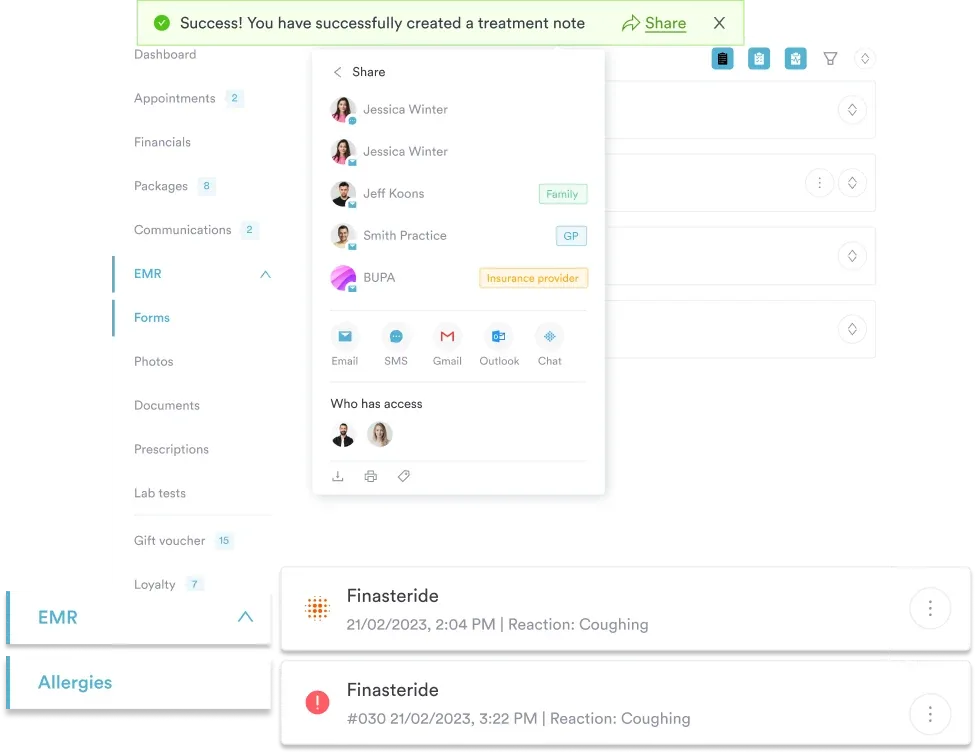
Postlaminectomy kyphosis needs documentation that survives several billing cycles. Surgical history, serial imaging reports, and visit-by-visit neurological findings all have to stay attached to one patient. Practice management software like Pabau keeps billing and clinical records in a single platform. Coders pull the prior laminectomy history and imaging dates through claims management software without hunting across separate systems. Coding sits in the middle of the revenue cycle, between registration and payment posting.

For rehabilitation teams seeing postoperative spine patients. Those are the same three elements an M96.3 claim has to evidence.
That catches the history before the first billing cycle rather than after a denial. Linking it into wider patient care management workflows also cuts the risk of M96.1 and M96.3 being mixed up across different visits.

Pabau helps orthopedic, neurosurgery, and rehabilitation practices capture the surgical history, imaging findings, and clinical notes needed to support accurate M96.3 coding. Fewer denials, faster reimbursement.

ICD-10 Code M96.3 is a straightforward billable code once the documentation is in order. The decision comes down to one question. Is there a documented kyphotic deformity caused by a prior laminectomy? If yes, M96.3 is the right code. If the complaint is pain with no deformity, M96.1 applies instead.
Holding that documentation chain together across every follow-up visit is where practices lose money. Pabau links surgical history, imaging notes, and billing into a single record, so the evidence behind M96.3 is never scattered. Book a demo to see how Pabau structures postprocedural complication documentation for spinal surgery practices.

Coding a tibial shaft fracture that stopped healing? Tibial shaft fracture nonunion code It applies once an open left tibial shaft fracture has stopped healing rather than healing slowly.
Coding a spiral tibial fracture with nonunion? Spiral tibial shaft fracture code The 7th character N marks both the open wound grade and the nonunion at once.
Coding a comminuted tibial fracture healing on track? Comminuted tibial shaft fracture code The 7th character E marks routine healing for this open right tibial shaft fracture.
Coding a traumatic thoracic spine injury instead? S23.110A covers the initial encounter, with the documentation an acute claim needs.
ICD-10 Code M96.3 is the billable ICD-10-CM diagnosis code for postlaminectomy kyphosis, an abnormal spinal curvature that develops as a complication of laminectomy surgery. It falls under the M96 category, covering intraoperative and postprocedural complications of the musculoskeletal system. The code is valid for FY2026, from October 1, 2025 through September 30, 2026.
M96.1 (postlaminectomy syndrome) covers persistent pain after laminectomy without necessarily a structural spinal deformity, commonly called failed back surgery syndrome. M96.3 (postlaminectomy kyphosis) requires radiographic evidence of a kyphotic deformity caused by the laminectomy. Both can be reported together if both conditions are separately documented.
Yes. M96.3 is a valid, billable ICD-10-CM diagnosis code valid for HIPAA-covered electronic transactions during FY2026. Confirm validity each October 1 when the new fiscal year code set takes effect, as codes can be added, revised, or deleted annually.
M96.3 covers kyphosis following laminectomy specifically. M96.2 covers postradiation kyphosis. M96.4 covers postsurgical lordosis. If the kyphosis is not caused by a procedure, use the primary kyphosis codes M40.0 and M40.2. The specific causative procedure determines which M96 subcode applies.
Diagnosis code M96.1 is postlaminectomy syndrome, not elsewhere classified: persistent pain after spinal surgery with no structural deformity to explain it. It is billable and sits in the same category as M96.3. The practical split is what the imaging shows. Kyphotic curvature on a standing radiograph points to M96.3, while pain alone with normal alignment stays at M96.1.
Failed back surgery syndrome, or FBSS, is coded to M96.1 in ICD-10-CM. There is no separate FBSS code, so the search lands back on postlaminectomy syndrome, not elsewhere classified. If imaging then shows a kyphotic deformity caused by the surgery, M96.3 is the more specific and accurate choice.
Documentation must include the operative report for the prior laminectomy. Add standing lateral imaging that confirms the kyphotic deformity, with a Cobb angle measurement. Include a physician statement linking the deformity to the surgery, plus any neurological findings caused by the kyphosis. Missing the explicit causal link between surgery and deformity is the most common reason these claims are denied.
The parent category is M96, covering intraoperative and postprocedural complications and disorders of the musculoskeletal system, not elsewhere classified. M96 sits within Chapter 13 of ICD-10-CM, diseases of the musculoskeletal system and connective tissue (M00-M99).