ICD-10 Code Y76.0: Diagnostic obstetric and gynecological devices
ICD-10 Code Y76.0: Definition and billable status ICD-10 Code Y76.0 is a valid, ...

Last Updated: Oct 23, 2026
Billable Code Specific Code
M36.2 is the billable ICD-10-CM code for hemophilic arthropathy.
Coders who treat that order as flexible, or who reach for M36.3 instead, produce avoidable denials.
The 2026 edition of ICD-10-CM became effective October 1, 2025. It is maintained jointly by the Centers for Medicare and Medicaid Services (CMS) and the National Center for Health Statistics (NCHS). M36.2 is confirmed billable in that edition, and unchanged from the prior code year.
Let Pabau's smart automation suggest the right codes, reduce claim denials, and keep your practice compliant—effortlessly.
Automate repetitive tasks and focus on what matters most—your patients.
Reduce coding errors and ensure compliance with the latest regulations.
Clean claims, fewer denials, and faster reimbursements.
Powerful insights and reporting to help your practice thrive.
HIPAA compliant SOC 2 certified GDPR-compliant Trusted by 4,000+ clinics worldwide

M36.2 is the billable ICD-10-CM code for hemophilic arthropathy, valid for the 2026 code year (effective October 1, 2025)
M36.2 carries a Code first note, so the underlying hemophilia code (D66, D67, D68.0-, or D68.1) is always sequenced ahead of it
As a manifestation code in the M36 category, M36.2 can never be the principal or first-listed diagnosis
M36.2 has no Excludes note of its own. It inherits the M36 category Excludes2 for arthropathies in diseases classified elsewhere (M14.-)
Practice management software like Pabau keeps the Code first sequence and its supporting documentation intact across every encounter
ICD-10 Code M36.2 describes hemophilic arthropathy. It is a billable and specific ICD-10-CM diagnosis code, meaning it carries sufficient clinical detail to be used directly on a claim without further specification. Coders can verify the current status using the CDC/NCHS official ICD-10-CM web tool.
The tabular list prints a single inclusion term under M36.2, and it reads hemarthrosis in hemophilic arthropathy. A joint bleed in a patient with established hemophilic arthropathy therefore belongs at M36.2. That is also why M25.0, the code for hemarthrosis, carries an Excludes1 note pointing at M36.2.
The code is not new to the 2026 edition. It has been a stable, billable code across multiple code years. Coders should confirm billable status annually against the current CMS tabular list, as status can change between code years.
Hemophilic arthropathy is a progressive joint disease caused by repeated hemarthrosis (bleeding into joints) in patients with hemophilia. Each bleeding episode triggers an inflammatory cascade that, over time, degrades cartilage, thickens synovium, and erodes subchondral bone.
Clinicians treating these patients in physical therapy and occupational therapy see a consistent pattern. It runs from chronic synovitis to loss of range of motion, and then to joint contracture.
The knee, elbow, and ankle are the joints most commonly affected, though any joint can be involved in severe hemophilia.
For documentation purposes, the clinical record should reflect the specific joint or joints affected. It should also name the hemophilia type and the evidence of the underlying coagulation disorder. This documentation underpins correct sequencing and supports medical necessity when a payer reviews the claim.
M36.2 carries a Code first note. It does not carry a Code also note, and that distinction changes how the claim is built. A Code first note dictates sequencing, so the underlying disease is always reported before M36.2. A Code also note carries no sequencing direction at all.
The note printed under M36.2 in the FY2026 tabular list names the qualifying underlying diseases:
Reporting the underlying disease is mandatory, and so is the order. Official Guideline I.A.13 sets out the etiology and manifestation convention, where the underlying condition is sequenced first and the manifestation code follows.
M36.2 sits in category M36, which covers connective tissue disorders in diseases classified elsewhere. No code in that category is ever reported as the principal or first-listed diagnosis.
The table below maps each Code first option to the clinical picture behind it.
The order does not depend on the reason for the encounter. That is the practical difference between the two conventions, since a Code also note leaves sequencing to the circumstances of the visit.
The Alphabetic Index makes the same point in shorthand, listing the hemophilia entry as D66 [M36.2]. A code in brackets is a manifestation code, and it is always sequenced second.
Incorrect sequencing is a leading cause of denials for this code pair. Practices using claims management software that validates code order at the point of entry can catch the error before submission.

Clinics managing athletic injuries often pair these codes with outcome tracking in software for sports medicine.
M36.2 has no Excludes1 or Excludes2 note of its own. The only Excludes2 note in play sits on the parent category M36, and every code in that category inherits it. It excludes arthropathies in diseases classified elsewhere (M14.-).
Two further notes name M36.2 from the outside, and both are Excludes1. Good clinical documentation practices at the point of care keep these boundaries clear.
The two note types are not interchangeable. Excludes1 means the conditions are mutually exclusive and cannot be reported together for the same encounter. Excludes2 means the excluded condition is not part of the code, but a patient may have both, so both codes are reportable when documented.
Nothing in the tabular list places an Excludes relationship between M36.2 and M36.3. They are adjacent codes in the same category, and each carries its own Code first list. M36.3 covers arthropathy in other blood disorders, and its note points to blood disorder unspecified (D75.9), other hemoglobinopathies (D58.2), and thalassemia (D56.-).
The choice between them turns on documented etiology, not on severity or on which joint is involved. Hemophilia named as the cause sends you to M36.2. Another blood disorder, such as sickle cell disease or thalassemia, sends you to M36.3. Both codes can appear on one claim when a patient genuinely has two distinct arthropathies.
Thalassemia and sickle cell disease are sometimes treated by bone marrow transplant, and a failed graft is reported separately as T86.02. That complication code carries its own documentation, so it does not replace the arthropathy code on the claim.
Provider documentation does not always use the precise ICD-10-CM language. Coders encountering any of these terms in a clinical note can map them to M36.2, provided the hemophilia connection is established in the record. The AAPC Codify ICD-10-CM lookup tool lists these synonyms alongside the code for quick reference.
Keep the official inclusion term separate from these approximate synonyms. Hemarthrosis in hemophilic arthropathy is an inclusion term at M36.2, so a joint bleed in a patient with established arthropathy is coded here.
An isolated acute bleed in a patient with no documented arthropathy is a different clinical picture. Once hemophilic arthropathy is on the record, M25.0 cannot carry the hemarthrosis, because M25.0 excludes M36.2.
M36.2 sits within the M36 category, which groups systemic disorders of connective tissue that are manifestations of diseases classified elsewhere. Reviewing the full M36 group helps coders select the correct subcategory when a patient’s arthropathy has a different systemic origin.
Neighboring categories in the same block cover other systemic connective tissue disorders. The CDC ICD-10-CM tool provides hierarchical navigation by chapter and block.
Every code in this category is a manifestation code with its own Code first note, and none of them can be first-listed. The differentiator is the systemic cause the provider documents. A neoplasm-related arthropathy goes to M36.1, and an arthropathy from a hypersensitivity reaction goes to M36.4. Clear documentation of the underlying disease is what makes the selection defensible.
Accurate documentation for ICD-10 Code M36.2 requires the clinical record to establish three things. The first is the presence of hemophilia, with the type and factor deficiency named. The second is evidence of joint disease resulting from hemarthrosis. The third is the joint or joints affected.
Three pitfalls account for most M36.2 denials. The first is reporting M36.2 with no underlying disease code, which breaks the Code first instruction outright. The second is listing M36.2 as the principal diagnosis, a position no M36 code may occupy. The third is selecting M36.3 when the record names hemophilia as the cause.
Set a pre-submission edit that rejects any claim carrying M36.2 without D66, D67, D68.0-, or D68.1 sequenced ahead of it. Most clearinghouse rules will also flag a manifestation code sitting in the first-listed position, which turns a payer denial cycle into a two-minute correction.
POA reporting applies to inpatient admissions. For ICD-10 Code M36.2, the POA indicator reflects whether hemophilic arthropathy was present at the time of admission. Because the condition is chronic and progressive, it will usually carry a POA indicator of Y.
That holds when the patient is admitted for any condition and the arthropathy is documented as a comorbidity. Coders should not default to “U” (unknown) without querying the provider if documentation is unclear.
CMS-HCC risk adjustment needs a separate check. Whether M36.2 maps to a Hierarchical Condition Category (HCC) affects a patient’s Risk Adjustment Factor (RAF) score. Model assignments are updated annually, so confirm the mapping for the applicable model year with the HCC ICD-10 Crosswalk tool before relying on it.
Practices managing patients with hemophilic conditions face a specific documentation challenge. The Code first sequence for M36.2 has to hold on every encounter, not only on the visit where the diagnosis was made. A missed D66 on a follow-up claim generates the same denial as missing it on the first submission.
Pabau is practice management software with claims management built in. It supports the ICD-10 documentation and billing workflow behind pairings like M36.2 and its underlying disease code.
Structured digital intake forms capture the factor deficiency type at intake and pull it into the clinical record. Coders then have the detail they need at the point of billing, instead of chasing provider documentation afterward. Most avoidable denials on this code trace back to eligibility verification that was never run.
The patient record management features in Pabau let practices flag chronic conditions like hemophilia at the record level. That surfaces the underlying diagnosis code during billing, so M36.2 does not go out without its Code first partner ahead of it.
Practices comparing broader practice management software features usually want the biggest billing win first. Claims management joined to structured record capture is one of the highest-impact areas of revenue cycle management. That pays off fastest on code pairs where the companion code is mandatory, as it is for M36.2.
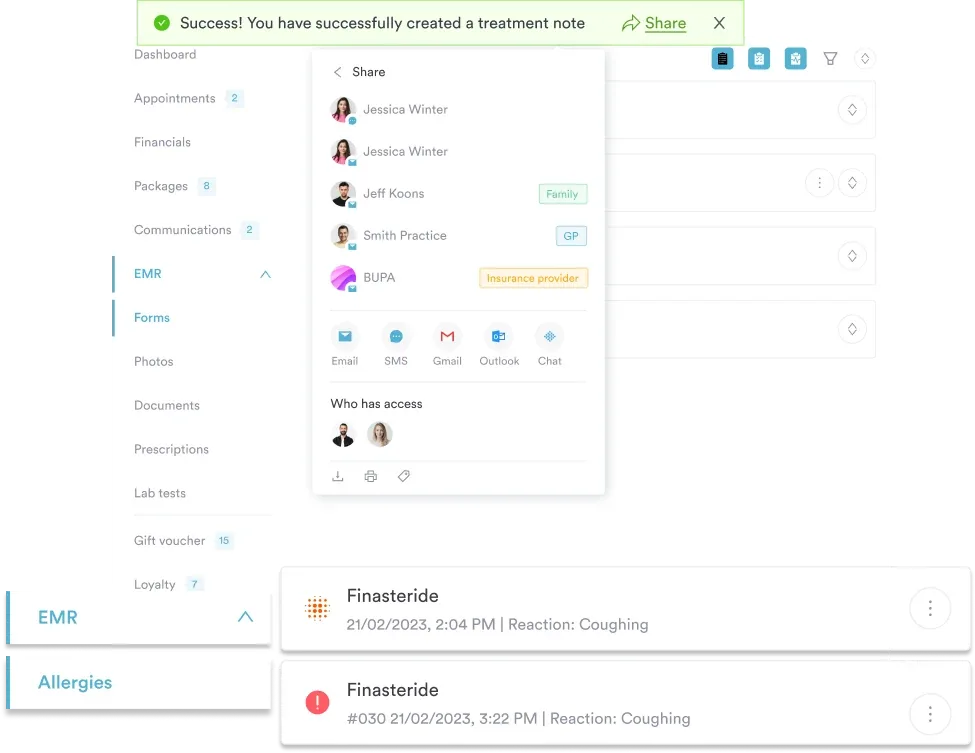

Pabau helps practices flag hemophilia at the record level, capture factor deficiency type at intake, and keep the underlying disease code ahead of M36.2. See how Pabau supports billing accuracy across complex specialty workflows.

ICD-10 Code M36.2 is a billable, specific code for hemophilic arthropathy, and it is a manifestation code. The Code first note under it makes the hemophilia diagnosis (D66, D67, D68.0-, or D68.1) a required companion, sequenced ahead of M36.2.
Submitting M36.2 on its own, or listing it first, is the most common billing error attached to this code. Either version will generate a denial in most payer edits.
Structured patient records and claims management in Pabau help practices hold that sequence on every encounter, turning a manual documentation check into a systematic one. To see how Pabau handles complex diagnostic code documentation, book a demo with the team.

Coding another chronic musculoskeletal diagnosis? ICD-10 code M45.3 walks through the documentation an ankylosing spondylitis claim needs.
Deciding between similar skeletal codes? ICD-10 code Q78.8 shows how provider wording drives the selection when several codes look close.
Coding a developmental delay before diagnosis? Developmental delay coding guide covers R62.50 and how coding too specifically before confirmation creates audit risk.
Hemophilic arthropathy is a progressive joint disease caused by repeated bleeding into joints (hemarthrosis) in patients with hemophilia. Each bleeding episode triggers inflammation and iron deposition in synovial tissue, gradually destroying cartilage and eroding bone. The knee, elbow, and ankle are the joints most commonly affected. The condition is distinct from other forms of arthropathy because the root cause is a hereditary coagulation factor deficiency, not an inflammatory or degenerative process.
ICD-10 Code M36.2 codes hemophilic arthropathy, meaning joint disease the provider has documented as caused by hemophilia. It carries a Code first note, so the underlying hemophilia code (D66, D67, D68.0-, or D68.1) is always sequenced ahead of it. M36.2 is never the principal or first-listed diagnosis. Its inclusion term also covers hemarthrosis occurring in hemophilic arthropathy.
Yes. M36.2 is a billable and specific ICD-10-CM code, valid for use on claims for the 2026 code year (effective October 1, 2025). It carries sufficient clinical specificity to be submitted without further expansion. Coders should confirm billable status annually using the CDC/NCHS ICD-10-CM tool, as status can change between code years.
M36.2 carries a Code first note, so the underlying disease code is required and is sequenced before M36.2. The tabular list names factor VIII deficiency (D66), with vascular defect (D68.0-), and factor IX deficiency (D67). It also names hemophilia classical (D66), hemophilia B (D67), and hemophilia C (D68.1). Because this is a sequencing instruction, the order is fixed and does not depend on the encounter.
M36.2 covers arthropathy caused by hemophilia (factor VIII, IX, or XI deficiency), and M36.3 covers arthropathy caused by other blood disorders. Each carries its own Code first list. M36.2 points to D66, D67, D68.0-, and D68.1. M36.3 points to blood disorder unspecified (D75.9), other hemoglobinopathies (D58.2), and thalassemia (D56.-). No Excludes note connects the two codes, and both can appear on one claim when the record supports each condition.
Yes. POA reporting applies to inpatient admissions where M36.2 appears as a secondary diagnosis. Hemophilic arthropathy is typically chronic and progressive, so the POA indicator is usually Y for present on admission. Coders should query the provider if the POA status is unclear rather than defaulting to U.