ICD-10 Code S52.101P: Right radius fracture with malunion
ICD-10 Code S52.101P: definition and code details ICD-10 Code S52.101P is a bill...

Last Updated: Oct 19, 2026
Billable Code Specific Code
M15.2 is the billable ICD-10-CM code for Bouchard's nodes (with arthropathy).
Let Pabau's smart automation suggest the right codes, reduce claim denials, and keep your practice compliant—effortlessly.
Automate repetitive tasks and focus on what matters most—your patients.
Reduce coding errors and ensure compliance with the latest regulations.
Clean claims, fewer denials, and faster reimbursements.
Powerful insights and reporting to help your practice thrive.
HIPAA compliant SOC 2 certified GDPR-compliant Trusted by 4,000+ clinics worldwide

ICD-10 Code M15.2 describes Bouchard’s nodes (with arthropathy), bony outgrowths at the proximal interphalangeal joints caused by osteoarthritis.
M15.2 is a billable/specific ICD-10-CM code valid for diagnosis reimbursement in the 2026 edition, effective October 1, 2025.
Bouchard’s nodes (M15.2) affect the PIP joints, while Heberden’s nodes (M15.1) affect the DIP joints. Coding the wrong level is a common documentation error.
Pabau’s claims management software and structured client records help practices submit accurate ICD-10-CM codes and reduce claim denials.
Bouchard’s nodes are hard bony outgrowths, or occasionally gelatinous cysts, that form at the proximal interphalangeal (PIP) joints of the fingers. They are a hallmark presentation of osteoarthritis affecting the hand, where cartilage degeneration leads to bony remodeling at the joint margins. The term “with arthropathy” in the code description signals that these nodes are clinically associated with joint dysfunction, not merely incidental findings. An itemized superbill keeps the required fields in one place: dates, codes, charges and provider identifiers.
Clinicians at chiropractic practices and musculoskeletal specialties encounter this presentation regularly. The condition typically presents in patients with generalized or polyosteoarthritis, often bilaterally, and frequently co-occurs with Heberden’s nodes at the distal interphalangeal (DIP) joints.
According to the WHO ICD-10 browser, the M15 category covers polyosteoarthritis, the subcategory addressing arthrosis affecting multiple sites simultaneously. M15.2 captures the specific clinical finding of Bouchard’s nodes when they are accompanied by joint pathology.
Multiple clinical terms map to ICD-10 Code M15.2. Coders and clinicians may encounter any of these in documentation, all pointing to the same billable code.
When chart documentation uses any of these terms, M15.2 is the correct corresponding ICD-10-CM code. The same discipline applies across the M15 family, including M15.8: match the clinician’s exact language to the most specific code available. If the documentation specifies Bouchard’s nodes without explicitly noting arthropathy, clinical context should confirm joint dysfunction before coding M15.2.
M15.2 sits within the M15 (Polyosteoarthritis) parent category, which covers osteoarthritis affecting multiple joints simultaneously. Understanding the full M15 hierarchy helps coders select the most specific subcode and avoid claim rejections.
The parent code M15 itself is not billable. Always code to the most specific subcode documented in the clinical record. Per CMS ICD-10 coding guidance, submitting the parent M15 without a subcode will result in rejection for covered entities under HIPAA electronic transaction standards.
This is where most coding errors occur. Bouchard’s nodes and Heberden’s nodes look similar on clinical exam, but they occupy different anatomical locations and carry different ICD-10-CM codes. Confusing them is one of the most common reasons for claim audits on osteoarthritis billing.
When both node types are present and documented, both codes may be assigned simultaneously. The CDC/NCHS ICD-10-CM lookup tool confirms these are separate, non-exclusive codes within the same M15 parent category. Ensure the clinical note specifies which joint level is affected before assigning either code.
When a patient presents with both Bouchard’s and Heberden’s nodes, document the affected joint level (PIP vs. DIP) explicitly in your clinical note. Assign M15.2 for the PIP presentation and M15.1 for the DIP presentation separately. This dual-coding approach reflects the full clinical picture and supports accurate reimbursement for both conditions.
Accurate coding workflows depend on matching documented clinical findings to the correct code, whether for M15.2 or a related code like M16.9. For M15.2, the guidelines are straightforward, but several nuances affect claim acceptance.
Per CMS ICD-10-CM Official Guidelines for Coding and Reporting, the code should reflect the highest degree of specificity supported by the medical record. For M15.2, this means:
Selecting the correct code. If the note only says “finger arthritis,” query the provider before defaulting to M15.2.
ICD-10 Code M15.2 does not exist in isolation. For each patient encounter, a CPT procedure code is submitted alongside the diagnosis code to justify medical necessity. The following CPT codes are frequently associated with M15.2 claims in physical therapy practice management and primary care settings.
CPT code pairings are subject to payer-specific medical necessity policies. The AAPC ICD-10-CM code lookup provides crosswalk tools to verify which CPT codes a payer accepts alongside M15.2 for your specific claim scenario. Always confirm with the payer before submitting a paired code for the first time.
Knowing what M15.2 excludes is as important as knowing what it covers. Submitting M15.2 for a condition that belongs in a different category is a common audit trigger.
The M15 category carries an ICD-10-CM exclusion note: it excludes bilateral involvement of a single joint (e.g., both knees only). Polyosteoarthritis under M15 requires multiple joint sites to be affected.
Before assigning M15.2, confirm two things in the clinical record. First, the nodes must be at the PIP joints, not the DIP joints. Second, the documentation must mention arthropathy or joint dysfunction alongside the nodular finding. If only one condition is documented without the other, query the provider or use a different code.
Diagnostic coding accuracy depends on two things for musculoskeletal and primary care practices. Clinical documentation quality at the point of care, and the billing workflow that follows, both matter. Errors in either stage flow directly into claim denials.
Pabau’s claims management software gives practices a structured pathway from clinical documentation to claim submission. Providers can attach ICD-10 codes like M15.2 directly within the client record, reducing transcription errors between the clinical note and the billing system. When the code is applied at the point of care, the margin for misassignment narrows considerably.

Supporting accurate coding is also about capturing the right clinical detail upfront. Pabau’s digital intake forms let practices build joint-specific templates that ask about symptom location and nature. This prompts clinicians to document the PIP vs. DIP distinction before the appointment begins, separating M15.2 from M15.1 early.

Practices tracking clinical documentation software requirements benefit from structured client records that keep every ICD-10 code assignment traceable to the supporting documentation. This traceability is what survives a payer audit.
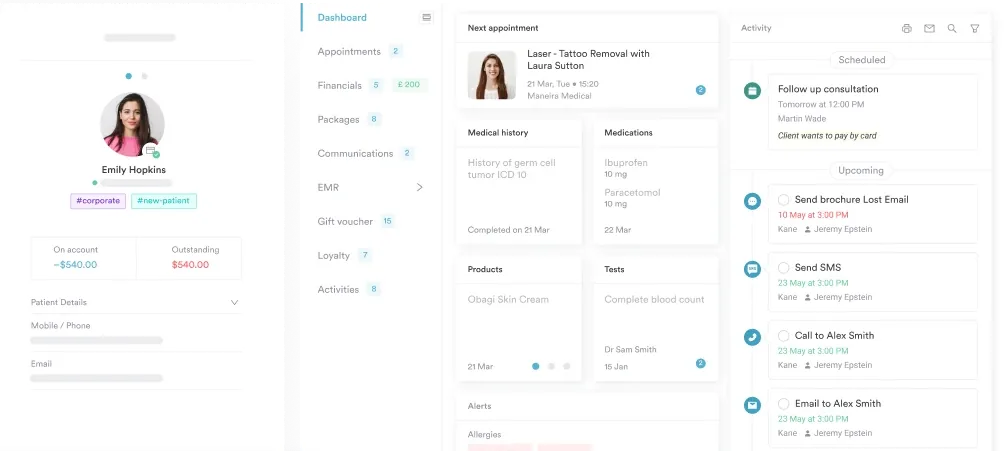
Practices using a practice management platform for billing workflows benefit from integrating diagnostic coding directly into the clinical record. This is more reliable than treating coding as a separate billing step. Pabau supports this integration natively, without requiring a separate coding interface.

Pabau’s claims management software helps musculoskeletal and primary care practices capture the right diagnostic codes at the point of care, reducing claim denials and rework.

The PIP-versus-DIP distinction is what separates a clean M15.2 claim from an audit flag. Query the provider whenever a note says “finger arthritis” without naming the joint level, rather than defaulting to the code that seems closest.
That query takes seconds at the point of care, but it’s easy to skip when documentation and billing run as separate steps. Book a demo to see how Pabau keeps ICD-10 coding tied to the clinical note that supports it.

Coding a wrist condition in an adult patient? Kienbock’s disease coding explains M93.1, the billable code for adults, which has no laterality digit.
Coding chest wall pain that is not cardiac? Tietze syndrome coding explains why costochondritis and Tietze syndrome share the same M94.0 code.
Coding a different connective tissue condition? M35.5 covers multifocal fibrosclerosis documentation and billing.
Working through a traumatic injury code instead? S41.022A covers a shoulder laceration with a retained foreign body.
Need a code for a skin condition tied to another diagnosis? L45 covers papulosquamous disorders classified elsewhere.
ICD-10 Code M15.2 is the diagnosis code for Bouchard’s nodes (with arthropathy). These are bony outgrowths or cysts at the proximal interphalangeal (PIP) joints, caused by osteoarthritis. It is a billable, specific ICD-10-CM code valid for direct claim submission in the 2026 edition, effective October 1, 2025.
Yes. M15.2 is a billable/specific ICD-10-CM code, which means it can be submitted directly for reimbursement without a more granular subcode. The parent code M15 is not billable on its own; M15.2 is the appropriate subcode when Bouchard’s nodes with arthropathy are documented.
Bouchard’s nodes (M15.2) form at the proximal interphalangeal (PIP) joints, the middle knuckles of the fingers. Heberden’s nodes (M15.1) form at the distal interphalangeal (DIP) joints, closest to the fingertip. Both are caused by osteoarthritis and can co-exist, in which case both codes may be assigned simultaneously.
The ICD-10-CM code for Heberden’s nodes (with arthropathy) is M15.1. It is the sibling code to M15.2 within the M15 (Polyosteoarthritis) parent category. M15.1 applies specifically when nodular changes are documented at the DIP joints, not the PIP joints.
CPT codes frequently paired with M15.2 include 99213 and 99214 for office visits, and 97110 for therapeutic exercise. Other common pairings are 20600 for small joint injection and 73120 for hand X-ray. Payer-specific medical necessity policies determine which pairings are accepted; always verify with the payer before submitting.
The parent code for M15.2 is M15 (Polyosteoarthritis). M15 covers osteoarthritis affecting multiple joint sites and is not billable on its own. M15.2 is one of seven billable subcodes under M15, ranging from M15.0 (primary generalized osteoarthritis) to M15.9 (polyosteoarthritis, unspecified).
No. The M15 category is for polyosteoarthritis, meaning multiple joint sites must be involved. For osteoarthritis affecting only a single finger joint, use the M19.041/M19.042/M19.049 code series for primary osteoarthritis of the hand, by side. The M15 exclusion note also specifies that bilateral involvement of a single joint type does not qualify for this category.
The 2026 edition of ICD-10-CM M15.2 became effective on October 1, 2025. This is the current active version for US diagnosis coding and reimbursement. Verify current status using the CDC/NCHS ICD-10-CM web tool for the most up-to-date edition information.