ICD-10 code S61.201A: Open wound of left index finger without nail damage
ICD-10 code S61.201A covers a left index finger wound of unstated type ICD-10 co...

Last Updated: Oct 16, 2026
Billable Code Specific Code
M04.8 is the billable ICD-10-CM code for other autoinflammatory syndromes, and it covers five named conditions. Those are Blau syndrome, deficiency of interleukin 1 receptor antagonist (DIRA), Majeed syndrome, PFAPA syndrome, and PAPA syndrome.
The code sits in Chapter 13 and shares category M04 with only three siblings, M04.1, M04.2 and M04.9. Coders trip on that structure, because M04.3 and M04.4 have never existed. Assignment turns on a documented systemic autoinflammatory disorder that falls outside the periodic fever syndromes at M04.1 and the cryopyrin-associated syndromes at M04.2. That single routing decision is where most M04.8 billing errors start.
Let Pabau's smart automation suggest the right codes, reduce claim denials, and keep your practice compliant—effortlessly.
Automate repetitive tasks and focus on what matters most—your patients.
Reduce coding errors and ensure compliance with the latest regulations.
Clean claims, fewer denials, and faster reimbursements.
Powerful insights and reporting to help your practice thrive.
HIPAA compliant SOC 2 certified GDPR-compliant Trusted by 4,000+ clinics worldwide

M04.8 is the billable ICD-10-CM code for other autoinflammatory syndromes, valid for FY2026 from October 1, 2025
Five conditions are named under M04.8: Blau syndrome, DIRA, Majeed syndrome, PFAPA syndrome and PAPA syndrome
Category M04 holds only four codes, M04.1, M04.2, M04.8 and M04.9. There is no M04.3 and no M04.4
TRAPS, hyperimmunoglobulin D syndrome, mevalonate kinase deficiency and familial Mediterranean fever all route to M04.1
M04 carries an Excludes2 note for Crohn’s disease (K50.-), so M04.8 and a K50 code can be reported together
ICD-10 code M04.8 is the billable ICD-10-CM code for other autoinflammatory syndromes. It is one of four active codes in category M04, and it carries five named conditions of its own.
Per the CDC/NCHS ICD-10-CM web tool, M04.8 is both billable and specific. That means it can stand alone as the primary diagnosis on a professional claim, with no further characters needed.
The CMS ICD-10 codes page confirms that the FY2026 update files carry M04.8 with no change to its description or billable status. Still, re-check the M04 block each October. A new subcategory would narrow what this residual “other” code is allowed to absorb.
M04.8 covers five named autoinflammatory conditions, and ICD-10-CM lists them directly under the code. They are Blau syndrome, deficiency of interleukin 1 receptor antagonist (DIRA), Majeed syndrome, PFAPA syndrome, and PAPA syndrome.
None of them is a leftover. Each is a recognized syndrome that the tabular list files here rather than giving it a code of its own.
Autoinflammatory syndromes are disorders of the innate immune system. They produce recurring episodes of systemic inflammation, fever, serositis, and organ-specific findings. What they lack is the autoantibody or antigen-specific T-cell response that marks autoimmune disease.
Documentation for M04.8 has to reflect that innate-immune picture, because autoimmune arthropathies are classified elsewhere in ICD-10-CM.
Two further groups land on M04.8 in practice. The first is an undifferentiated systemic autoinflammatory disease, where the phenotype is documented but genetic testing has not named a syndrome.
The second is a newly described entity with no code of its own yet. Both still need the physician to state an autoinflammatory diagnosis in the record.
Watch the routing in the other direction too. Familial Mediterranean fever, hyperimmunoglobulin D syndrome, mevalonate kinase deficiency, and TRAPS are all inclusion terms under M04.1. None of them belongs on M04.8, and the cryopyrin-associated syndromes go to M04.2.
The tabular list attaches instructional notes at two levels here. M04.8 carries its own inclusion terms. The Excludes2 note sits one level up at the M04 category, so it applies to M04.8 as well.
An inclusion term is a diagnosis the code set has already routed for you. When the physician documents one of the five terms below, M04.8 is the correct assignment. No physician query is needed to justify the choice.
Category M04 carries a single Excludes2 note, for Crohn’s disease (K50.-). An Excludes2 note means the excluded condition is not part of what M04 represents, though a patient can have both. When the record documents Crohn’s disease alongside a separate autoinflammatory syndrome, report both codes on the claim.
That distinction matters at the claim edit level. An Excludes1 note would block the pairing outright and generate a rejection. M04’s note is an Excludes2, so a claim carrying M04.8 and a K50 code together is valid. Both diagnoses just have to be documented separately.
Records rarely use the tabular list’s exact wording. The table below maps phrases that turn up in referral letters, rheumatology notes, and discharge summaries to the coding decision each one should trigger.
Be careful with “periodic fever” on its own. The AAPC listing for M04.1 shows that the phrase maps to the periodic fever syndromes code, not to M04.8. PFAPA is the one periodic fever picture that does belong on M04.8, and only because the tabular list names it there.
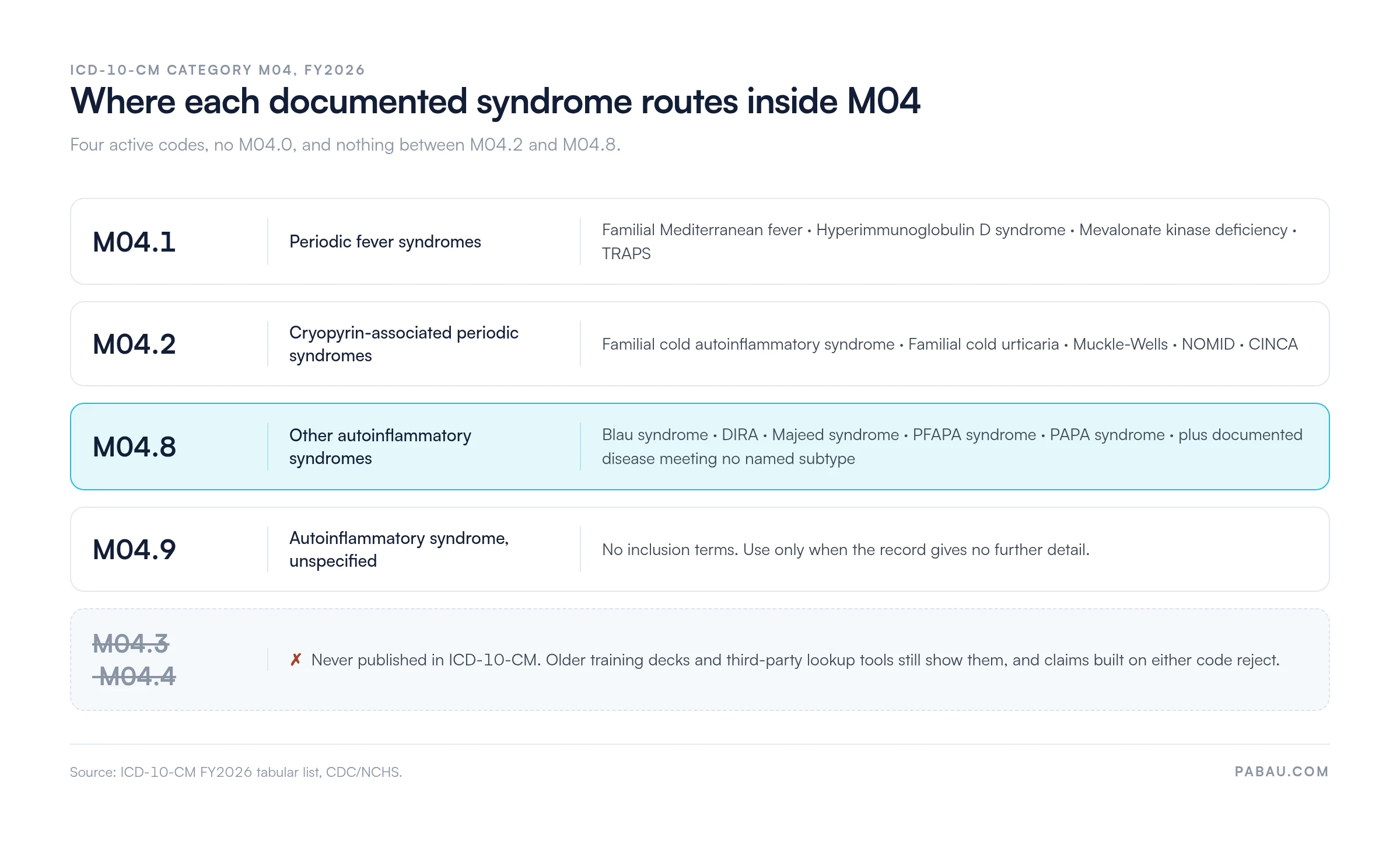
M04.8 is one of four active codes in the M04 category. The block is smaller than coders often assume. There is no M04.0, and the numbering jumps straight from M04.2 to M04.8. The table below shows the full FY2026 sibling set.
The hierarchy follows standard ICD-10-CM convention. A documented syndrome that appears as an inclusion term goes to the code that names it. A documented autoinflammatory disease with no named subtype goes to M04.8.
Only a bare “autoinflammatory syndrome” with no further detail goes to M04.9, and a physician query is usually worth raising first. The chart below puts the whole routing decision on one page.
Accurate coding of M04.8 rests on the treating physician’s documentation, and a coder cannot supply the clinical judgment. The ICD-10-CM Official Guidelines for Coding and Reporting, maintained by CMS and the NCHS, require diagnosis codes to reflect a confirmed diagnosis.
For M04.8, that means a named inclusion term in the record. Failing that, it means an explicit statement of a systemic autoinflammatory syndrome outside M04.1 and M04.2.
Payer coverage attached to an M04.8 diagnosis varies widely. Some commercial plans apply medical necessity criteria that call for genetic testing results or a documented specialist evaluation before they authorize treatment. Verify the individual payer’s policy rather than assuming coverage.
Run the record against this list before the claim leaves the practice. Each item below is something a payer can ask to see.
Those elements belong in the chart before the claim goes out, not after a payer asks for them. A clean claim on M04.8 follows the same rule as any other diagnosis. The code has to be billable, the documentation has to support it, and the claim has to match the record.
Run a physician query before coding M04.8 on any record whose only diagnostic language is ‘periodic fever,’ ‘recurrent fever,’ or ‘systemic inflammation.’ None of those phrases confirms an autoinflammatory syndrome. ‘Periodic fever’ in particular points to M04.1, and an unconfirmed presentation may belong on a symptom code such as R50.9 until the diagnosis is established.
Rheumatology and pediatric practices coding autoinflammatory syndromes need a repeatable sequence. The five steps below follow an M04.8 claim from the note to submission.
Here is how that runs in a typical pediatric case. A six-year-old presents with monthly fevers, aphthous ulcers, and pharyngitis, and the rheumatologist documents PFAPA syndrome. Step two ends the decision, because PFAPA is a named inclusion term under M04.8. No query, no genetic result, and no trip through M04.9 is needed.
M04.8 is a diagnosis code, so it never appears alone on a professional claim. It supports the procedure and drug codes reported for the encounter. The table below lists the codes that most often accompany an autoinflammatory syndrome visit.
One caveat is worth flagging to the billing team. Most labeled indications for the IL-1 inhibitors sit with the syndromes coded at M04.1 and M04.2. Rilonacept (J2793) is the exception, because its FDA-approved labeling names DIRA, which is an M04.8 condition.
Outside that indication, a payer reviewing a drug claim carried by M04.8 will often ask for the clinical rationale. Expect a prior authorization request, and have the specialist’s note ready before the drug is given.
Most M04.8 problems trace back to the same handful of habits. Build each one below into a pre-submission check.
M04.8 has held the same descriptor and billable status since the M04 category was created for FY2017. The table below summarizes the code’s history.
The category has been stable since then, which is part of why the four-code structure is worth memorizing. Practices should still review the ICD-10-CM update files each October. If a new subcategory is ever added to M04, conditions currently sitting on M04.8 would move. A static code list would keep sending the old code.
Audit your EHR’s saved favorites list for M04.3 and M04.4. Neither code exists in ICD-10-CM. Both still appear in older training material and in some third-party lookup tools, which is how they end up saved as shortcuts. Replace them with M04.1, which is where the tabular list puts TRAPS and hyperimmunoglobulin D syndrome.
M04.8 is billable, so it can be reported as a primary or secondary diagnosis on a professional claim. Payer coverage policies still vary a great deal. Some commercial plans use the M04.8 diagnosis itself as the trigger for prior authorization on specialist visits, infusion therapy, or biologic agents.
The claim itself travels through a clearinghouse, which checks that the required fields are complete before it reaches the payer. Then read the electronic remittance advice closely. The denial codes that turn up on M04.8 usually sit in the “diagnosis not covered” and “medical necessity” families.
Practices with recurring M04.8 claims benefit from tracking those denials by reason code. Rare disease codes attract more scrutiny than routine ones. A pattern by payer is much easier to fix than a run of one-off appeals.
Most M04.8 errors start outside the chart. A coder opens a reference site in a second tab, and the list there may include subcategories ICD-10-CM never published. The result then gets typed into the claim by hand.
The syndrome names in category M04 are long, the block is small, and one mis-typed digit produces a code that does not exist. Practice management software like Pabau closes that loop by keeping the code search inside the clinical record.
Staff search the ICD-10-CM catalog from within the encounter and attach M04.8 to the note it belongs to. The code then carries through to the claim. Because Pabau’s claims management software keeps its lookup libraries refreshed against the official releases, an entry such as M04.3 has nowhere to enter the workflow.
Claims then go out through Claim.MD, Pabau’s US clearinghouse partner, which tracks claim status and posts remittance back into the same system. Denial handling happens against the original documentation rather than a spreadsheet.
For a practice running a handful of autoinflammatory patients, that means fewer rejections on codes nobody bills often enough to memorize.

Pabau puts a refreshed ICD-10-CM code library inside the clinical record, so staff search, select, and attach M04.8 without leaving the platform. Claims then go out through the Claim.MD clearinghouse, with status and remittance tracked in the same system.

The whole M04.8 decision comes down to two questions. Does the record name one of the five syndromes listed under the code? If not, does it state an autoinflammatory disease that M04.1 and M04.2 do not cover? Answer both and the code is settled.
The trade-off worth remembering is what M04.9 costs you. Reaching for the unspecified code feels safe, but it hands a payer a reason to review a rare disease claim. M04.8 is the stronger position once the record identifies the condition as autoinflammatory.
Keeping the lookup inside the patient record is what stops M04.3 reappearing in a claim two years from now. Book a demo to see how Pabau handles ICD-10 code selection and claim submission for a rheumatology caseload.

Coding the periodic fever syndromes instead? ICD-10 code M04.1 covers the FMF, HIDS and TRAPS routing in full.
Stuck with an unspecified autoinflammatory diagnosis? ICD-10 code M04.9 sets out when the unspecified code is the right call.
Wondering where Behçet’s disease is classified? ICD-10 code M35.2 explains the code that takes it, outside category M04.
Need to know how the claim reaches the payer? Medical claims clearinghouse guide explains how clearinghouses process ICD-10-coded professional claims.
Chasing a rejection on a rare diagnosis code? Denial codes in medical billing maps the common payer rejection codes and how to respond.
No. M04.8 is complete at four characters and needs no fifth character or seventh character. The code set treats it as both billable and specific, so it stands on a claim exactly as written.
No. Adult-onset Still’s disease has its own code, M06.1, in the inflammatory polyarthropathies block. It is autoinflammatory in character, but ICD-10-CM classifies it outside category M04, so M04.8 would be wrong.
Behçet’s disease is coded to M35.2, under other systemic involvement of connective tissue. Coders reach for M04.8 because the disease is autoinflammatory, yet the tabular list puts it in a different block entirely.
The tabular list does not block it, because M04 carries no Excludes1 note between its own codes. One patient rarely carries two named autoinflammatory syndromes, so expect a payer to ask what the record shows.
Only when it names a syndrome that carries a different code. A positive result for a syndrome listed at M04.1 or M04.2 moves the claim there. An inconclusive or negative result leaves M04.8 in place, provided the physician still documents an autoinflammatory syndrome.