ICD-10 code S61.201A: Open wound of left index finger without nail damage
ICD-10 code S61.201A covers a left index finger wound of unstated type ICD-10 co...

Last Updated: Oct 16, 2026
Billable Code Specific Code
L50.3 is the billable ICD-10-CM code for dermatographic urticaria. It applies when the record documents a confirmed mechanical trigger: scratching, stroking, or pressure that reproducibly raises a linear wheal.
That documented trigger separates L50.3 from allergic urticaria (L50.0), idiopathic urticaria (L50.1), and the unspecified default L50.9. The FY2026 edition took effect on October 1, 2025 with no changes from the prior year.
Let Pabau's smart automation suggest the right codes, reduce claim denials, and keep your practice compliant—effortlessly.
Automate repetitive tasks and focus on what matters most—your patients.
Reduce coding errors and ensure compliance with the latest regulations.
Clean claims, fewer denials, and faster reimbursements.
Powerful insights and reporting to help your practice thrive.
HIPAA compliant SOC 2 certified GDPR-compliant Trusted by 4,000+ clinics worldwide

ICD-10 Code L50.3 is the billable diagnosis code for dermatographic urticaria (dermographism), a physically triggered subtype of hives distinct from allergic or idiopathic urticaria.
L50.3 sits under parent code L50 (urticaria) within the L49-L54 block and chapter L00-L99 (diseases of the skin and subcutaneous tissue).
Documentation must confirm a mechanical trigger and a reproducible wheal response; defaulting to L50.9 when dermographism is confirmed is a coding error.
Pabau’s claims management software supports accurate ICD-10 code submission and integrates with Claim.MD for electronic claim validation across 4,000+ US payers.
ICD-10 Code L50.3 is a billable, specific ICD-10-CM diagnosis code representing dermatographic urticaria, effective October 1, 2025 (FY2026). It is valid for use on claims submitted for dates of service from October 1, 2025 through September 30, 2026. Assignment turns on a single documented finding. A mechanical stimulus must reproducibly raise a linear wheal on the skin.
The code is maintained by CMS and the National Center for Health Statistics (NCHS) as part of the ICD-10-CM annual update cycle. Dermatology and allergy clinicians reach for it when a patient presents with reproducible mechanical skin hypersensitivity.
Dermatographic urticaria is a physical urticaria subtype in which light mechanical stimulation of the skin triggers a localized wheal-and-flare response. The reaction typically appears within 2 to 5 minutes of scratching or stroking and resolves spontaneously within 30 minutes to 2 hours.
Clinically, the condition is confirmed by dermographometry. The examiner strokes the forearm with a blunt instrument and watches for a raised, linear wheal tracing the path of the stimulus. That reproducibility is what separates L50.3 from non-specific hives, where no consistent physical trigger appears on examination. Documenting the provocation result is what makes an L50.3 assignment defensible later.
L50.3 sits at the fourth level of the ICD-10-CM hierarchy. Understanding the parent structure helps coders navigate between specificity levels and avoid selecting a non-billable parent code.
L50 (urticaria) is a non-billable category code. Claims submitted with only “L50” will be rejected for insufficient specificity. Coders must always reach the fourth-character subcategory level. The CDC/NCHS ICD-10-CM web tool provides the official annual tabular list where these hierarchy relationships are confirmed.
The ICD-10-CM Alphabetic Index lists several terms that map to L50.3. Coders searching by condition name rather than code number should recognize all of these as equivalent entry points.
“Factitious urticaria” is the one to watch. It appears in older clinical notes and legacy dictation systems, and it describes the same mechanically induced wheal response. Coding teams working with transcribed records should map the term straight to L50.3 rather than defaulting to L50.9.
The L50 category contains nine billable subcodes covering distinct urticaria subtypes. Selecting the correct code depends on identifying the specific trigger documented in the clinical record.
The full L50 family is searchable via the AAPC Codify ICD-10-CM lookup. Practices treating urticaria across several subtypes need patient records that capture the specific trigger at every encounter. Without that field in the record, a coder has only the clinician’s free text to work from.
Physical urticaria codes share a structural pattern. They all describe reactions induced by a defined external stimulus rather than an immune-mediated or idiopathic mechanism. The differences lie in the specific stimulus type, and that distinction drives code selection.
Cholinergic urticaria (L50.5) is the code most commonly confused with L50.3 in documentation reviews. Both present with hives after activity. Cholinergic urticaria produces small, pinpoint wheals triggered by sweating rather than a localized mechanical response. A clinician who documents “hives after exercise and scratching” without naming the dominant mechanism should be queried before coding is finalized.
Practices transitioning legacy records or reconciling historical claims need the ICD-9-CM predecessor for dermatographic urticaria.
The mapping is one-to-one. ICD-9-CM 708.3 converts directly to ICD-10-CM L50.3 with no ambiguity. Verify every crosswalk mapping against the official CMS General Equivalence Mapping (GEM) files before applying it to production claims.
Dermatographic urticaria requires specific clinical evidence in the record to support the code assignment. Payers auditing dermatology claims look for the elements below. Missing any one of them can turn an L50.3 claim into a query or a denial.
Paper intake forms rarely carry a field for a provocation test result, so the outcome ends up in free text or nowhere at all. A digital record with a dedicated field keeps that evidence attached to the encounter it belongs to. Audit defensibility across the whole L50 family improves for the same reason.
Run a dermographometry test at the first presentation and document the wheal threshold and onset time in the encounter note. That single entry is the strongest audit anchor for L50.3. It also settles the most common reason dermatology claims are queried, which is the absence of objective evidence for the mechanical trigger.
L50.3 attracts a narrow set of coding errors, and they surface consistently in dermatology billing audits. Each one below traces back to a step the practice can change. The chart shows where each documented trigger lands inside the L50 category.
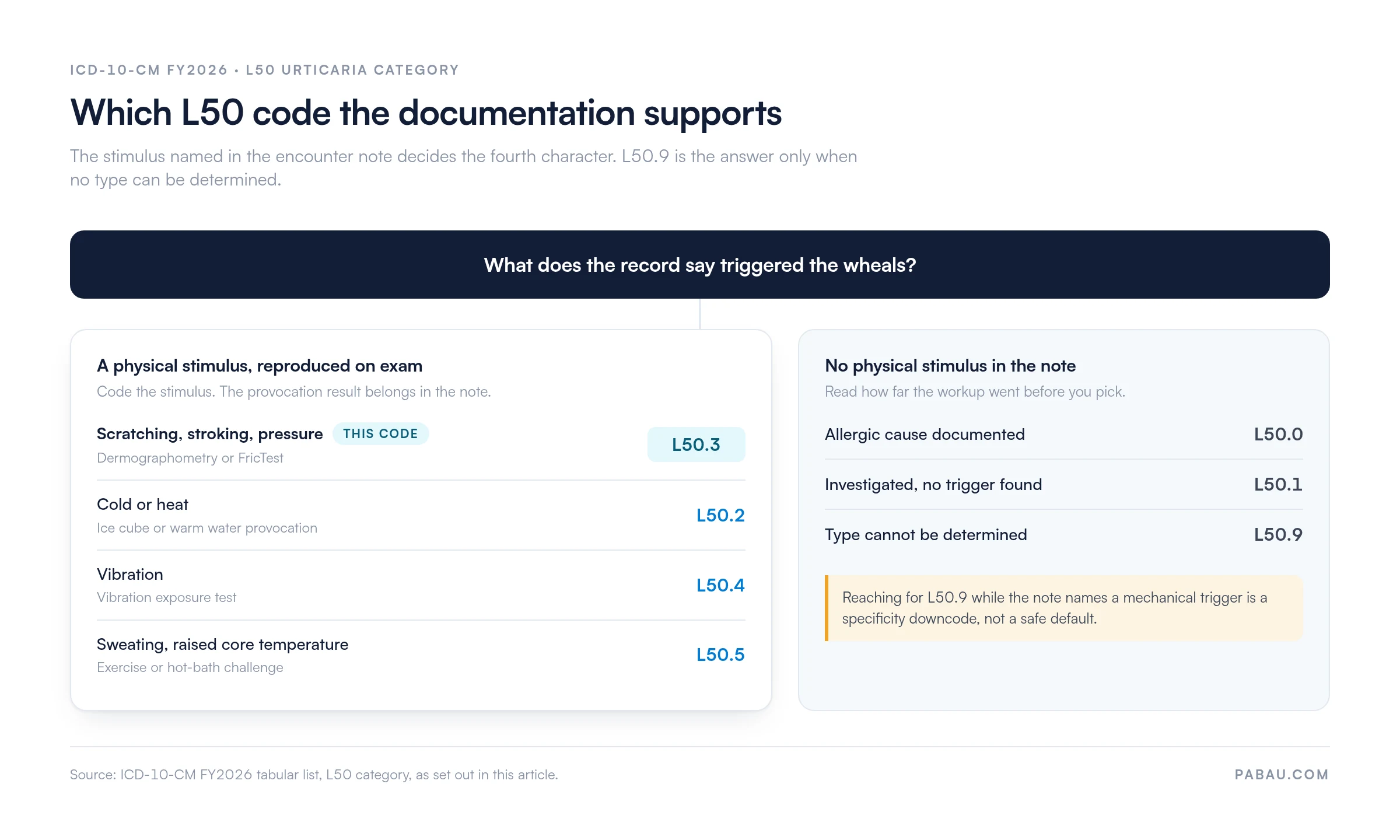
The most frequent error is assigning urticaria, unspecified (L50.9) to a patient whose record documents a mechanical trigger. L50.9 is a valid code only when the urticaria type cannot be determined from available documentation.
Once a clinician has written “hives from scratching” or “skin writing,” the record supports L50.3, and L50.9 becomes a specificity downcode. Many EHRs default to L50.9 in their urticaria pick-list. Coders need to override that default whenever the documentation is specific.
L50.1 (idiopathic urticaria) applies when no trigger is identified despite clinical investigation. Dermographism has a confirmed, reproducible trigger by definition. If the clinician has performed and documented a positive provocation test, L50.1 is wrong.
Payers running medical necessity edits for antihistamine therapy may scrutinize L50.1 claims differently from L50.3 claims, particularly in chronic presentations. When the code and the note disagree, the claim comes back with one of the standard denial codes and has to be reworked.
A diagnosis of dermatographic urticaria can appear in the assessment with no provocation test anywhere in the examination section. The ICD-10-CM Official Guidelines for Coding and Reporting require that codes reflect what is clinically documented.
With no provocation test in the record, a coder cannot show the diagnosis is L50.3 rather than L50.9. Encourage clinicians to add a one-line provocation test result even when the outcome is obvious to them.
Add ICD-10 Code L50.3 to your dermatology encounter pick-list alongside L50.0, L50.5, and L50.9. When the EHR defaults urticaria encounters to L50.9, a curated pick-list surfaces L50.3 next to the documentation prompt. That cuts coding time and prevents inadvertent specificity downcoding.
The ICD-10-CM tabular list does not include specific Excludes1 or Excludes2 notes at the L50.3 level. Relevant exclusions operate at the category (L50) level.
Excludes1 notes carry weight in medical billing compliance. Reporting a condition named in an Excludes1 note alongside the primary code, on the same claim, may trigger an automatic rejection. Review the full tabular exclusions at the L50 category level before assigning additional skin codes for the same encounter.
L50.3 is a diagnosis-only code. It has to be paired with a procedure code (CPT or HCPCS) describing the service rendered. For most dermographism encounters that is an evaluation and management code for a dermatology office visit, 99202 to 99215 depending on complexity.
Tracking is the other half of the job. A claim carrying L50.3 should be traceable from the encounter note through the 837P file to the remittance advice that closes it. When a denial does arrive, the provocation test result needs to be one click away rather than in a scanned folder.
Most dermatology practices split this work across three places. The provocation test result sits in a scanned form. The diagnosis code comes from an EHR pick-list that defaults to L50.9. The claim is then keyed into a separate billing portal, and nobody sees the mismatch until the remittance arrives.
Pabau is practice management software that keeps the encounter, the diagnosis code and the claim on one patient record. Custom clinical forms give the provocation test its own field, so the evidence for L50.3 is captured during the exam rather than reconstructed months later. The Claim.MD integration then validates the diagnosis and procedure pair before the 837P file leaves the practice, and that file reaches 4,000+ US payers electronically.
The outcome is a shorter path from exam to payment. Running claims software for dermatology against the same record the clinician wrote in cuts specificity queries and reworked claims. Electronic remittance advice posts each payer response straight against the encounter, so the loop closes without a spreadsheet.


Pabau integrates with Claim.MD to validate ICD-10 codes and submit clean claims to 4,000+ US payers. See how it works for a dermatology practice.

Dermographism is one of the few urticaria subtypes a clinician can prove at the bedside in under five minutes. That makes L50.9 hard to defend once the note names a mechanical trigger. The decision gets made in the exam room rather than in the billing queue.
So the change worth making is a small one. Give the provocation test its own field, fill it during the exam, and the specific code follows on its own. Practices that skip it keep the convenience of a vague code and pay for it in queries and reworked claims. Book a demo to see how Pabau ties dermatology documentation to the claim that depends on it.

Coding another physical urticaria subtype? ICD-10 Code L50.4 covers vibratory urticaria, which carries the same demand for a confirmed stimulus in the note.
Want the dermatology claim to pass on the first try? What makes a clean claim sets out the checks that keep a submission from bouncing back.
Mapping where a diagnosis code sits in the wider revenue cycle? Revenue cycle management explains how diagnosis codes, procedure codes and electronic submission work together to reduce denials.
ICD-10 Code L50.3 is the billable ICD-10-CM diagnosis code for dermatographic urticaria. That is a physical urticaria subtype in which mechanical skin stimulation, such as scratching or pressure, produces a localized wheal-and-flare response. It is valid for FY2026 claims with a service date from October 1, 2025 onward.
Yes, L50.3 is a billable, specific ICD-10-CM code and is valid for use on HIPAA-covered transactions. Its parent code L50 (urticaria) is non-billable, so claims must carry the full four-character subcategory code.
Dermographism is a condition where lightly stroking or scratching the skin causes a raised, linear wheal at the exact site of contact. It is coded with ICD-10 Code L50.3. The ICD-10-CM Alphabetic Index maps the term “dermographism” directly to L50.3.
L50.3 is used when the record documents a confirmed mechanical trigger for urticaria. L50.9 (urticaria, unspecified) applies only when the urticaria type cannot be determined from available documentation. Using L50.9 where dermographism is confirmed is a specificity downcode and may attract payer scrutiny in an audit.
The L50 category contains L50.0 (allergic), L50.1 (idiopathic), L50.2 (cold and heat), L50.3 (dermatographic) and L50.4 (vibratory). It also contains L50.5 (cholinergic), L50.6 (contact), L50.8 (other) and L50.9 (unspecified). All are billable at the subcategory level, while parent code L50 alone is non-billable.
The ICD-9-CM predecessor for L50.3 is code 708.3 (dermatographic urticaria). The mapping is one-to-one with no ambiguity. Verify the crosswalk against official CMS GEM files before applying it to production claims.