ICD-10 Code S42.444P: Medial epicondyle fracture, right humerus
ICD-10 Code S42.444P: full descriptor and code validity ICD-10 Code S42.444P car...

Last Updated: Oct 13, 2026
Billable Code Specific Code
K73.8 is the billable ICD-10-CM code for other chronic hepatitis, not elsewhere classified.
Let Pabau's smart automation suggest the right codes, reduce claim denials, and keep your practice compliant—effortlessly.
Automate repetitive tasks and focus on what matters most—your patients.
Reduce coding errors and ensure compliance with the latest regulations.
Clean claims, fewer denials, and faster reimbursements.
Powerful insights and reporting to help your practice thrive.
HIPAA compliant SOC 2 certified GDPR-compliant Trusted by 4,000+ clinics worldwide

ICD-10 Code K73.8 identifies other chronic hepatitis, not elsewhere classified – a billable, specific code effective for FY2026 (October 1, 2025).
K73.8 carries five Excludes1 restrictions – chronic alcoholic hepatitis (K70.1-), chronic drug-induced hepatitis (K71.-), chronic reactive/granulomatous hepatitis (K75.2-K75.3), and chronic viral hepatitis (B15-B19) – none of which can be coded alongside it.
When autoimmune hepatitis is confirmed in documentation, K75.4 is the preferred code over K73.8 due to greater specificity.
Pabau’s claims management software runs pre-submission validation checks, catching missing claim details like membership numbers or authorization codes before a claim goes out.
K73.8 is a billable, specific ICD-10-CM code. It can be used directly on a claim to indicate a diagnosis for reimbursement purposes – no additional subclassification is needed. The AAPC ICD-10-CM code reference and icd10data.com both confirm its billable status. Coding names the service; medical billing gets it submitted, adjudicated and paid.
The 2026 edition of ICD-10-CM Code K73.8 became effective on October 1, 2025, as part of the standard CMS annual update cycle.
The qualifier “other” in K73.8 does specific work in ICD-10-CM. It signals that the condition is chronic hepatitis that does not fit any of the more precisely defined subcategories within K73 – and that a viral etiology (hepatitis B or C) has been ruled out or is not documented.
Clinically, K73.8 covers chronic liver inflammation of six or more months’ duration where documentation identifies hepatitis but cannot assign it to a named subtype. Conditions this code may cover include cryptogenic chronic hepatitis and seronegative or atypical autoimmune hepatitis, when confirmed autoimmune hepatitis (K75.4) does not apply.
Drug-induced chronic hepatitis is not one of these “other” presentations. It carries an Excludes1 note under K73 and must be coded under K71.- (toxic liver disease), never K73.8.
K73.8 carries five Excludes1 notes at the K73 category level, which means none of these conditions can be coded at the same encounter as K73.8 – they are mutually exclusive by definition. According to the CMS ICD-10 codes page, Excludes1 instructions indicate that the excluded code represents the same condition and should never be used with the parent code.
The practical consequence: if a patient’s chart confirms alcoholic etiology, drug- or toxin-induced etiology, a reactive or granulomatous histologic pattern, or a positive viral hepatitis result (hepatitis B surface antigen or hepatitis C RNA), you cannot use K73.8. The corresponding excluded code takes over completely.
Submitting K73.8 when one of these five excluded conditions applies is a claim accuracy violation and a common audit target. Drug-induced chronic hepatitis is a particularly frequent misclassification – it must be coded under K71.- (toxic liver disease), never K73.8.
The K73 category contains four subcodes. Choosing incorrectly among them is the most common error in chronic hepatitis coding. The distinction between K73.8 (other/NEC) and K73.9 (unspecified) trips up even experienced coders. This table, drawn from the CDC/NCHS ICD-10-CM web tool, maps the full category:
K73.8 vs. K73.9 – the critical distinction: K73.8 applies when the provider documents a specific characterization of the hepatitis (such as “cryptogenic chronic hepatitis” or “seronegative autoimmune hepatitis”) but that characterization does not match K73.0, K73.1, or K73.2 patterns precisely.
K73.9 applies when documentation simply says “chronic hepatitis” with no further detail. Using K73.9 when K73.8 is supportable in the record is an undercoding error.
Review biopsy reports before assigning any K73 subcode. The histologic pattern – portal-only inflammation (K73.0), lobular necrosis (K73.1), or interface hepatitis (K73.2) – drives the selection. If the biopsy report does not match any of those patterns but confirms chronic hepatitis, and viral labs are negative, K73.8 is the right pick.
The single most consequential coding decision for chronic hepatitis is whether the etiology is viral. The B18.x series (chronic viral hepatitis) carries an Excludes1 instruction against K73.8, so the two groups are mutually exclusive by definition. Here is how the logic flows at the encounter level:
The WHO ICD-10 browser makes this hierarchy clear: B18.x codes sit in the infectious disease chapter (B00-B99), completely separate from the digestive diseases chapter (K00-K93) where K73.8 lives. The underlying etiology determines the chapter, not the clinical presentation alone.
Payers reviewing K73.8 claims look for documentation that justifies both the “chronic” qualifier and the “other” designation. Missing either element leaves the claim vulnerable to downcoding or denial. A coding error surfaces as a cash flow problem weeks later, which is why the healthcare revenue cycle is measured end to end.
That holds whether the workup started in a GP practice or a functional medicine practice running the metabolic panel – the provider note needs to carry all four elements listed below before coding.
Facilities using electronic client records can structure templates around these four elements so providers capture the necessary detail at the point of care. Chasing documentation post-encounter for HIPAA-compliant clinical documentation purposes is far more time-consuming than building it into the intake workflow.
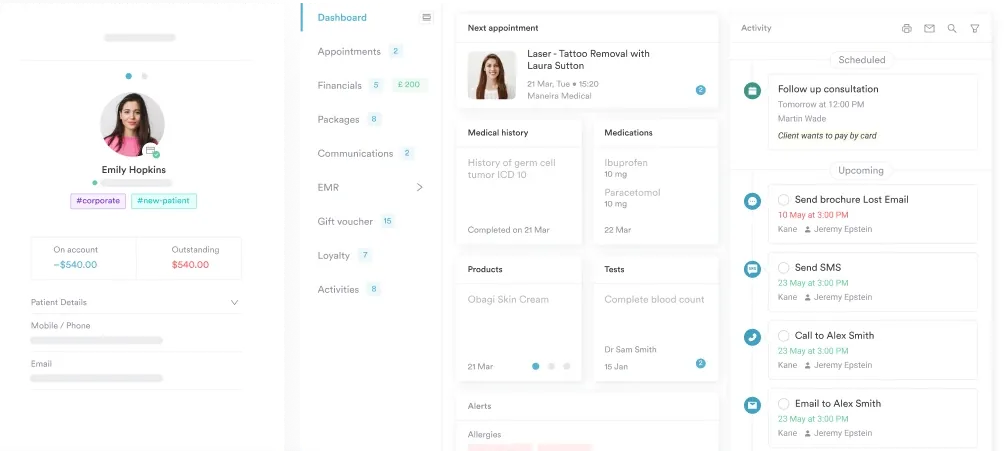

Pabau’s integrated clinical records let you build ICD-10 documentation checklists into your consultation templates. K73.8 gets the supporting evidence it needs before the note is ever closed.

K73.8 has a narrow, specific use case. Most errors come from coders who treat it as a catch-all for any chronic hepatitis that does not immediately match a viral code. Understanding where coders go wrong reduces rework and audit exposure. The same specificity discipline applies to K74.60 and other liver diagnostic families.
Good medical office compliance practices include a periodic audit of K73.8 claims against the chart to catch these patterns before they surface in external reviews.
Chronic hepatitis almost always presents with abnormal liver function tests. Elevated transaminases (AST and ALT) are so central to the diagnosis that coders frequently ask whether they should be coded separately or left implicit in K73.8.
According to the general coding principle in CMS ICD-10-CM Official Guidelines, signs and symptoms integral to a confirmed diagnosis are not coded separately. However, liver enzyme elevation significant enough to be monitored or investigated independently of the hepatitis diagnosis may warrant a separate code.
The relevant code is R74.01, which covers elevation of liver transaminase levels. When a provider separately notes and monitors transaminitis as a clinical problem distinct from the underlying hepatitis, R74.01 can be coded alongside K73.8 at the same encounter.
Sequencing follows standard guidelines: the condition driving the visit is the principal diagnosis. K73.8 leads if the hepatitis management is the reason for the encounter, while R74.01 leads only if the enzyme elevation investigation is the primary reason.
Verifying sequencing against current CMS Official Guidelines Section I.C.18 for signs and symptoms is advisable before finalizing claims that combine K73.8 with R74.01.
Legacy systems and long-term health record comparisons sometimes require mapping K73.8 back to its ICD-9-CM predecessor. The General Equivalence Mappings (GEMs) published by CMS provide the official crosswalk. Practices using EHR integration to bridge ICD-9 and ICD-10 data should reference these mappings rather than relying on memory.
The crosswalk confirms that K73.8 has a narrow ICD-9-CM source: 571.49. Do not use a GEM mapping as justification to upgrade a previously coded 571.40 (unspecified) to K73.8 without reviewing the underlying clinical record for supporting documentation.
Run a periodic crosswalk audit for any K73.8 claims originating from ICD-9-CM legacy data imports. A 571.40-to-K73.8 mapping in an automated conversion is technically incorrect – 571.40 maps to K73.9. Flag these for physician query before billing.
K73.8 solves a specific coding problem: chronic hepatitis that has been worked up thoroughly but does not fit a viral or clearly histologic pattern. The code is valid and billable, but it demands precise documentation – confirmed chronicity, exclusion of viral etiology, and a provider characterization that distinguishes “other” from “unspecified.”
Pabau’s integrated billing and clinical documentation tools let you build those requirements directly into consultation templates, so the documentation that supports ICD-10 Code K73.8 is captured at the point of care rather than chased afterward. See how Pabau handles diagnosis-to-claim workflows by scheduling a demo with our team.

Need the code for liver disorders classified elsewhere? ICD-10 code K77 covers liver conditions that are manifestations of diseases classified in other chapters, and how to sequence them against the underlying diagnosis.
Documenting right-sided wrist pain? ICD-10 code M25.531 guide covers right wrist pain coding and the laterality errors that trigger denials.
Coding other specified liver conditions? ICD-10 code K76.89 covers other specified diseases of the liver that do not fit a more specific K76 subcategory.
ICD-10 Code K73.8 is a billable diagnosis code used to classify other chronic hepatitis, not elsewhere classified – specifically chronic hepatic inflammation of six or more months’ duration where viral etiology (hepatitis B or C) has been excluded and the presentation does not fit the more specific K73.0 to K73.2 patterns. It applies to conditions like cryptogenic chronic hepatitis and seronegative or atypical autoimmune hepatitis when confirmed autoimmune hepatitis (K75.4) cannot be assigned. Drug-induced chronic hepatitis is excluded from K73.8 (Excludes1) and must be coded under K71.- (toxic liver disease) instead.
Yes, K73.8 is a billable and specific ICD-10-CM code. It can be used directly on a claim to support reimbursement without further subclassification. The code became effective for FY2026 on October 1, 2025.
K73.8 (other chronic hepatitis, not elsewhere classified) requires that the provider has characterized the hepatitis as a specific type – even descriptively – that does not match K73.0 through K73.2. K73.9 (chronic hepatitis, unspecified) applies when documentation simply states “chronic hepatitis” with no further clinical characterization. Using K73.9 when documentation supports K73.8 is an undercoding error that may attract payer scrutiny.
K73.8 carries Excludes1 notes for five conditions: chronic alcoholic hepatitis (K70.1-), chronic drug-induced hepatitis (K71.-), chronic reactive or nonspecific hepatitis (K75.2), chronic granulomatous hepatitis NEC (K75.3), and chronic viral hepatitis (B15-B19). These are mutually exclusive with K73.8 – if any of these five etiologies is confirmed in the patient record, the corresponding excluded code must be used instead, and drug-induced chronic hepatitis specifically must always be coded under K71.-, never K73.8.
Supporting documentation for K73.8 must establish four elements: confirmed chronicity (six or more months of hepatic inflammation), exclusion of viral hepatitis through serology or clinical rationale, laboratory or histologic evidence of chronic inflammation, and a provider characterization that identifies the hepatitis as a specific “other” type rather than simply unspecified. Biopsy findings with grading (Metavir or Ishak) provide the strongest documentation support.
The ICD-10 code for elevated liver transaminase levels (transaminitis) is R74.01. It can be coded alongside K73.8 at the same encounter when the provider separately addresses and documents the enzyme elevation as a distinct clinical problem. When K73.8 is the confirmed underlying cause of the enzyme elevation, R74.01 may be dropped since the transaminitis is integral to the hepatitis diagnosis. Verify sequencing against current CMS ICD-10-CM Official Guidelines Section I.C.18 before finalizing these claims.