

ICD-10 code S61.201A: Open wound of left index finger without nail damage
ICD-10 code S61.201A covers a left index finger wound of unstated type ICD-10 co...

Last Updated: Oct 16, 2026
Billable Code Specific Code
K22.4 is the billable ICD-10-CM code for dyskinesia of esophagus. It covers diffuse esophageal spasm, corkscrew esophagus, and spasm of esophagus, and it is valid on its own.
Coders confuse it most with K22.0, achalasia of cardia. An Excludes1 note bars the two codes from the same claim for the same condition. So the code follows the physician's documented diagnosis rather than the presenting symptom.
Let Pabau's smart automation suggest the right codes, reduce claim denials, and keep your practice compliant—effortlessly.
Automate repetitive tasks and focus on what matters most—your patients.
Reduce coding errors and ensure compliance with the latest regulations.
Clean claims, fewer denials, and faster reimbursements.
Powerful insights and reporting to help your practice thrive.
HIPAA compliant SOC 2 certified GDPR-compliant Trusted by 4,000+ clinics worldwide

K22.4 is a valid, billable ICD-10-CM code for dyskinesia of esophagus, effective October 1, 2025 for FY2026.
Three conditions map directly to K22.4: diffuse esophageal spasm, corkscrew esophagus, and spasm of esophagus.
An Excludes1 note bars coding K22.4 and K22.0 (achalasia) together for the same condition.
Symptom codes such as R13.10 and R07.9 never stand in for K22.4 once the physician documents the diagnosis.
K22.4 carries medical necessity for esophageal manometry, which makes CPT 91010 its most common pairing.
ICD-10 code K22.4 is the billable, specific diagnosis code for dyskinesia of esophagus. It is valid for claims in every healthcare setting under the FY2026 edition, effective October 1, 2025.
Billable means the code is specific enough to stand alone as a principal or secondary diagnosis, per the Centers for Medicare and Medicaid Services (CMS). Nothing more detailed sits beneath it.
The code lives in the K22 block, other diseases of esophagus, inside digestive system chapter K00-K95. Gastroenterology practices meet it most often.
Patients arrive with chest pain, dysphagia, or odynophagia caused by uncoordinated esophageal contractions, and manometry confirms the pattern.
Three conditions sit under the Applicable To note for K22.4 in the tabular list. Each one is a different presentation of uncoordinated esophageal motility. When the physician documents any of them, K22.4 is the correct assignment.
All three fall under K22.4, and no sub-code splits them apart. One of those terms in the note is enough to assign the code completely.
Several clinical and administrative terms lead to K22.4 in the ICD-10-CM index. Knowing which ones belong to this code, and which belong to a neighbor, saves a rebill later.
Watch the first one. “Esophageal dysmotility” is an approximate synonym rather than an Applicable To term, so it guides a coder toward K22.4 without settling the assignment.
The physician’s documented diagnosis does that. Query for clarification when the note says only “esophageal dysmotility”, because some presentations belong in K22.8.
K22.4 carries an Excludes1 note for cardiospasm, K22.0. The two codes cannot be assigned together for the same condition in the same encounter. Excludes1 is a pure exclusion, so the excluded condition is never part of the coded condition. Reporting both contradicts itself clinically.
In practice the difference comes down to the mechanism and the manometry findings in the note.
Overlapping features do turn up. When they do, the physician’s primary documented diagnosis picks the code. Never split the difference by reporting both.
K22.4 sits inside the K22 subcategory for other esophageal diseases. Reading the sibling codes tells you when K22.4 is right and when something more precise applies.
The table below follows the K22 family as it stands in the FY2026 tabular list.
K22.8 is the usual alternative when the note describes a motility variant outside the three K22.4 inclusion terms. Query before you fall back on K22.9, which carries no specificity and invites payer edits.
The mapping below runs from the note to the code, which is the order a coder actually works in.
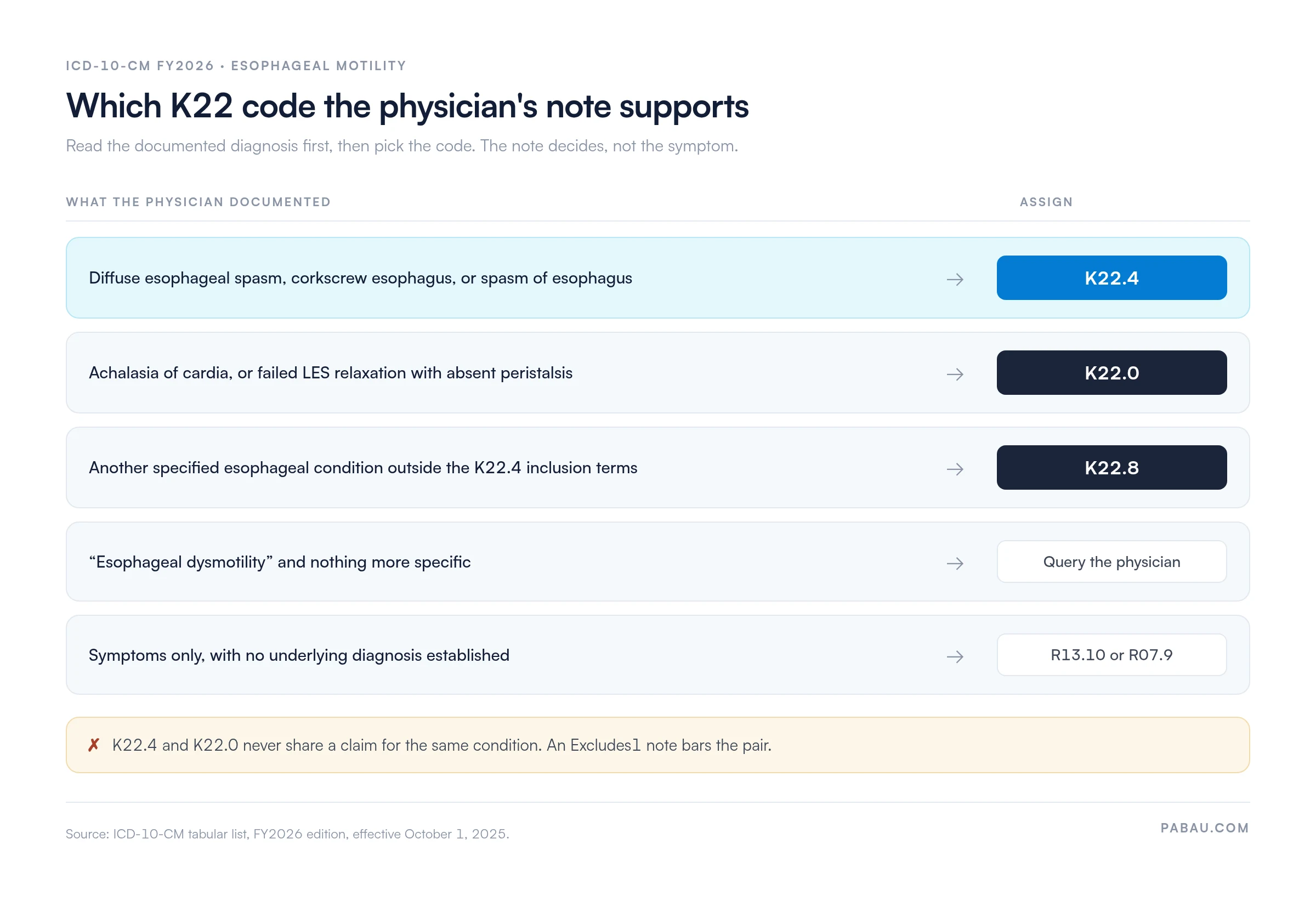
A K22.4 claim needs documentation that carries both the diagnosis and the clinical basis for it. The physician’s own words do that work, not a coder’s reading of the symptoms. Four elements should appear in the encounter record.
One habit makes all four easier to satisfy. Practice management software like Pabau holds the manometry report on the encounter record itself. The evidence and the code then get reviewed together, rather than weeks apart.

Run a chart audit on K22.4 claims denied in the past 90 days. Start with the ones where no manometry report was attached. Then send the report with the appeal as medical necessity evidence, citing the American College of Gastroenterology criteria for diffuse esophageal spasm.
K22.4 is the diagnosis code that carries medical necessity for esophageal motility procedures and the visits around them. The CPT codes below pair with it most often. Coverage varies by payer, so check the local coverage determination before you claim.
One pairing needs a second look before you bill it. Some commercial payers reimburse 91010 only for gastroenterology or motility-credentialed providers, so confirm the specialty and the place of service first.
Coding rules are only half the job. The claim itself travels a short route, and it stalls in places you can predict.
Run this list on any claim carrying K22.4. It takes under a minute and catches most of what comes back.
Most K22.4 denials and audit flags trace back to four repeatable mistakes. Each one is preventable while the note is still being read.
Flag K22.4 for secondary review whenever it turns up beside K22.0, an R07 or R13 symptom code, or an unspecified K22.9. The billing denial codes reference lists the CARC codes attached most often to Excludes1 conflicts.
Build a K22.4 query template into your workflow. Trigger it whenever a gastroenterologist documents ‘esophageal dysmotility’ with nothing more specific. The query asks whether the diagnosis meets criteria for diffuse esophageal spasm or a different K22 variant. One clarification saves a run of denials and rebills.
K22.4 has stayed structurally stable across recent ICD-10-CM editions. There has been no descriptor revision and no change to the Applicable To terms since the original implementation. Annual editions follow the federal fiscal year, so each one takes effect on October 1.
Use 530.5 only as an approximate reference when you review older claims data. The General Equivalence Mappings published by CMS are the authoritative crosswalk. To confirm the current tabular status and inclusion terms, read them from the official release in the CDC ICD-10-CM web tool.
In many gastroenterology practices the manometry report, the encounter note, and the claim live in three separate places. A coder reads the note in one system and types the code into another. Each handoff is a chance for the diagnosis and the code to drift apart.
Pabau keeps them on one patient record. The note, the attached report, and the assigned diagnosis code sit together, so a coder reviews the evidence and the code side by side. Pabau’s claims management software then runs the eligibility check and submits the claim electronically through a clearinghouse.
A coder still makes the Excludes1 call, because that decision belongs to the person reading the note. Pabau puts the manometry evidence and the assigned code on one screen for it, so the review happens before submission rather than after a denial.

Pabau brings the encounter note, the manometry report, and the diagnosis code onto one patient record, then submits the claim electronically. Your coders review the evidence and the code together, before the claim leaves the practice.

K22.4 is a stable, specific code with a narrow set of inclusion terms and one hard exclusion. The two errors worth building a habit around are the K22.0 conflict and the symptom-code substitution. Both get caught while the note is being read, well before the clearinghouse sees the claim.
So start with a query template for notes that say only “esophageal dysmotility”. File the manometry report with the encounter while it is fresh. Read the documented diagnosis before you reach for a symptom code.
Book a demo to see how Pabau keeps that evidence and the K22.4 claim on one record.

Need to understand how clean claims reduce denials? Submitting a clean claim covers the documentation and code-pairing requirements that keep esophageal motility claims out of the denial queue.
Want the wider picture around one code? Revenue cycle management fundamentals maps the full path from encounter to payment, which is where a mis-assigned diagnosis code costs the most time.
Managing denials on esophageal motility claims? Electronic remittance advice (ERA) processing shows how to read the CARC denial codes returned on K22.4 claims and route them to the right correction workflow.
No. K22.4 is complete at four characters, so a fifth character would make it invalid. Codes in the K22 block carry no laterality and no encounter extension, unlike the injury codes in chapters S and T.
Yes. K22.4 carries an Excludes1 note for K22.0 only, so nothing bars it from pairing with gastro-esophageal reflux disease. Report both when the physician documents both conditions and each one is managed at the encounter.
Code the confirmed part and ignore the uncertain part. An outpatient record cannot carry a suspected or ruled-out condition as a diagnosis. So K22.4 stands on the documented spasm, and K22.0 is not reported at all.
Yes, where it is the condition established after study that chiefly caused the admission. That is unusual, because esophageal spasm is managed in outpatient care, so most inpatient records carry K22.4 as a secondary diagnosis.



