

ICD-10 code S61.201A: Open wound of left index finger without nail damage
ICD-10 code S61.201A covers a left index finger wound of unstated type ICD-10 co...

Last Updated: Oct 16, 2026
Billable Code Specific Code
I61.5 is the billable ICD-10-CM code for nontraumatic intracerebral hemorrhage, intraventricular. Two elements have to appear in the chart note before it can be assigned. The hemorrhage must be documented as nontraumatic, and it must involve the ventricular compartment.
The FY2026 edition took effect on October 1, 2025, with documentation and exclusion rules unchanged from prior years. Coders working inpatient claims should still check current MS-DRG assignments against the CMS IPPS tables, since grouper weights shift each fiscal year.
Let Pabau's smart automation suggest the right codes, reduce claim denials, and keep your practice compliant—effortlessly.
Automate repetitive tasks and focus on what matters most—your patients.
Reduce coding errors and ensure compliance with the latest regulations.
Clean claims, fewer denials, and faster reimbursements.
Powerful insights and reporting to help your practice thrive.
HIPAA compliant SOC 2 certified GDPR-compliant Trusted by 4,000+ clinics worldwide

ICD-10 Code I61.5 is the specific, billable code for nontraumatic intracerebral hemorrhage confined to the intraventricular space.
Under the Excludes1 rule, traumatic intraventricular hemorrhage routes to S06.- codes, so physician documentation of nontraumatic etiology comes first.
Once the acute episode resolves, sequelae are captured with I69.1- codes. I61.5 is never reported alongside an I69.1- code for the same encounter.
Practice management software like Pabau validates ICD-10-CM codes such as I61.5 with Claim.MD against thousands of US payers before submission.
ICD-10 Code I61.5 is a valid, billable ICD-10-CM code for nontraumatic intracerebral hemorrhage, intraventricular. It applies to claims with dates of service on or after October 1, 2025 (FY2026). The code belongs to category I61 (Nontraumatic intracerebral hemorrhage), inside the ICD-10-CM block I60-I69 (Cerebrovascular diseases).
The code captures one presentation: spontaneous bleeding that starts within the brain’s ventricular system, or extends into it, with no traumatic event behind it. Because I61.5 is a specific, leaf-level code in the tabular list, it can be reported directly on a claim without further subcategory detail. Coders using the CDC/NCHS ICD-10-CM web tool will find it under the chapter for diseases of the circulatory system (I00-I99).
Nontraumatic intraventricular hemorrhage is spontaneous bleeding inside the brain’s ventricular system. That system holds the lateral, third, and fourth ventricles, the fluid-filled cavities that circulate cerebrospinal fluid. Nontraumatic means no external force caused the bleed. The hemorrhage arises from a vascular event such as hypertension, an arteriovenous malformation, or anticoagulant therapy.
The distinction from traumatic intracerebral hemorrhage decides which chapter the claim comes from. Traumatic hemorrhage follows a defined injury event, such as a fall, a motor vehicle collision, or an assault. It is coded from the S06.- series under Chapter 19.
I61.5 requires physician documentation that characterizes the etiology as spontaneous or nontraumatic. A coder cannot reach that conclusion from the clinical record alone. The CMS ICD-10 coding guidance is clear that code assignment follows physician documentation, not coder inference.
Knowing where I61.5 sits in the tabular list helps coders navigate when documentation is ambiguous about site. The table below traces the path from chapter level down to the specific billable code. That structure comes from the WHO ICD-10 classification and carries into the ICD-10-CM US clinical modification. Neighboring categories in the same chapter are listed in Pabau’s ICD-10-CM code library.
Category I61 covers nontraumatic intracerebral hemorrhage by anatomical site. Picking the right subcategory depends on documented specificity about where the bleeding happened. I61.5 is the correct choice only when the hemorrhage is documented as intraventricular.
For any other site, a different subcategory applies. Coders referencing AAPC’s ICD-10-CM lookup will find the full I61 family listed with descriptor detail.
Imaging often shows hemorrhage extending from the parenchyma into the ventricular system. Query the physician about which site came first, because an intraparenchymal bleed with ventricular extension may code differently from a primarily intraventricular one. Documentation drives the code here. Never assign I61.5 on imaging language alone, without physician attestation of the nontraumatic, intraventricular character.
The tabular list at category I61 carries an Excludes1 note that rules out I61.5 whenever trauma is involved. Excludes1 means the two codes cannot be used together, because the conditions are mutually exclusive by definition.
Four documentation patterns turn up on intraventricular bleeds, and only one of them lands on I61.5.
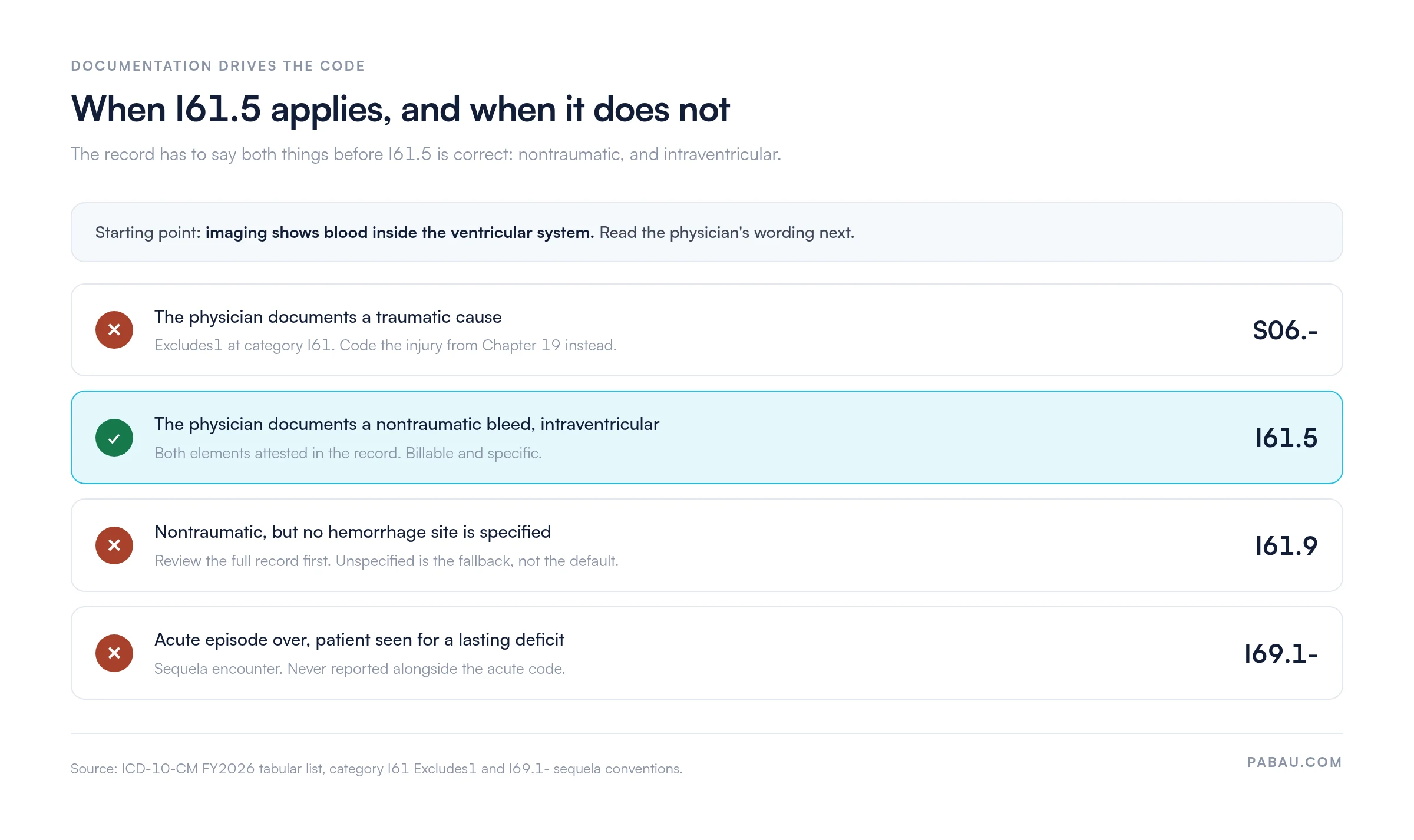
The Excludes1 rule is a frequent denial trigger for this code. Payer edits at clearinghouse level reject any claim that pairs I61.5 with an S06.- code on the same claim header.
Confirm that trauma or nontraumatic etiology is documented unambiguously before assigning. A working knowledge of denial management in healthcare helps coding teams build queues that intercept these conflicts before submission.
Medical records must support every element of I61.5 before the code can be assigned. Incomplete documentation is the other frequent denial route, after traumatic and nontraumatic confusion. The following elements belong in the clinical record.
A record that holds the attending’s attestation, the imaging correlation, and the etiology on one timeline removes most query delays. These claims stay clean when the documentation is complete at the point of care, long before the clearinghouse ever sees them.
In UK private practice, the surgical excision of a ruptured arteriovenous malformation is billed under the CCSD schedule as A0260. That schedule is separate from ICD-10-CM, so it does not apply to US claims.
Query the attending physician any time the imaging report describes ‘intraventricular extension’ without a corresponding attestation in the progress note or discharge summary. A radiology impression does not substitute for physician documentation of the hemorrhage site and etiology for ICD-10-CM coding purposes.
Once the acute intraventricular hemorrhage resolves, later encounters for its neurological consequences take the I69.1- series, not I61.5. That principle applies across the whole I61 category. The acute code is never reported concurrently with an I69.1- code for the same condition.
The I69.1- subcategories capture sequelae of nontraumatic intracerebral hemorrhage by the deficit the patient presents with. Cognitive deficits, hemiplegia, aphasia, dysphagia, and other neurological impairments each have a designated subcategory code. Coding teams handling post-stroke rehabilitation claims need both halves of the episode: the acute I61.5 encounter and the downstream I69.1- codes.
When I61.5 is the principal diagnosis on an inpatient claim, it maps to Medicare Severity DRGs in the intracranial hemorrhage grouping. Assignment is then stratified by whether a complication or comorbidity (CC) or a major complication or comorbidity (MCC) is present.
That single distinction moves the reimbursement weight noticeably. Verify current MS-DRG assignments against the CMS inpatient prospective payment system (IPPS) grouper tables, which update each October 1.
The general DRG family for nontraumatic intracerebral hemorrhage includes:
Submitting I61.5 claims through a clearinghouse that validates ICD-10-CM codes before transmission lowers the risk of a DRG miscalculation caused by a coding error. Pabau’s Claim.MD integration checks codes against thousands of US payers before the 837P claim file goes out. Payment details come back as an electronic remittance advice, so billing teams can reconcile DRG payments and spot underpayments without manual rework.
Four errors turn up repeatedly in I61.5 claim denials and audit findings. Each one is preventable with a documentation review before submission.
This is the most consequential error. A patient admitted after a fall with an intraventricular bleed on imaging may have a traumatic hemorrhage (S06.-) rather than a spontaneous one. A coder who assigns I61.5 without the physician’s explicit nontraumatic designation files an incorrect principal diagnosis.
That triggers payer edits and can flag the claim for RAC audit. Query the attending when etiology is ambiguous, and never assign I61.5 on imaging alone.
Coders sometimes default to I61.9 when documentation mentions intracerebral hemorrhage broadly, without checking the record for site-specific detail. A discharge summary that states intraventricular hemorrhage elsewhere in the record supports I61.5. Review the full record first: progress notes, imaging reports with physician correlation, and operative reports.
An outpatient visit six weeks post-discharge for left-sided weakness after a prior intraventricular hemorrhage is a sequela encounter, not an acute one. Applying I61.5 to that visit misrepresents the patient’s current clinical status. Use the appropriate I69.1- code and add any specific deficit code.
When hypertension, a coagulation disorder, or anticoagulant use is documented as contributing to the hemorrhage, the guidelines require an additional code for that condition. Reporting I61.5 alone on a record that documents hypertensive origin drops a secondary diagnosis from the claim.
The coded record becomes less accurate, and CC/MCC capture that drives DRG weight can be lost with it. A standing query workflow catches the missing codes while the chart is still open.
Accurate coding for a diagnosis like I61.5 depends on documentation that is complete at the point of care, not reconstructed at the billing stage. Pabau’s claims management software builds ICD-10-CM validation into the submission workflow, checking codes against payer-specific rules before the claim leaves the practice.
The Claim.MD clearinghouse integration connects to thousands of US payers and adds real-time eligibility verification. Built-in ICD-10-CM and CPT catalogs flag mismatched codes before transmission.

For hospital coding and health information management teams, the payoff is a documentation-to-claim chain that holds together. The clinical record captures the attestation of nontraumatic etiology, the ventricular site, and the relevant comorbidities. That data then maps to the correct principal diagnosis and its secondary codes. Nobody has to reconcile the two by hand at month end.

Pabau integrates with Claim.MD to validate ICD-10-CM codes like I61.5 against thousands of US payers before submission. Fewer denials, cleaner claims, faster reimbursement.

I61.5 has a narrow application, and that is the whole point of the code. It belongs to nontraumatic intracerebral hemorrhage documented as intraventricular, and to nothing else.
Four failures cost practices money here, and each one starts in the documentation. A traumatic bleed gets misclassified, or the record defaults to unspecified I61.9. On other claims the acute code lands on a sequela visit, or a causal condition never reaches the claim at all.
So the work sits upstream of the claim. Build a query step that fires whenever the etiology or the site is ambiguous, and most of these denials never reach the payer. Book a demo to see how Pabau validates ICD-10-CM codes like I61.5 before your claims go out.

Need a deeper dive into clearinghouse claim validation? Claim.MD clearinghouse integration explains how Pabau connects to thousands of US payers for real-time ICD-10-CM validation.
Working through denial patterns on cerebrovascular claims? Denial codes in medical billing covers the most common CARC denial reasons and how to resolve them.
Want to understand how ICD-10-CM codes flow through a claim? Revenue cycle management maps the full journey from diagnosis documentation to payment posting.
ICD-10 Code I61.5 is the billable ICD-10-CM diagnosis code for nontraumatic intracerebral hemorrhage, intraventricular. It covers spontaneous bleeding into the brain’s ventricular system without a traumatic cause. The code is valid for claims with dates of service from October 1, 2025 onward.
Yes. I61.5 is a specific, billable ICD-10-CM code that can be reported directly on a claim without additional subcategory detail. It appears as a valid code in the official CMS tabular list.
I61.5 applies only to nontraumatic, spontaneous hemorrhage. Traumatic intraventricular hemorrhage is coded from the S06.- series in Chapter 19. The attending physician makes and documents that distinction, because imaging alone cannot settle it. Applying I61.5 to a traumatic case is an Excludes1 violation.
Sequelae of nontraumatic intracerebral hemorrhage are captured with the I69.1- subcategory codes. Those codes identify the specific deficit, such as hemiplegia (I69.15-), aphasia (I69.120), and dysphagia (I69.191). The acute code I61.5 is never used alongside an I69.1- code for the same encounter.
Clinically it is classified as a hemorrhagic stroke when it meets stroke diagnostic criteria. The ICD-10-CM convention still places it under category I61, intracerebral hemorrhage, rather than the ischemic stroke codes. Follow the physician’s documentation, not the general stroke label, when choosing between I61.x and I63.x codes.
Four errors account for most I61.5 denials. The first is assigning it when the etiology is traumatic, which violates Excludes1. The second is defaulting to I61.9 when site-specific documentation exists. Third, the acute code gets applied to sequela encounters that belong in I69.1-. Fourth, causal condition codes for documented hypertension or coagulopathy are left off the claim. A pre-submission documentation review catches all four.



