ICD-10 Code S42.444P: Medial epicondyle fracture, right humerus
ICD-10 Code S42.444P: full descriptor and code validity ICD-10 Code S42.444P car...

Last Updated: Oct 13, 2026
Billable Code Specific Code
H17.03 is the billable ICD-10-CM code for adherent leukoma, bilateral. It describes a dense white corneal scar in both eyes, with iris tissue fused to the back of the cornea. The scar usually forms after a corneal perforation heals.
Denials on this code rarely come from picking the wrong code family. They come from a note that records the scar but never states the iris adhesion or the laterality. Without both, the record supports only H17.00 or H17.9.
Let Pabau's smart automation suggest the right codes, reduce claim denials, and keep your practice compliant—effortlessly.
Automate repetitive tasks and focus on what matters most—your patients.
Reduce coding errors and ensure compliance with the latest regulations.
Clean claims, fewer denials, and faster reimbursements.
Powerful insights and reporting to help your practice thrive.
HIPAA compliant SOC 2 certified GDPR-compliant Trusted by 4,000+ clinics worldwide

ICD-10 code H17.03 is the billable, specific code for adherent leukoma, bilateral.
An adherent leukoma is a dense corneal scar with iris tissue fused to it, usually after a healed perforation.
H17.03 is valid under the FY2026 ICD-10-CM edition, covering encounters on or after October 1, 2025.
Bilateral involvement must be documented, or the record supports only H17.00, the unspecified-eye code.
H17.03 is not H17.13: that code covers bilateral central corneal opacity, which has no iris adhesion.
Pabau’s claims management software links ICD-10 diagnosis codes to encounter claims for accurate submission.
ICD-10 code H17.03 is a billable, specific ICD-10-CM diagnosis code describing adherent leukoma, bilateral. It covers a dense white corneal scar in both eyes with iris tissue fused to the back of the cornea. The code is valid for encounters on or after October 1, 2025, under the CMS FY2026 ICD-10-CM edition. Because H17.03 sits at the leaf level of the hierarchy, it can be reported directly on a claim.
H17.03 carries no age edit and no sex edit. It may be reported as a principal or a secondary diagnosis, depending on the reason for the encounter. Check it against the current-year tabular list before submitting, as you would any of the ICD-10-CM codes on the claim.
H17 is a non-billable header code covering the full range of corneal scarring and opacity conditions under the H00-H59 chapter. Payers will reject a claim submitted with H17 alone. A valid, billable child code is required on every claim.
The H17 category splits into three subcategory blocks, separated by the kind of scar rather than by laterality. Reading the block structure first tells a coder which family the documented lesion belongs to.
H17.03 falls within the H17.0x block, adherent leukoma. The WHO ICD-10 browser provides the international classification context. The US-specific tabular list at the CDC/NCHS ICD-10-CM web tool carries the authoritative descriptor and usage notes for US claims.
The H17.0 subcategory uses a four-way laterality split, and H17.03 is the bilateral designation. Coders select the code that matches what the treating provider documented. Involvement of both eyes takes H17.03, not the unspecified-eye code H17.00.
The common coding error here is assigning H17.00 when the note describes each eye separately but never uses the word bilateral. Guideline I.B.13 lets laterality be taken from another clinician’s entry in the record when the treating provider has not stated it. The diagnosis itself still has to come from the provider, so query before defaulting to unspecified.
The full H17 category covers adherent leukoma, central corneal opacity, minor and peripheral opacity, and two catch-all groupings. Choosing between them takes documentation that names the type of scar and, where the code asks for it, the part of the cornea involved.
Note the difference between H17.03 and H17.13: H17.03 sits in the adherent leukoma block (H17.0x) while H17.13 is in the central corneal opacity block (H17.1x). Verify the slit-lamp findings and provider documentation before selecting between them. The AAPC Codify ICD-10-CM lookup provides a searchable reference for the full H17 subcategory tree.
An adherent leukoma is a dense white corneal scar with iris tissue fused to its back surface. It forms after a corneal perforation heals. The iris moves forward to plug the opening, and the scar that seals the wound traps it there. What remains is an opacity continuous with the iris rather than a free-standing corneal scar.
Bilateral involvement means both corneas carry a scar of this kind. Reported causes include perforated infectious keratitis, severe corneal ulceration, chemical and thermal burns, trachoma, and vitamin A deficiency. A bilateral pattern points toward a systemic or environmental cause rather than a single injury to one eye.
Because the iris is drawn forward into the scar, the pupil is often distorted and the anterior chamber angle can be compromised. Secondary glaucoma is a recognized complication, and practices frequently code it alongside H17.03 when the provider documents it.
Coding context only: the clinical descriptions above help coders understand what documentation is needed. This page does not constitute diagnostic guidance or clinical advice.
The chart note must support all three elements H17.03 carries: a leukoma of the cornea, iris tissue adherent to it, and involvement of both eyes. A note recording corneal opacity with no lesion type and no laterality supports only H17.9.
The treating provider has to record all of the following in the clinical note or the slit-lamp entry. Each element carries a separate part of the code, and a note that covers two of the three lands somewhere else in H17.
Which code a note supports follows from those three elements in combination, not from the diagnosis line on its own.
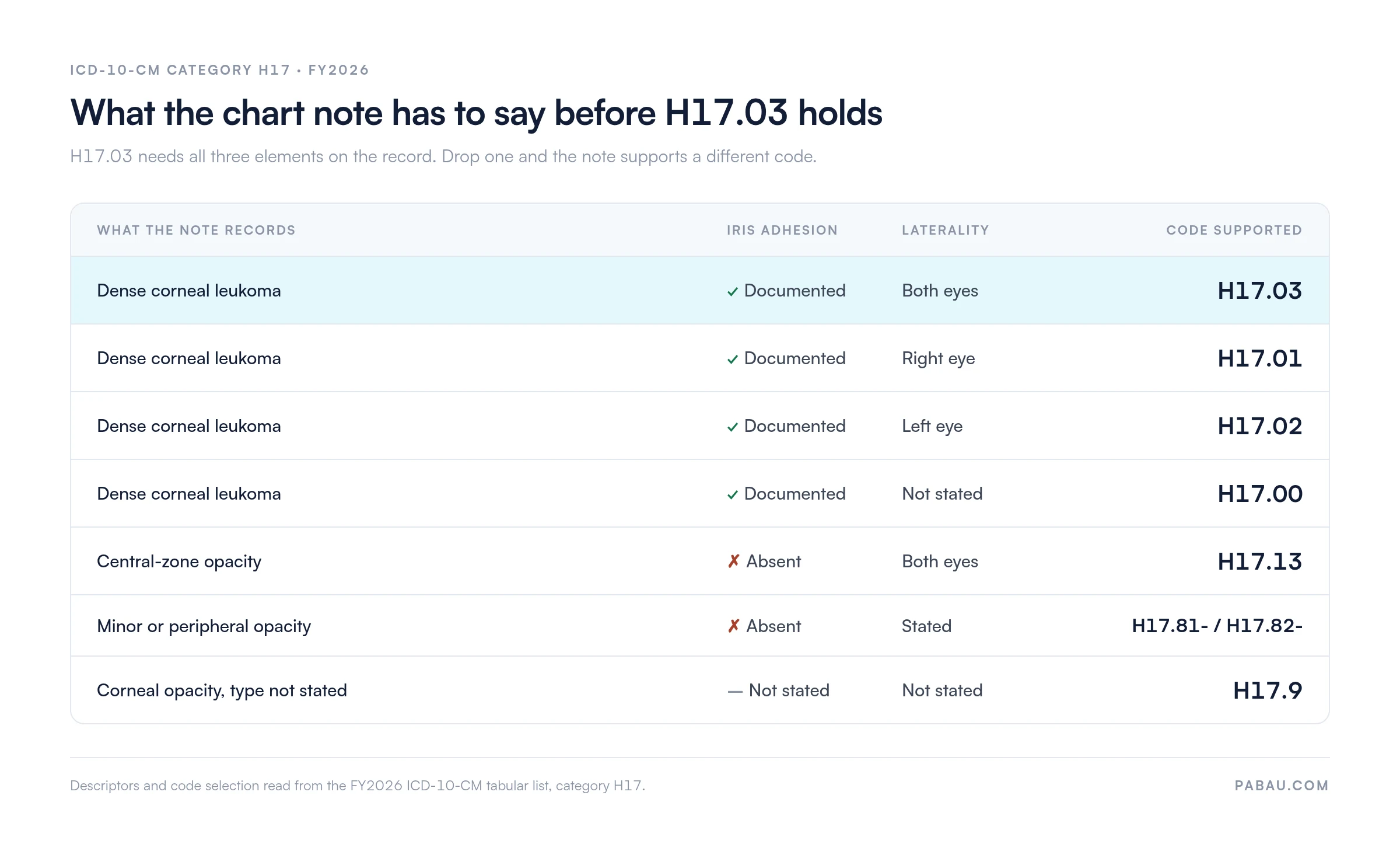
A structured ocular exam recording adherent leukoma OD and OS supports H17.03. A note that says bilateral corneal scarring, with no mention of iris adhesion, does not support H17.03 without a provider query.
ICD-10-CM carries no code-specific instructional note at H17.03, so the general laterality rules in Section I.B.13 apply. Where the documentation supports involvement of both eyes, the bilateral code is the correct choice. Reporting H17.00 in that situation is a coding error rather than a cautious one.
Payers processing H17.03 claims may request operative or slit-lamp documentation to support the bilateral designation. That request is most likely when the claim covers imaging or a surgical procedure on the cornea.
Run a quarterly audit of your H17.00 usage. Any encounter coded H17.00 where the clinical note describes both eyes is a likely undercoding of H17.03. Query the treating provider before retroactively changing a submitted code. The pattern usually reflects a documentation habit, and a short provider education note corrects it going forward.
The ICD-10-CM alphabetical index routes several clinical terms into the H17.0 subcategory. Knowing those entries helps coders confirm the selection when the provider uses a non-standard term.
Leukoma of the cornea with no adherent qualifier routes to H17.89, other corneal scars and opacities. Adding the word adherent moves the entry to the H17.0 subcategory, and documented involvement of both eyes takes it to H17.03. The provider’s wording decides which index entry applies.
Ophthalmology practices submitting claims with H17.03 pair it with the CPT procedure code for the service rendered. The diagnosis code alone does not generate a payment; it supports medical necessity for the associated procedure. Commonly paired services include anterior segment examination, visual acuity testing, and corneal topography.
Practice management software like Pabau integrates with Claim.MD, our US clearinghouse partner, supporting 4,000+ payers for CMS-1500 and 837P electronic claim submission. Practices using Pabau attach ICD-10 diagnosis codes such as H17.03 to the encounter record. Claims then move through the clearinghouse for real-time eligibility checks and ERA processing. The built-in ICD-10 catalog supplies the descriptor, so coders do not retype it on every bilateral adherent leukoma claim.
Pabau’s claims management software supports the full submission lifecycle for specialty practices. The diagnosis code, the encounter note and the claim stay in one record. That matters on a code like H17.03, because the payer question is almost always about the wording of the slit-lamp record.
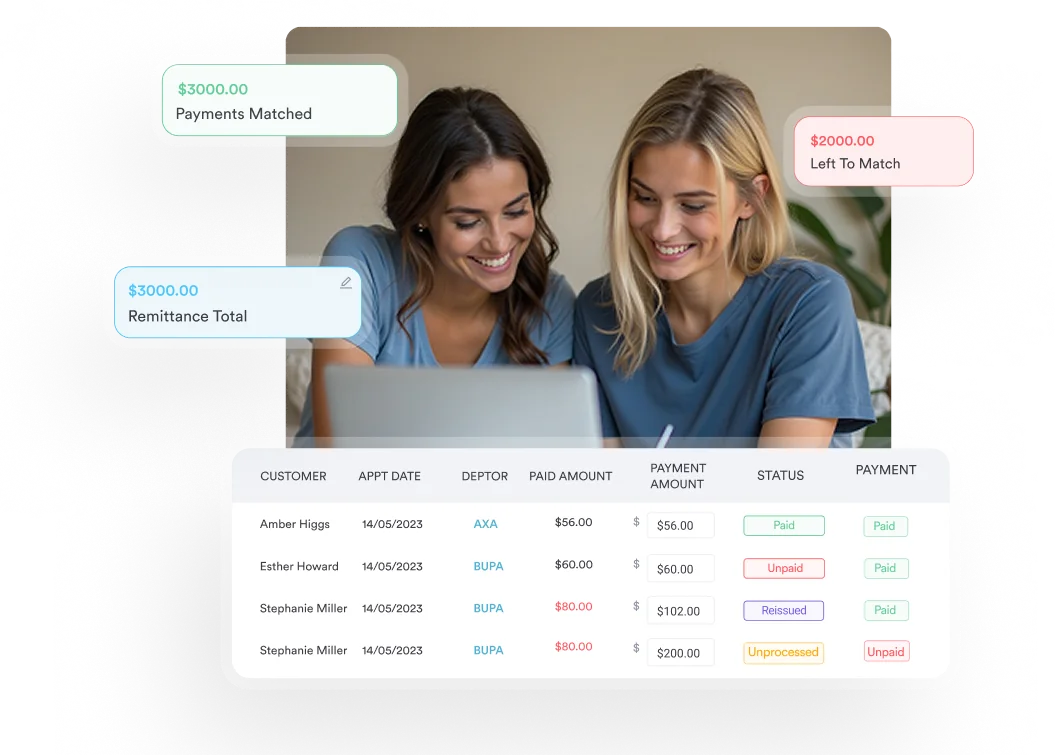

Pabau links ICD-10 diagnosis codes to encounter claims and supports accurate submission workflows for ophthalmology and specialty practices. See how it works for your team.

ICD-10 code H17.03 turns on two documented elements: a corneal leukoma with iris tissue adherent to it, and involvement of both eyes. The most common billing error is falling back on H17.00 when the record already describes both corneas. The second is reaching for H17.13, which describes a central corneal opacity with no adhesion at all.
Pabau’s claims management platform links ICD-10 diagnosis codes including H17.03 directly to encounter records and routes claims through the Claim.MD clearinghouse for pre-submission validation. If your ophthalmology or specialty practice wants to reduce diagnosis-code-related denials, book a demo to see how the workflow fits your team.

Note records an opacity but no lesion type? ICD-10 code H17.9: Unspecified corneal scar and opacity covers the fallback code that thin documentation leaves you with.
Cornea disorder documented without a named lesion? ICD-10 code H18.9: Unspecified disorder of cornea shows when the H18 category applies instead of H17.
Tracing the inflammation that scarred the cornea? ICD-10 code H16.9: Unspecified keratitis covers the keratitis that often precedes an adherent leukoma.
Coding the secondary glaucoma alongside it? ICD-10 code H40.9: Unspecified glaucoma sets out the documentation that supports the added diagnosis.
Billing the exam that documented the scar? CPT code 92012: Intermediate eye exam explains when the intermediate ophthalmological service applies.
ICD-10 code H17.03 is the billable ICD-10-CM diagnosis code for adherent leukoma, bilateral. It applies when the provider documents a dense corneal scar with adherent iris tissue in both eyes. The code is valid for claim submission under the FY2026 ICD-10-CM edition, which covers encounters from October 1, 2025.
Yes. H17.03 is a specific, billable ICD-10-CM code and can be reported directly on a claim. Its parent codes H17.0 and H17 are non-billable headers, so only five-character child codes such as H17.03 are valid for submission.
H17.01 describes adherent leukoma in the right eye only, while H17.03 describes adherent leukoma in both eyes. Use H17.03 when the documentation confirms bilateral involvement. Use H17.01 when only the right cornea is affected.
An adherent leukoma is a dense white corneal scar with iris tissue fused to its back surface. It usually follows a corneal perforation that healed with the iris sealing the opening. Because the iris is pulled forward, the pupil is often distorted and intraocular pressure can rise.
Yes. H17.03 is valid for the FY2026 ICD-10-CM edition. It applies to encounters on or after October 1, 2025, and remains current through the end of the fiscal year. Verify against the CMS annual update files each October for any future changes.
The clinical note must record three elements to support H17.03: the leukoma, the iris adhesion, and involvement of both eyes. A slit-lamp description of the scar and the adhesion in each eye is the strongest support. Corneal opacity alone supports only H17.9.