Fertility clinic marketing: Strategies that attract & convert patients
Fertility clinic marketing is how a fertility practice attracts, educates, and c...

Last Updated: Oct 14, 2026

A proactive waitlist fills last-minute cancellations in minutes. A passive list in a notebook or spreadsheet leaves those slots empty.
Empty slots are expensive. At an average med spa visit of $527, missing four a week adds up to more than $100,000 a year (AmSpa, 2024).
Automated waitlist management moves clients into earlier openings and makes those appointments 38% less likely to become no-shows (JMIR).
Capture each client’s treatment, availability, preferred provider, and urgency up front so your software can auto-match the right person to every opening.
The right waitlist management software instantly matches an open slot to the right waiting client, so your team can notify them by SMS or email in one click.
Many med spas can fill their schedules. The harder part is what happens when a client reschedules, cancels the morning of, or a rush of new requests lands all at once.
A waitlist is how you handle all of it. It fills cancellations, reduces no-shows, and keeps revenue steady, so an open slot becomes a booked one instead of lost income.
But a name jotted in a notebook won’t fill that slot. Below, you’ll see how a proactive waitlist actually works, the exact messages that turn an opening into a booking, and how to build the whole thing into your day. Before you choose a system to run your waitlist, our ranking of the best med spa software looks at how eight platforms handle scheduling.
Waitlist management is the system that fills a slot the moment it opens. When a client cancels or reschedules, it tracks who’s waiting, matches the opening to the right client, and fills the appointment before it goes to waste, instead of relying on someone to remember to call around.
A structured waitlist management program keeps that process consistent, so it runs the same on your busiest day as your quietest one.
Good med spa software handles it without relying on memory or last-minute calls. It helps you:
Pro tip: When managing your waitlist and client information, remember that HIPAA compliance isn’t just a checkbox. Make sure your med spa software offers granular user permissions that restrict access to sensitive client data. This keeps your practice secure and builds trust with clients who expect their information to be handled with care.
A passive waitlist is the old-school approach. You jot down names in a notebook or keep a spreadsheet that only gets updated when someone has a spare minute. It can work for a while, but as soon as your schedule fills up, clients get overlooked or kept waiting too long.
A proactive system does the work for you. With medical spa software like Pabau, every request is saved and easy to find. When a slot opens, the client hears right away. They can book it themselves, or your team can confirm in a few clicks.
Here’s how it looks in the dashboard.
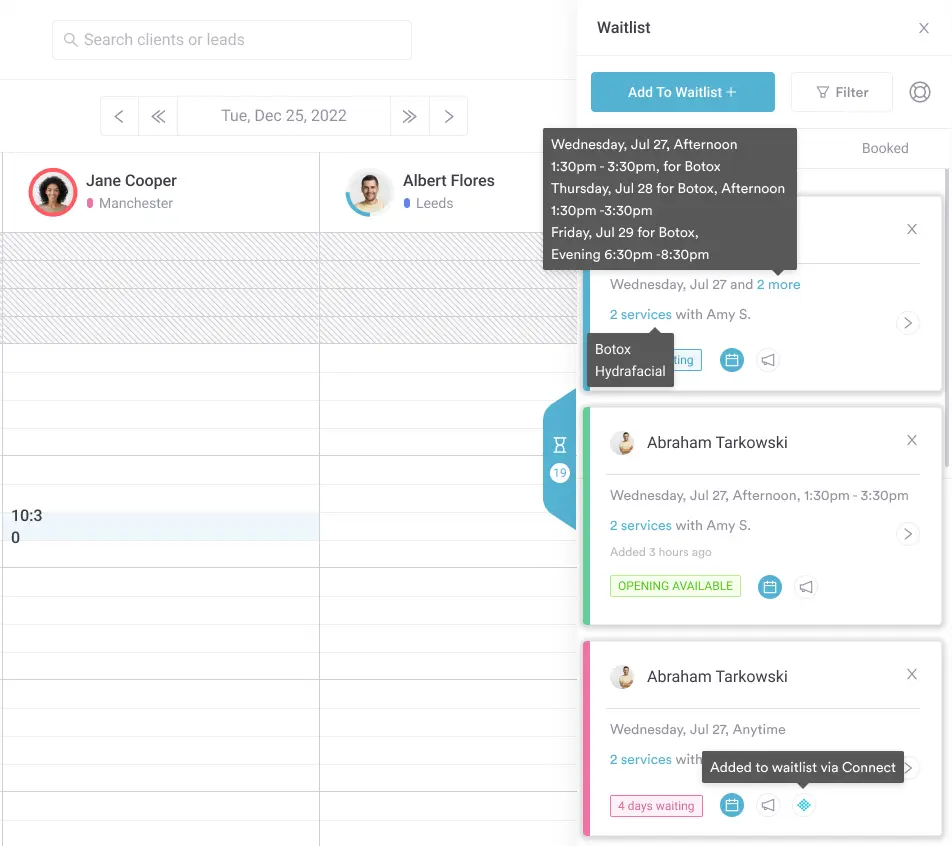
Source: Pabau
Everything is right there on the screen, clear and organized. You can see:
It’s a smarter way to keep your team and your clients on the same page.
Clients expect flexibility. If your med spa can’t offer quick access or handle a reschedule cleanly, they’ll book elsewhere next time.
A well-run waitlist keeps those clients booked with you instead of a competitor. It helps you:
A 2025 Mayo Clinic study tracking 229,998 appointments found that automated waitlists helped patients secure an earlier slot in 24.6% of waitlisted appointments, rescheduling an average of 22.6 days sooner. That study covered general healthcare appointments rather than med spas, but the mechanics of filling a canceled slot are the same.
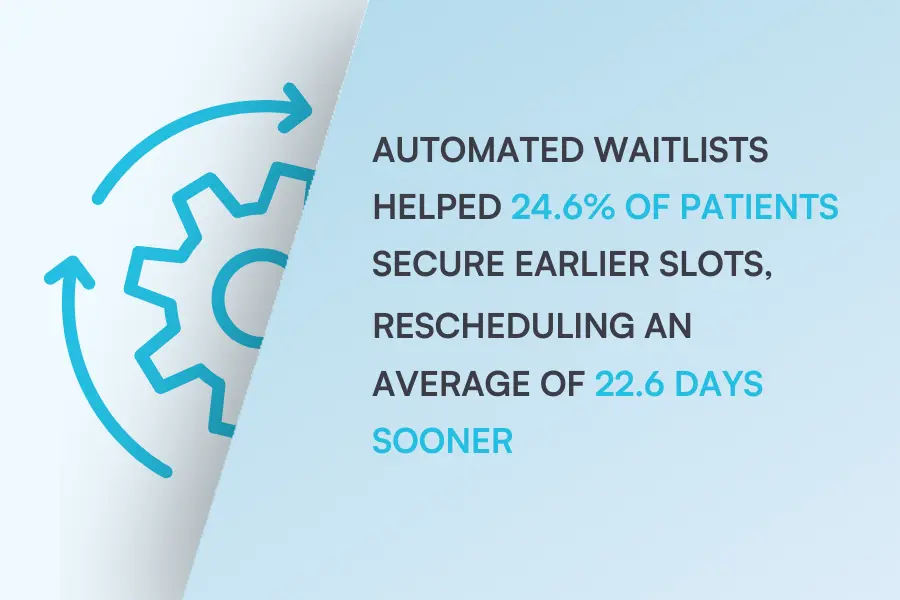
Illustration: Pabau / Data: PubMed
The study also found that when clients could choose to accept or skip earlier slots themselves, scheduling ran more smoothly and wait times dropped.
To keep this level of consistency going, you need tools that take the manual work off your plate.
Pabau’s all-in-one practice management software handles everything from automated reminders to follow-ups. So instead of shuffling papers or chasing no-shows, your team can spend more time making clients glad they chose you.
On paper, it all looks simple enough.
Clients book appointments, show up on time, and the day moves along. In practice, though, one change can set off a chain reaction that throws your schedule off balance.
These are some of the most common challenges you’ll run into.
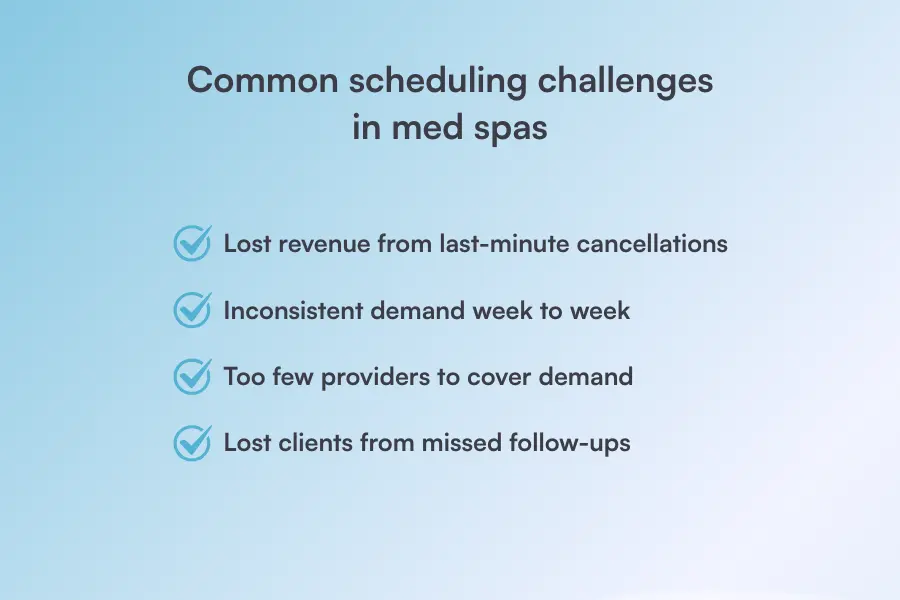
Illustration: Pabau
Let’s take a closer look at how each one can impact your business:
A waitlist won’t prevent every problem, but it helps you recover faster when the schedule takes a turn.
You don’t need a finance degree to see how unfilled slots drain your profitability over time.
The American Med Spa Association’s 2024 report puts the average visit at $527. Miss four a week, and that’s over $100,000 gone by year’s end.
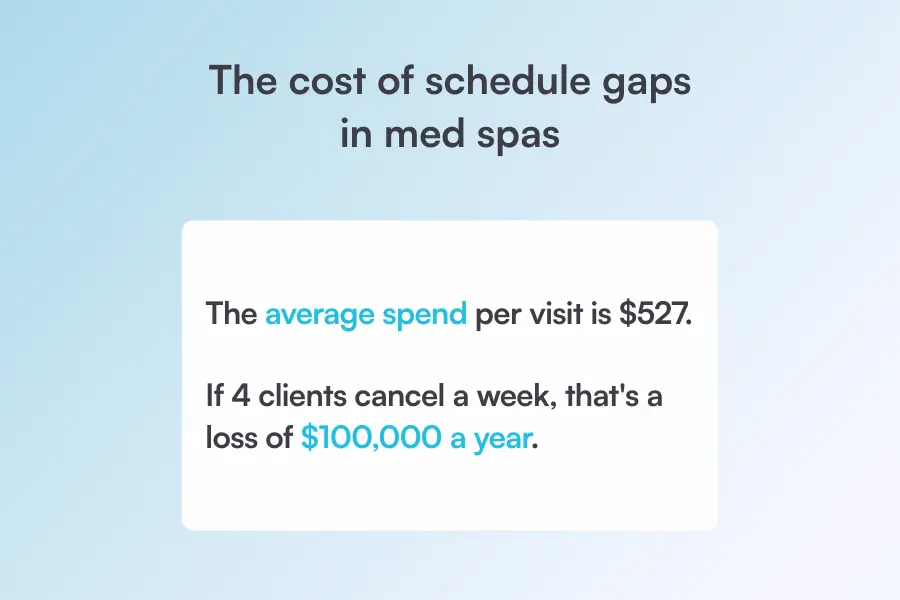
Illustration: Pabau / Data: AmSpa
Multiply that across a couple of treatment rooms or locations, and the numbers get uncomfortably big.
This is exactly why strategic waitlist management pays for itself many times over.
A smart waitlist is a practical, strategic tool that does more than keep your schedule full. Here are a few benefits you’ll see when you put it to work:
People remember when you offer them an earlier spot. Even if they don’t take it, the gesture feels genuine. That small touch is what keeps them coming back instead of browsing around for their next appointment.
The numbers speak for themselves. A study in the Journal of Medical Internet Research found that appointments moved through an automated waitlist were 38% less likely to become no-shows.
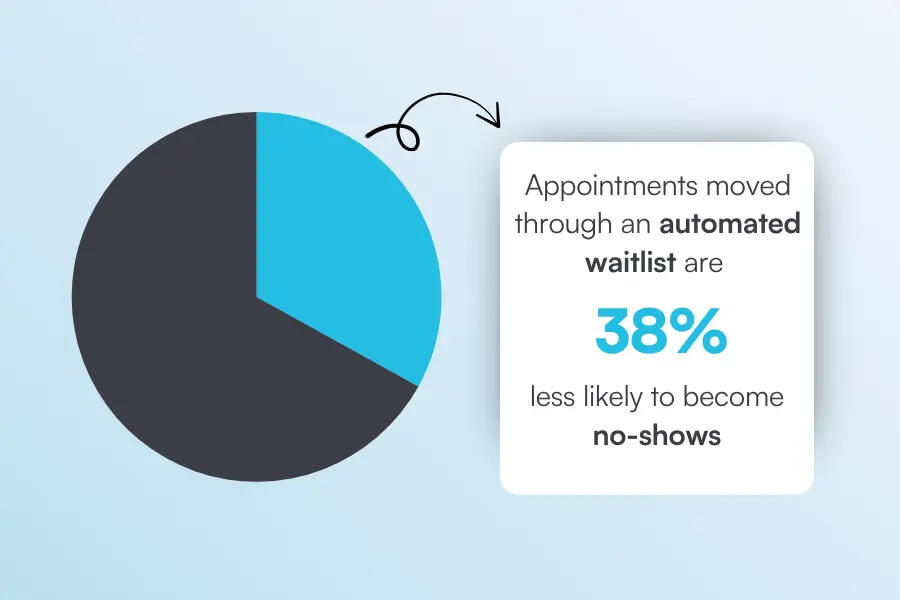
Illustration: Pabau / Data: JMIR Publications
In plain terms, that’s more clients on the table and less time watching the clock.
A waitlist does more than patch holes in your schedule. It shows you exactly which treatments everyone wants and when they want them. Over time, you start to see patterns you can actually use to plan better and stay ahead of the rush.
At the end of the day, having a steady line of clients ready to book is still one of the easiest ways to keep your business thriving and your reputation strong.
A waitlist works best when it’s treated as part of daily operations, not a side project.
The goal is simple. Make it easy for clients to say yes when an appointment slot opens, and make sure your team knows exactly how to keep things moving.
Here’s how to build a system that does both.
Waitlists are most effective when you use them with intention.
Take a look at your calendar from the past few months, and you’ll start to see patterns. You might notice injectables are always the first to fill up, while evening appointments disappear faster than anything else on the schedule. That pattern tracks the most requested cosmetic procedures, where neurotoxins and fillers outrank every other treatment by volume.
Common scenarios worth setting up a waitlist for include:
By being selective, you keep your waitlist focused where it makes the biggest difference without piling on unnecessary work for the team.
Setting up an appointment waitlist takes only a few minutes in your scheduling software. What you collect at that moment is what decides how well it works.
A waitlist is only as good as the details you collect. If all you have is a name and a phone number, you’ll spend half your day tracking people down or trying to figure out which treatment they were hoping for.
It helps to set a standard for the information you gather up front. At a minimum, include:
Some practices also add an “urgency level,” so you know who’s willing to drop everything for a last-minute opening.
Having this information in one place saves your team time and makes it far easier to match the right client to the right slot without second-guessing.
Manual waitlists eat time. You could spend an afternoon calling everyone on the list one by one, or let your software handle the booking process in seconds.
With medical spa software that offers online booking, the moment an appointment opens up, the system matches it to the right waiting clients. Your team sends them a text or email to claim the slot in one click, or clients book it themselves through your online booking portal. Confirmations go through right away, leaving no doubt about who’s booked in.
Here’s a simple sequence that turns an open slot into a booking, without a single phone call:
Set it up once, and automated waitlist management handles the matching and the admin every time a slot opens.
Every name on your waitlist is a clue about what your clients value. Over a few weeks, those names start to show clear patterns you can actually act on.
If your Tuesdays are always overbooked or everyone’s waiting for a specific treatment, that’s more than just interesting. It’s a reason to tweak your schedule or open up extra spots.
Those patterns also tell you where to add staff or hours. If injectables always sell out on Fridays, that’s when to put your busiest providers on the floor. A full waitlist is a direct way to increase bookings on days that would otherwise run quiet.
Using this data means you’re not relying on hunches. You’re planning your schedule and staffing around what clients actually book.
If you’re going to have a waitlist, make it work for you.
These best practices help you fill slots faster, keep clients happy, and get more value out of every opening.
If everyone ends up in the same bucket, you’re bound to waste time offering the wrong slots to the wrong people.
Grouping clients by what they’re waiting for, like injectables, Hydrafacial sessions sessions, or consultations, makes it faster to match them to openings they’ll actually want.
Some practices also tag their most loyal or high-value clients and reward them with priority booking in the waitlist as part of their loyalty programs or memberships.
Think of it like a fast pass. Regulars get first choice when your schedule frees up. It’s a simple way to show appreciation while keeping your most valuable relationships strong.
You don’t have to frame your waitlist as a last resort.
Position it as an exclusive perk for clients who want first dibs on prime times. Instead of saying, “I’ll put you on the list,” try, “I can add you to our priority list for any earlier appointments.”
That small shift makes clients feel looked after, not parked on hold. Over time, it also builds the sense that your schedule is in high demand, which it is.
You can also pair the priority list with targeted promotions, so waitlisted clients get first access to seasonal offers.
Just because someone didn’t snag a spot doesn’t mean they’re gone for good. Reaching out to thank them for their patience or offering the next available appointment keeps the connection strong.
A quick check-in shows you’re paying attention and ready to help them book as soon as the timing works. It’s a simple habit that often leads to more loyal, long-term clients.
Most med spas would rather not run a separate tool for every job, a booking app here, a spreadsheet there, a CRM somewhere else. A waitlist works best when it lives inside the software you already use to run the practice, so an open slot, a client record, and a confirmation all connect.
When you compare waitlist management software, or a broader med spa scheduling software, medspa management software, a medspa CRM, or a med spa EMR, look for a few essentials:
Standalone waitlist software, or a generic salon and spa software with automated waitlist management, can handle the basics. The best medical spa software goes further and ties patient waitlist management software to the rest of your operations, records, payments, and marketing, so nothing sits in a separate place.
Waitlist depth varies widely between platforms. Comparisons like Aesthetic Record vs GlossGenius or Portrait Care vs PatientNow show how differently two systems can handle scheduling.
Pabau is an all-in-one practice management platform built for med spas and aesthetic practices, and its waitlist feature lets you:
It’s how you fill more slots, keep your team focused, and hold revenue steady without piling on admin.
A waitlist stops being a notepad afterthought the moment you treat it as part of daily operations. Capture the right details up front, let your software match open slots to waiting clients, and send the offer the instant something frees up.
Do that, and a cancellation becomes a booked appointment instead of lost income. Your calendar stays full, your no-show rate drops, and your regulars get the earlier slots they were hoping for.
Want to see it work on your own schedule? Book a free demo and watch Pabau fill an open slot from your waitlist in real time.

Want the full business case? Waitlist benefits breaks down what a proactive waitlist adds beyond filling cancellations.
Trying to book more clients? Increase bookings turns a full waitlist into steady, recurring revenue.
Promoting your open slots? Waitlist marketing shows how to position the list as a VIP perk clients want in on.
Yes. Good med spa software links each client’s treatment plan to their record, so a course of treatments or a review can be scheduled or offered automatically before the client leaves. If the ideal slot is full, the same system can add them to the waitlist for an earlier opening.
Pabau brings the calendar, online booking, and automated reminders into one place. Clients book or join the waitlist online, receive SMS and email reminders before their visit, and the schedule updates on its own when plans change.
Most med spas don’t outsource scheduling, they automate it. Instead of paying an answering service, let scheduling and waitlist software handle bookings, reminders, and slot-filling, then use the waitlist’s demand data to plan staff around your busiest days.
Yes. Waitlist management for practices and medical practices works the same way it does in a med spa. Patient waitlist management fills cancellations, cuts no-shows, and keeps providers busy, whether you run an aesthetic practice, a dermatology office, or a wider healthcare setting.
A waitlist turns demand you’d otherwise lose into booked appointments. Every cancellation gets refilled, popular treatments and peak times keep a ready line of clients, and slow days can be topped up from the list instead of sitting half empty.