HD Brows consultation form: Free template and guide
HD Brows is a seven-step brow treatment that combines consultation, tinting, wax...

2
Last Updated: Oct 13, 2026

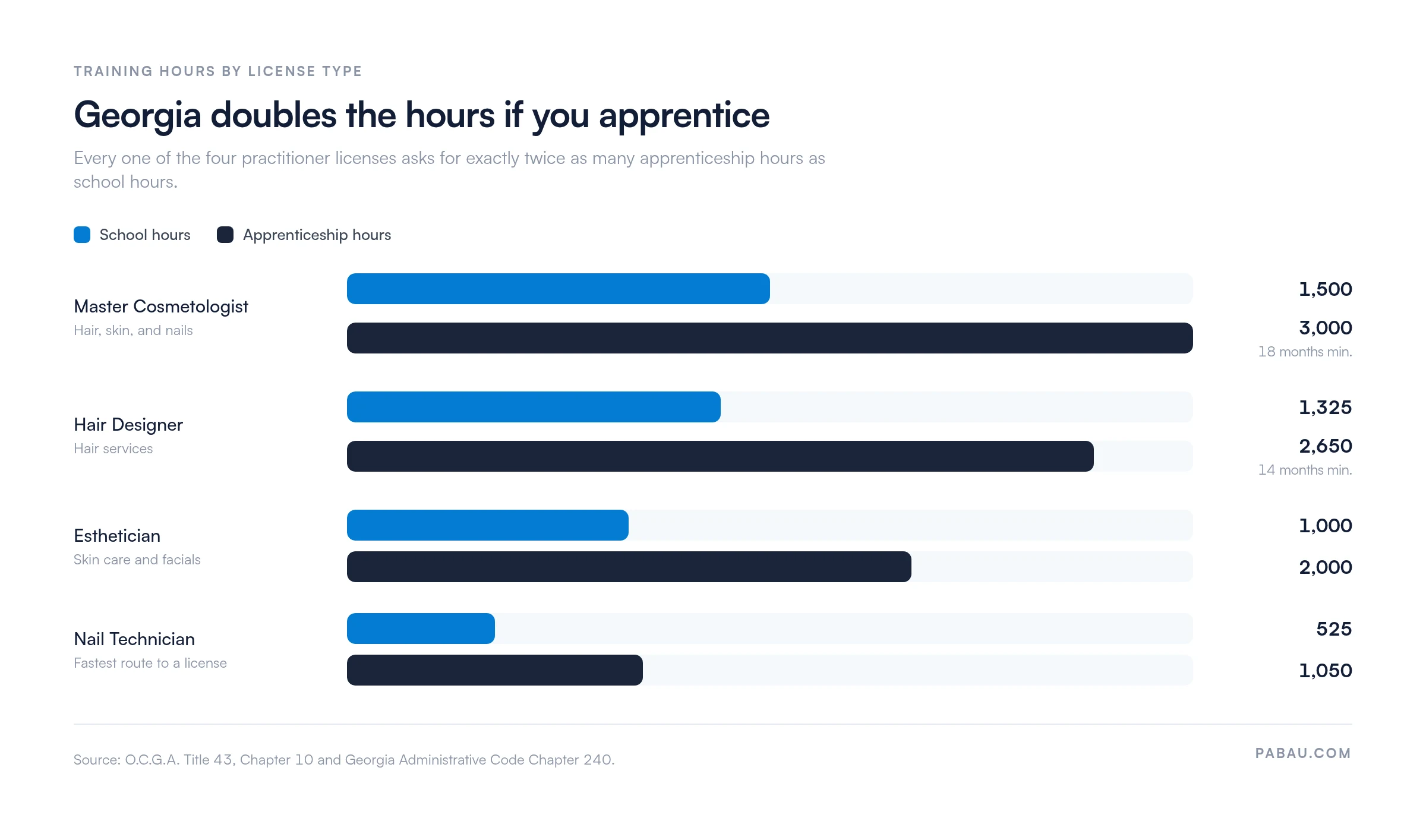
A Master Cosmetologist license needs 1,500 school hours or 3,000 apprenticeship hours.
State and exam fees total about $139 before tuition: $30 to apply, $45 written exam, $64 practical.
Licenses run two years and expire March 31 of even-numbered years. Renewal costs $50 plus five continuing education hours.
A Georgia cosmetology license covers hair, skin, and nail services. Lasers and injectables answer to two different boards.
Out-of-state licenses transfer by endorsement, reviewed case by case. Georgia publishes no list of automatic reciprocity states.
Georgia cosmetology license requirements change depending on which license you apply for. The Georgia State Board of Cosmetology and Barbers issues four practitioner licenses plus a separate instructor credential. Each one carries its own training-hour count.
The rules live in O.C.G.A. Title 43, Chapter 10. The Georgia cosmetology state board rules and regulations sit in Chapter 240 of the Georgia Administrative Code. Some schools still call the agency the Georgia State Board of Barbering and Cosmetology, and it is the same body.
Cosmetology license requirements are set state by state, so hours you earned elsewhere don’t carry over automatically.
This guide also answers a second question the board’s own pages leave open. A Georgia cosmetology license covers hair, skin, and nail services. Lasers and injectables answer to different boards entirely. That boundary decides who can legally run a laser device or inject in a Georgia practice.
Georgia’s four practitioner licenses run from 525 to 1,500 school hours. All four carry the same $139 in state and exam fees. The table below sets out the GA cosmetology license requirements side by side.
That $139 breaks down into a $30 application fee, a $45 written exam fee, and a $64 practical exam fee. School tuition sits on top and the state doesn’t set it. Full-time students finish 1,500 hours in roughly nine to 12 months.
Meet the eligibility rules, complete your training hours, pass two exams, then apply to the board. Four steps, and the training hours are the long one.
The board sets a minimum age and a general education requirement, usually a high school diploma or GED. Both sit in Chapter 240 of the Georgia Administrative Code. Check the current wording there before you enroll anywhere, because a school’s summary page is not the rule.
You can train at a licensed school or through a registered apprenticeship. The apprenticeship route roughly doubles the hours. A Master Cosmetologist needs 1,500 school hours or 3,000 apprenticeship hours over at least 18 months. An Esthetician needs 1,000 school hours or 2,000 apprenticeship hours.
Apprentices have one deadline the school route doesn’t. Under O.C.G.A. § 43-10-13(c), an apprentice must sit the theory exam within the first 12 months of the apprenticeship. Miss it and the apprenticeship record itself is at risk.
Both exams come from PSI Services LLC, which administers the National Cosmetology Examination. You need 70% or higher on each, and passing one does not carry the other.
The written exam covers theory: sanitation, infection control, chemistry, and state law. The PSI cosmetology practical exam in Georgia is a separate sitting with its own $64 fee, and it scores hands-on work. Budget for both when you plan your dates.
File the application with the board and pay the $30 fee. The board issues the license once your hours, your exam results, and your application all line up on file. Incomplete school-hour documentation is the usual reason a file stalls.
The Master Cosmetologist license is the broadest of the four. That one credential covers hair, skin, and nail services. The other three are narrower and faster to earn.
A master cosmetology license is also the usual base for practitioners who later add an instructor credential. The same license is one of the qualifying base licenses for the state’s entry-level laser credential, which the laser section below covers in full.
Natural hair braiding is exempt from cosmetology licensing in Georgia entirely. No age, hours, exam, fee, or application requirement applies. O.C.G.A. § 43-10-1 defines the work and excludes it from the chapter.
The statutory definition covers twisting, wrapping, weaving, extending, locking, or plaiting hair. That work can be done by hand or with a mechanical device, and it uses no chemicals or dyes. Step outside that definition and the exemption ends. Washing a client’s hair or applying a chemical treatment puts you back under the full license requirement.
Georgia cosmetology licenses run two years and expire March 31 of even-numbered years. Renewal costs $50 plus five continuing education hours.
Those five hours split into two parts:
Two exceptions are worth knowing. The first renewal after initial licensure is exempt from continuing education. Instructors carry a heavier load instead, at 15 hours per cycle, and at least 7.5 of those must be in teaching methods.
Cosmetology license renewal online is the board’s standard route. Renewals run through GOALS, the Georgia Online Application Licensing System. Log in with the account tied to your license. Georgia State Board of Cosmetology license renewal closes on the expiration date, not at the end of the month you happen to notice it.
A license expired less than six months can be renewed with a late fee. Past six months, the board may require you to reapply rather than renew.
The continuing education bill does not pause while a license sits lapsed. O.C.G.A. § 43-10-10 requires you to make up every hour missed since the license expired. There is no waiver for hours you skipped, so a license left lapsed for two cycles comes back with 10 hours owed.
Georgia reviews out-of-state applicants case by case under O.C.G.A. § 43-10-9, and publishes no list of automatic reciprocity states. Endorsement is the process, and a complete file is what moves it.
You will need:
The endorsement application fee is $50. Processing typically takes four to six weeks once the file is complete. License verification from the other state is usually the slow piece, so request it first rather than last.
Because there is no fixed reciprocity list, an hour shortfall against Georgia’s numbers can mean make-up training. Compare your original program’s hours against the cosmetology license requirements in Georgia listed above. Our guide to Texas cosmetology license requirements sets out that state’s hours if you are moving between the two.
A Georgia cosmetology license covers hair, skin, and nail services only. The license never authorizes injectables, and never authorizes a laser device on its own. It sets the floor for a beauty practice and stops well short of medical work.
That distinction matters the moment a salon starts thinking about a laser hair removal room or a filler menu. Two separate boards take over, and neither of them is the cosmetology board. In practices we onboard, the esthetician-to-laser route is the question owners raise most often.
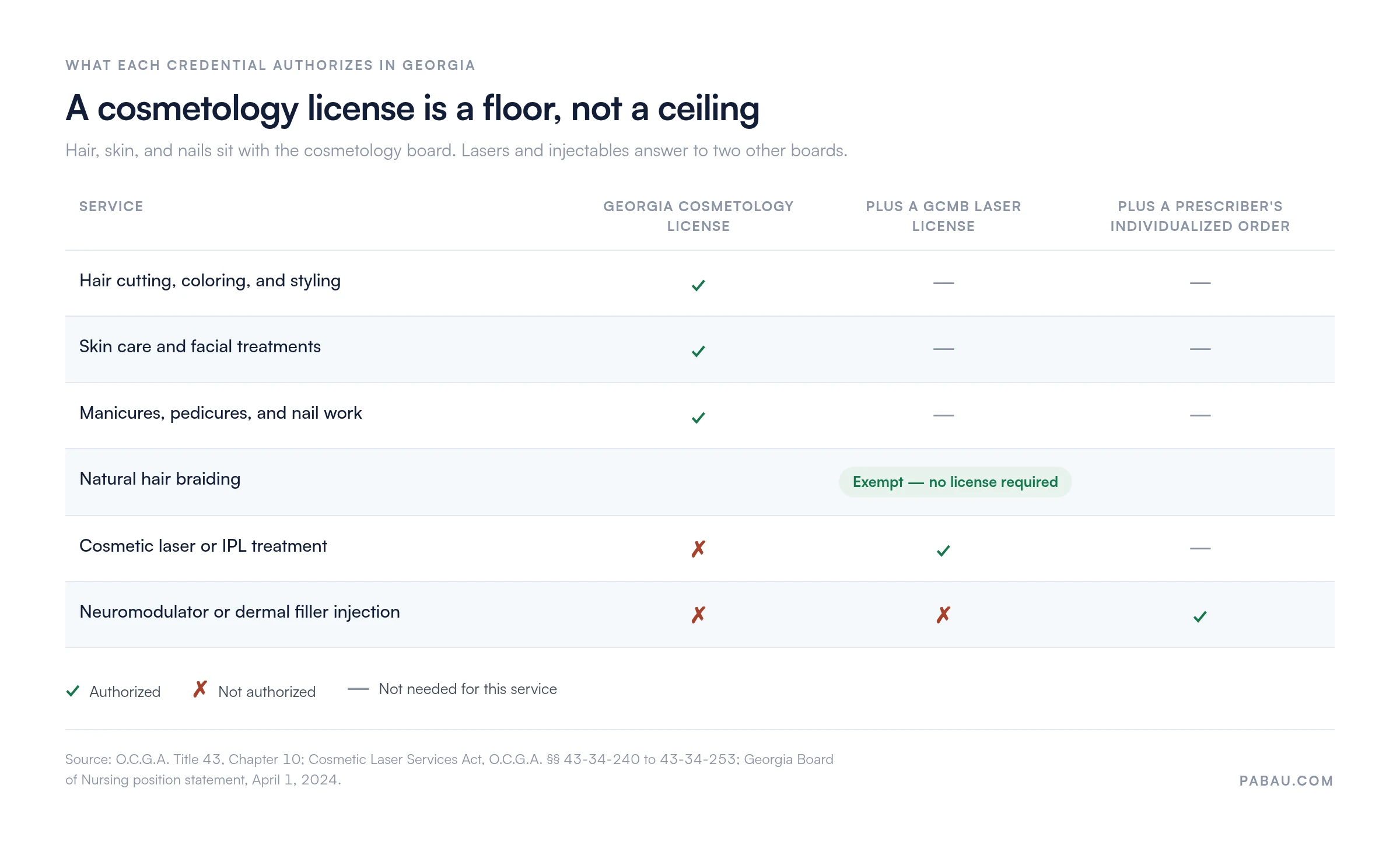
A cosmetic laser or IPL device in Georgia requires a Georgia Composite Medical Board license. The Georgia Composite Medical Board, or GCMB, is a different agency from the cosmetology board. IPL means intense pulsed light, used for hair removal and skin rejuvenation.
The Georgia Cosmetic Laser Services Act, at O.C.G.A. §§ 43-34-240 through 43-34-253, creates two tiers. The Assistant Laser Practitioner works under supervision. The Senior Laser Practitioner does not.
Read the base-license row closely. A licensed esthetician or master cosmetologist is eligible to apply for the Assistant tier, alongside PAs, LPNs, and RNs. Neither a cosmetology license nor an LPN license reaches the Senior tier. That tier takes a PA, an RN, or an APRN.
So a Georgia cosmetology license is a valid starting credential on the path to running a laser. The GCMB license is the authorization to switch the device on. Hiring an esthetician and buying a laser does not get a practice there on its own.
A Georgia cosmetology license carries no authority to inject neuromodulators or dermal fillers. No training course changes that. Botox is a neuromodulator brand, and these injections count as medical procedures in Georgia.
The Georgia Board of Nursing set the terms in its position statement on cosmetic and aesthetic procedures, issued April 1, 2024. An RN may perform these injections only under an individualized order from a physician, APRN, or PA. That prescriber must first complete a personal history and physical exam of the patient.
Standing orders are not an acceptable substitute for that individualized order. The Board made the point twice in bold, which tells you how often it gets ignored. LPNs are prohibited from performing cosmetic or aesthetic injections at all.
APRNs sit under one more requirement. An APRN providing or delegating these aesthetic services needs a written Nurse Protocol Agreement with a delegating physician. That comes from O.C.G.A. § 43-34-25 and GCMB Rule 360-32.
Georgia has no standalone corporate practice of medicine statute today. Licensing law reaches nearly the same place. Corporate practice of medicine, or CPOM, is the doctrine that restricts ownership of a medical practice to licensed physicians.
Georgia’s original prohibition, former O.C.G.A. § 43-34-37, was repealed in 1982. CPOM principles survived inside two other places in state law:
The practical outcome is a split. A cosmetology license lets someone perform, and even own, a pure beauty-services business. Add laser or injectable services and the clinical entity has to sit under a physician’s licensed control.
Owning the salon and controlling the medical service are two different legal questions in Georgia. Answering only the first one is how a compliant salon turns into a non-compliant med spa. Our guide to medical spa ownership rules walks through how other states draw the same line.
A Georgia practice selling facials, laser hair removal, and filler answers to three boards at once. The cosmetology board covers the estheticians. The GCMB covers the laser credential. The Board of Nursing covers the injector and the order behind every injection.
Practice management software like Pabau keeps the paperwork behind those boundaries in one client record. Consent forms attach to the treatment they belong to. Treatment notes tie to the provider who performed the service, so a laser session and a filler appointment each show who did the work.
Scheduling is where the license boundary gets enforced day to day. In software for med spas, service and provider setup means a laser appointment only reaches a provider you set up to perform it. Front desk staff stop guessing which team member is credentialed for which treatment. The calendar stops booking the wrong person into the wrong room.
If you are still shortlisting systems, our roundup of medical spa EMR software sets out what each platform covers.
If your Georgia practice is staffing across cosmetology-licensed and nursing-licensed providers, book a demo. We will walk through how the consent, notes, and provider records hold up if a board asks to see them.

Pabau ties each service to the providers set up to deliver it. Consent forms and treatment notes file against the provider who performed the work, so a board audit finds one record per treatment.

Getting licensed in Georgia is the straightforward half. Pick your license type, put in the hours, pass both PSI exams, pay your $139, and diary March 31 of the next even-numbered year.
The harder half is knowing what the license authorizes once you have it. Hair, skin, and nails are yours. A laser needs a GCMB credential on top, and an injectable needs a prescriber’s individualized order. Those are not formalities a busy practice can catch up on later.
If you are hiring across both sides of that line, the record-keeping is what proves you stayed on the right side of it. Book a demo and see what that looks like in one system.

Licensed in Texas instead? Texas cosmetology license requirements: hours, fees, and exams sets out that state’s hour counts and exam route.
Moving a license from the West Coast? California cosmetology license requirements and application steps covers the hours and the exam California asks for.
Adding lasers or injectables to the menu? Who can open a medical spa? State ownership rules shows how other states draw the ownership line.
A Master Cosmetologist needs 1,500 school hours or 3,000 apprenticeship hours. Estheticians need 1,000 school hours, and nail technicians need 525. Hair Designers need 1,325 school hours.
Yes, through endorsement under O.C.G.A. § 43-10-9, reviewed case by case. Georgia has no fixed reciprocity list. You will need an active license in good standing, proof of hours, board verification, and exam records. The fee is $50 and processing usually takes four to six weeks.
No, apart from natural hair braiding. Any hair service outside the braiding exemption in O.C.G.A. § 43-10-1 needs a Master Cosmetologist or Hair Designer license. Washing or chemically treating hair crosses that line.
No. Georgia excludes natural hair braiding from cosmetology licensing entirely. No hours, exam, fee, or application apply. The exemption covers twisting, wrapping, weaving, extending, locking, and plaiting without chemicals or dyes.
Barbers, hairstylists, and cosmetologists earned a national median of $35,420 in May 2024. That figure comes from the Bureau of Labor Statistics and works out to $17.03 an hour. Third-party salary estimators put the Georgia average lower, around $29,000 to $31,000. Those are private estimates rather than BLS state figures.
Use GOALS, the Georgia Online Application Licensing System, which also handles renewals. A lookup is worth running before you hire, so you can confirm a candidate’s license is active rather than lapsed.
No, neither treatment is covered. A laser or IPL device needs a Georgia Composite Medical Board license under the Cosmetic Laser Services Act, O.C.G.A. §§ 43-34-240 through 43-34-253. An esthetician or master cosmetologist qualifies only for the supervised Assistant Laser Practitioner tier. Injectables sit with the Georgia Board of Nursing, which requires a prescriber’s individualized order.