Health appraisal form
A health appraisal form is a record a licensed provider signs to document someon...

2
Last Updated: Oct 13, 2026

Tebra targets solo and small independent practices under 10 providers, while eClinicalWorks suits mid-to-large primary care groups and FQHCs with heavier workflows.
eClinicalWorks carries the deeper RCM offering, though its claims route through TriZetto Provider Solutions, a third-party clearinghouse rather than one it owns.
Tebra holds 3.9/5 on Capterra from roughly 1,380 reviews, and eClinicalWorks holds 3.3/5 from roughly 396, with support complaints recurring on both.
Tebra publishes per-provider monthly pricing, while eClinicalWorks quotes only after a demo and often ties larger practices into multi-year contracts.
Practices running on private pay, aesthetics, or wellness services may fit neither platform, so practice management software like Pabau is worth a look.
Tebra vs eClinicalWorks is rarely a close call once you know your own numbers. Both platforms are built around US insurance billing, but they were designed for practices at opposite ends of the size range. Tebra grew up serving the solo physician. eClinicalWorks grew up serving the 20-provider primary care group.
Pick the wrong end and you pay twice, first in setup fees and then in the months a second migration takes. So the question worth answering is which platform matches your provider count, your payer mix, and the implementation your team can absorb.
The sections below work through documentation, billing, pricing, and go-live time, in the order that usually settles it.
Practice size drives most of the differences below, so read the first row before the rest of the table.
Tebra is a cloud EHR and practice management platform for independent medical practices. It came out of the Kareo and PatientPop merger, which closed in November 2021. The unified Tebra brand finished rolling out by the first quarter of 2022. Most of its customers run fewer than 10 providers.
The pitch is simplicity. One platform covers clinical documentation, scheduling, insurance billing, and patient communications, with no dedicated IT team required. The Kareo side brought billing infrastructure tuned for US payers. From PatientPop came SEO and reputation tools that legacy EHRs rarely touch.
eClinicalWorks is one of the largest independent EHR vendors in the US, serving over 180,000 providers by its own count. It aims squarely at mid-to-large primary care groups, federally qualified health centers (FQHCs), and multi-specialty practices.
Those buyers want specialty documentation templates, population health management, and FHIR-compliant data exchange. Large health systems are Epic’s core market, so our eClinicalWorks vs Epic comparison is the better guide if your organization is that size.
One piece of history is worth knowing before you sign a long contract. In 2017, eClinicalWorks paid a $155 million settlement with the US Department of Justice over false claims about its EHR certification status.
The company has updated its compliance practices since, but the settlement is part of the public record.
Start with charting, because it is the screen your clinicians live in all day. Tebra keeps it accessible. SOAP note templates are customizable and built for the generalist workflow, and an AI scribe cuts the typing during and after an encounter. For a solo family medicine physician seeing 20 to 25 patients a day, that simplicity pays off.
eClinicalWorks goes considerably deeper. It ships specialty-specific templates across dozens of care areas and an AI scribe, called Scribe, that sits inside the charting workflow.
Its FHIR-compliant interoperability supports data exchange under the 21st Century Cures Act. For a multi-specialty group or an FQHC coordinating care across providers, that depth earns its keep.
Charting is a daily annoyance. Billing is where the money is, so this is the difference that shows up in your bank account. Tebra checks insurance eligibility in real time, submits claims, and surfaces denials inside the same system that holds the chart.
The path a claim takes is the same on both platforms, and it is worth walking once. First the encounter closes and the charge posts.
Next, the claim gets scrubbed against payer rules. A clearinghouse then relays it to the payer, and the remittance or the denial lands back in the same work queue.
eClinicalWorks goes deeper on the service layer rather than on the pipes. It sells outsourced RCM, so a practice can hand off coding, submission, and follow-up completely. Its claims still travel through TriZetto Provider Solutions, a third-party clearinghouse, not one eClinicalWorks owns.
EBO stands for eClinicalWorks Business Optimizer, which is a reporting and analytics tool. It tells you where revenue is leaking, but it never clears a claim. So treat any mention of an in-house eClinicalWorks clearinghouse with care.
For a 15-physician group billing across many payers, that service depth earns its cost. A three-physician practice ends up paying for overhead nobody switches on.
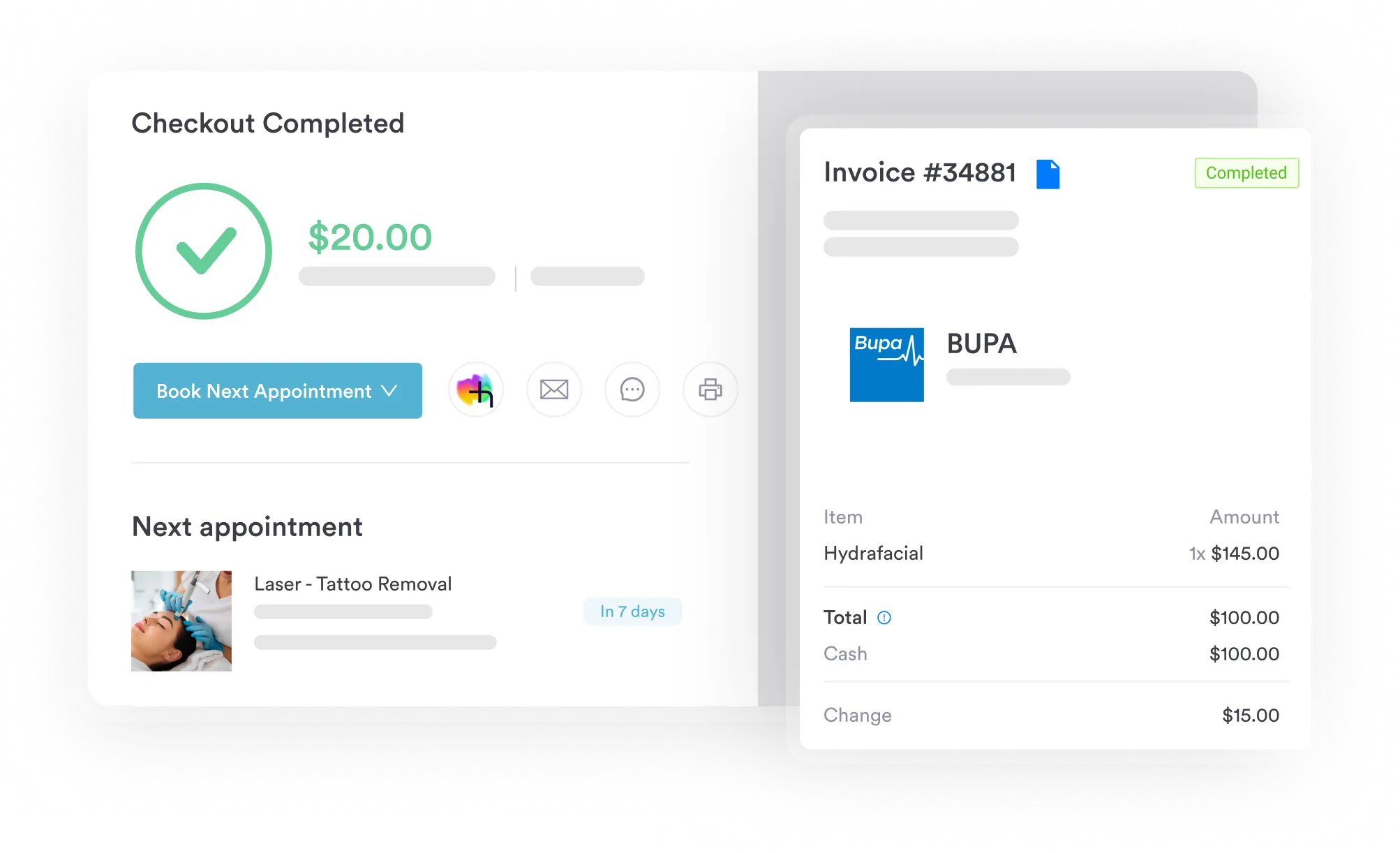
Both platforms support claims management workflows, but the scale they are tuned for differs by roughly an order of magnitude. At the far end of that spectrum, checkout looks like the screen below.
Neither platform saves you from a sloppy front desk. Run these five before the claim leaves the building.
Practices switching platforms usually blame the software for denials that started with a missed eligibility check. Fix the workflow first, then judge the vendor.
The same size pattern repeats in the calendar. Tebra’s scheduling module is built for one site and a short provider list.
Booking, calendar management, and patient self-scheduling all work without heavy configuration. Real-time eligibility checks also let the front desk confirm coverage before the patient arrives, rather than after the visit.
eClinicalWorks handles scheduling at scale. Multi-provider and multi-location calendars, population health outreach, and tight links between the calendar and the chart give it the edge for larger groups.
The trade-off is configuration. Getting those workflows right takes time and expertise, which is one reason implementations regularly run three to six months.
Patients feel this difference more than staff do. Healow bundles a patient portal, telehealth visits, self-scheduling, secure messaging, and population health tools into one patient-facing app.
For a primary care group chasing chronic disease panels and preventive care outreach, those outreach features are hard to replicate with a basic portal.
Tebra covers the essentials instead, with online scheduling, a portal, automated reminders, and two-way messaging. For a small independent practice, that scope is usually enough.
Where Tebra pulls ahead is its PatientPop inheritance. It ships built-in tools for online reviews, local SEO, and marketing that traditional EHR vendors leave out.
Both platforms include telehealth. eClinicalWorks runs video visits inside Healow, and the charting flows straight back into the record.
Tebra also offers telehealth, though reviewers report that integration depth varies and some workflows need extra configuration. If telehealth is a core service line rather than an occasional option, eClinicalWorks is the more mature build.
Features rarely kill a deal. Price structure often does. On Capterra, quote-only pricing and multi-year commitments are two of the most common eClinicalWorks complaints.
Buyers get a number only after a demo, and larger implementations tend to land on multi-year terms that are awkward to exit.
Tebra is more straightforward, with a per-provider monthly structure you can budget against. Reviewers on G2 do note that price rises since the merger have pushed some smaller practices to shop around.
Our breakdown of Tebra pricing walks through what sits inside each line. eClinicalWorks reviewers on G2 raise similar frustrations about total cost once training is counted.
Ask both vendors for a fully loaded cost estimate, not a monthly rate. That means base subscription, implementation, training, data migration, and any ongoing support tier. eClinicalWorks in particular can look affordable per user while carrying implementation overhead that only shows up after you sign.
Price gets agreed in a week. Go-live is the part that eats your year. Tebra’s onboarding is deliberately light, and a solo or small-group practice can expect to be working in weeks rather than months.
Activating the full PatientPop marketing suite adds setup work, but the core EHR and billing timeline stays manageable.
eClinicalWorks implementation is a different category of project. Three to six months is normal for a mid-sized primary care group. Practices with a complex payer mix, a large data migration, or several locations often take longer, and every clinical and administrative role needs dedicated training.
Two problems blow up timelines more often than any vendor failure does. Dirty data in the old system turns a two-week migration into a two-month clean-up. And payer enrollment slips when nobody in the practice owns it, which leaves you live on the new system but unable to bill.
Review scores are a blunt instrument, so here is what sits behind them. Tebra’s strongest marks come from small practices that want an integrated, low-overhead system. eClinicalWorks pulls ahead on depth, but its frustration clusters around onboarding and support rather than the feature set itself.
Feature lists rarely settle this. Practice size and billing model do, and they answer in that order. Work down the two questions below before you book another demo.
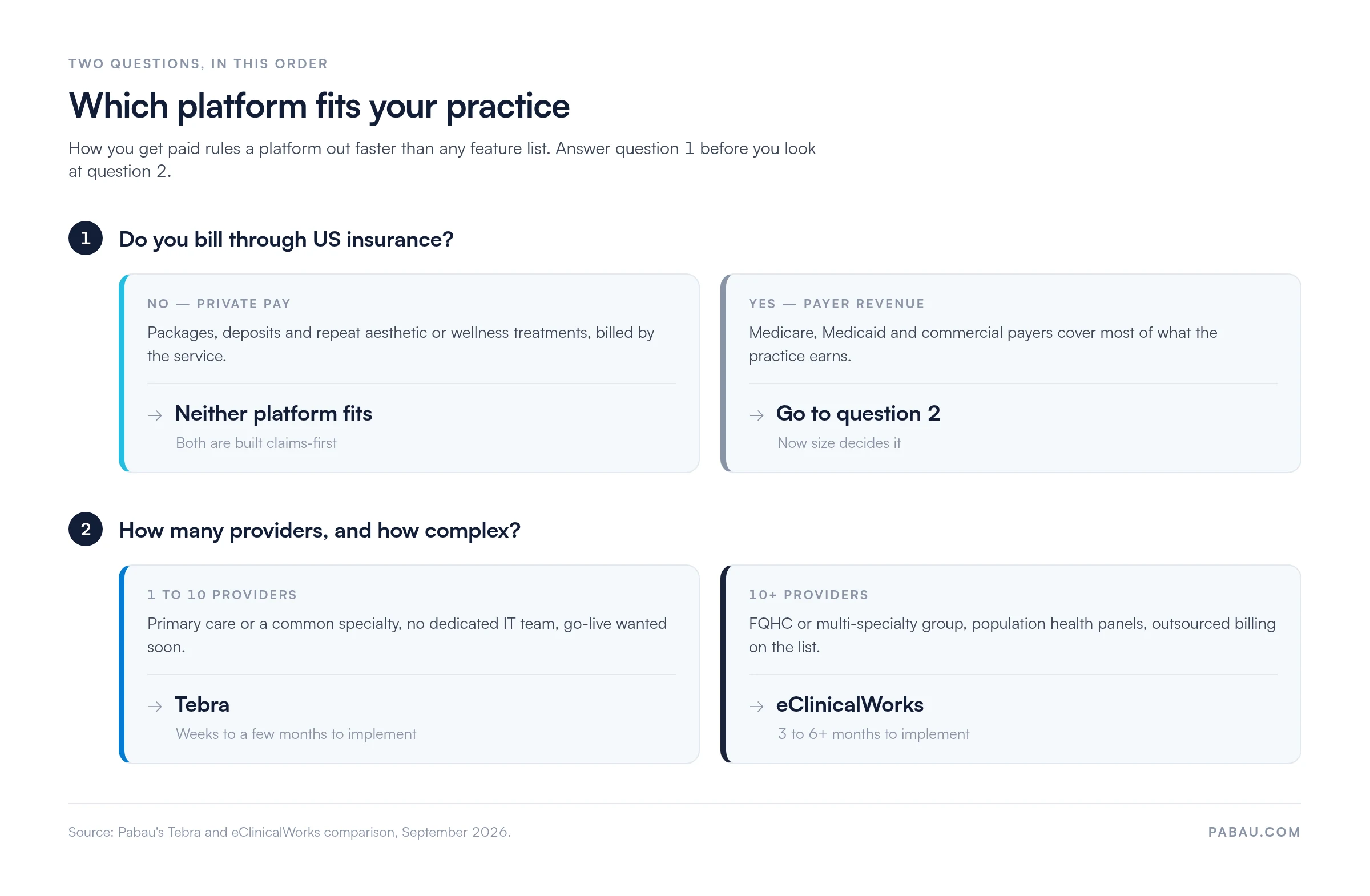
Watch for one pattern in particular. Small practices that buy eClinicalWorks for its breadth often end up paying to maintain infrastructure they never switch on.
Practices that buy Tebra for its simplicity sometimes hit a ceiling as they grow. If you are already in that second group, the shortlist of Tebra alternatives is a sensible next read.
Both platforms are built around US insurance billing. That is a deliberate design choice, and it makes each a strong tool for practices whose revenue depends on Medicare, Medicaid, and commercial payers.
For practices running on private pay, packages, or service models outside primary care, the same architecture turns into friction.
An aesthetics practice billing for Botox, dermal fillers, and laser treatments by the service does not need prior-authorization workflows. It needs deposits, treatment plan tracking, before-and-after photos, and retention campaigns.
Practice management software like Pabau is built for that work. It covers procedure-centric charting, online booking, automated reminders, recall campaigns, and invoicing for fee-for-service treatments.
Pricing is based on location and number of users, with no multi-year commitment. If you want the detail, see how Pabau compares against the platforms already on your shortlist.

Pabau brings clinical documentation, scheduling, payments, and patient communications into one platform built for aesthetics, wellness, and private-pay practices. No claims clearinghouse to manage, and no multi-year contract.

Size decides this one. If your practice bills insurance and runs under 10 providers, Tebra gets you working sooner and costs less to keep running. A larger group or an FQHC is a different case, because multi-specialty charting and outsourced billing are where eClinicalWorks scales and Tebra does not.
The trade-off worth remembering is that you are buying an implementation, not only software. A platform your team never finishes configuring costs more than the one you almost picked.
And if your revenue does not come from claims at all, the whole comparison changes shape. Book a demo to see how Pabau handles charting, booking, and payments for a private-pay practice.

Weighing Tebra against a smaller-practice EHR? Tebra vs DrChrono compares the two on charting, billing, and how quickly each one goes live.
Shortlisting budget-friendly EHRs? DrChrono vs Practice Fusion looks at what independent practices give up at the lower price point.
Still building your shortlist? Pabau competitors and alternatives sets out how the main platforms differ by practice type.
No. Kareo merged with PatientPop in November 2021, and the combined company rebranded as Tebra, with the rollout finishing in early 2022. Kareo’s billing engine still sits underneath the platform, so older Kareo guides often describe workflows that still apply. Anything branded Kareo today is legacy naming.
No. Healow is eClinicalWorks’ patient-facing product family, covering the portal, telehealth, and self-scheduling. Patients download the Healow app, while staff work inside eClinicalWorks. Buying eClinicalWorks is what gets you Healow, so you do not shop for it separately.
Plan for a quarter, not a weekend. Demographics, insurance details, and open balances usually migrate cleanly. Clinical notes often arrive as PDFs rather than structured data, so historic problem lists and results may stop being searchable. Check your exit terms and payer enrollment before you set a go-live date.
Usually not. Both are built around insurance claims, while aesthetic revenue comes from packages, deposits, and repeat treatments. A med spa needs treatment plan tracking, before-and-after photos, and retention campaigns, none of which sit at the center of either platform.