Journal prompts for mental health
Journal prompts for mental health are guided questions that help people process ...

2
Last Updated: Oct 13, 2026

The Stroop task is a neuropsychological paradigm that John Ridley Stroop published in 1935 to measure cognitive interference.
It times how long a patient takes to name ink colors when the word meaning conflicts, which indexes selective attention and inhibitory control.
The clinical version runs three cards at 45 seconds each, so a full administration takes about five minutes.
Clinical uses span ADHD evaluation, brain injury assessment, dementia screening, and schizophrenia research, always inside a broader battery.
Practice management software like Pabau keeps intake answers, interference scores, and clinical notes in one client record.
The Stroop task asks a patient to name the ink color of a word that spells a different color. It takes seconds to explain and about five minutes to administer. What it exposes is how efficiently the brain overrides an automatic response.
Ninety years after John Ridley Stroop published it, the paradigm still sits in neuropsychological batteries for ADHD, brain injury, dementia, and schizophrenia. Clinicians never use it alone. It holds its place because the interference score is quick, quantified, and comparable against population norms.
That score is also fragile. Fatigue, anxiety, and current medication all move it, which makes the record around the test as important as the test itself.
The Stroop task is a cognitive psychology paradigm in which participants name the ink color of a printed color word as fast as they can. The word either matches the ink or conflicts with it. Reaction time rises sharply on the conflicting trials, and that rise is the Stroop effect.
According to the American Psychological Association, John Ridley Stroop published the foundational paper in 1935 in the Journal of Experimental Psychology. It was titled “Studies of Interference in Serial Verbal Reactions,” and the procedure has been in continuous use ever since.
The formal clinical version is the Stroop Color and Word Test (SCWT), standardized for neuropsychological assessment. The SCWT produces normative scores by age and education level. That lets a clinician read one patient’s performance against population benchmarks rather than against an impression.
The underlying effect is a much broader research paradigm. It appears in hundreds of experimental designs that never touch the structured clinical instrument.
Administration is straightforward. Participants see stimuli one at a time or in rows, and name the ink color while suppressing the impulse to read the word.
Gorilla.sc’s task documentation describes the two conditions at the core of every version, congruent and incongruent. Many research designs add a third, neutral condition to give the baseline a cleaner comparison.
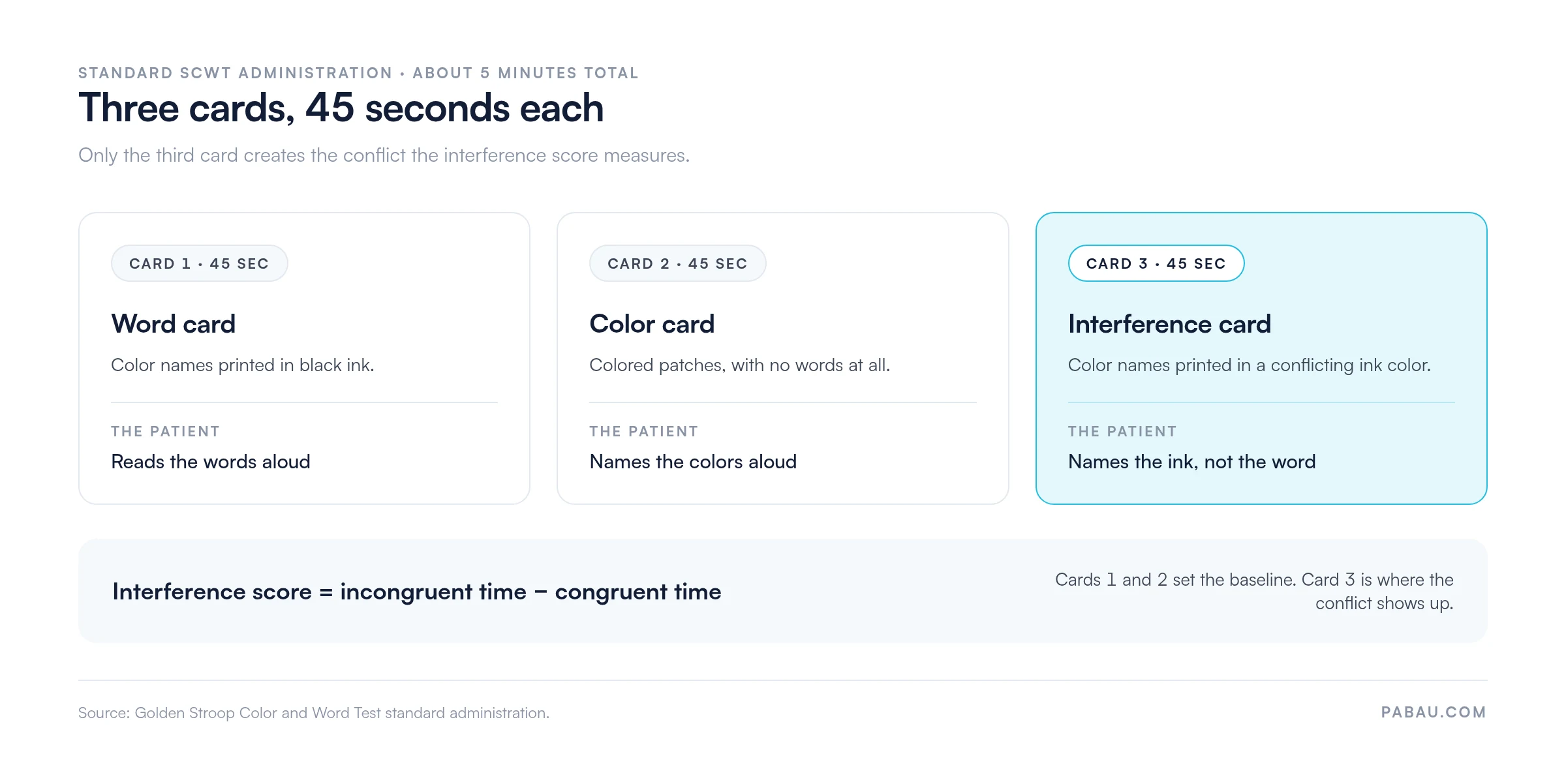
The difference in reaction time between the incongruent and congruent conditions is the interference score. That figure is the primary metric for clinicians and researchers. A larger interference score means more difficulty suppressing automatic word reading in favor of naming the color.
Standard administration uses printed cards or a computerized display. The clinical SCWT runs three cards in sequence, and only the last one puts the word and the ink in conflict. Each card is timed at 45 seconds, so a full administration takes approximately 5 minutes in total.
The order matters, because the first two cards establish the baseline that the third card is measured against.
Four cognitive constructs are indexed directly by the Stroop task. Each one maps to a distinct clinical or research use.
Working memory plays a secondary role in some versions. Computerized variants in particular ask participants to hold response rules in mind across long trial sequences.
Three theoretical accounts explain why incongruent stimuli slow responses. They disagree about where the interference actually comes from.
Processing speed theory: Word reading is faster than color naming because it has had far more practice. The brain finishes processing the word before the color, and the word response competes with the correct one. This account explains why the effect holds across almost every literate adult sample.
Selective attention theory: Attentional resources are limited. When word meaning and ink color conflict, attention has to actively exclude the irrelevant dimension. Individuals with stronger attentional control produce smaller interference effects.
Automaticity theory: Reading is so automatic in practiced readers that it cannot be fully suppressed. On this account the interference comes from the word’s meaning activating on its own, not from a speed difference. The theory predicts smaller Stroop effects in poor readers, which developmental studies have confirmed.
When you interpret a Stroop result, consider which account fits the patient in front of you. A patient with ADHD-related inhibitory deficits often shows the selective attention pattern. A patient with acquired reading difficulty after a brain injury may show a smaller Stroop effect. The automatic reading response that creates the interference is itself weakened.
The classic color-word format has produced several important variants. Each one targets a different dimension of cognitive or emotional processing.
The emotional Stroop task swaps the color words for emotionally charged ones, such as DEATH, FAILURE, or ATTACK. Neutral words like RELAX and SAFE act as the comparison set. Participants still name the ink color, but the salient words capture attention involuntarily and slow the response.
The variant is widely used in anxiety, PTSD, and depression research to measure attentional bias toward threat. Clinically, it shows whether a patient’s attentional disruption is domain-specific or general. A patient slowed only by trauma-related words points somewhere different from one slowed across the board.
The spatial Stroop replaces color words with directional words such as LEFT and RIGHT. Participants respond to the side of the screen where the word appears, not to what the word says. The reverse Stroop asks for the word and ignores the ink, which most adults find substantially easier.
Reading is the more automatic response, so removing the conflict removes most of the cost. Comparing the two directions helps isolate automaticity from attentional competition.
The Stroop task appears in neuropsychological batteries for a wide range of presentations. It is never a standalone diagnostic tool. It contributes one piece of evidence to a picture built from several measures.
For ADHD, the Stroop task is one of several executive function measures inside a full evaluation. Clinicians usually pair it with a behavioral rating scale, and our guide to the Vanderbilt ADHD rating scale covers that scoring. Together they give a multi-informant, multi-method read on attention.
In dementia work the Stroop task usually sits alongside a broader cognitive screen. The Montreal Cognitive Assessment covers memory, language, and orientation, while the Stroop task isolates the frontal control piece. Reading them together helps separate broad decline from a narrower loss of inhibitory control.
In psychiatric assessment more broadly, the task may sit inside a longer evaluation protocol. A psychiatric evaluation template keeps those multi-component assessments organized. The cognitive screen then gets documented next to the interview findings instead of in a separate note.
Three metrics come out of any administration of the Stroop task.
Clinical interpretation rests on age- and education-stratified norms. A score that looks poor in absolute terms can fall inside normal limits for an older adult. The same score in a young, highly educated patient may point to significant impairment. The SCWT manual by Golden and Freshwater supplies the most widely used reference tables.
Computerized versions capture reaction time to the millisecond, which paper administration cannot match. That precision is not the same as validation. For any formal assessment, use an instrument with published norms and psychometric data rather than a free online version.
Practices running neuropsychology, psychiatry, or ADHD assessment services hit the same problem once the testing is finished. The interference score lands in one place, the pre-assessment answers in another, and the interview notes in a third. Six months later, nobody can reconstruct the conditions the patient was tested under.
Practice management software like Pabau keeps the whole sitting in one client record. Digital intake forms go out before the appointment, so fatigue, anxiety, and current medication are captured while the answers are still accurate. The clinician then reads the interference score next to those answers rather than guessing at them.

Structured note templates then hold the interpretation itself. Different assessors describe an elevated interference score differently, and that variation makes a longitudinal comparison harder. Psychology practice software with shared templates keeps the wording consistent across the team and across visits.
Scheduling, documentation, and reporting all feed the same record in a practice that bills assessment work. Keeping them inside unified therapy practice management beats a testing folder that sits outside the clinical system.

Pabau keeps assessment documentation, digital intake forms, and client records in one place. Psychology and neuropsychology teams spend less time rebuilding a file and more time with patients.

The Stroop task earns its place in a battery because it is fast, quantified, and normed. Five minutes of cards produces a number a clinician can defend against population data.
That number is also easy to misread. It moves with fatigue, anxiety, and medication, and it says little without the age and education context around it. Capture those conditions at intake and the score stays interpretable at the next visit.
Pabau’s client records and digital forms keep the whole assessment in one place for neuropsychology and mental health teams. Book a demo to see how Pabau keeps cognitive screening documented and comparable across visits.

Pairing the Stroop task with an ADHD rating scale? Scoring the Vanderbilt ADHD rating scale walks through scoring and interpretation for the tool most often paired with it.
Documenting executive function findings? Executive function assessment gives you a form for recording the domains a Stroop result sits inside.
Running a full intellectual assessment? WAIS-IV template structures the recording and scoring of the battery the Stroop task often sits alongside.
The Stroop task is a cognitive psychology paradigm developed by John Ridley Stroop in 1935. Participants name the ink color of color words as quickly as they can. When the word meaning and the ink color conflict, such as the word GREEN in red ink, reaction time increases. That interference measures how well the brain suppresses automatic reading in favor of a controlled response.
The Stroop task measures selective attention, inhibitory control, executive function, and processing speed. Its interference score is the difference in reaction time between the incongruent and congruent conditions. That figure is the primary index of how well an individual manages cognitive conflict.
The Stroop effect demonstrates that reading is a highly automatic process that competes with deliberate, controlled processing. The brain cannot fully suppress a learned automatic response, even when suppressing it would improve performance on the task in front of it.
ADHD is associated with deficits in inhibitory control, which the Stroop task measures directly. Individuals with ADHD typically show larger interference scores and higher error rates on incongruent trials. The task contributes one objective measure to a broader ADHD evaluation that also includes interviews and rating scales.
The emotional Stroop task replaces color words with emotionally charged words such as THREAT, PAIN, or SAFE, printed in colored ink. Participants still name the ink color. In individuals with anxiety, PTSD, or depression, the salient words slow the response and reveal an attentional bias toward threat.
The standard Stroop Color and Word Test takes approximately 5 minutes in total. It runs three cards, each timed at 45 seconds, with instructions between them. That makes it one of the quickest measures in a neuropsychological battery.
The Stroop test is scored on raw reaction time, error rate, and the interference score, which is incongruent minus congruent reaction time. Results are read against age- and education-stratified normative data. A larger interference score points to weaker inhibitory control or executive function.