Punch excision aftercare instructions template
Punch excision is a minor procedure that removes a small cylinder of skin with a...

1
Last Updated: Oct 15, 2026

South Carolina requires 1,500 training hours at an LLR-approved cosmetology school, plus a written and practical NIC exam through Prov, each needing a 75% score.
The minimum age is 16, with a 10th-grade education or equivalent, and total state fees run about $165 before school tuition.
Licenses run on a fixed two-year cycle, expiring March 10 of odd-numbered years, with a $52 renewal fee and 4 hours of continuing education.
South Carolina has not joined the Cosmetology Licensure Compact, so out-of-state cosmetologists apply by endorsement instead of a multistate license.
A cosmetology or esthetics license never covers Botox, fillers, or laser treatments. Those sit with the Board of Medical Examiners and the Board of Nursing.
South Carolina’s cosmetology license covers hair, skin care, and nails. It stops short of every service the state classifies as practicing medicine. Getting one means 1,500 hours at an LLR-approved school, then two exams through the board’s testing vendor, Prov. Memberships and retail for spas that pair cosmetology services with medical treatments are covered in our roundup of the best med spa software.
Harder to pin down is where the license’s authority ends. An injectable or a laser crosses into medicine, as South Carolina’s Medical Practice Act defines it, and a different set of boards takes over.
This guide walks through the licensing steps every applicant needs. It also maps the scope-of-practice line that decides who may do what in a spa or aesthetic practice.
Getting licensed follows four steps, in order, with no shortcut around the training hours.
Applicants need to be at least 16, with a 10th-grade education or an equivalent the board accepts (S.C. Code §40-13-230(A)). There’s no separate background-check step before enrollment.
South Carolina requires all 1,500 hours to happen at a board-approved school. Unlike some neighboring states, it doesn’t accept an apprenticeship in place of school hours. The curriculum covers:
Both exams run through Prov, the board’s contracted vendor, and both need a 75% score. The written exam covers roughly the same curriculum as the school hours. The practical exam tests hands-on skills against a set checklist. That includes bringing a mannequin with hair long enough to demonstrate every required technique.
The application goes to LLR with a $45 fee, on top of the exam fees paid directly to Prov. Once LLR confirms the passed exams and completed hours, it issues the license.
South Carolina’s Board of Cosmetology issues five separate license types, each with its own hour requirement and its own narrower scope.
An esthetician’s scope is drawn tightly by statute. It covers skin care performed “for the sole purpose of beautifying the skin,” with nothing medical implied.
School tuition runs well beyond these regulatory fees and varies by program, so get a specific quote before enrolling anywhere.
Full-time students typically finish the 1,500 hours in ten to twelve months. Part-time or evening programs often stretch past a year. Add exam scheduling through Prov and LLR’s application processing, and most applicants are licensed within twelve to fifteen months of starting school.
South Carolina licenses out-of-state cosmetologists through endorsement, not a multistate license. To qualify, applicants need:
LLR asks for that training documentation because hour totals differ from state to state. Texas, for one, sets its own total rather than matching South Carolina’s 1,500, and the Texas cosmetology license requirements guide has that breakdown.
South Carolina has not joined the Cosmetology Licensure Compact. A compact-member license doesn’t transfer automatically, so endorsement is the only route in either direction for now.
Every South Carolina cosmetology license expires March 10 of odd-numbered years, regardless of when it was issued. The deadline is the same statewide, so it does not track the licensee’s birthday. Renewal costs $52 and requires 4 hours of board-approved continuing education.
Two groups skip the education requirement. Licensees with 15 or more consecutive years at age 60-plus qualify, as do those with 30 or more years at age 50-plus. A license that lapses can be reinstated for $152 within three years of expiration. Past that window, expect the board to require retraining.
Two legislative changes matter for anyone tracking this space. Act No. 162 (2022) let licensed barbers and master hair care specialists work inside a salon registered with the Board of Cosmetology. Before that, they were restricted to standalone barbershops.
Bill H.4186, introduced in 2025, would add a portable operations permit. It would also exempt basic services such as shampooing and thermal styling, without cutting or chemicals, from licensure altogether.
As of this writing H.4186 has not passed, and a floor vote request in May 2025 was objected to. Neither change touches the 1,500-hour training requirement.
A cosmetology or esthetics license authorizes hair, skin care for beautification, and nail services. It never authorizes injectables, lasers, or any service South Carolina’s Medical Practice Act defines as the practice of medicine (S.C. Code §40-47-20(36)). The matrix below plots where each service sits and what supervision it demands.
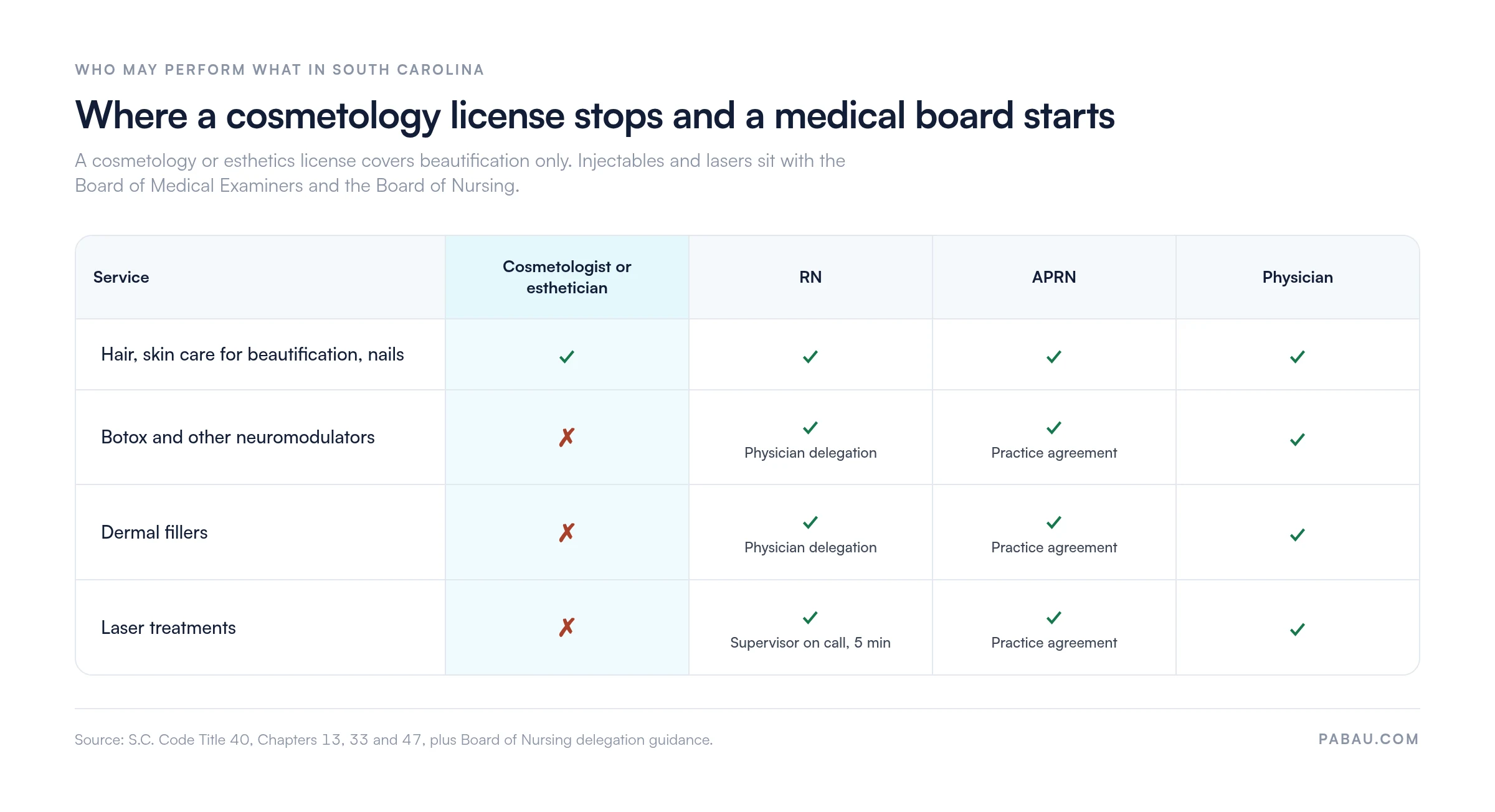
That line matters most to anyone opening or staffing a spa that offers both beauty services and medically supervised treatments. A written record of who may perform what keeps the two chains auditable, and our med spa compliance checklist covers the wider documentation set.
Three separate boards, all under LLR, split the oversight:
A treatment’s classification, not the provider’s business card, decides which board’s rules apply.
South Carolina has no single corporate-practice-of-medicine statute. The rule instead comes from Ezell v. Ritholz, a 1938 South Carolina Supreme Court case. Board of Medical Examiners guidance builds on that case.
It reads the Medical Practice Act’s definition of “practice of medicine” to require physician ownership of any entity that provides medical treatment.
In practice, that means a medical aesthetic business needs to operate as a professional corporation under South Carolina’s Professional Corporation Supplement (Title 33, Chapter 19).
Every shareholder must hold the license the corporation practices under (§33-19-500). A shareholder who loses that license must be bought out (§33-19-103, §33-19-230).
A registered nurse never administers neuromodulators, dermal fillers, or laser treatments independently. Each one requires a licensed physician’s direct delegation and supervision.
An APRN works from a written practice agreement with a physician instead. Every procedure must be spelled out in that agreement, and the physician stays “readily available for consultation” (S.C. Code §40-33-34).
South Carolina remains a restricted-practice state for APRNs. Bills granting full practice authority have been introduced in recent legislative sessions, and none have passed as of this writing.
RN delegation for laser procedures carries its own supervision rule from the Board of Nursing. The supervising physician or APRN must complete an initial patient assessment, then stay available to respond within five minutes.
A location that mixes cosmetology-licensed staff with medically supervised treatments runs two compliance chains under one roof. Each chain answers to a different board, so the paperwork behind each has to stay separate.
Most practices keep that record in a spreadsheet or a folder of scanned certificates. An expired esthetician license then goes unnoticed until an inspector asks for it. Practice management software like Pabau stores each team member’s license type, certification, and renewal date on their staff profile instead.
The scheduling view then offers only the services that person’s license covers, so a laser appointment cannot land on a cosmetologist’s calendar.
Regulators start with one question. Was the person who performed a treatment licensed to perform it? Purpose-built medical spa software turns that into a lookup rather than a search through paper files.
Scheduling is where a license record earns its keep, and the systems differ widely on how they handle it. Our roundup of med spa scheduling software compares the options for a mixed-service practice.

Pabau’s staff profiles store each team member’s license type, certification, and renewal date. A scheduling view then shows only the services that person is licensed to perform.

A South Carolina cosmetology license is a personal credential. It takes 1,500 hours, two exams through Prov, a $45 application, and renewal every two years. A salon or booth rental needs its own separate license on top of that.
The moment a service crosses into an injectable or a laser, the Board of Cosmetology’s authority ends and a medical board takes over. Confusing those three license chains is the most common compliance mistake in a mixed-service South Carolina practice. Decide which chain each service belongs to before you hire for it, not after an inspector asks.
Book a demo to see how Pabau helps a multi-license South Carolina practice manage staff credentials, scheduling, and records in one system.

Opening a med spa in South Carolina? How to start a med spa covers the ownership, staffing and setup decisions that come before the first booking.
Not sure which credential a role actually needs? Aesthetic qualifications in the US maps requirements by role across the country.
Comparing ownership rules in another state? Who can own a med spa in Texas? covers Texas’s ownership rules for comparison.
A full cosmetology license needs 1,500 training hours. The narrower licenses need fewer: 450 for an esthetician, 300 for a nail technician or natural hair care specialist.
Budget about $165 in state fees: a $55 written exam, a $65 practical exam, and a $45 application. That’s on top of school tuition, which varies by program.
Yes, through endorsement: at least two years of active licensure elsewhere, proof of good standing, your training-hours documentation, 4 CE hours, and a $60 fee. South Carolina isn’t part of the Cosmetology Licensure Compact, so no automatic multistate license applies.
Most applicants finish in twelve to fifteen months: ten to twelve months of full-time training, plus time for exam scheduling and LLR’s application processing.
No. South Carolina has not enacted the compact. A license from a member state still needs South Carolina’s own endorsement process rather than a multistate license.
No. A cosmetology or esthetics license covers beautification only. Injectables and laser treatments fall under the Board of Medical Examiners and Board of Nursing. Either requires a physician’s delegation or an APRN’s written practice agreement.